Table of Contents >> Show >> Hide
- Why This Story Blew Up So Fast
- Ariana Grande Has Already Addressed This Exact Problem
- The “Bizarre Interaction” Problem: How Viral Clips Distort Reality
- The Wicked Era Added More Pressure, Not Less
- When “Concern” Crosses the Line Into Body Policing
- Specific Examples That Shaped Public Perception
- What a More Responsible Take Looks Like
- Why This Story Resonates Beyond Ariana Grande
- Experience, Emotion, and the Cost of Being Watched
- Conclusion
Celebrity culture has always had one terrible hobby: turning a few seconds of footage into a full-blown diagnosis. And when that celebrity is Ariana Grande, the internet somehow manages to crank the volume up to eleven. A recent wave of online chatter has centered on Grande’s public appearances, emotional interview moments, and a handful of interactions that some viewers have labeled “bizarre,” “awkward,” or “concerning.” That reaction has fueled a familiar headline cycle: people claiming to be worried about Ariana Grande’s health while often doing the very thing she has already asked them not to docommenting on her body and projecting meaning onto her appearance.
That tension is what makes this story worth unpacking. Yes, concern has grown. Yes, clips have gone viral. And yes, fans are reading every glance, gesture, and whisper like it is a secret map to a hidden crisis. But the more useful conversation is not whether strangers on the internet can correctly decode a celebrity’s well-being from a red carpet clip. The real question is why public fascination keeps turning human vulnerability into spectator sport.
In Ariana Grande’s case, the answer sits at the intersection of fame, fandom, social media, beauty culture, and the exhausting pressure placed on women in the public eye. It is a messy intersection, full of hot takes, cold assumptions, and way too many amateur detectives with Wi-Fi.
Why This Story Blew Up So Fast
The latest concern surrounding Ariana Grande did not appear out of nowhere. It built slowly through a series of viral moments linked to the Wicked press cycle, emotional interviews, and the kind of online discourse that can turn a facial expression into a full conspiracy thread in under ten minutes. Fans and casual viewers alike have been scrutinizing her tone, body language, and physical appearance, often claiming they are simply being caring. But that “care” has increasingly blurred into speculation.
Part of the reason the reaction has been so intense is simple: Grande is not just famous, she is hyper-visible. She has been under a microscope since her teen years, and every career era seems to come with a new set of public expectations. One phase demands pop-star perfection. Another wants emotional transparency. Another expects reinvention, but only the “acceptable” kind. So when she appears different in any waymore reserved, more emotional, thinner, softer-spoken, more theatrical, more guardedpeople do what the internet does best: they narrate it.
Unfortunately, online narration rarely comes with humility. A clip gets posted. Someone calls it “odd.” Another person says she looks tired. A few commenters insist something is wrong. Suddenly, concern grows for Ariana Grande’s health after a bizarre interaction becomes the headline, even when the “interaction” may simply be a brief, emotionally intense, or awkward moment taken out of context.
Ariana Grande Has Already Addressed This Exact Problem
Here is the part many people conveniently skip: Ariana Grande has already spoken directly and clearly about public commentary on her appearance. She has said that the body people once considered her “healthy” body was actually the unhealthiest version of her body. She has also explained that there are many different ways to look healthy and beautiful. In other words, she has asked the public to stop treating appearance as evidence.
That message mattered because it pushed back against one of the internet’s favorite myths: that health can be accurately measured by a photo, a red carpet video, or a side-by-side collage made by a stranger who peaked in high school biology. Grande’s point was not complicated. People do not know what someone is going through. They do not know what medical care they are receiving, what support system they have, what stress they are carrying, or what private factors shape the way they look.
Later, during the Wicked press tour, she again spoke emotionally about how relentless appearance criticism can be. That moment resonated because it showed this issue is not just a passing annoyance. It is cumulative. It is invasive. And it is exhausting when the same culture that claims concern keeps rewarding the conversation that causes harm.
The “Bizarre Interaction” Problem: How Viral Clips Distort Reality
The phrase “bizarre interaction” is doing a lot of heavy lifting in this story. It sounds dramatic, clickable, and just vague enough to let readers fill in the blanks with whatever theory they already want to believe. But in practice, many so-called bizarre moments involving Ariana Grande have been nothing more than highly emotional interview exchanges, unusually intimate co-star chemistry, intense press-tour fatigue, or split-second reactions clipped away from their full context.
That matters. A ten-second video is not a documentary. A facial twitch is not a diagnosis. An emotional reaction is not automatically evidence of a health crisis. And a performer who behaves differently across interviews is still, shockingly, a human being and not a malfunctioning robot from a startup keynote.
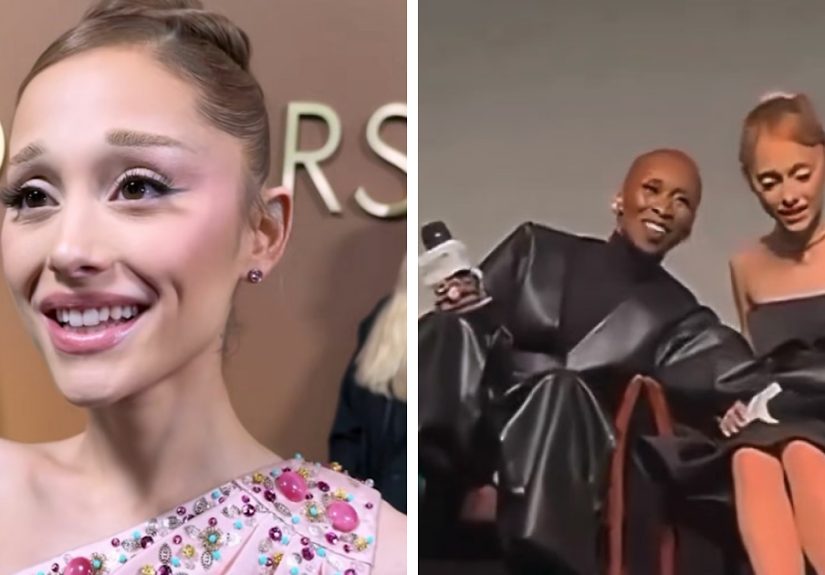
Grande’s bond with Cynthia Erivo during the Wicked press run has also been a big part of the online conversation. Their closeness, emotional interviews, and affectionate rapport became endlessly memeable. Some viewers found their dynamic moving. Others found it strange. But calling a close, emotional friendship “bizarre” often says more about internet discomfort with visible tenderness than it does about the people on camera.
Why Emotional Interviews Trigger So Much Speculation
People are accustomed to celebrity interviews being polished, breezy, and friction-free. Smile, joke, promote the movie, leave. When someone gets emotional or appears fragile, audiences often interpret that as evidence that something is deeply wrong. Sometimes the reality is far more ordinary: exhaustion, pressure, sensory overload, personal sensitivity, long production schedules, grief, anxiety, or simply being a person who feels things intensely.
In Grande’s case, that emotional intensity has often been recast online as instability. That is a leap, and not a fair one. Stars are frequently punished for being too polished and too vulnerable at the same time, which is a neat trick if your goal is to create standards no one can possibly meet.
The Wicked Era Added More Pressure, Not Less
It is impossible to discuss this topic without mentioning the massive pressure surrounding Wicked. The adaptation carried huge expectations long before the first official trailer arrived. Ariana Grande was stepping into a beloved role, facing scrutiny from theater fans, film fans, music fans, critics, and the internet’s self-appointed Ministry of Vibes. That is a lot of eyeballs for one person, even before awards chatter, promotional obligations, and public commentary enter the picture.
Press tours can be emotionally draining on their own. Add a major fan base, endless social media clipping, beauty discourse, body commentary, and a nonstop schedule, and it becomes easier to understand why every appearance might feel charged. Even the warmest, most successful press cycle can become exhausting when the audience is watching for signs of collapse instead of listening to what the person is actually saying.
And then there is the broader emotional context. Grande has been open in the past about difficult experiences and the psychological toll public life can take. That does not give outsiders permission to speculate about her current health. It does, however, remind us that public scrutiny is not harmless background noise. It lands somewhere. It accumulates.
When “Concern” Crosses the Line Into Body Policing
There is a difference between compassion and surveillance. Real compassion respects boundaries. Surveillance disguises itself as kindness while demanding access, explanation, and proof. Much of the online conversation about Ariana Grande has crossed that line.
People often justify invasive commentary by saying they are only worried. But concern that spreads through quote posts, zoomed-in screenshots, mocking captions, and public guessing games is not neutral. It still places a person’s body and demeanor on trial. It still invites others to pile on. And it still encourages the idea that public figures owe viewers a health explanation because their appearance has become a trending topic.
This is especially true for women in entertainment, whose bodies are treated as public property far more often than they should be. They are told they are too thin, too curvy, too changed, too tired-looking, too youthful, too altered, too natural, too emotional, too detached. The goalposts sprint around the field like they just had three espressos.
The Internet’s Favorite Bad Habit
The internet loves patterns, even when none exist. It sees a few clips, assembles a narrative, then behaves as if the narrative is confirmed fact. Once that cycle starts, every new image becomes supporting evidence. A neutral moment becomes “proof.” A tired expression becomes “telling.” A quiet interview becomes “deeply troubling.”
This is not analysis. It is accumulation bias with a ring light.
Specific Examples That Shaped Public Perception
Several kinds of moments have helped shape the current conversation around Ariana Grande’s health and public image. Emotional Wicked interviews circulated widely and were often clipped without context. Her appearance continued to be discussed online despite her past requests for people to stop commenting on bodies. Later, reminders she shared about the danger of those comments reignited debate rather than ending it. In other words, the public had already been told where the line was, and a large chunk of the internet simply moonwalked right over it.
There were also stressful public incidents that understandably intensified fan protectiveness. When a performer is visibly shaken at an event or appears emotionally raw during a press appearance, it can make viewers more alert to signs of strain. That response is human. But turning that alertness into certainty is where the problem begins.
To be fair, not every fan discussion is cruel. Many people are expressing genuine discomfort with how intense the scrutiny has become. Others are calling for media consumers to stop making armchair health assessments. That pushback is important because it suggests audiences are slowly learning that concern does not need to become content.
What a More Responsible Take Looks Like
A more responsible article on Ariana Grande’s health after a bizarre interaction does not pretend to know her medical reality. It does not transform body commentary into SEO bait and call it empathy. It does not confuse emotional openness with breakdown. And it does not turn viral moments into medical gossip.
Instead, it asks better questions. Why are audiences so eager to decode women’s bodies? Why do emotional interviews get framed as evidence of instability? Why does celebrity culture reward invasive speculation even after stars explicitly ask for boundaries? And what does it say about us that one of the most repeated forms of “care” online is the public dissection of someone else’s appearance?
The healthiest response may be the least glamorous one: let public figures be people. Listen when they tell you a line has been crossed. Resist the urge to pretend a clip gives you access to a stranger’s private condition. And maybe, just maybe, retire the internet medical degree earned entirely through observation of red carpets and TikTok edits.
Why This Story Resonates Beyond Ariana Grande
This topic sticks because it is not really just about Ariana Grande. It is about the modern habit of reading emotional strain as public property. It is about how online culture confuses visibility with intimacy. It is about the way we have normalized talking about bodies as if they are open tabs for group discussion.
Plenty of readers respond strongly to this story because they recognize the pattern from everyday life. Maybe not on a red carpet, but in family gatherings, school halls, workplaces, comment sections, or random social moments where appearance becomes the first and loudest topic. “You look tired.” “You’ve lost weight.” “You were healthier before.” “Are you okay?” Those comments may sound casual, but they often hit harder than the speaker intends.
That is partly why Grande’s earlier comments struck such a nerve. She named something many people know from experience: what others praise may not match what you were actually living through. The version of you that looked “best” to someone else may have been the version struggling most.
Experience, Emotion, and the Cost of Being Watched
One reason the online reaction to Ariana Grande feels so intense is that it mirrors a wider human experience: the discomfort of being interpreted while you are still trying to live. Most people know some version of this, even if their audience is not global. They know what it feels like to walk into a room and have someone instantly decide what your body says about your life. They know what it feels like when a strange week becomes a permanent impression in someone else’s head. They know how exhausting it is when one tired day gets mistaken for your whole story.
Think about how often people are judged in ordinary life for looking different. A college student goes home after finals looking worn out, and relatives immediately start commenting. A new parent shows up at an event and gets a dozen remarks about looking drained. Someone loses weight during a stressful season, and the compliments roll in before anyone asks whether they are actually doing okay. Another person gains weight while finally recovering from a rough patch, only to hear that they used to “look better.” It is the same bad pattern in different clothing: people mistake visibility for understanding.
That is why stories like this hit a nerve. They are celebrity stories, yes, but they also expose a deeply familiar social reflex. We are trained to read bodies before we read boundaries. We are encouraged to comment first and think later. We tell ourselves we are observant when we are often just intrusive with better lighting.
There is also the emotional layer of performance. Many people have had the experience of smiling through stress because a room expects them to. Workers do it. Students do it. Parents do it. Entertainers definitely do it. Then when a person drops the polished version of themselveseven brieflyit shocks the audience. Suddenly a quiet answer, teary eyes, or unusual tension feels dramatic, when in reality it may just be what a real human being looks like under pressure.
That makes Ariana Grande’s situation feel bigger than one headline. The fascination with her recent interactions says a lot about how modern audiences consume vulnerability. We want authenticity from celebrities, but only the kind that is tidy, photogenic, and easy to summarize in a caption. If it becomes messy, complicated, or emotionally ambiguous, people rush to explain it away with a diagnosis, a rumor, or a hot take. Ambiguity makes the internet itchy.
There is a better lesson here. Sometimes the most respectful response to a public moment is not decoding it. It is allowing it to remain incomplete. Not every tear needs a theory. Not every awkward exchange needs a headline. Not every visible change needs a public referendum. And not every concern needs to become a performance of concern.
In that sense, the conversation around Ariana Grande is really a mirror. It reflects how we talk about women, how we handle emotion, and how quickly we turn observation into ownership. If readers take anything useful from this story, it should be this: care is quieter than gossip. Empathy asks less, not more. And sometimes the kindest thing an audience can do is stop narrating someone else’s body and let them have their own life back.
Conclusion
Concern may continue to grow for Ariana Grande whenever a clip goes viral or an emotional moment gets stripped of context. That is the reality of modern celebrity. But the smarter, more humane response is not to intensify the guessing game. It is to recognize the pattern, reject the body commentary, and take Grande’s own words seriously.
Public curiosity is not going away. Neither is fandom. But audiences can choose whether they want to be thoughtful observers or intrusive narrators. Ariana Grande’s recent media cycle has shown how quickly a supposedly caring conversation can become invasive. If there is one takeaway worth keeping, it is this: concern without respect is just gossip wearing a nicer outfit.