Table of Contents >> Show >> Hide
- What an Aerospike Engine Actually Is (and Why It’s Called That)
- If Aerospikes Are So Great, Why Haven’t We Been Flying Them for 50 Years?
- The Aerospike’s Greatest Hits: What We Learned the First Time Around
- What Changed: Why Aerospikes Look More “Flyable” Now
- So… Is the Aerospike “Ready to Fly” or Is This Another Round of Hype?
- Where Aerospikes Could Win First
- What Still Needs to Be Proved (a.k.a. The Part Engineers Lose Sleep Over)
- Why This Moment Feels Different
- Conclusion: The Aerospike Is No Longer Just a “Museum Engine”
- Extra: of “Aerospike Experience” (What Following This Tech Feels Like)
Rocket engines have a long history of looking deceptively simple: light a controlled bonfire, point the fire the right way, and don’t let the vehicle become an expensive, dramatic lawn ornament. For decades, the “right way” has usually meant a bell-shaped nozzlebig, flared, and optimized like a race car tuned for one specific track. It’s fantastic at that track. Then the rocket climbs, the outside pressure changes, and the nozzle is suddenly wearing flip-flops to a black-tie event.
That’s the core promise of the aerospike engine: a nozzle that stays closer to “optimal” across a wide range of altitudes, from sea level to near-vacuum. Engineers have been chasing that promise since the early days of the Space Age. And nowthanks to modern manufacturing, better modeling, and a very 2020s obsession with reusabilitythe aerospike is starting to look less like a sci-fi prop and more like flight hardware.
What an Aerospike Engine Actually Is (and Why It’s Called That)
An aerospike isn’t a new propellant or a magical combustion trick. It’s a nozzle conceptspecifically an altitude-compensating nozzle. Traditional rocket nozzles are “best” at one ambient pressure. Near sea level, a nozzle designed for vacuum is overexpanded and loses efficiency; higher up, a nozzle designed for sea level is underexpanded and wastes potential performance.
Aerospikes flip the problem inside out. Instead of forcing exhaust through a bell that’s fixed in shape, an aerospike lets exhaust expand against a central “spike” (or wedge in the linear version), with the outer boundary shaped partly by the atmosphere itself. At low altitude, higher outside pressure naturally squeezes the exhaust plume closer to the spike. As the vehicle climbs and ambient pressure drops, the exhaust expands farther outwardeffectively behaving like a nozzle that “adjusts” as it goes.
There are a few common flavors:
- Linear aerospike: A wedge-like spike with exhaust flowing along two sidesoften discussed for lifting-body vehicles and spaceplanes.
- Toroidal (annular) aerospike: Exhaust exits in a ring around a central spike, forming a doughnut-like geometry.
- Truncated aerospike: A shorter spike that accepts some efficiency loss to save mass and complexity (because infinite-length spikes are not, unfortunately, in stock anywhere).
If Aerospikes Are So Great, Why Haven’t We Been Flying Them for 50 Years?
Because rocket engineering is where “in theory” goes to get bullied by “in practice.” Aerospikes offer real advantages, but they also come with a list of practical headaches that kept them parked in research papers, test stands, and ambitious concept art.
1) Cooling the Spike Is a First-Class Problem
A bell nozzle has a hot inner wall, but an aerospike exposes a larger surface area to ferocious exhaust flowespecially around the spike where heat flux can be brutal. Cooling channels, material choices, and thermal margins become make-or-break. If you can’t keep the spike from overheating, you don’t have an engineyou have a very intense candle.
2) Weight and Packaging Can Cancel the Performance Gain
Aerospikes can deliver better average efficiency over ascent, but hardware mass matters. If the spike and its cooling system add too much weight, the vehicle-level benefit shrinks or disappears. Rockets are unromantic that way: they don’t care about elegant ideas, only the mass fraction.
3) The Flowfield Is Messy, Especially at the Base
Aerospike exhaust involves complex plume behavior, recirculation regions, and interactions with vehicle aerodynamics. That can mean unexpected heating, noise, and structural loads. Even when you can model it, proving it with testsacross the full range of speeds and altitudesis expensive.
4) Development Programs Have a Habit of Getting Canceled
Aerospikes aren’t new. NASA and industry invested heavily in them for next-generation reusable launch vehicle concepts in the 1990s, including work tied to the X-33/VentureStar vision. Hardware was built and tested; flight experiments gathered data; and then the broader program goals collapsed under the combined pressure of technical risk, funding realities, and schedule. The aerospike didn’t “fail” so much as it got stranded when the vehicle it was meant to serve didn’t make it to the pad.
The Aerospike’s Greatest Hits: What We Learned the First Time Around
The aerospike story isn’t “we tried nothing and gave up.” It’s “we tried a lot, learned a lot, and discovered that rockets don’t accept partial credit.”
Ground Tests Proved It Can Work at Serious Scale
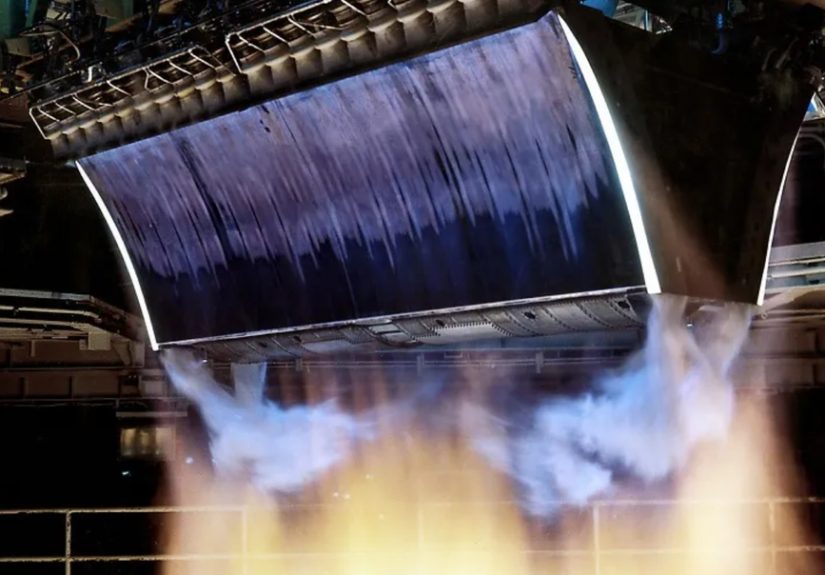
One of the most famous examples is the linear aerospike work associated with the XRS-2200 program. That effort produced real engine hardware and extensive test data, including sea-level tests at NASA’s Stennis Space Center. The point wasn’t just to see flamesengineers measured performance, plume radiation, heating, and the messy realities of operation that never show up in clean diagrams.
A Flight Experiment Helped Answer “Will the Plume Ruin the Aerodynamics?”
Aerospikes aren’t only about nozzle efficiency; they’re also about how the exhaust plume interacts with the vehicle body at high speed. NASA’s Linear Aerospike SR-71 Experiment mounted a scaled, half-span configuration on the back of an SR-71 to study plume effects and validate predictive tools. Even without a full hot-fire in flight, the program gathered critical data on the aerodynamics and integration challenges that aerospike vehicles would face.
What Changed: Why Aerospikes Look More “Flyable” Now
The biggest shift isn’t that physics changed. It’s that engineering leverage changed. Several modern trends align unusually well with what aerospikes need to stop being “cool on paper” and start being “repeatable in hardware.”
1) Additive Manufacturing Makes the “Impossible Geometry” Less Impossible
Aerospikes want intricate cooling channels, compact plumbing, and shapes that are hard to machine conventionally. Modern additive methods can build internal passages and complex contours in a single piece, reducing welds and assembly stepsoften the places where high-temperature hardware loves to fail.
NASA’s advanced manufacturing work is a good example of how quickly nozzle hardware is evolving: large-scale demonstrator nozzles with integral channels and rapid build timelines aren’t a distant dream anymorethey’re the kind of thing engineers are actively testing and iterating.
2) Better Simulation Tools Reduce the “Guess-and-Test” Tax
Aerospike flowfields are complex. Better CFD, more compute, improved turbulence models, and stronger coupling between simulation and test data mean engineers can explore designs faster and avoid dead ends earlier. That matters when each hot-fire campaign costs real money and real schedule.
3) Reusability Has Changed the “Best Engine” Conversation
The 2010s proved you can recover and reuse large boosters. The 2020s are now obsessed with doing it faster, cheaper, and more completelyincluding upper stages, which traditionally get one glorious ride and then a long nap in the ocean (or a permanent job as space debris).
Aerospikes pair intriguingly with reusable architectures because they can be integrated into shapes that also serve thermal-protection and landing needsespecially concepts that blend engine geometry with heat-shield design. In other words: if you’re already redesigning everything about how a stage survives reentry, you might be more willing to redesign the nozzle too.
So… Is the Aerospike “Ready to Fly” or Is This Another Round of Hype?
Here’s the honest version: the aerospike looks closer than it has in a long time, but “ready to fly” depends on what you mean by “fly.”
There’s a Big Difference Between These Milestones
- Hot-fire test: Proves the engine can ignite and run under controlled conditions.
- Relevant-duty-cycle test: Runs at durations, throttling, restarts, and thermal loads that match real missions.
- Integrated vehicle test: Engine performs while attached to the full stage, with real feed systems, vibrations, loads, and control loops.
- Flight demonstration: Engine operates in the environment that matters mostdynamic pressure, changing altitude, and real aerodynamic interactions.
- Operational service: The engine flies repeatedly, predictably, and economically. This is where “cool” becomes “credible.”
Recent reporting and public test updates suggest aerospike concepts are moving along this ladder againespecially at smaller scales and in demonstrator roles. That’s exactly how rocket technology usually graduates: first you prove it can run, then you prove it can run again, then you prove it can run when everything around it is shaking like a washing machine full of sneakers.
Where Aerospikes Could Win First
Aerospikes aren’t automatically the best choice for every rocket. The bell nozzle is popular for a reason: it’s well-understood, relatively straightforward to cool, and decades of flight heritage make it the safe bet. Aerospikes are more likely to break through where their unique strengths solve a specific architectural pain.
1) Reusable Upper Stages and “Engine-as-Heat-Shield” Concepts
Upper stages live in vacuum but also face atmospheric reentry if they’re coming home. Designs that integrate propulsion with thermal protection may benefit from aerospike-like geometries, especially if the engine layout can double as part of a robust reentry system and support controlled landings.
2) Spaceplanes and Lifting Bodies
Linear aerospikes naturally fit into flat or wedge-like aftbody geometries, which can align with certain lifting-body designs. If a vehicle’s shape already pushes toward a wide, integrated aft end rather than a single circular nozzle, linear aerospikes become more mechanically “at home.”
3) Specialized In-Space or Near-Space Applications
Small aerospikes can also appear in niche roles where packaging, plume shaping, or specific mission profiles make them attractive. Not every engine has to be a first-stage workhorse to mattersometimes the breakthrough is proving reliability in a smaller, cheaper platform first.
What Still Needs to Be Proved (a.k.a. The Part Engineers Lose Sleep Over)
Thermal Durability Over Multiple Cycles
The spike has to survive repeated heating and cooling without cracking, warping, or losing performance. In reusable designs, that means not just surviving once, but surviving many times with minimal refurbishment.
Stable Operation Across Conditions
Engines must behave during start-up transients, throttling, and shutdownespecially if the vehicle intends to relight or use the engine for landing maneuvers in-atmosphere. “It ran for 10 seconds” is a great start. “It ran for the full mission profile every time” is the goal.
Integration: Plume, Noise, Loads, Controls
Aerospike exhaust interacts with the vehicle body in a more exposed way than a bell nozzle. That can affect heating, acoustics, and control authority. It’s not enough for the engine to make thrustyou need the whole vehicle to remain happy while it does.
Why This Moment Feels Different
The aerospike’s past is full of “almost.” But the present has a new mix of incentives:
- Faster build-test-iterate loops enabled by modern manufacturing.
- Better simulation and validation pipelines that reduce brute-force trial and error.
- Reusable architectures that make integrated nozzle/heat-shield ideas more attractive.
- More players willing to bet on unconventional propulsion if it unlocks lower operational costs.
Put bluntly: the aerospike has always had a good résumé. What it’s lacked is a job market willing to take a chance on a brilliant candidate with a complicated personality. The reusability era might be that job market.
Conclusion: The Aerospike Is No Longer Just a “Museum Engine”
Aerospikes are not brand-new, and they’re not guaranteed to replace bell nozzles. But the technology is closer to practical flight than it’s been in decades, supported by real test heritage from NASA-era programs and accelerated by today’s manufacturing and design capabilities.
The most realistic outcome isn’t an overnight revolution where every rocket suddenly sprouts a spike. It’s a gradual normalization: aerospikes appear in targeted roles first, prove they can be manufactured and reused economically, and then expandonly if they earn it.
In rocket engineering, the finish line isn’t “it works.” The finish line is “it works reliably, repeatedly, and cheaply enough that nobody argues about it anymore.” Aerospikes aren’t at that finish line yet. But for the first time in a while, you can squint and actually see it.
Extra: of “Aerospike Experience” (What Following This Tech Feels Like)
If you’ve ever fallen into an aerospike rabbit hole, you know the emotional rhythm by heart: excitement, skepticism, deep nerd joy, and then the inevitable “wait, why didn’t this fly already?” It’s like rooting for a gifted athlete who keeps getting sidelined by mysterious injuriesexcept the “injury” is heat flux, and the coach is the mass fraction.
The experience usually starts with the visuals. Bell nozzles look like something you’d sketch if someone said “draw a rocket engine.” Aerospikes look like something you’d sketch if someone said “draw a rocket engine, but make it futuristic and mildly intimidating.” Linear aerospikes are especially fun because they resemble an engine you could park under a spaceplane like a spoiler on a race carexcept the spoiler is made of fire, and it’s not there for looks.
Then you find the history. You read about serious programs that built hardware, ran tests, and even strapped experiments onto an SR-71because if you’re NASA and you need flight data, sometimes you borrow the fastest plane you can find and call it research. You realize this isn’t a hobbyist fantasy; it’s a mature concept that repeatedly got close, learned important lessons, and then got pushed aside when budgets, schedules, or vehicle programs changed direction.
The next stage is the “manufacturing glow-up.” Modern aerospike talk is full of phrases that would’ve sounded like science fiction to 1990s engineers: internal cooling channels that snake through complex contours, single-piece builds that reduce weld seams, rapid iteration where a design can be updated and re-tested in weeks instead of years. Even if you don’t care about rockets, it’s hard not to admire the craftsmanshiplike watching a master chef plate a dish that could also survive reentry heating.
And then, inevitably, you start watching for the signals that it’s becoming real: longer hot-fires, repeatability, integrated stage tests, hardware that looks less like a lab demo and more like something that belongs on a flight line. You notice how grown-up the conversations become. People stop saying, “It’s more efficient!” and start asking, “How many cycles can it survive?” “What’s the refurbishment plan?” “Does it behave during landing burns?” That’s the moment the aerospike stops being a cool idea and starts being a productbecause real hardware is judged by operations, not vibes.
The funniest part is that aerospikes are both radical and oddly familiar. The goal is almost conservative: get closer to optimal expansion over the full ascent, reduce wasted performance, and make vehicles simpler. The path there is what’s daringnew shapes, new cooling strategies, and tight integration with vehicle design. If aerospikes finally break through, it won’t feel like a sudden surprise. It’ll feel like a long-running sequel that took decades to release… and somehow might actually be worth the wait.