Table of Contents >> Show >> Hide
- What You’re Looking At: A Perpetual Calendar, Printed
- Why Cams Make This Clock Special
- Powered by a Quartz Movement (Yes, the Cheap Kind)
- The Calendar Displays: More Than Just the Date
- Inside the Mechanism: Program Wheel, Springs, and a Gravity Assist
- Why It Works Until March 2100 (And Why It Stops There)
- Printability and Design for Real-World Makers
- Adjustment and Usability: “Set It and Forget It”… Mostly
- What This Build Teaches (Even If You Never Print It)
- Common Build Challenges (and Why They’re Normal)
- of Maker Experiences: Life With Clever Cams
- Conclusion
- SEO Tags
Most “smart” clocks solve timekeeping with Wi-Fi, an app, and a tiny existential crisis when the router reboots.
This one goes the opposite direction: a 3D printed perpetual calendar clock that does Gregorian-calendar math using
cams, gears, springs, and a little gravityall powered by a humble, battery-driven quartz clock movement.
It’s the kind of project that makes you stare at a rotating plastic wheel and think,
“Yep… that’s a mechanical spreadsheet.”
The headline feature is bold: the calendar advances correctly through 30-day months, 31-day months, and February,
including leap years, and shouldn’t require a manual date correction until March 2100 (assuming normal quartz drift and the occasional battery swap).
The secret sauce isn’t a microcontrollerit’s a set of cleverly shaped cams and a “program wheel” that physically encodes the calendar rules.
What You’re Looking At: A Perpetual Calendar, Printed
In watchmaking, a “perpetual calendar” is a classic complication: a mechanism that automatically knows when to jump from the 30th to the 1st,
from the 31st to the 1st, and when February ends at 28 or 29. Traditionally, that’s fancy, tiny, expensive, and hidden behind a dial.
Here, the magic is big enough to seea skeleton-style build that turns the inner workings into the main event.
The design discussed in maker circles (and showcased widely online) is notable for what it doesn’t do:
it doesn’t “cheat” with motors and network time. Instead, it relies on a commercially available AA-powered quartz movement
and builds a mechanical calendar module around itmostly 3D printed parts, plus common hardware like small screws and a steel nut.
Why Cams Make This Clock Special
A cam is one of the oldest “mechanical computing” tricks in the book: you shape a rotating part so that, as it turns,
it pushes a follower a specific distance at a specific time. In other words, the cam’s geometry becomes a stored program.
That’s perfect for calendar logic, because the calendar is basically a repeating pattern with a few rules and exceptions.
The Big Idea: Encode the Calendar in Plastic Geometry
Rather than asking a chip to remember month lengths, the clock uses a rotating program wheel (think: a calendar ROM you can hold)
and a main arm that locks, releases, and nudges the calendar forward at the right moments.
The cam profile determines when a “extra day” should be allowed and when the mechanism should force a jump to the next month.
This is where “clever cams” earns its title: the parts are doing logic by shape, not by code.
If you’ve ever appreciated a music box cylinder or a mechanical knitting machine, you already understand the vibe:
the “instructions” are carved into the rotating element.
Powered by a Quartz Movement (Yes, the Cheap Kind)
The heart of the system is a standard quartz movementthe kind sold everywhere for DIY wall clocks.
That choice creates a fun engineering constraint: quartz movements are consistent, but they have limited torque.
So every gear mesh, every bit of friction, every slightly-too-tight screw matters.
The mechanism has to be efficient enough that a small plastic-and-coil motor doesn’t give up and unionize.
A Key Constraint That Shapes the Whole Build
One practical requirement is that the hour shaft length needs to be long enough (commonly referenced as around 12 mm or more)
to properly interface with the printed gearing and hands. The rest of the system is engineered around that “tiny axle with big responsibilities.”
The Calendar Displays: More Than Just the Date
A lot of perpetual-calendar projects stop at “date + month.” This design goes further with sub-dials and indicators that
make it feel like a mini observatory instrument panel (but friendlier, and less likely to require a grant).
- Date (advances daily, with correct month-end behavior)
- Month (advances at the correct transitions)
- Day of the week (synced to midnight changeover)
- 24-hour dial (because why not add one more moving part?)
The “why not?” is actually practical: the 24-hour indication can help users understand when the mechanism is approaching its midnight turnover window,
which matters for adjustment and for appreciating the motion choreography.
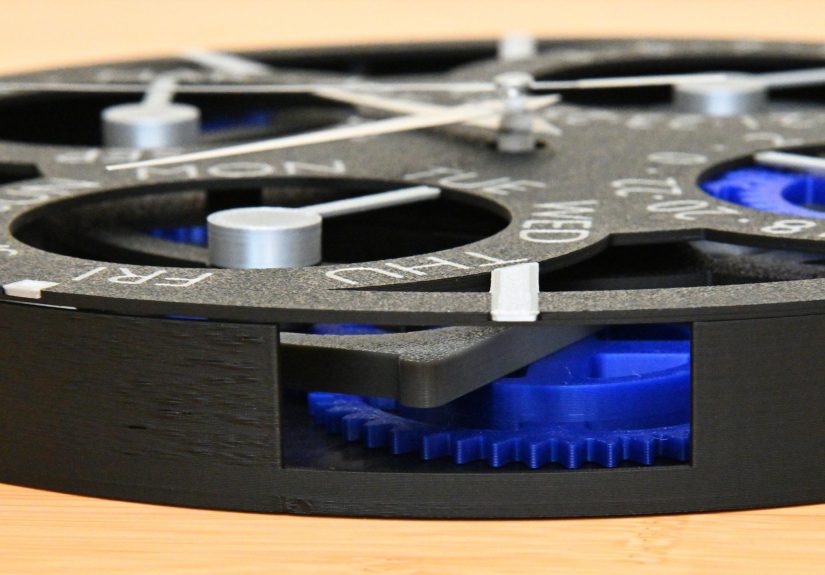
Inside the Mechanism: Program Wheel, Springs, and a Gravity Assist
If you strip the clock down to principles, it’s a calendar machine that is carefully timed by the movement’s gear train.
Several printed gears translate hour-hand rotation into slower, coordinated movements that trigger calendar actions.
The Program Wheel: A Mechanical Calendar “Lookup Table”
The program wheel is the part that quietly does the heavy thinking. Its profile (and the way it interfaces with the main arm and followers)
determines whether the date rotor should advance “normally” or whether it needs to “skip” into the next month at just the right time.
That’s how it handles the difference between April (30 days) and May (31 days) without needing electronics.
Springs: Small Forces, Big Timing
Springs provide the tension that makes the calendar “snap” forward when it’s supposed to.
But too much tension steals torque from the quartz movement; too little and the display won’t advance reliably.
This clock treats spring force like seasoning: you can ruin the whole recipe with enthusiasm.
The Delightful Hack: A Steel Nut as a Weight
One clever detail is using a steel M8 nut as a weight on the main arm.
That added mass lets gravity assist in the calendar’s movement at the critical moments,
reducing the burden on the quartz motor.
It’s a wonderfully analog solution: instead of demanding more power, the mechanism recruits physics.
Why It Works Until March 2100 (And Why It Stops There)
If you’re wondering why March 2100 keeps coming up, welcome to the Gregorian calendar’s “fine print.”
The leap year rule is:
add February 29 every year divisible by 4, except century years not divisible by 400.
That means 2100 is not a leap year, even though it’s divisible by 4 and would have been a leap year under simpler rules.
Many perpetual calendar mechanisms (especially simplified ones) assume the 4-year leap cycle repeats forever.
That works fine until a century exception arrives. This clock is designed to stay correct through the end of February 2100,
at which point the real-world calendar diverges from the simplified cyclehence “no adjustment until March 2100.”
Printability and Design for Real-World Makers
The clock isn’t just clever mechanically; it’s thoughtful as a home 3D printing project.
A standout goal is that the parts are designed to be printable without support structures, which reduces cleanup and helps preserve accuracy.
Multi-material options are also supported for faceplates and markings, so you can get crisp readability without paint-and-pray tactics.
Why Print Tolerances Matter More Here Than Most Projects
In many prints, a slightly gritty gear just means “it’s a little crunchy when you spin it by hand.”
In this clock, grit means “the quartz movement silently loses the will to live.”
Because torque is limited, the gear train and calendar parts have to be clean and smooth:
minimal blobs, minimal debris, and careful assembly so nothing binds.
Visibility as a Feature, Not a Side Effect
The skeleton layout isn’t just prettyit’s practical.
You can see where friction happens, where alignment is off, and where a spring is misbehaving.
That’s huge for troubleshooting, especially in a mechanism that relies on tiny forces.
Adjustment and Usability: “Set It and Forget It”… Mostly
A perpetual calendar that’s impossible to set is basically a museum exhibit.
This design is intentionally maker-friendly: you can adjust the calendar by rotating the clock hands
rather than hunting for hidden buttons.
Adjustment Habits That Keep the Mechanism Happy
-
Weekday adjustments: The weekday hand can usually be rotated manually, but it’s smart to avoid doing so during the mechanism’s active turnover window
(often cited as roughly late evening through early morning, when the midnight change is in progress). - Date direction matters: The date mechanism is typically designed to move forward in one direction; forcing it backward can fight the spring-and-cam logic.
- Month changes may require “unlocking”: Because the main arm locks the program wheel during normal operation, setting the month can involve temporarily lifting or releasing that lock point.
The result is a clock that behaves like a normal wall clock on the outside,
but gives you a front-row seat to the little mechanical decisions that happen as days roll over.
What This Build Teaches (Even If You Never Print It)
Not everyone will print 40+ parts and tune springs for fun. (Some people relax by doing puzzles; others relax by building puzzles that also tell time.)
But even as a concept, a printed perpetual calendar clock is a masterclass in design constraints:
limited torque, printed tolerances, gear ratios, friction management, and human-friendly adjustment.
Lesson 1: Mechanical Logic Scales Surprisingly Well
We tend to treat “logic” as a silicon-only thing. This clock is a reminder that cams and followers can store rules,
and levers can evaluate conditions. The calendar “knows” month lengths because the cam says so.
There’s something satisfying about seeing a rule embodied as a curve instead of a line of code.
Lesson 2: Constraint-Driven Elegance Beats Overpowered Solutions
Sure, you could drive calendar disks with steppers and an ESP32.
But the quartz-powered approach forces careful engineeringusing gravity, spring tuning, and efficient geometry.
It’s not “less modern.” It’s a different kind of modern: digital fabrication enabling analog intelligence.
Common Build Challenges (and Why They’re Normal)
Perpetual calendars have a reputation for being fussyeven in luxury watches.
In a printed version, the fussiness is just more visible and more fixable.
Here are the most common pain points makers report with projects like this:
- Gear friction: A single rough tooth can cascade into missed calendar advances.
- Spring tension balance: Reliable snapping without stealing too much torque is the whole game.
- Alignment timing: Midnight turnover must be synchronized so day/week/date shifts happen cleanly.
- Hand clearance: Hands must sit close enough for readability but free enough not to rub.
The encouraging part is that these are not mysterious problems. They’re the expected “tuning phase” of a precision mechanism
made from consumer-grade printed parts. If anything, that’s the charm: the clock is both a tool and a lesson.
of Maker Experiences: Life With Clever Cams
Building (or even just living with) a printed perpetual calendar clock tends to create a particular kind of maker joy:
the joy of watching something complicated behave calmly. The first “experience” most people have is surprise at how much
calendar logic can be packed into a few rotating shapes. You set the time, you set the date, and then you notice that the
mechanism doesn’t just tickit decides. It decides that April is done at 30. It decides February sometimes gets an extra day.
And it makes those decisions with the same confidence as a door latch: no drama, no menus, no firmware updates.
The second experience is humility, usually delivered in the form of friction. A quartz movement is polite but not muscular,
so the clock teaches you to respect small losses: a tiny print blob, a too-tight screw, a slightly warped gear.
Many makers describe the “aha” moment when they realize that cleaning a gear isn’t cosmeticit’s functional.
Smoothing a tooth or freeing a binding axle can transform the whole build from “almost works” to “quietly reliable.”
It feels less like assembling a gadget and more like tuning an instrument.
Then there’s the experience of observability. Unlike a sealed wall clock, a skeleton calendar clock encourages you to look.
People often find themselves checking the mechanism the way you might check a campfire: not because you need to, but because it’s mesmerizing.
You start recognizing patternshow the program wheel rotates, how the main arm lifts and releases, how a spring stores energy and then “pops” the display forward.
Over time, you gain an intuitive sense of what “healthy” motion looks like. If the date hand hesitates, you notice. If the week hand changes too early,
you notice. The clock becomes a gentle mechanical feedback loop for your attention.
A fun, shared experience is the “calendar stress test.” Makers love advancing time quickly (carefully, in the safe direction) to watch month transitions.
The jump from the 31st to the 1st is satisfying, but February is the real finale. When the clock handles February cleanly,
it feels like watching a robot do a magic trick. And when it reaches leap day properly, the satisfaction is oddly personallike the mechanism
just proved it understands the rules of the world.
Finally, there’s the social experience: this clock is a conversation starter because it’s honest.
It doesn’t hide complexity behind a screen. Guests can literally see the gears doing the work, and that makes people ask better questions.
“How does it know?” turns into “What part tells it?” and suddenly you’re explaining cams, followers, and the weirdness of century leap years.
In a world of sealed devices, a printed perpetual calendar clock is refreshingly teachableand once you’ve lived with one,
regular clocks feel a little like they’re keeping secrets.
Conclusion
“Printed Perpetual Calendar Clock Contains Clever Cams” isn’t just a catchy headlineit’s an accurate summary of why this build matters.
The project blends everyday reliability (quartz timekeeping) with visible, mechanical intelligence (cams and a program wheel) to produce a clock
that’s both practical and fascinating. It’s proof that 3D printing can do more than make shapes: it can make systems
systems that store rules in geometry, use gravity like a teammate, and quietly keep track of the calendar’s quirks all the way to March 2100.