Table of Contents >> Show >> Hide
- Situational vs. Behavioral: What’s the Difference?
- Meet Your Best Friend: The STAR Method
- Before the Interview: Prep Like a Pro
- How to Structure a Perfect Situational Answer (with Mini-Templates)
- Sample Situational Questions (and How to Nail Them)
- 1) “What would you do if your manager disagreed with your approach?”
- 2) “How would you handle a missed deadline on a critical project?”
- 3) “If you joined and discovered the process was broken, what would you do?”
- 4) “How would you deal with a difficult teammate?”
- 5) “A client requests a feature that’s not feasible nowwhat do you do?”
- Advanced Tips That Differentiate Top Candidates
- Role-Specific Situational Examples (Plug-and-Play)
- Common Pitfalls (and What to Do Instead)
- Rapid-Fire Practice Drills
- Putting It All Together: A Model Answer
- FAQ: Short, Honest Answers
- Conclusion
- 500-Word Experience Add-On: What Actually Works in the Room
Situational interview questions put you in a realistic, job-related scenario“What would you do if…?”and ask you to walk the interviewer through your decision-making. They test judgment, problem-solving, and how you’d behave with limited time, information, and resources. The good news? With a clear structure and some practice, you can turn hypothetical curveballs into confident, compelling answers.
Situational vs. Behavioral: What’s the Difference?
Situational questions are about hypothetical future actions (“What would you do if a client changed scope at the last minute?”). Behavioral questions ask about past actions (“Tell me about a time a client changed scope at the last minute. What did you do?”). Both aim to predict performance, but one projects forward while the other looks backward. Many employers intentionally mix both styles in interviews because the combination reveals how you think, act, and learn.
Meet Your Best Friend: The STAR Method
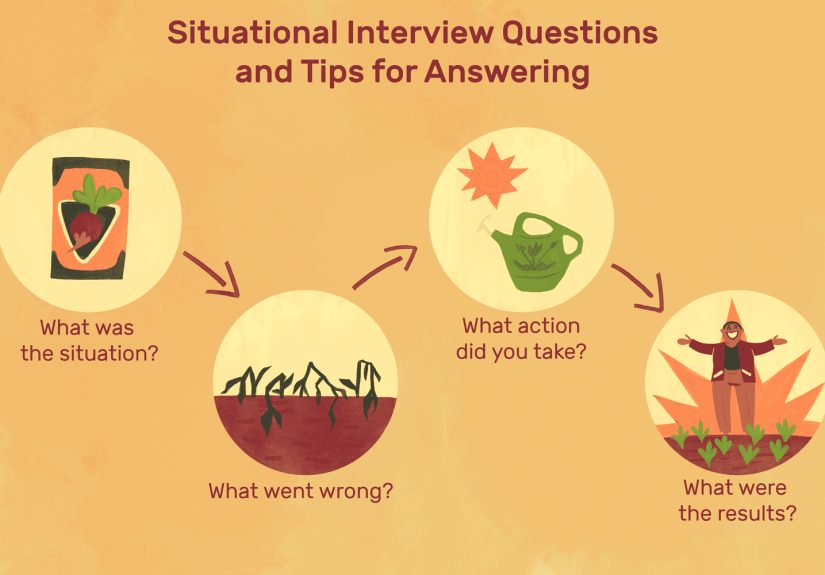
The simplest way to answer situational questions is to borrow a technique often taught for behavioral ones: STARSituation, Task, Action, Result. Even for hypotheticals, STAR keeps you focused and concise: briefly set the context (Situation), define your objective (Task), explain what you would do (Action), and forecast the measurable outcome (Result). Hiring managers love STAR because it creates apples-to-apples comparisons across candidates and reduces rambling.
Before the Interview: Prep Like a Pro
1) Decode the job
Scan the job description for repeated competencies (e.g., stakeholder management, prioritization, conflict resolution). Expect scenarios that probe those exact skills. Career guides consistently recommend aligning your examples to the role’s top 3–5 competencies.
2) Build a “Scenario Library”
Draft 6–8 quick outlines you can adapt on the fly: a tough deadline, an unhappy customer, a team conflict, a shifting priority, a data gap, a process failure, a budget cut, and a leadership moment. Resources from career centers and recruiters show these themes dominate situational prompts across industries.
3) Practice aloud
Use a timer and keep answers to ~90 seconds. That’s enough time to cover STAR without losing your audience. Professional coaches and employer guides emphasize clarity, brevity, and concrete outcomes over buzzwords.
How to Structure a Perfect Situational Answer (with Mini-Templates)
Template A: Risky Decision Under Time Pressure
Situation: “If the system goes down during a product launch…” Task: “I must restore core functions and communicate status to stakeholders.” Action: “I’d convene an incident bridge within 5 minutes, assign leads (triage, comms, rollback), publish 15-minute updates, and choose rollback vs. patch based on error scope and SLA impact.” Result: “We’d restore priority services within SLA and capture root cause in a postmortem to prevent recurrence.”
Template B: Unhappy Customer Escalation
Situation: “A key client is upset about missed deliverables.” Task: “Preserve the relationship and reset delivery.” Action: “I would acknowledge impact, share facts (no excuses), offer two remediation options with timelines, and schedule weekly check-ins.” Result: “We reduce churn risk, meet the revised timeline, and document a playbook for future escalations.” Employer playbooks often highlight this approach for service roles.
Template C: Conflicting Priorities
Situation: “Two executives request competing deliverables due tomorrow.” Task: “Protect impact and relationships.” Action: “Clarify each request’s business outcome, estimate effort, surface trade-offs, and propose a sequencing plan aligned to company goals.” Result: “You meet the higher-impact deadline and deliver the second within an agreed timeline.” Recruiters routinely probe prioritization under pressure.
Sample Situational Questions (and How to Nail Them)
1) “What would you do if your manager disagreed with your approach?”
Goal: Collaboration + influence. Answer angle: Seek to understand, present data, propose a small test, and align on criteria for success. Close with a learning mindset and commitment to team outcomes. This echoes best practices from interview guides that stress evidence-backed persuasion and stakeholder alignment.
2) “How would you handle a missed deadline on a critical project?”
Goal: Ownership + recovery plan. Answer angle: Communicate early, quantify impact, propose options (scope cut, headcount shift, schedule slip), and implement a daily standup until stable. Postmortem for systemic fixes. Major career sites emphasize proactive communication and concrete mitigation over excuses.
3) “If you joined and discovered the process was broken, what would you do?”
Goal: Process improvement + change management. Answer angle: Map current flow, quantify cost-of-poor-quality, run a low-risk pilot, measure, then scale. Reference measurable results (time saved, defects reduced).
4) “How would you deal with a difficult teammate?”
Goal: Conflict resolution + teamwork. Answer angle: Private, specific feedback; listen for underlying constraints; agree on working norms; escalate only with data. University and recruiter resources highlight structured conflict approaches that preserve trust.
5) “A client requests a feature that’s not feasible nowwhat do you do?”
Goal: Customer empathy + prioritization. Answer angle: Validate the need behind the ask, offer alternatives, set expectations with a timeline, and capture the request in backlog with impact metrics.
Advanced Tips That Differentiate Top Candidates
Quantify the Result
When you forecast outcomes in a hypothetical, quantify impact“reduce response time by 30%,” “cut churn risk by 15%,” “recover the timeline within one sprint.” Research-backed guides on STAR emphasize closing with outcomes because hiring managers think in business metrics.
Name the Trade-Offs
Great answers acknowledge constraints: time, budget, risk, headcount. Briefly state the trade-offs you’d consider and why. This conveys judgment, not just optimism. Recruiter playbooks call this “showing your work.”
Use the Company’s Language
Mirror terms in the job description (OKRs, SLAs, sprints, funnel, LTV, CAC, SOPs). This demonstrates domain fluency and makes interviewers picture you on the team. Career guides encourage tailoring language to the employer’s context.
Stay Coachable
If your interviewer challenges your plan, welcome it. Adapt based on new information and state how you’d test and iterate. Hiring literature highlights adaptability as a core signal in both situational and behavioral assessments.
Role-Specific Situational Examples (Plug-and-Play)
Customer Support
Prompt: “A customer threatens to cancel due to a recurring bugwhat do you do?”
Answer: Acknowledge the impact, apologize, and move to resolution: confirm severity, provide a workaround, commit to a timeline, follow up with a status note and a make-good if policy allows. Close with how you’d prevent recurrence (bug tag, RCA follow-up). This mirrors best-practice checklists in service hiring guides.
Project/Program Management
Prompt: “A dependency slips and jeopardizes launch.”
Answer: Rebaseline the plan, escalate risks, pull forward parallel tasks, and create an executive-visible burn-down. Forecast your new critical path and identify a scope slice to protect a date-based milestone.
Sales
Prompt: “Procurement stalls after verbal approval.”
Answer: Re-qualify stakeholders, uncover legal or security blockers, co-create a close plan, and propose a time-bound incentive linked to value realization, not discounts alone.
Marketing
Prompt: “Your campaign CTR is half the benchmark midway.”
Answer: Pause low-performing variants, tighten audience, refresh creative, and shift budget to winning channels. Commit to a daily dashboard and a post-campaign debrief with learnings.
Common Pitfalls (and What to Do Instead)
- Rambling. Fix it: cap yourself at ~90 seconds and stick to STAR.
- Vague results. Fix it: give a number, range, or tangible outcome.
- Over-promising. Fix it: mention risks and how you’d mitigate them.
- Dodging accountability. Fix it: emphasize your actions, not what “we” might do.
- One-size-fits-all answers. Fix it: incorporate the company’s tools, process names, and success metrics.
Rapid-Fire Practice Drills
Use these 10 prompts to rehearse. Answer each in STAR, out loud, in 90 seconds:
- A critical stakeholder disagrees with your plan.
- A release introduces a bug impacting revenue.
- An intern makes a high-visibility mistake.
- Your vendor misses a milestone.
- Your top account signals churn risk.
- Your team is over capacity for the quarter.
- A compliance change forces rework.
- A peer team misses handoffs.
- Leadership requests a last-minute deck.
- Data contradicts your hypothesis mid-project.
Putting It All Together: A Model Answer
Question: “What would you do if your project fell two weeks behind because a vendor slipped?”
STAR Answer: Situation: “We’re two weeks behind due to a vendor delay on the analytics integration.” Task: “Minimize impact on the Q3 launch.” Action: “I’d (1) run a replan session to map the new critical path, (2) pull forward tasks not blocked by analytics (copy, QA, training), (3) negotiate a temporary stub to unblock end-to-end testing, (4) set a daily 15-minute cross-team standup and a twice-weekly exec update.” Result: “We limit slippage to three business days and enter GA with analytics enabled. Postmortem adds an earlier vendor readiness gate.” STAR keeps your answer tight and outcome-focused.
FAQ: Short, Honest Answers
Do I always need a number in the Result?
Prefer numbers, but “what changed” also works: “We restored availability for 95% of users,” or “We prevented a churn escalation.”
Can I reference a real past example for a situational question?
Absolutely. Many coaches suggest blending: describe what you would do and anchor it with what you did in a similar past situation.
How long should my answer be?
About 60–90 seconds is the sweet spot for most roles, unless the interviewer invites more depth.
Conclusion
Situational interview questions aren’t pop quizzesthey’re open-book tests on your thinking. Use STAR, quantify your impact, acknowledge trade-offs, and speak your future employer’s language. With a small scenario library and a lot of practice out loud, you’ll show not just that you can do the jobbut how you’ll do it when things get messy.
sapo: Facing “What would you do if…?” in your next interview? This guide shows you exactly how to structure situational answers with the STAR method, quantify results, name trade-offs, and tailor your approach to the job. You’ll get role-specific examples (support, PM, sales, marketing), mini-templates for high-pressure scenarios, and a 10-question practice setso you can turn hypotheticals into hired.
500-Word Experience Add-On: What Actually Works in the Room
After hundreds of mock interviews and debriefs with hiring managers, a few patterns keep showing upand they’re surprisingly human. First, the strongest candidates treat situational prompts like collaborative problem solving, not courtroom cross-exams. They ask a clarifying question or two (“Are we optimizing for speed or quality here?”), which instantly signals stakeholder awareness. Then they outline a brief plan with decision checkpointsalmost like reading out a mini project planso the interviewer can track their logic. Interviewers consistently describe those answers as “easy to follow” and “confidence-inspiring.”
Second, they front-load risk. Average answers sound like wish lists: “I’d escalate, align, and deliver.” Great answers acknowledge the messy middle: “If we’re missing data, I’ll set a 24-hour deadline to collect what’s critical and use a decision matrix to choose path A or B. If we can’t get signoff, I’ll escalate with two options and a clear trade-off.” That’s judgment. It shows you can navigate ambiguity without hand-waving. Career resources repeatedly note that interviewers are listening for this balance of optimism and realism in situational questions.
Third, measurable outcomes matter more than perfect prose. Candidates who close with numberseven rough onesstick in the panel’s memory. “We’d recover the schedule within three business days,” “We’d reduce response times by ~25%,” or “We’d contain the incident within our SLA” are the kinds of lines that end up in hiring committee notes. STAR frameworks from reputable sources hammer this home: always finish with the Result.
Fourth, adaptability beats certainty. Interviewers often nudge: “What if legal says no?” or “What if the customer pushes back?” Treat those as improv prompts, not traps. The most persuasive candidates pivot gracefully: “In that case, I’d propose a staged rollout and schedule a compliance review this week,” or “I’d offer an interim workaround and schedule a postmortem to fix the root cause.” Resources from employer guides and university career centers consistently highlight adaptability as a key differentiator.
Finally, your tone matters. Panels are deciding if they want to work with you under pressure. Friendly, concise, and composed beats hyper-formal or defensive. Smile. Breathe. Keep your structure tight and your examples relatable. If you do nothing else, pick three scenario types relevant to the role, write a 4–5 sentence STAR outline for each, and practice them until they sound naturalnot memorized. When the inevitable “What would you do if…?” arrives, you’ll have a blueprint you can adapt in real timeand that’s exactly what great situational answers are: structured, specific, and surprisingly human.