Table of Contents >> Show >> Hide
- From Beeping Plastic to Tiny Nuclear Lab
- What the Teardown Revealed About the Plutonium Inside
- Why Use Plutonium in a Smoke Detector at All?
- Is a Plutonium Smoke Detector Dangerous?
- What This Teardown Tells Us About the Cold War
- Lessons for Modern Makers and Collectors
- 500 Extra Words: Experiences and Reflections Around the Plutonium Smoke Detector Story
Most of us think of a smoke detector as a beige plastic puck that chirps at 3 a.m.
and guilt-trips us into changing batteries. For electronics tinkerers and
radiation geeks, though, that humble device is also a tiny, legal source of
ionizing radiation. In the U.S., that usually means a speck of
americium-241 hidden inside an ionization smoke detector.
But in the Soviet Union? Things were a little more… ambitious.
When Hackaday highlighted a teardown of a Soviet-era KI-1 smoke detector,
the surprise inside wasn’t americium at all – it was actual plutonium,
carefully plated onto a ring and sealed into a brass “lipstick” capsule.
Nuclear forensics specialist Carl Willis got his hands on one of these
vintage Soviet smoke detectors, dismantled it (in a controlled lab setting,
not on the kitchen table), and used gamma and alpha spectroscopy to see what
made it tick. The result is a fascinating slice of Cold War engineering:
about one milligram of reactor-grade plutonium doing fire safety duty in
an everyday consumer product.
From Beeping Plastic to Tiny Nuclear Lab
How “normal” ionization smoke detectors work
To understand why the Soviet plutonium smoke detector is so unusual, it helps
to start with the standard design used in most modern homes. Ionization smoke
detectors rely on a tiny radioactive sourcealmost always americium-241to
ionize the air between two electrodes inside an ionization chamber.
Americium-241 emits alpha particles, which knock electrons off air molecules,
creating a gentle stream of charged particles that lets a small electrical
current flow. When smoke enters the chamber, it disrupts this current, and
the circuit trips the alarm. The amount of americium in a typical household
smoke detector is microscopicon the order of 0.9–1 microcurie of activity,
corresponding to fractions of a microgram of material.
Regulators like the U.S. Nuclear Regulatory Commission (NRC) and public
health agencies consistently emphasize that the radiation dose from these
detectors is negligiblefar lower than normal background radiationand that
the devices are safe as long as you don’t smash them open and play with the
radioactive core.
What made the Soviet design so different?
The Soviet KI-1 detector went a very different route. Instead of using
americium-241, engineers opted for plutonium as the ionizing source.
The active material is deposited as a thin, grayish band on a metal ring and
placed inside a brass capsule that looks uncannily like a tube of lipstick.
Willis’s analysis showed that the plutonium source in his KI-1 unit contained
roughly 1 milligram of plutonium with a total activity around 700 microcuries,
dominated by Pu-241 and supplemented by Pu-238, Pu-239, and Pu-240. On a mass
basis, that’s still tinyabout a grain of dustbut in the world of radiation
sources, it’s a lot more “lively” than the americium speck in a modern
detector.
By modern standards, the choice is quirky but not totally irrational.
Plutonium is an efficient alpha emitter, and the Soviet nuclear industry
had plenty of it. The KI-1 appears to have been produced in the late 1960s
and early 1970s, using low-burnup reactor-grade plutonium from dedicated
production reactors. Willis’s radiometric dating placed the plutonium’s
chemical separation around 1972.
What the Teardown Revealed About the Plutonium Inside
Reactor-grade, not bomb-grade
Mention “plutonium” and most people instantly picture nuclear weapons.
That’s why one of the first questions Willis set out to answer was:
What kind of plutonium is this?
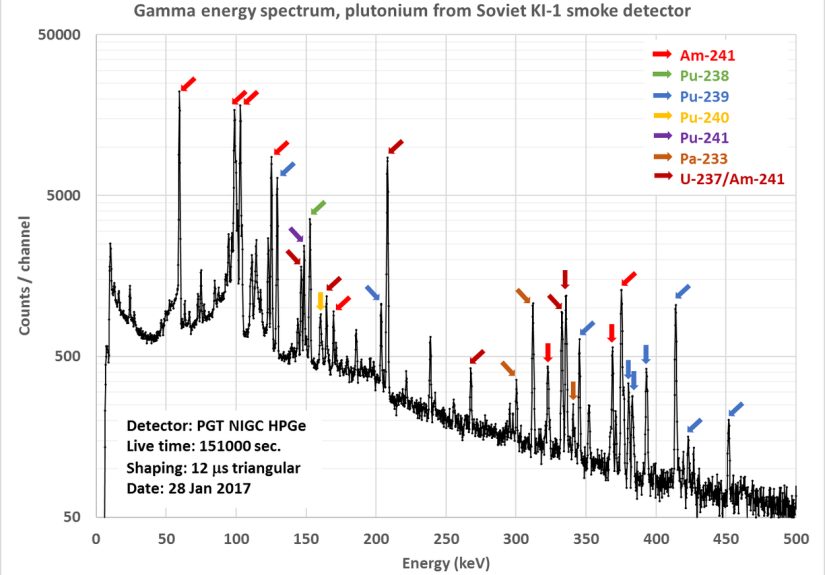
Using high-resolution gamma spectroscopy, he teased out the relative amounts
of Pu-238, Pu-239, Pu-240, and Pu-241 in the sample. The resulting isotopic
mix showed a Pu-240 concentration close to 20%, squarely in the
“reactor-grade” category rather than weapons-grade (which typically has much
lower Pu-240 content).
That distinction matters because Pu-240 has a high spontaneous-fission rate.
In a bomb core, too much Pu-240 increases the chance that neutrons appear
at the wrong moment, spoiling the carefully timed chain reaction and
reducing yield. Reactor-grade plutonium can still be used in weapons, but
it’s harder to handle and less predictable.
In other words, the KI-1 held nuclear-weapons adjacent material, not
a ready-made warhead core. You won’t be building a doomsday device out of
one Soviet smoke detectorunless you somehow collect an absurd number of
them and also have an entire weapons program lying around, which, to be
clear, is not a DIY project.
How much plutonium are we talking about?
The ~1 milligram of plutonium in the KI-1 doesn’t sound like much, but it’s
large by smoke-detector standards. A modern americium-based residential
detector uses perhaps 0.2–0.3 micrograms of Am-241, corresponding to roughly
0.9–1 microcurie.
By contrast, the KI-1’s source, at about 700 microcuries, is hundreds of
times more active than a typical home unit. That doesn’t automatically make
it deadlyactivity, shielding, and exposure time all matterbut it does mean
that the Soviet detector was not something you’d want to casually grind up
or dismantle without proper lab controls and protective equipment.
Willis’s write-up emphasizes this point: while the KI-1 source is a
fascinating collectible and lab specimen, it’s not a toy. Even if the
external dose is modest, finely dispersed plutonium is a serious inhalation
hazard, and that’s the kind of risk professionals go out of their way to
avoid.
Why Use Plutonium in a Smoke Detector at All?
The Cold War supply chain answer
The choice of plutonium over americium in Soviet smoke detectors probably
says less about detector physics and more about supply chains and politics.
Western manufacturers standardized on americium-241, a convenient byproduct
of plutonium-241 decay in commercial power reactors.
The Soviet Union, however, operated large dedicated plutonium production
reactors for both military and civilian purposes. Reactor-grade plutonium
was abundant, well-understood, and already being fabricated into a variety
of industrial sources and instruments. For an engineer in that system,
“use plutonium” may simply have been the obvious answer.
Another plausible factor: design heritage. The KI-1’s source geometry closely
resembles early U.S. Pyrotronics plutonium and americium sources, suggesting
that engineers were adapting an established architecture while swapping in a
material their own industry could supply at scale.
Performance versus practicality
From a performance standpoint, plutonium and americium can both provide the
steady alpha flux needed for an ionization chamber. The main trade-offs are
in gamma emissions, half-life, and regulatory complexity.
-
Americium-241 has a half-life of about 432 years and
emits low-energy gamma rays, making shielding easier and dose rates lower
outside the detector housing. -
Reactor-grade plutonium is a mix of isotopes with
shorter half-lives and more complex gamma spectra, which complicates dose
calculations and shielding design.
Over time, Western regulators and manufacturers coalesced around americium
as the safer, simpler choice for mass-market devices. The Soviet KI-1
represents an earlier, more freewheeling era when “tiny bit of plutonium”
could apparently make it through the design review process.
Is a Plutonium Smoke Detector Dangerous?
This is the obvious, slightly panicked questionand the answer is more
nuanced than “yes” or “no.”
External radiation risk: surprisingly modest
Plutonium and americium in smoke detectors emit mainly alpha particles.
Alpha radiation is easily stopped by a few centimeters of air, a sheet of
paper, or the plastic housing of the detector. As long as the source is
intact and sealed, the external dose is relatively lowfar below everyday
background exposure in most environments.
Regulatory analyses of ionization smoke detectors, even those with higher
activity sources, consistently find that normal use does not pose a
meaningful health risk to occupants. That’s why agencies like the NRC and
EPA allow consumers to own and discard these devices without special
licenses, although manufacturers themselves do operate under strict
licensing rules.
Inhalation risk: do not try this at home
The story changes dramatically if the radioactive material becomes
airborne or ingestible. Inhaled plutonium particles can lodge in the lungs
or lymphatic system, delivering a long-term dose and significantly
increasing cancer risk. This is why professionals treat plutonium handling
with extreme caution, using glove boxes, fume hoods, and strict contamination
control procedures.
That’s also why the Hackaday feature and Willis’s original write-up both
include an implicit safety message: teardowns like this are for
properly equipped labs, not weekend garage projects. If your
smoke detector, Soviet or otherwise, still works and is intact, the safest
and most sensible option is to leave it that wayor follow official
disposal guidance if it’s at end of life.
What This Teardown Tells Us About the Cold War
On one level, the KI-1 teardown is a neat electronics story: curious
engineer opens mysterious Soviet device, finds a tiny nuclear curiosity
inside, and reverse-engineers its history using spectroscopy and decay
chains. But it’s also a miniature history lesson.
-
It shows how deeply nuclear technology penetrated everyday liferight
down to the smoke detector bolted to an industrial ceiling in the
1970s USSR. -
It highlights the different industrial ecosystems on either side of the
Iron Curtain: americium-centered in the West, plutonium-centered in the
Soviet bloc. -
It underscores how modern nuclear forensics can reconstruct the age,
reactor type, and processing history of even a milligram-scale sample of
plutonium, decades after it was produced.
For hardware hackers, the teardown scratches that eternal itch to see
“what’s really inside.” For nuclear scientists, it’s a case study in how
consumer items can become unintentionally interesting data points in the
history of technology and proliferation.
Lessons for Modern Makers and Collectors
Today, hobbyists still collect vintage smoke detectors, radiation sources,
and oddball Cold War artifacts. Online forums are full of discussions about
old Pyrotronics units, Soviet RID-series detectors, and Geiger counters with
more personality than some laptops.
The KI-1 teardown gives that community a few clear takeaways:
-
Respect the physics. Even small sources can pack a lot of
activity. Activity numbers in microcuries or becquerels aren’t just trivia;
they’re a proxy for how careful you need to be. -
Don’t chase plutonium for its shock value. From a
scientific standpoint, an americium-based detector can teach you just as
much about ionization chambers, detection electronics, and shielding,
without the added complexity of reactor-grade plutonium. -
Know the rules. In many countries, owning intact
consumer smoke detectors is fine, but extracting or concentrating the
radioactive sources may bump you into regulatory territory very quickly. -
When in doubt, leave it sealed. If you’re not equipped
to treat the source like a lab-grade radiological specimen, admire it
as-is and keep it intact.
The Soviet plutonium smoke detector is a brilliant conversation piece and a
reminder that safety engineering, materials science, and geopolitics all
intersect in surprising placeseven in the thing that yells at you when
your toast burns.
500 Extra Words: Experiences and Reflections Around the Plutonium Smoke Detector Story
Stories like “Soviet Era Smoke Detector Torn Down, Revealing Plutonium” hit
a very specific nerve in the hacker and maker community. If you spend any
time in electronics circles, you’ll notice a pattern: someone posts a
teardown of a bizarre vintage device, the comments fill with equal parts
admiration and alarm, and before long, people are asking, “Where can I get
one?”
The plutonium smoke detector saga followed that script. Hackaday readers
marveled at the spectroscopy plots, the clever source geometry, and the
nuclear forensics that pinpointed the plutonium’s age to within a fraction
of a year. At the same time, there was a visible undercurrent of “Okay, but
should anyone else actually be doing this?”
On specialist blogs and forums, nuclear veterans chimed in with their own
experiences. Some had worked in safeguards or materials control, where
gamma spectroscopy on plutonium samples was just another Tuesday. Others
recalled training courses at national labs, where they learned to tease
isotopic information out of faint spectral lines and noisy backgrounds.
To them, the KI-1 sample looked less like a curiosity and more like a
familiar puzzle with unusually colorful packaging.
There’s also a broader cultural thread: the fascination with “legal but
spicy” sources of radiation. Long before this Soviet detector made the
rounds, hobbyists were salvaging americium sources from discarded U.S.
smoke detectors to build cloud chambers and simple detectors. Most of
those projects stayed firmly in the “educational and safe” category,
emphasizing how tiny the activity is and how tightly shielded the source
remains.
The plutonium story pushed that fascination to its limits. A KI-1 isn’t
something you casually pick up at the local hardware store, and the
combination of higher activity and more complex radiotoxicity means the
safety envelope is much narrower. The teardown served as an unintentional
stress test of community norms: how far can you go in the name of curiosity
before it becomes irresponsible?
What’s encouraging is that, in most technical spaces, the consensus landed
in a healthy place. The project was widely admired as a piece of careful,
well-documented lab work by someone who clearly understood shielding,
contamination control, and nuclear data. At the same time, practitioners
were quick to discourage copycat efforts by people without the same
background or infrastructure. In forums and comment threads, you’ll see
phrases like “Don’t try this at home,” “This belongs in a real lab,” and
“If you have to ask how to handle plutonium, you shouldn’t be handling it.”
There’s a useful analogy here to high-voltage and mains power projects.
Plenty of Hackaday builds involve lethal voltages, but the better ones
go out of their way to explain creepage distances, isolation, and
protective enclosures. The goal isn’t to scare people away from learning;
it’s to make sure curiosity is paired with respect for the underlying
hazards. The plutonium smoke detector teardown did the same thing for
radiological safety.
For content creators, the story is also a reminder of how powerful a single
“wow” detail can be. You can talk about americium in smoke detectors all day
and get polite nods. Say “this Soviet detector contains a milligram of real
plutonium,” and suddenly everyone is paying attention. The trick is to use
that attention to educate, not just to shock.
In that sense, “Soviet Era Smoke Detector Torn Down, Revealing Plutonium”
hits the sweet spot. It’s weird enough to be memorable, technical enough to
reward a deep dive, and grounded enough in reality that it teaches something
meaningful about nuclear materials, safety culture, and the quirks of
Cold War engineering. The next time your smoke alarm chirps at 3 a.m.,
you might still be annoyedbut you may also find yourself wondering what
tiny slice of nuclear history is hiding behind that plastic cover.