Table of Contents >> Show >> Hide
- What Trump Meant by “They Spit, We Hit” (and Why People Heard “Punch First, Ask Questions Never”)
- Jon Stewart’s Counterpunch: “Protect Hawk Tuah Girl!”
- So… Who Is the Hawk Tuah Girl, and Why Is She in a Political Monologue?
- Rhetoric as Policy: When a Catchphrase Becomes a Permission Slip
- The Legal and Operational Reality Behind the Headlines (Yes, Even Comedy Needs Footnotes)
- Why Stewart’s Hawk Tuah Reference Is a Masterclass in Political Satire
- Quick FAQ (Because This Story Is Equal Parts Civics and Chaos)
- Conclusion: Laughing, Learning, and Surviving the Slogan Era (Plus of Real-World “Yep, I’ve Been There” Experience)
Politics used to be a battle of ideas. Now it’s a battle of slogansshort, punchy, and occasionally indistinguishable from something you’d hear yelled across a bar at 1:47 a.m. And when President Donald Trump leaned into the phrase “they spit, we hit,” Jon Stewart did what Jon Stewart does best: he held the country’s forehead under a bright comedic lamp and said, essentially, “Okay… but have we considered the collateral damage to the Hawk Tuah Girl?”
If that sentence makes you laugh and then immediately wonder whether you should be laughing, congratulations: you’ve just experienced the exact emotional whiplash Stewart was aiming for. Because behind the punchline is a bigger questionabout political rhetoric, protest, power, and how the modern internet turns one viral catchphrase into a cultural flashbang that can go off anywhere, including the nightly news.
What Trump Meant by “They Spit, We Hit” (and Why People Heard “Punch First, Ask Questions Never”)
The phrase “they spit, we hit” didn’t arrive as a cute bumper-sticker update to “law and order.” It surfaced amid a tense moment: protests in Los Angeles tied to immigration enforcement actions, a heavy federal response, and a nationwide debate about how far a president can go in “restoring order” without steamrolling civil liberties.
The literal framingspit equals hitsounds like a schoolyard rule. But in the context of a government response, it’s a recipe for escalation. Spitting is assault in many jurisdictions, yes. It’s also disgusting, dehumanizing, and provocative. But when a leader translates that provocation into a promise of retaliation, the line between “protecting officers” and “endorsing violence” gets blurry fastespecially when you’re talking about crowd control, protest policing, and the already-fragile trust between communities and the state.
Why the Motto Stuck
Because it’s sticky. It’s rhythmic. It’s the kind of phrase that fits on a hat, a sign, a tweet, andthis part mattersa training-room vibe. It sounds like policy, but it behaves like a taunt. And taunts don’t calm streets. They dare streets to get louder.
The broader political subtext was hard to miss: the administration framed some protests as disorder requiring a strong federal hand, while critics saw a “test case” for expanded executive power, including federalizing the National Guard and bringing active-duty military resources into a domestic situation. Even when officials emphasize “protection of federal personnel and property,” the imagery alone can change the temperature of a city.
Jon Stewart’s Counterpunch: “Protect Hawk Tuah Girl!”
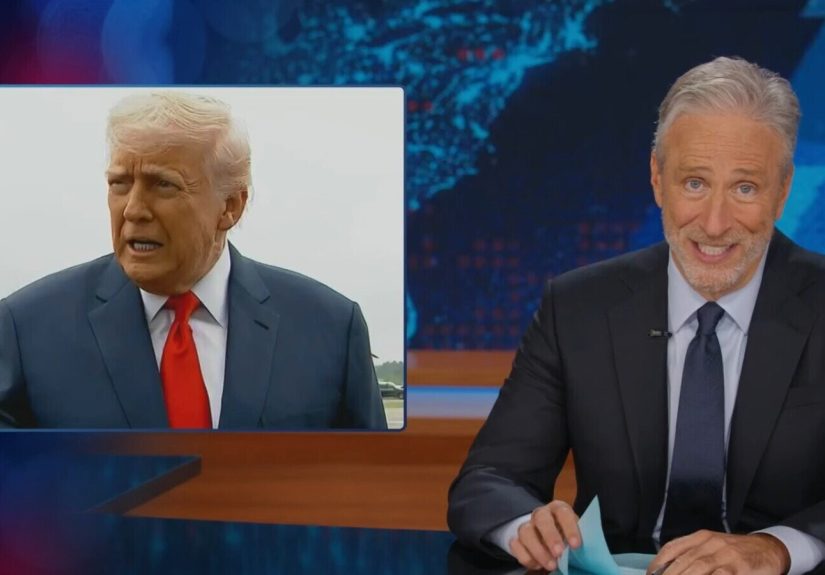
On The Daily Show, Stewart has a long tradition of taking the most serious, high-stakes political moment and revealing the tiny absurd hinge it swings on. When he heard “they spit, we hit,” he didn’t respond with a dry constitutional lecture. He reached for the most internet-brained association possible: spitting as a meme.
Stewart’s line“for the love of God, someone protect Hawk Tuah girl”wasn’t random. It was a comedic alarm bell. The joke works because it swaps the intended target of the slogan (protesters, “troublemakers,” “insurrectionists,” depending on who’s narrating the scene) with a totally unrelated person whose fame is literally tied to a spit sound effect.
That’s the trick: when your policy slogan is simple enough, it starts applying itself in dumb places. Stewart’s punchline is essentially a parody of “rules of engagement” logic: If spitting triggers hitting, the internet is about to qualify as a combat zone.
Why the Joke Lands So Hard
Because it turns a threat into a meme, and memes travel faster than nuance. Stewart didn’t just say “this is violent rhetoric.” He said, “this is violent rhetoric that’s so broad and so blunt it could accidentally recruit a viral celebrity into the blast radius.” In one sentence, he made the slogan feel both ridiculous and dangerouslike giving a toddler a megaphone and a foghorn.
So… Who Is the Hawk Tuah Girl, and Why Is She in a Political Monologue?
“Hawk Tuah Girl” is the nickname for Haliey Welch, who went viral in June 2024 after a street interview in Nashville produced an instantly meme-able line: “You gotta give ’em that hawk tuah… and spit on that thang.” It was crude, funny, and delivered with the kind of unapologetic timing that makes the internet hit “replay” like it’s a reflex.
Welch’s viral moment didn’t just spawn jokes. It built a full modern fame pipeline: social accounts, merchandise, interviews, appearances, and a podcast brand that leaned into the catchphrase while trying (at least publicly) not to be swallowed by it. It’s the American internet story in miniature: one clip, a million reposts, and suddenly your name is a headline whether you asked for it or not.
The Viral Fame Pipeline (a.k.a. “Congratulations, You’re a Brand Now. Please Don’t Move.”)
The Hawk Tuah moment became a case study in how “15 minutes” has turned into a subscription service. The coverage around Welch highlighted how quickly internet fame can be monetizedsometimes by the person who went viral, sometimes by everyone else within Wi-Fi range. Reports around the phenomenon pointed to significant merch sales early on, and a larger media ecosystem that treats virality like oil: drill first, ask ethical questions later.
The Not-So-Funny Part: When a Meme Meets Real Consequences
Welch’s story also illustrates the downside of internet celebrity: everything you do next becomes part of the “lore,” including business decisions. When she became associated with a meme coin launch, the coverage wasn’t just “haha, internet!” It turned into real financial controversy, public backlash, and the kind of scrutiny that doesn’t care whether you asked for fame in the first place.
That matters here because Stewart’s joke works on two levels: it’s a funny reference, and it’s a reminder that real people get dragged into cultural storms they didn’t create. A political slogan about “hitting” doesn’t exist in a vacuum; it exists in a country where the internet has already trained us to connect “spit” to a specific person’s face and voice.
Rhetoric as Policy: When a Catchphrase Becomes a Permission Slip
Political communication isn’t just “messaging.” It’s behavioral design. When leaders use violent-sounding language about protesters, they aren’t only describing a responsethey’re shaping expectations for what’s acceptable. It can embolden supporters, harden law enforcement posture, and make it harder for officials on the ground to de-escalate.
The irony Stewart spotlights is that slogans like “they spit, we hit” sound like toughness, but they function like volatility. They reduce messy, human situations into a one-line algorithm: Input: disrespect. Output: force. And the problem with algorithms is that they don’t do context. They do triggers.
What Makes It “A Plan,” Not Just a Quip
In modern politics, repeated rhetoric becomes a “plan” because it signals intent. If the public hears it enough, agencies feel it, opponents respond to it, and the media frames events through it. Whether or not the phrase was drafted like legislation, it can still influence how the public imagines state power being used especially alongside visible military deployments, legal memos, and official statements about mission scope.
The Legal and Operational Reality Behind the Headlines (Yes, Even Comedy Needs Footnotes)
Stewart’s job is to make the absurd obvious, but the underlying situation includes real legal guardrails and real arguments over where those guardrails begin and end. Federalizing National Guard units, deploying active-duty forces in support roles, and defining “protection” versus “policing” are not just semantic gamesthey’re the difference between a security mission and an overreach case.
Official statements have emphasized that Title 10 forces don’t perform law enforcement functions, framing their role as protecting federal personnel and property rather than conducting arrests. Civil liberties groups argued the deployments were inflammatory and unnecessary, and legal battles later tested how those roles played out in practice.
This is where Stewart’s joke becomes more than a joke. Comedy can’t adjudicate Title 10 authority, but it can highlight the core fear: once “hitting” becomes part of the brand, restraint starts sounding like weakness, and that is a terrible incentive structure for a democracy.
Why Stewart’s Hawk Tuah Reference Is a Masterclass in Political Satire
Stewart didn’t pick the Hawk Tuah Girl reference because he needed an easy laugh. He picked it because it compresses the entire moment into one mental image: a government slogan about violence colliding with the internet’s most famous spitting sound effect.
Satire works when it does two things at once: (1) makes you laugh, and (2) makes you notice something you’d been letting slide. If you laughed at “Protect Hawk Tuah Girl,” you also just admitted that “they spit, we hit” is a phrase that can be detached from context and applied like a blunt instrument. That’s not strength. That’s a liabilityespecially in a country where half the population is always filming and the other half is always remixing.
The Deeper Point: Memes Are the New Shared Language
You don’t have to know every TikTok trend to understand the danger here. Memes are cultural shortcuts. When political leaders use shortcut rhetoric, they create a situation where the crowd responds in the same language: slogans, chants, clips, edits, bait. Escalation becomes content. Stewart’s joke is a warning label stuck on a gasoline can: “Funny, yes. Also: maybe don’t light this near your face.”
Quick FAQ (Because This Story Is Equal Parts Civics and Chaos)
Did Jon Stewart really say “Protect Hawk Tuah Girl”?
YesStewart used the line in a The Daily Show segment riffing on the “they spit, we hit” rhetoric, playing off the cultural association between “spit” and the viral Hawk Tuah catchphrase.
Is “they spit, we hit” official policy?
It’s best understood as political rhetoric signaling an aggressive posture. The concern is less whether it’s written in a policy memo and more how it shapes expectations about force during protests and crowd encounters.
Why bring Haliey Welch into it at all?
Stewart wasn’t accusing Welch of anything. He used her meme status as a comedic device to show how reckless slogans can become when “spitting” is treated like a universal trigger for violence.
Conclusion: Laughing, Learning, and Surviving the Slogan Era (Plus of Real-World “Yep, I’ve Been There” Experience)
If you’ve lived through even one election cycle with an internet connection, you’ve probably had this experience: you open your phone for weather, and somehow you’re reading an argument about constitutional authority, a viral sound bite, a meme coin, and a comedian’s monologueall before coffee. That’s the world Stewart is talking to. And that’s why “Protect Hawk Tuah Girl” is more than a punchline. It’s a map of how modern attention works: politics becomes content, content becomes identity, identity becomes a target, and the whole thing runs on slogans because slogans are easy to repeat and hard to unwind.
In real life, the “slogan era” shows up in smaller, familiar ways. Maybe you’ve watched a tense conversation at a family cookout turn ugly because someone repeats a line they heard on TV like it’s a fact-check-proof spell. Maybe you’ve seen a protest clip get shared with zero context, then reposted with a caption that turns “a chaotic moment” into “the whole story.” Or maybe you’ve felt that weird, sinking sensation when you realize a political leader is speaking in the same tone as the comment section: not persuading, not explainingjust daring someone to clap back.
Here’s the uncomfortable truth: slogans are emotional shortcuts, and shortcuts skip the safety features. “They spit, we hit” is built to feel satisfying in the momentsimple cause, simple effect, instant dominance. But when you apply that logic to crowds, to protests, to heated encounters where everyone’s adrenaline is already spiking, it becomes a recipe for misunderstanding and overreaction. And if you’ve ever worked customer service, coached a youth sport, managed a team, or even tried to break up a fight outside a bar, you already know the basic rule of escalation: the second you announce you’re ready to swing, someone somewhere decides the swinging has started.
That’s also why the Hawk Tuah Girl reference hits (pun fully acknowledged). A viral meme is basically a slogan with better distribution. It’s short, repeatable, and designed for maximum spreadjust like political catchphrases. When those two ecosystems collide, you get a surreal moment where a comedian has to protect a random internet celebrity in a hypothetical rules-of-engagement scenario. And you laugh, because it’s absurd. But the laugh sticks in your throat because the mechanism is real: broad, aggressive language turns complex situations into triggers, and triggers don’t care who gets caught in the blast.
The practical takeaway isn’t “never make jokes” or “never be tough.” It’s this: words set the boundaries of behavior. Leaders who speak like bouncers eventually get treated like bouncers. And citizens who are constantly told to pick a side eventually forget that the real goal is to live together without anyone getting hit for spitting, for shouting, or for simply being in the wrong place when a slogan becomes a permission slip.
Stewart’s line is funny because it’s ridiculous. It’s powerful because it’s plausible. In the end, “Protect Hawk Tuah Girl” is a reminder that in a country where the internet can turn anything into a punchline, politicians should be extra careful about turning anything into a threat.