Table of Contents >> Show >> Hide
- Why Dogs Bark at People (A Quick Reality Check)
- 1) Meet the Need First: Rule Out “I’m Not Okay” and Burn the Extra Fuel
- 2) Stop the “Barking Rehearsal”: Management That Actually Helps
- 3) Teach a “Do This Instead” Behavior (Yes, Barking Is a JobOffer a Better One)
- 4) Desensitization + Counterconditioning: Change How Your Dog Feels About People
- 5) Upgrade the Greeting Routine (Because Chaos Is a Habit Too)
- What Not to Do (If You Want This to Get Better)
- Quick Troubleshooting: “But My Dog Still Barks!”
- Real-Life Moments: What This Looks Like in the Wild (500+ Words of Experience)
- Conclusion
- References (No Links, Just the Real-World Sources Behind the Methods)
- SEO Tags
If your dog barks at people like they’re running a 24/7 neighborhood podcast (“Breaking news: A human… wearing a HAT!”),
you’re not alone. Barking is normal dog communicationbut barking at people can feel like your dog is hosting an
unsolicited talk show every time someone walks by, visits, or dares to exist near your front porch.
The good news: you can absolutely reduce barking at strangers and visitorswithout turning your home into a silent monastery
or your dog into a stressed-out, confused mess. The secret is simple (but not always easy): figure out why your dog
is barking, then teach a calm, rewarding alternative while preventing “practice reps” of the barking habit.
Why Dogs Bark at People (A Quick Reality Check)
Dogs bark at people for different reasons, and your dog may have more than one “bark agenda” depending on the situation:
- Alarm/territorial barking: “This is my house. Also my sidewalk. Also my airspace.”
- Fear or uncertainty: “I’m not sure about that person, so I’ll shout about it.”
- Frustration/excitement: “HELLO NEW FRIEND. I MUST ANNOUNCE MY JOY WITH MY FACE NOISES.”
- Learned behavior: Barking works (people leave, doors open, attention happens), so barking continues.
Translation: to stop barking, you’re not “turning off” a dog. You’re changing an emotional response, a habit, or both.
That’s why quick fixes usually backfireand why the strategies below focus on humane training that actually sticks.
1) Meet the Need First: Rule Out “I’m Not Okay” and Burn the Extra Fuel
Before you tackle training, ask a blunt question: Is your dog physically and mentally set up to succeed?
A dog who is under-exercised, overstimulated, or uncomfortable is basically a soda can that’s been shaken all daydon’t be surprised
when the “pop” happens at the first sight of a stranger.
What to do
-
Health check (especially if barking is new or suddenly worse):
Pain, sensory changes, or anxiety can change behavior. If this is a new pattern, talk to your vet. -
Daily decompression:
Add sniff walks, food puzzles, lick mats, basic training games, and calm enrichment. A tired brain barks less than a bored brain. -
Predictable routine:
Dogs who know what’s coming tend to feel safersafety is the enemy of panic barking.
Example
Your dog barks at every person in the hallway of your apartment building. If your dog hasn’t had a sniffy walk all day and you’re
rushing outside at peak traffic hour, you’ve basically scheduled a “reactivity performance.” A 10–15 minute enrichment session
before the walk (scatter feeding, puzzle toy, short training) can lower the baseline enough to make training possible.
2) Stop the “Barking Rehearsal”: Management That Actually Helps
Dogs get better at what they practice. If your dog rehearses barking at people 40 times a day through a living-room window,
you’re trying to train calm behavior while the environment is handing out barking practice like free samples at Costco.
What to do
- Block the view: Close curtains, use frosted window film, move furniture away from “bark stations.”
- Create a calm zone: Use baby gates, pens, or a quiet room when delivery people or guests arrive.
- Leash/harness indoors for practice: A lightweight leash can help you guide your dog to a mat without grabbing.
- Give the mouth a job: Chews, stuffed Kongs, or lick mats during trigger-heavy times (mail delivery, school pickup hours).
- Reduce surprise: White noise, fans, or soft music can mask hallway sounds that trigger alarm barking.
Example
If your dog loses it at people walking past the front window, management is not “giving in.”
It’s pressing pause on the barking habit so you can teach the replacement behavior in a calmer state.
Close the curtains during peak foot traffic, then train intentionally during controlled sessions.
3) Teach a “Do This Instead” Behavior (Yes, Barking Is a JobOffer a Better One)
Telling a dog “don’t bark” without teaching what to do is like telling a toddler “don’t be loud” without giving them anything else
to do with their feelings. Your dog needs a clear alternative that is rewarding and repeatable.
Pick one go-to behavior
- Go to mat / place: The gold standard for doorways, visitors, and hallway noise.
- Hand target (“touch”): A quick redirect that reorients your dog to you.
- Sit + look: Simple, effective, and socially acceptable in public.
Bonus skill: Teach “Quiet” (the Humane Way)
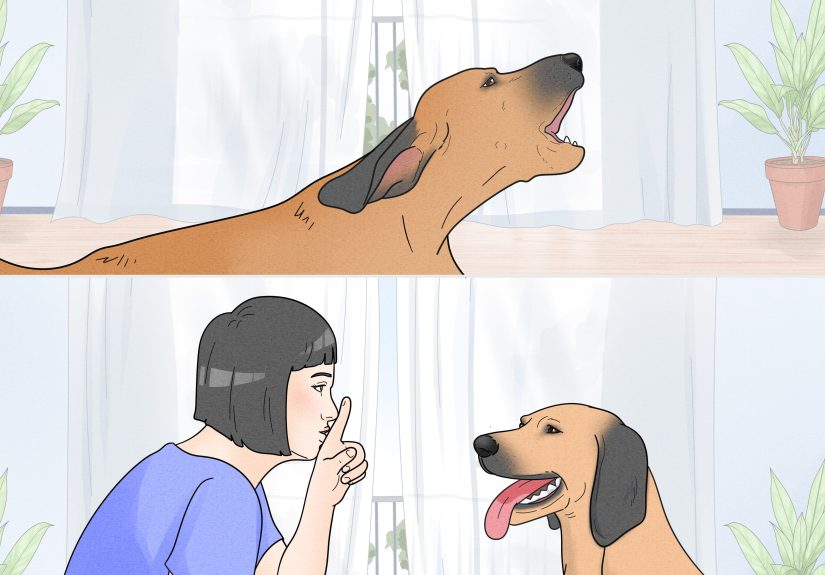
The goal of “Quiet” isn’t to punish barkingit’s to teach your dog that silence has value. Here’s a friendly version:
- When your dog barks, approach calmly and say “Quiet.”
- The second your dog pauses, feed a steady stream of tiny treats for that silence.
- After repetitions, gradually increase the time you ask for quiet (2 seconds, 5 seconds, 10 seconds…).
Important: don’t yell “QUIET!” like you’re trying to out-bark your dog. Your dog hears that as:
“Oh good, we’re barking together now.”
Example
Doorbell rings → dog barks → you cue “Go to mat” → dog runs to mat → you pay with treats or a chew.
Over time, the doorbell becomes a cue for “mat party,” not “intruder announcement.”
4) Desensitization + Counterconditioning: Change How Your Dog Feels About People
If your dog barks because strangers feel scary, your job is not to “win the argument.” Your job is to change the emotion.
This is where desensitization and counterconditioning shine: you expose your dog to the trigger at a low enough intensity
that they can stay calm, and you pair that trigger with something your dog loves.
The two rules that matter most
- Stay under threshold: If your dog is already barking, lunging, or frozen, you’re too close or the situation is too intense.
- Make the math obvious: Person appears → chicken rains from the sky. Person leaves → chicken stops. Your dog learns fast.
Step-by-step plan for barking at people on walks
- Start farther away than you think. Cross the street. Step behind a car. Create space.
- Mark the moment your dog notices the person (a glance) and begin feeding high-value treats.
- Keep feeding until the person passes and the trigger is gone, then stop the treats.
- Repeat. Over days/weeks, your dog starts to look at a person and then look back at you like, “Where’s my paycheck?”
- Gradually reduce distance only if your dog stays calm and can eat treats.
Step-by-step plan for barking at visitors
- Prep your station: Mat/bed placed away from the door. Treat jar ready. Leash available.
- Practice with fake visitors: Doorbell sound at low volume or a gentle knock, then feed on the mat.
- Add realism slowly: Louder knock, door opening, person stepping insideonly one variable at a time.
- Coach guests: Ignore the dog at first, no eye contact, no reaching, no “It’s okayyyy.” Calm entry only.
This approach isn’t glamorous, but it’s powerful. You’re not just suppressing barkingyou’re building a dog who feels safer around people.
5) Upgrade the Greeting Routine (Because Chaos Is a Habit Too)
Many dogs bark at people because greetings are unpredictable and emotionally intense. So your mission is to make greetings
boring (in the best way). Think: “polite hotel lobby,” not “surprise birthday party.”
Create a simple visitor protocol
- Before the person enters: Dog goes to mat, leash on if needed, treats ready.
- When the person enters: Guest ignores the dog. You feed the dog on the mat.
- If barking happens: Increase distance (dog behind a gate or in another room) and resetdon’t “push through.”
- Only reward calm greeting: The dog earns “say hi” after a few seconds of quiet and relaxed body language.
Doorbell-specific tip
Doorbells are basically a sound effect for “something is happening!” Instead of fighting that energy, redirect it:
doorbell → mat, doorbell → toy, doorbell → chew. When the cue becomes predictable, barking often drops on its own.
When to call in a pro
If barking includes growling, snapping, lunging, or a hard stareor if you can’t keep your dog under thresholdget help from a
qualified, reward-based trainer or veterinary behavior professional. Safety and skill-building come first.
What Not to Do (If You Want This to Get Better)
If your dog barks at people because they’re worried, punishing them can make strangers feel even scarier. That’s how you go from
“loud dog” to “loud dog with sharper opinions.” Avoid:
- Yelling: Often reads like you’re joining the barking event.
- Flooding: Forcing close contact with people until your dog “gets over it.” Many dogs get worse.
- Aversive tools as a shortcut: They may suppress noise while increasing stress or fear.
- Accidental reinforcement: Opening the door, giving attention, or letting the dog greet while barking can reward the behavior.
Quick Troubleshooting: “But My Dog Still Barks!”
If your dog won’t take treats
You’re too close to the trigger or the environment is too intense. Add distance. Use higher-value treats. Lower the difficulty.
If barking is worse at home than on walks
That’s commonhome can trigger territorial or “this is my safe place” feelings. Use window management, mat training, and controlled visitor setups.
If your dog improves… then backslides
Normal. Progress is rarely a straight line. Go back to an easier level for a few days and rebuild.
Real-Life Moments: What This Looks Like in the Wild (500+ Words of Experience)
Here’s what dog owners often experience when they start working on barking at peoplebecause the “how” is one thing, but the
real life version includes socks, schedules, and at least one delivery driver who appears the moment you run out of treats.
Scenario 1: The Window Security Guard.
A dog discovers the front window is basically a 4K livestream of “People Doing People Things,” and decides to provide commentary.
The first week of training usually feels like: you close the curtains… and your dog stares at the curtains like they’re a personal betrayal.
This is where management saves your sanity. Blocking the view doesn’t mean your dog “wins.” It means you stop giving them daily reps
of barking practice. Then you train on purpose: one controlled session a day where a friend walks by at a distance and you toss treats
for calm. After a couple weeks, many dogs start doing the cutest thing: they hear footsteps, look toward the window… and then whip their
head toward you like, “Are we doing snacks about this or what?”
Scenario 2: The Doorbell Meltdown Artist.
Doorbells are dramatic. They’re designed to be dramatic. Your dog agreesenthusiastically. Owners often try to solve this by repeating
“It’s okay!” in a tone that suggests it is not okay. A smoother path is to rehearse a new routine when no one is actually at the door.
People are always surprised how quickly “doorbell → mat → treat” starts to click when it’s practiced in calm, 60-second sessions.
The breakthrough moment usually isn’t silenceit’s direction. Instead of sprinting to the door and barking inches from the knob,
your dog starts pausing, then heading to the mat because that’s where the paycheck lives. Once that happens, you can build duration and
slowly add real visitors. Some homes even turn it into a game: the dog hears the bell and races to the mat like it’s a sport.
(Finally, a competition where everyone wins and nobody needs a trophy.)
Scenario 3: The “I’m Fine Until They Look at Me” Walker.
Many dogs don’t bark at every personjust the ones who stare, approach directly, reach out, or pop around a corner too fast.
Owners often notice patterns: hats, hoodies, kids on scooters, joggers, people carrying bags. That’s not your dog being “random.”
That’s your dog being a very specific creature who has opinions about physics and surprise. Counterconditioning helps because it doesn’t ask
your dog to “be brave.” It teaches, slowly, that these weird human patterns predict good things. Starting at a distance is huge here.
If you can get one calm glance at a jogger and immediately feed, you’re building a new association. If you’re close enough that your dog
is exploding, you’re not teaching calmyou’re just surviving a moment.
Scenario 4: The Visitor Who Loves Dogs Too Much.
One of the biggest real-world obstacles isn’t the dogit’s the guest. The well-meaning friend who rushes in, squeals, leans over,
and extends a hand directly toward your dog’s face. (Your dog: “I did not schedule this meeting.”) It’s completely fair to coach visitors:
“Please ignore him at first. No eye contact, no reaching. Toss treats on the floor if you want to help.” This single script often changes everything.
The dog feels less pressure, barking drops faster, and the greeting becomes calmer. You’re not being rudeyou’re being your dog’s advocate.
The common thread across these experiences is that success usually comes from two things done consistently:
fewer barking reps (thanks to management) and more calm reps (thanks to training).
And yes, you will forget treats once. You will have a visitor arrive early. Your dog will have an “off day.”
Keep going anyway. Calm is a skillskills get stronger with practice.
Conclusion
To stop dogs from barking at people, you don’t need to “dominate” your dog or wage war against sound. You need a plan that combines:
(1) meeting needs and lowering stress, (2) managing the environment so barking isn’t constantly rehearsed, (3) teaching a clear replacement behavior,
(4) changing your dog’s emotional response with desensitization and counterconditioning, and (5) building predictable greeting routines.
You’ll still have a dog who barks sometimesbecause they’re a dog, not a library. But with humane training and consistency,
you can turn barking at people from a daily headline into an occasional footnote.
References (No Links, Just the Real-World Sources Behind the Methods)
- ASPCA guidance on barking and teaching “Quiet”
- American Kennel Club (AKC) training guidance on desensitization and counterconditioning
- VCA Animal Hospitals: desensitization, counterconditioning, and response substitution
- VCA Animal Hospitals: barking prevention through socialization and habituation
- UC Davis School of Veterinary Medicine handout on barking motivations
- Humane World for Animals: humane techniques to reduce barking (management, desensitization, incompatible behaviors)
- Humane Society of Missouri: door greetings and “sit/stay” foundation
- Oregon Humane Society: doorbell and mat/toy protocols
- AVSAB position statement on humane dog training and the risks of aversive methods
- CCPDT policy and standards for humane training and behavior intervention practices
- PetMD veterinary-reviewed guidance on teaching alternative behaviors (mat/bed)
- MSD Veterinary Manual discussion of fear/territorial context differences at home vs. outside