Table of Contents >> Show >> Hide
- Why Vermont White Marble Feels Like a Holiday Material
- Why Wood Belongs in the Same Sentence as Marble
- Menorah Basics: Make Sure It’s Beautiful and Correct
- Designing a Vermont White Marble & Wood Menorah
- Care & Cleaning: Keep the Glow, Lose the Stress
- Safety: The Festival of Lights, Not the Festival of “Why Is the Curtain Smoldering?”
- Styling Ideas: From Modern Minimal to Vermont Cabin Chic
- Buying Checklist: How to Spot Quality
- 500-Word Experience Add-On: What It’s Like to Live With a Marble & Wood Menorah
- Conclusion
There are two kinds of Hanukkah menorahs in this world: the ones that do the job, and the ones that make you pause mid-latke, mid-sentence, and say, “Okay… that’s beautiful.” A Vermont white marble & wood menorah aims for the second categorywhile still doing the first one flawlessly (because a menorah that can’t hold eight lights is basically a very confident paperweight).
This guide breaks down what makes Vermont white marble special, why wood is the perfect counterbalance, how to design (or shop for) a menorah that’s both meaningful and practical, and how to keep it looking gorgeous year after yearwithout turning your holiday into a “why does it smell like smoke?” mystery.
Why Vermont White Marble Feels Like a Holiday Material
It’s not just “white marble.” It’s Vermont white marble.
Vermont has a long, nationally significant marble storyone that shows up in American architecture, monuments, and historic interiors. One of the most famous Vermont marbles is Danby (including varieties often referred to as Imperial Danby), quarried in the Green Mountain region. The material is prized for its crisp, luminous look, and its ability to read as “classic” while still playing nicely with modern design.
If you like your facts with a side of “wow,” consider this: the Danby operation is known for underground quarrying on a massive scale, with the quarry extending deep into the mountain. That underground approach helps produce large blocks while keeping a consistent aesthetic that designers loveespecially when they want clean white stone with subtle movement rather than chaotic veining that looks like it’s arguing with itself.
Low drama, high impact
A menorah base needs to feel stable. Marble delivers that “anchored” feeling instantly. The weight helps prevent tipping, and the stone’s cool touch creates a quiet contrast to candle flamelike the material version of “calm down, it’s a celebration, not a campfire.”
Many Danby/Imperial Danby descriptions highlight relatively low absorption compared with other marbles, which can be a plus in real-world homes (think: wax drips, tiny oil smudges, and the occasional enthusiastic child with sticky fingers). That said, marble is still marble: it can stain, and it can etch if you treat it like a cutting board and introduce acids to the situation.
Why Wood Belongs in the Same Sentence as Marble
Warmth, symbolism, and a Vermont-level cozy factor
Marble is cool, smooth, and formal. Wood is warm, textured, and forgiving. Together, they create a menorah that feels both elevated and lived-in: “museum object” meets “family heirloom,” but without the velvet ropes.
A Vermont-inspired wood choice often points toward the hardwoods that define the region’s forestsespecially maple (including hard/sugar maple), along with walnut, cherry, or birch. Maple is famous not only for syrup culture, but also for its strength and clean grain, which makes it a favorite for woodworking that wants to look refined without looking fussy.
Design advantage: wood shapes easily
If you want graceful arms, gentle curves, or a minimalist “floating” candle line, wood is a dream material. It can be laminated, carved, turned, or kept sharply geometric. Marble, in comparison, is more likely to say: “I am happy to be a base. Do not ask me to be an elaborate swoop unless you also enjoy expensive tooling.”
Menorah Basics: Make Sure It’s Beautiful and Correct
The essential structure
- Eight lights for the eight nights of Hanukkah.
- A shamash (helper light) that is distinctoften higher, offset, or otherwise clearly not “one of the eight.”
- Alignment matters: many traditions emphasize the eight lights being in a straight line and at the same level.
Placement and lighting order (the classic “right-to-left / left-to-right” twist)
A widely taught practice: place candles from right to left (as you face the menorah), adding a new candle each night. Then light from left to right, beginning with the newest candle. This creates a nightly rhythm that feels ceremonial and surprisingly satisfyinglike holiday choreography that actually makes sense once you do it twice.
Designing a Vermont White Marble & Wood Menorah
1) Start with the base: proportions and stability
Marble shines as a foundation. A good rule: the base should be wide enough to resist tipping if a sleeve brushes the table (we’ve all been there), and thick enough to feel intentional rather than like a leftover tile sample pretending to be a design decision.
Popular base shapes that work well with Vermont white marble:
- Rectangular plinth: modern, clean, easy to center candle spacing.
- Soft oval: gentle, classic, and friendly on a dining table.
- Stepped base: architectural, with a subtle nod to monument stone.
2) Choose the wood: contrast with purpose
Wood selection changes the mood instantly:
- Maple: bright, smooth, and distinctly “Vermont energy.” Great for a Scandinavian-leaning minimal look.
- Walnut: rich and deephigh contrast against white marble, perfect for a dramatic modern piece.
- Cherry: warm, traditional, and it deepens in color over time (a slow glow-up, like the holiday itself).
- Birch: light and subtle; pairs well if you want a soft, tonal palette rather than bold contrast.
3) Candle cups: the safety and sanity upgrade
If wood is involved anywhere near the flame line, use metal or glass inserts (candle cups) designed for Hanukkah candles or oil cups. They protect the wood from heat, contain wax, and reduce the odds of your menorah developing a “rustic scorch patina” you did not request.
4) Spacing: make it look intentional (and lightable)
Even spacing helps the menorah read as elegant and prevents candles from leaning into each other like they’re trying to share secrets. Also, it keeps flames from crowdinggood for both aesthetics and heat management.
5) Finish choices: keep it beautiful, keep it practical
For the wood portion, avoid finishes that can soften under heat. Many makers choose durable hardwax oils or cured finishes appropriate for decorative objects. For a more natural maintenance routine, some people use food-safe mineral oil and wax blends on wood (especially if the piece is handled often), though you’ll still want to keep any finish away from direct flame exposure by using inserts.
For marble, consider whether the maker sealed it. Sealing can help with stain resistance, but it won’t stop etching from acids. The best finish is still basic care and quick cleanup.
Care & Cleaning: Keep the Glow, Lose the Stress
Marble care (a.k.a. don’t feed it lemons)
- Skip acidic cleaners like vinegar or lemon-based sprays. They can dull or etch marble.
- Use gentle, stone-safe cleaner or mild soap with water, then dry with a soft cloth.
- Clean wax drips carefully: let wax cool, lift gently (a plastic scraper can help), and wipe residue with warm water and mild soap.
Wood care (the “hydrate me occasionally” routine)
- Keep it dry: wipe spills quickly, don’t soak.
- Refresh the finish as needed (especially for oil/wax finishes) to prevent drying and dullness.
- Protect from heat with candle cups and reasonable spacing.
Safety: The Festival of Lights, Not the Festival of “Why Is the Curtain Smoldering?”
Hanukkah candles are small, but their confidence is enormous. A few smart habits keep the celebration joyful:
- Place the menorah on a stable, nonflammable surface.
- Keep it away from anything that can burn (curtains, paper décor, dish towels, that one stack of mail you swear you’ll sort).
- Never leave lit candles unattendedespecially if kids, pets, or overly curious roommates are in the mix.
- Let candles burn safely, then extinguish before bed or before leaving the room for long stretches.
Styling Ideas: From Modern Minimal to Vermont Cabin Chic
Modern gallery look
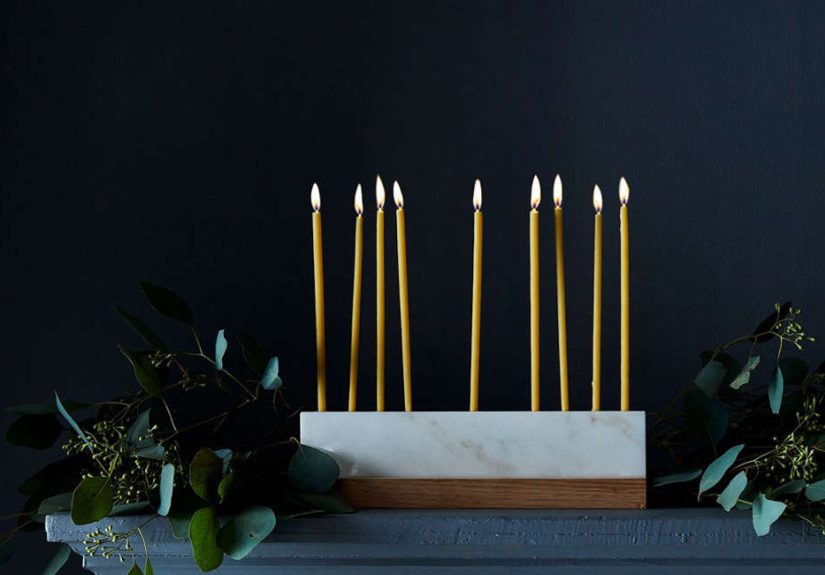
Pair a crisp white marble base with walnut arms and simple metal candle cups. Keep the silhouette linear and low. Set it on a neutral runner with a single sprig of evergreen. The vibe: “I have taste,” not “I bought every Hanukkah decoration in a single afternoon.”
Classic heirloom feel
Choose cherry or maple with softly rounded arms. Add slightly taller candle cups and a shamash that stands a bit above the rest. The look reads timeless, like it’s been in the family for decades (even if it’s new enough to still smell faintly like a woodworking shop).
Vermont cabin cozy
Lean into texture: a honed (matte) marble base, a warmly oiled maple body, and natural linen beneath. Add a bowl of apples, a stack of books, and hot cocoa nearby. Your menorah becomes part of the room, not just a holiday obligation.
Buying Checklist: How to Spot Quality
- Stone quality: look for tight, consistent polish or honing and clean edges (or intentionally softened edges that still feel precise).
- Wood joinery: arms should feel sturdy with no wobble; joints should be clean and thoughtfully reinforced.
- Candle fit: standard Hanukkah candles should sit securely; oil cups should be stable if it’s an oil design.
- Shamash distinction: it should clearly read as separatehigher, offset, or visually differentiated.
- Protective inserts: especially important if wood is anywhere near the candle line.
500-Word Experience Add-On: What It’s Like to Live With a Marble & Wood Menorah
The first thing most people noticebefore the candles, before the blessings, before the annual debate about whether latkes are better than sufganiyotis the feel of the menorah itself. Marble has that cool, steady presence that makes a table feel “set,” even if the rest of the room is busy with cooking, guests, and someone asking where the matches went (again). When you lift a marble-based menorah, it has weight in the handsreassuring, like it won’t scoot across the table because a sleeve brushed it. That heft quietly changes the mood: you’re handling something meant to last.
Wood adds the opposite sensation. Where marble feels crisp and formal, wood feels friendly. People tend to touch it without thinkingrunning fingertips along the grain while talking, adjusting it by instinct, noticing how the finish catches the light. If the wood is maple, it often reads bright and calmclean lines, soft warmth, “Vermont in winter” energy. Walnut tends to feel dramatic and modern, especially next to white stone. Cherry feels cozy, and over the years it deepens slightly, so the menorah doesn’t just sit through holidaysit ages with them.
Then comes night one, and there’s a little ritual to the setup. You place the menorah where it can be seen, but not where it can be bumped. You check spacing, you straighten candle cups, you make sure the shamash is ready to do its job like the responsible friend in the group chat. When the candles are lit, the marble behaves like a reflector: it subtly bounces warm light upward. A honed finish glows softly; a polished finish sparkles more. Either way, it’s hard not to pause for an extra second because the flame + stone combination looks quietly expensive (even when your dreidels are plastic and your chocolate coins are suspiciously lightweight).
Real life shows up quickly, of course. Wax drips happen. Someone leans in too close to admire the design. A kid wants to “help” by moving the menorah one inchan act that feels small until you remember physics and open flame are not casual acquaintances. This is where a well-designed piece shines: stable base, secure candle cups, and enough clearance that the flames don’t crowd. Cleanup becomes part of the rhythm. After the candles burn down, you let everything cool. Wax that lands on marble usually pops off more easily once hardened, and the remaining film wipes away with gentle soap and water. On the wood, the best experience is when wax never touches it because the inserts do their jobfuture-you will be grateful.
Over time, the menorah becomes a “seasonal anchor.” It comes out, and suddenly the house feels like Hanukkah is real, not just a date on a calendar. People start to remember where it sits, how it looks with the room lights dimmed, how the marble catches the glow. It becomes the object guests comment on, the one you gift with confidence, the one you wrap carefully because you can already imagine it being unwrapped years later. The best part? A Vermont white marble & wood menorah doesn’t have to shout to feel special. It just sits therestone-steady, wood-warmdoing what good design always does: making ordinary moments feel a little more meaningful.
Conclusion
A Vermont white marble & wood menorah is more than a pretty objectit’s a smart blend of stability, warmth, and tradition. Vermont marble (especially Danby/Imperial Danby varieties) brings a crisp American heritage and a clean, luminous presence. Wood adds human warmth and craft. When the design respects menorah basics (eight lights plus a distinct shamash) and includes safety-forward details like proper candle cups and stable proportions, you end up with a piece that feels both modern and timelessready for tonight’s candles and decades of future ones.