Table of Contents >> Show >> Hide
- Why Small-Kitchen Storage Matters More Than Ever
- 1. Use Your Vertical Space Like It Pays Rent
- 2. Add Pull-Out Storage Inside Lower Cabinets
- 3. Turn Cabinet Doors Into Hidden Storage
- 4. Double Shelves With Risers, Bins, and Stackers
- 5. Use Lazy Susans in Corners, Cabinets, and the Fridge
- 6. Get Small Appliances Off the Counter
- 7. Take Advantage of Narrow Gaps and Weird Slivers
- 8. Store Flat Items Vertically Instead of Stacking Them
- 9. Bring in a Slim Rolling Cart or Small Island
- 10. Claim Hidden Space: Toe-Kicks, Under-Sink Rods, and Under-Shelf Hooks
- Small-Kitchen Organization Tips That Make These Ideas Work Better
- Real-Life Experiences: What Actually Changes When You Organize a Small Kitchen
- Conclusion
If your kitchen feels like it was designed for one coffee mug, two forks, and a dangerously optimistic attitude, welcome. Small kitchens are charming right up until the toaster is living on top of the microwave and your cutting board needs a permission slip to come out of the cabinet. The good news? You do not need a full remodel, a celebrity designer, or a magical disappearing air fryer to make a compact kitchen work harder.
The secret is not just adding more storage. It is adding smarter storage. The best small-kitchen storage ideas make every inch more useful, from walls and cabinet doors to awkward corners and skinny gaps you used to ignore. When your layout is tight, strategy matters more than square footage.
In this guide, you will find 10 practical, stylish, and realistic ways to maximize space in a small kitchen. These ideas are built around how people actually cook, snack, unload groceries, and panic-clean before guests arrive. Whether you live in an apartment, condo, older home, or just have a kitchen with “cozy” written all over it, these tips can help you create a space that feels bigger, functions better, and looks less like a game of storage Jenga.
Why Small-Kitchen Storage Matters More Than Ever
A cramped kitchen is not just annoying. It slows down meal prep, makes cleaning harder, and turns everyday tasks into little obstacle courses. When counters are crowded and cabinets are overstuffed, you waste time hunting for things, rebuying what you already own, and muttering at plastic lids that never seem to match anything.
Good kitchen organization solves more than clutter. It improves workflow. It helps you see what you have, store things where you actually use them, and reduce visual chaos. In a small kitchen, that kind of order can make the room feel noticeably larger. And no, that is not interior-design wizardry. It is just what happens when every item has a home instead of freeloading on the countertop.
1. Use Your Vertical Space Like It Pays Rent
When square footage is limited, look up. Walls are prime real estate in a small kitchen, and too many homeowners leave them completely underused. Open shelves, floating shelves, wall rails, pegboards, and magnetic knife strips can move everyday items off the counter and out of crowded drawers.
What to store vertically
- Mugs and cups
- Spices and oils
- Frequently used utensils
- Cutting boards
- Knives on a magnetic strip
- Small pots and pans on hooks
This works best when you keep the display intentional. In other words, do not turn one floating shelf into a museum of random sauce packets. Store items you use often, keep containers consistent, and leave a little breathing room so the setup feels helpful instead of chaotic.
2. Add Pull-Out Storage Inside Lower Cabinets
Lower cabinets are notorious black holes. You crouch down, reach into the abyss, and somehow still cannot find the skillet you know is in there. Pull-out drawers or slide-out organizers fix that problem fast.
Instead of stacking heavy cookware in deep cabinets, install pull-out shelves that bring the contents to you. This makes bulky items easier to access and keeps things from being forgotten in the back. It is especially useful near the stove, where you want pots, pans, and mixing bowls within easy reach.
If you rent or do not want a major project, there are also removable slide-out organizers that can make existing cabinets far more functional without requiring a full renovation.
3. Turn Cabinet Doors Into Hidden Storage
The inside of a cabinet door is one of the most overlooked storage zones in the kitchen. It is also wildly useful. Add slim racks, adhesive organizers, hooks, or small caddies to hold the things that usually get lost in drawers.
Best uses for cabinet-door storage
- Pot lids
- Foil, parchment paper, and plastic wrap
- Cleaning sprays and gloves under the sink
- Measuring spoons and measuring cups
- Spices in narrow racks
This simple trick creates storage without taking up additional counter, floor, or shelf space. It is the organizational equivalent of finding money in a winter coat pocket.
4. Double Shelves With Risers, Bins, and Stackers
Many kitchen cabinets waste vertical room inside the shelf itself. You get one tall opening, toss items in, and end up with a messy stack of bowls, plates, or pantry goods that requires engineering skills to reach safely. Shelf risers fix that.
Risers, stackable bins, and tiered organizers help you create levels within a cabinet or pantry shelf. That means more usable storage and better visibility. Instead of a single layer of cans or dishes, you get two tiers. Instead of a chaotic pile of snack bags, you get contained zones.
This is especially effective for:
- Pantry items
- Coffee supplies
- Mugs and bowls
- Food containers and lids
- Canned goods and spices
Bonus points if you label bins. Labels are not just pretty. They keep everyone in the house from putting tortilla chips in the baking section like tiny household anarchists.
5. Use Lazy Susans in Corners, Cabinets, and the Fridge
Awkward corners are where good intentions go to die. A lazy Susan, turntable, or rotating organizer makes those areas far easier to use. Instead of shuffling ten bottles to reach the soy sauce, you just spin and grab.
These are perfect for upper cabinets, pantry shelves, deep corners, under-sink products, and even refrigerator condiments. In small kitchens, access matters just as much as capacity. If you cannot see it or reach it, you are not really storing it well.
Choose divided turntables for smaller items, or larger sturdy ones for oils, vinegars, sauces, and canned goods. If you have a corner cabinet, a dedicated corner organizer can make that formerly cursed zone feel surprisingly efficient.
6. Get Small Appliances Off the Counter
Nothing makes a small kitchen feel smaller than a countertop parade of appliances. Coffee maker. Toaster. Blender. Air fryer. Stand mixer. Suddenly you have no prep area left, and making a sandwich feels like a logistical event.
The fix is to create an appliance strategy. Keep only daily-use appliances on the counter. Everything else should move to a designated home, such as a pantry shelf, appliance garage, cabinet with pull-outs, or rolling cart.
A simple rule
If you use it every day, keep it accessible. If you use it once a month, it should not be hogging the best seat in the kitchen.
For example, a stand mixer used mainly for holiday baking can live on a lower pull-out shelf. A slow cooker can move to a nearby utility cabinet. A microwave stand with shelves can also create a compact “appliance hub” in apartments or galley kitchens.
7. Take Advantage of Narrow Gaps and Weird Slivers
That little strip of space beside your refrigerator or between cabinets may look too small to matter, but it can become a surprisingly useful storage zone. Slim rolling pantries, narrow carts, or custom pull-out units can turn dead space into storage for spices, canned goods, oils, or wraps.
This idea is especially smart in older kitchens where layouts were not exactly planned with modern snack habits in mind. A narrow pull-out keeps items visible, organized, and easy to access, all without demanding precious cabinet room.
Think of it as the kitchen equivalent of parallel parking: awkward at first, but deeply satisfying when it works.
8. Store Flat Items Vertically Instead of Stacking Them
Baking sheets, cutting boards, serving platters, cooling racks, and pot lids are some of the most frustrating kitchen items to store. When stacked horizontally, they slide, clang, and somehow summon every other object in the cabinet to fall with them.
Vertical dividers are the answer. Use file-sorter style racks, cabinet partitions, or pull-out tray organizers to store flat items upright. This makes each piece easier to grab without disturbing everything around it.
This method works beautifully in lower cabinets, pantries, or even narrow spaces beside the oven. It is one of those changes that seems small until you realize you no longer have to excavate a baking sheet like an archaeologist.
9. Bring in a Slim Rolling Cart or Small Island
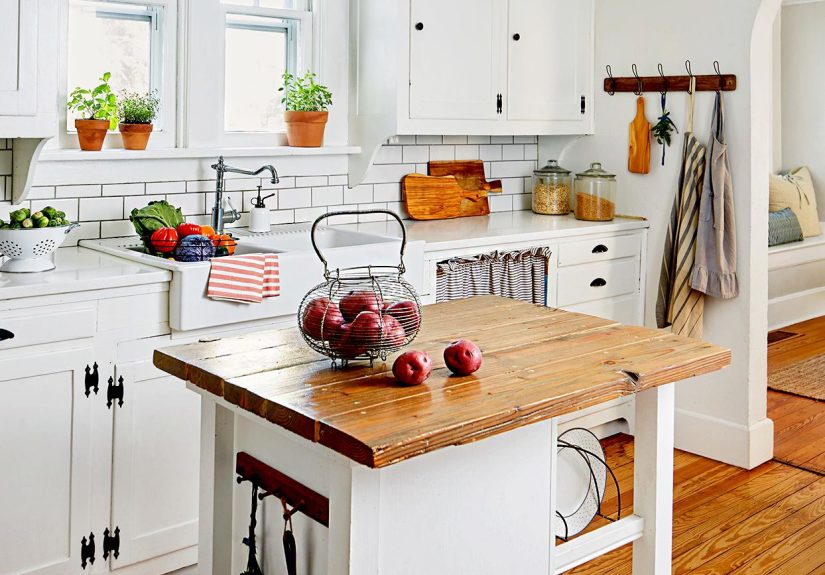
If your kitchen lacks both storage and prep space, a narrow rolling cart can solve two problems at once. The best versions include shelves, drawers, hooks, or towel bars, giving you flexible storage that can move where you need it.
A rolling cart can serve as:
- A mini island
- A coffee station
- A baking zone
- A produce cart
- Overflow pantry storage
Mobility is the real advantage. You can tuck it away when not in use, pull it closer while cooking, or park it near the dining area when serving. In a small kitchen, anything that can multitask deserves a standing ovation.
10. Claim Hidden Space: Toe-Kicks, Under-Sink Rods, and Under-Shelf Hooks
Small kitchens reward people who notice the “almost invisible” spaces. Toe-kick drawers under lower cabinets can store flat trays, linens, or rarely used tools. Under-sink tension rods can hang spray bottles and free up the cabinet base below. Under-shelf baskets and mug hooks can turn the underside of shelves into bonus storage.
These hidden-space solutions are ideal when your kitchen already feels full and you need places that do not visually crowd the room. They are subtle, efficient, and strangely satisfying once installed.
In other words, they are not flashy. They are just very, very good at their jobs.
Small-Kitchen Organization Tips That Make These Ideas Work Better
Create zones
Store items near where you use them. Coffee supplies near the coffee maker. Prep tools near the cutting area. Pots near the stove. This reduces wasted movement and makes the kitchen feel more intuitive.
Edit before you organize
Do not buy ten bins to store gadgets you never use. Declutter first. Donate duplicates, toss broken tools, and stop letting mystery lids run the household.
Keep counters selective
Even a well-organized small kitchen looks cramped if every surface is occupied. Leave some open counter space whenever possible. The room will feel larger, cleaner, and more functional.
Choose matching containers when you can
Uniform storage containers help maximize shelf space and reduce visual clutter. They also make your pantry look suspiciously like you have your life together.
Real-Life Experiences: What Actually Changes When You Organize a Small Kitchen
Here is what people often notice after applying these small-kitchen storage ideas: the room does not magically grow, but it starts behaving like a bigger kitchen. That is a huge difference. When your most-used tools are easy to reach, you cook more calmly. When your pantry is visible, you stop buying your fifth jar of paprika because you forgot the first four existed. When your counters are clear, even making breakfast feels less chaotic.
One common experience is that the biggest improvement often comes from the smallest upgrade. A renter might add an over-the-door organizer and suddenly have room for wraps, spices, and cleaning supplies. A homeowner installs pull-out shelves and wonders why they spent years kneeling on the floor to search for pots in the back of a cabinet. Another person adds a magnetic knife strip and instantly gets back a whole chunk of counter space. None of these changes are dramatic on their own, but together they transform how the kitchen works.
There is also a psychological effect. A small kitchen that is organized feels less stressful. You are not constantly reminded of what does not fit. Instead, you start noticing what does work. Your coffee station becomes a tidy little ritual. Your narrow rolling cart becomes your MVP during dinner prep. Your shelf risers make it easy to see exactly where the cereal, pasta, and snacks belong. Suddenly the kitchen feels less like a problem to solve and more like a room that supports your day.
Families often find that better storage reduces friction. Kids can grab snacks from labeled bins. Partners stop asking where the measuring cups are every single weekend. Cleanup gets faster because there is an obvious place to put things away. In shared spaces, good organization is not just about neatness. It is about making daily life run with fewer tiny arguments and fewer countertop avalanches.
People who love to cook usually notice another benefit: improved flow. In a cramped kitchen, workflow is everything. If your prep area is clear, your knives are on the wall, your mixing bowls slide out easily, and your oils are grouped together on a turntable, cooking becomes smoother. You spend less time moving stuff and more time actually making food. That is a big win in a room where every inch counts.
Even the visual change matters. Small kitchens can feel cluttered fast, especially when open shelving, colorful packaging, and multiple appliances compete for attention. Once items are grouped, decanted, stacked, or hidden away, the kitchen feels calmer. Cleaner. More intentional. It may still be tiny, but it starts looking like a tiny kitchen with a plan.
The best part is that most people do not need to do everything at once. You can start with one shelf, one cabinet, or one problem area. Maybe it is the pot lids. Maybe it is the coffee corner. Maybe it is the under-sink cabinet that currently looks like a haunted supply closet. Start there. Fix what annoys you most. Then build from that win.
That is the real experience of maximizing a small kitchen: less frustration, more function, and a surprising amount of relief. Not because your home changed overnight, but because your space finally started working with you instead of against you.
Conclusion
The best small-kitchen storage ideas do not rely on having more space. They rely on using your existing space more intelligently. When you combine vertical storage, pull-out organizers, cabinet-door storage, shelf risers, turntables, mobile carts, and hidden-space solutions, even a compact kitchen can feel efficient and comfortable.
Start with the areas that frustrate you most. Maybe that is your crowded counter, your messy pantry shelf, or the cabinet where pot lids go to start trouble. Choose one or two solutions, set up simple zones, and build from there. You do not need a massive renovation to make a small kitchen function beautifully. You just need smart storage, a little consistency, and perhaps the courage to finally throw away that chipped promotional mug from 2014.