Table of Contents >> Show >> Hide
- What the Project Actually Does
- Why a Piezo Disk Is the Perfect Villain for a Component Abuse Challenge
- Why the Crystal Matters More Than the Drama
- Is It Useful? Not Really. Is It Important? Absolutely.
- The Real Engineering Takeaway
- What This Says About the 2025 Component Abuse Challenge
- Common Bench Experiences With Piezo-and-Crystal Experiments
- Final Thoughts
Every once in a while, a hardware project shows up and politely asks engineering to loosen its tie. Then it throws the tie out the window and uses it as an antenna. That is roughly the energy behind “2025 Component Abuse Challenge: A Piezo Disk Powers A Transmitter”, one of those gloriously stubborn builds that reminds us electronics is not just about following datasheets. Sometimes it is about looking at a perfectly respectable component, ignoring its day job, and asking, “What else have you got?”
In this case, the overworked employee is the humble piezo disk. Most people know it as the thing that beeps in alarms, buzzers, toys, and budget gadgets with all the emotional warmth of a microwave. But piezo elements are wonderfully weird little parts. They can make sound, sense vibration, act as crude microphones, and generate electrical energy when bent or struck. In the 2025 Component Abuse Challenge, that last trick gets pushed into delightfully questionable territory: can a piezo disk generate enough electrical kick to help power a radio transmitter?
The answer is not “Yes, behold the next breakthrough in wireless infrastructure.” The answer is closer to, “Yes, technically, and that makes it amazing.” And honestly, that is the sweet spot for maker culture. Not every project needs to become a product. Some projects exist to prove a point, reveal a principle, or make every RF engineer in the room squint and say, “Wait… that actually works?”
What the Project Actually Does
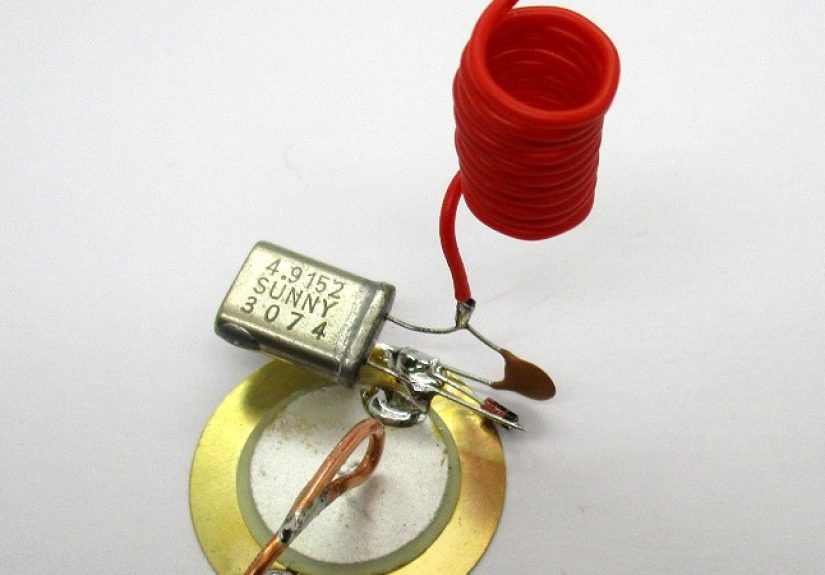
The project behind this story is wonderfully minimalist. A piezo disk is mechanically flexed by a small metal lever. That motion generates a voltage pulse. A simple contact arrangement creates a sharp switching edge, a diode keeps the piezo from charging in the wrong direction on the return motion, and a tiny capacitor helps shape the behavior of the circuit. The quartz crystal does the most elegant part of the job: once it is kicked by that pulse, it “rings” at its natural resonant frequency. That ringing produces a tiny burst of radio-frequency energy that a suitable receiver can detect.
That description matters because it separates this build from the usual mental picture of a transmitter. Most people imagine a powered oscillator, an amplifier stage, maybe some proper matching, perhaps an antenna that is not emotionally attached to a paperclip. This project is much leaner and much stranger. It is not a practical communications rig. It is more like a proof that if you combine piezoelectric generation, crystal resonance, and just enough circuit trickery, you can create a legitimate RF event with almost absurdly little hardware.
Think of it as the radio equivalent of flicking a wine glass and hearing it sing. You are not building a concert hall. You are exciting a resonant object and letting physics do the showing off.
Why a Piezo Disk Is the Perfect Villain for a Component Abuse Challenge
The name Component Abuse Challenge is not an insult. It is a celebration of parts used in ways that are technically legal in the laws of physics, but slightly suspicious in the court of normal design practice. A piezo disk is perfect for that theme because it already lives a double life. Apply voltage, and it bends. Bend it, and it makes voltage. That two-way behavior is the core of piezoelectricity, and it makes piezo parts natural candidates for experiments that blur the line between sensor, actuator, and energy source.
Normally, a piezo disk is asked to make beeps and boops. In sensor mode, it is happy detecting taps, knocks, shock, and vibration. In more ambitious systems, piezoelectric materials appear in energy harvesting designs, instrumentation, and resonant actuation. So the idea of using one as a tiny generator is not crazy. What makes this build charming is how far it stretches that idea. We are not talking about lighting an LED after a tap and calling it a day. We are talking about nudging a crystal hard enough to produce a detectable radio signal.
That is a much taller order, because voltage and usable energy are not the same thing. Piezo elements can surprise you with sharp voltage spikes, but the total energy available is still small. That is why the project feels like a magic trick until you look closer. It is not brute force. It is precision. The circuit does not waste energy trying to be big; it arranges a small event so cleverly that the crystal can do something memorable with it.
Why the Crystal Matters More Than the Drama
If the piezo disk is the dramatic actor in this story, the quartz crystal is the disciplined stage manager who makes the production possible. Quartz crystals are piezoelectric resonators with very high Q, which is engineer-speak for being extremely selective and efficient at ringing at a specific frequency. That is why crystals are used in timing circuits, oscillators, and RF systems that need stability. They are excellent at saying, “I will resonate here, thank you very much, and not just wherever the vibes take me.”
In this project, the crystal is not merely a passive bystander. It is the frequency-defining heart of the trick. The pulse coming from the piezo and switching contact is brief, but the crystal turns that brief shove into a controlled burst of oscillation. Without the crystal, the circuit would mostly be a noisy gesture. With it, the build gains focus. The result is still tiny, still low power, and still more laboratory curiosity than practical radio tool, but it is no longer random chaos. It is structured chaos, which is where engineering starts looking respectable again.
This is also why the project feels smarter the longer you look at it. It is not “a piezo powers a transmitter” in the chunky, everyday sense of powering a whole RF front end. It is more accurate to say the piezo supplies the impulse that lets a high-Q resonant element briefly come alive. That difference is the whole magic act.
Is It Useful? Not Really. Is It Important? Absolutely.
Let’s be honest: nobody is replacing conventional RF transmitters with finger-flexed piezo disks. This is not the future of Wi-Fi, LoRa, satellite telemetry, or even glorified garage remotes. The signal is tiny. The energy is tiny. The control is limited. The whole build lives in the beautiful category of “works far better as a lesson than as a product.”
And that is exactly why it matters.
Projects like this are important because they expose the hidden personalities of ordinary components. They remind builders that every part has side effects, edge cases, and alternate uses. LEDs can sense light. Speakers can act like microphones. Resistors become heaters. Quartz crystals are mechanical devices pretending to be electrical parts. Piezo disks are little translators between motion and voltage. The more a designer understands those secret identities, the better that designer gets at solving unusual problems.
There is also a cultural lesson here. Modern electronics often pushes people toward modules, black boxes, and “known good” reference designs. That is practical, efficient, and often necessary. But it can also make hardware feel like appliance assembly. The Component Abuse Challenge pushes in the opposite direction. It asks builders to rediscover the analog weirdness underneath the neat symbols in a schematic. That is healthy. Electronics was never supposed to be only tidy. Sometimes it should be a little mischievous.
The Real Engineering Takeaway
The smartest takeaway from this transmitter experiment is not that piezo disks are secret radio power supplies. It is that energy coupling and resonance can do a lot when losses are low and timing is right. That principle shows up everywhere: filters, oscillators, sensing circuits, energy harvesters, tuned amplifiers, and even mechanical systems. A small impulse, applied at the right moment to the right resonant structure, can create an effect that looks larger than the input suggests.
That is why this challenge entry resonates with both makers and seasoned engineers. The maker sees a cheeky hack. The engineer sees a lesson in impedance, transient behavior, resonance, polarity management, and the practical difference between “this should not work” and “this should not work much, but maybe enough.” Those are not the same sentence. A lot of innovation lives in the gap between them.
It also makes a useful point about measurement. Weak, pulse-like RF behavior can be hard to characterize without the right receiver, scope technique, and test setup. Builds like this teach patience. They force you to think about what the circuit is really doing rather than what you wish it were doing. That is an underrated engineering skill, right up there with labeling wires before the smoke test.
What This Says About the 2025 Component Abuse Challenge
The broader 2025 Component Abuse Challenge celebrates designs that exploit non-ideal behavior, reverse expected roles, or push parts beyond their usual narrative. That spirit is alive in this piezo-powered transmitter. It is not flashy in the usual sense. There is no enormous PCB, no machine-learning dashboard, no unnecessarily cinematic enclosure rendered in six shades of matte black. Instead, there is a sharp idea executed with restraint.
And that restraint is part of what makes the project memorable. Minimal circuits are brutally honest. They cannot hide behind firmware, calibration tables, or layers of abstraction. Every component has to justify its existence. In this build, each part earns its place. The piezo makes the pulse. The contact makes the edge. The diode keeps the behavior directional. The capacitor helps the AC path. The crystal rings. The receiver notices. End of story. Tiny story, yes. But still a story with excellent plot structure.
That is why the project stands out in an SEO-friendly way as well as a technical one. It taps into several high-interest ideas at once: piezoelectric power generation, quartz crystal resonance, ultra-simple transmitter design, Hackaday challenge projects, and the always irresistible internet theme of making a part do something it absolutely did not expect to do today.
Common Bench Experiences With Piezo-and-Crystal Experiments
Anyone who has spent time experimenting with piezo elements and crystals will recognize the strangely theatrical nature of these parts. On paper, the setup looks almost too simple to be interesting. On the bench, it becomes a full personality test. Tap the piezo lightly and nothing obvious seems to happen. Tap it a little harder and suddenly the scope wakes up, the receiver hints at life, and you start leaning closer like the circuit just whispered a secret. That experience is common with piezo-based experiments: they reward patience, careful observation, and a willingness to believe that a tiny mechanical action can produce a meaningful electrical event.
Another very familiar experience is discovering that piezo elements can feel much “stronger” than they really are. A piezo disk can generate surprisingly high voltage spikes, which makes it seem powerful, but the available energy is still modest. Builders often learn this the funny way. The first reaction is, “Wow, this thing is serious.” The second reaction, about ten minutes later, is, “Right, but it still cannot run much.” That tension between impressive voltage and tiny stored energy is exactly why piezo experiments are both educational and humbling.
Crystals add a different kind of drama. They often feel magical because they turn a messy impulse into something precise. When a crystal is behaving properly, it gives a circuit a sense of discipline. But that does not mean the experimenter gets an easy afternoon. Small changes in lead length, stray capacitance, contact bounce, receiver tuning, and even how confidently you press a lever can affect the result. Many people who try similar minimalist RF experiments report the same pattern: the circuit works, then does not, then works again after a tiny adjustment that seems too trivial to matter. Welcome to high-Q life.
There is also the very human experience of discovering how mechanical the whole process feels. In ordinary electronics, we like to pretend circuits are abstract and tidy. In piezo-and-crystal hacks, your fingers become part of the signal chain. The force of the press, the speed of release, the stiffness of the lever, and the exact point of contact all matter. That makes the project feel closer to playing a tiny instrument than simply switching on a device. You are not just powering a circuit; you are exciting a resonant system.
One more classic lesson from these experiments is that the bench environment matters more than expected. A noisy workspace, poor grounding, long clip leads, or a casually placed scope probe can turn a clear result into a mystery novel. People often come away from these builds with a deeper respect for test technique, because weak signals do not care about your optimism. If the setup is sloppy, the circuit will punish you by becoming a philosophy question.
That is why projects like “A Piezo Disk Powers A Transmitter” are so memorable. Even when the output is tiny, the learning experience is huge. You get a crash course in piezoelectric behavior, resonant circuits, transient events, polarity, tuning, and legal common sense around RF work. More than that, you get the feeling that hardware still has room for surprise. And in a world full of prebuilt modules, that surprise is half the fun.
Final Thoughts
2025 Component Abuse Challenge: A Piezo Disk Powers A Transmitter is the kind of project that captures attention because it is both technically legitimate and slightly ridiculous. That is a compliment. By bending a piezo disk to create a pulse that excites a quartz crystal into a detectable RF burst, the build turns a buzzer-style part into the opening act of a transmitter. It is not practical radio. It is not robust radio. It is not the sort of thing you would hand to a product manager and call market-ready unless you were trying to get escorted out of the meeting.
But it is absolutely good engineering entertainment, and better than that, it is good engineering education. It shows how resonance can magnify a tiny event, how component side effects become features in the right hands, and how clever circuit thinking can extract useful behavior from almost nothing. In an age where so many devices hide their workings under firmware and abstraction, this project does the opposite. It puts the raw physics front and center and lets the weirdness shine.
That is why this little transmitter matters. Not because it will change wireless design forever, but because it reminds us that great hardware often starts with a mischievous question. What if this part is more than what the label says? In 2025, one piezo disk answered that question with a tiny burst of radio and a very loud grin.