Table of Contents >> Show >> Hide
- Quick facts (the snack-size version)
- So… what exactly is Sagittarius A*?
- How we know it’s there: the “stars don’t lie” evidence
- How we “took a picture” of a black hole (without breaking physics)
- What’s going on around Sagittarius A* right now?
- Was Sagittarius A* always this quiet?
- Why Sagittarius A* matters (besides being extremely metal)
- Common misconceptions (so we can all sleep better)
- What’s next: how Sagittarius A* research keeps leveling up
- Conclusion: the center of the Milky Way isn’t emptyit’s busy being awesome
- Experiences: getting closer to Sagittarius A* (without leaving Earth)
There’s a heavyweight living in the middle of the Milky Way. It doesn’t sparkle, it doesn’t pose for selfies, and it definitely
doesn’t pay rentyet almost everything in our galaxy is, in some sense, orbiting it. Meet Sagittarius A* (pronounced
“Sagittarius A-star”), the supermassive black hole at our galaxy’s center: a cosmic object so influential that astronomers use it like a
“north star” for understanding how galaxies work… and so elusive that getting its first image required turning Earth into a telescope.
If you’ve ever wondered how humans can “see” something that doesn’t emit light, why the center of the Milky Way is both crowded and hidden,
or how a black hole can be “quiet” yet still throw occasional tantrums, you’re in the right place.
Quick facts (the snack-size version)
- What it is: The supermassive black hole at the galactic center of the Milky Way.
- Where it is: In the direction of the constellation Sagittarius, about 26,000 light-years away.
- How massive: Roughly 4 million times the mass of our Sun.
- Why it’s famous: It’s the closest known supermassive black hole, making it our best laboratory for black hole physics.
- Big 2022 moment: The Event Horizon Telescope released the first image of its shadowa glowing ring around darkness.
- Temperament: Usually underfed (astronomically speaking), but it can flare in infrared and X-rays.
So… what exactly is Sagittarius A*?
Sagittarius A* (often shortened to Sgr A*) is a compact radio source at the Milky Way’s center that astronomers have
long suspected is a supermassive black hole. It’s “supermassive” because it’s not made by one star collapsing; it’s the
galaxy-scale varietymillions (or billions) of solar masses packed into a region smaller than you’d expect for something that heavy.
The center of the Milky Way is a messy neighborhood: dense star clusters, swirling gas, magnetic fields, and dust thick enough to make
visible-light astronomy throw up its hands and request a different assignment. That’s why Sgr A* was first studied primarily in
radio wavelengths, and why modern observations lean heavily on infrared and X-ray
instruments that can punch through dust better than visible light.
If you’re imagining a black hole as a gigantic vacuum cleaner roaming the galaxy like a cosmic Roomba, let’s gently set that idea down and
walk away. A black hole’s gravity is powerful, but it behaves like gravity anywhere else: you can orbit it safely if you’re far enough away,
and our solar system is extremely far away. The real drama happens close inwhere gas gets heated, magnetic fields twist, and orbits become
fast enough to make Einstein’s equations start doing backflips.
How we know it’s there: the “stars don’t lie” evidence
Astronomers didn’t confirm Sagittarius A* by watching it glow in visible light (it doesn’t). They confirmed it the way you’d confirm an
invisible elephant in your kitchen: by watching everything else react.
1) Stellar orbits: nature’s best lie detector
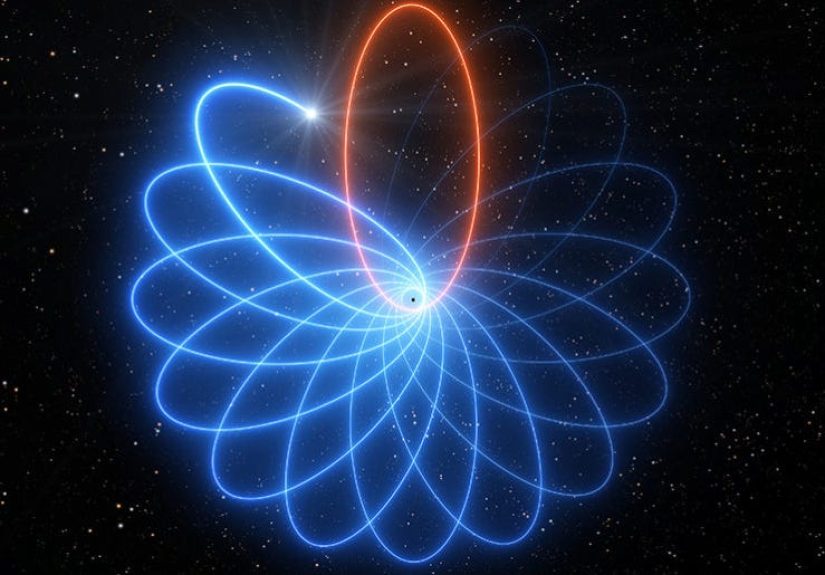
Near the galactic center is a group nicknamed the S-starsstars that whip around the center at incredible speeds. One of the
most famous is often called S0-2 (also known as S2 in other naming schemes). It completes an orbit in about
16 years, which is wild when you remember that our Sun takes about 225–250 million years to orbit the Milky Way once.
By tracking these stars for yearsmeasuring their positions and velocities with high-resolution imagingastronomers can calculate the mass
of the object they’re orbiting. The results point to an unseen, extremely massive object concentrated into an incredibly small volume.
That combinationhuge mass + tiny sizeis the black hole signature.
This painstaking work is a big reason the 2020 Nobel Prize in Physics recognized research tied to the Milky Way’s central
mass. It’s not just “there’s something heavy there.” It’s “the data leave basically no room for a normal cluster of objects to explain it.”
2) Compactness: four million Suns in a space that’s (comparatively) tiny
Plenty of things can be massive. The key is how tightly the mass is packed. A dense cluster of stars, for example, would still take up a lot
of space and would behave differently over time. The observations near Sgr A* indicate the mass is concentrated so strongly that a
supermassive black hole is the best explanation we currently have.
3) The center is also a physics lab, not just a scale model
When stars pass close to the central object, their light and motion can show relativistic effects. In plain English: near a very strong
gravitational field, “normal” orbital intuition starts to fail, and the universe behaves the way Einstein said it should. Observations of
close-passing stars have been used to test those predictions in an extreme environment.
How we “took a picture” of a black hole (without breaking physics)
Here’s the tricky part: black holes themselves don’t shine. But the material around them can. Gas and dust falling inward can heat up to
incredible temperatures, glowing at radio and other wavelengths. In 2022, the Event Horizon Telescope (EHT) released an
image of Sagittarius A* that looks like a bright, uneven ring surrounding a dark center.
What you’re actually seeing in the famous image
The dark center is the shadownot a “hole” punched in space like a cartoon portal, but a region where light paths are
bent and captured by extreme gravity. The bright ring is emission from hot material around the black hole, with the glow shaped by
relativity and the motion of the gas.
Why this was harder than the earlier black hole image (M87*)
The EHT’s first big public-black-hole moment was the 2019 image of M87*, a supermassive black hole in another galaxy. Sagittarius A* is
much closer to us, which sounds easierlike photographing a closer mountain rather than a far one. But nature added difficulty settings:
Sgr A* is smaller than M87* (still enormous, just less enormous), and the bright gas around it changes on short timescales.
Imagine trying to take a long-exposure photo of a candle flame while the flame keeps changing shape. That’s part of the challenge:
the emission near Sagittarius A* varies quickly, so the EHT team had to use sophisticated techniques to reconstruct a stable image from
observations gathered across a global network of radio telescopes.
Earth-size telescope energy (a.k.a. VLBI in a tuxedo)
The EHT works using very long baseline interferometrycombining data from radio observatories across the world to simulate a
telescope roughly the size of Earth. It’s the astronomy version of a group project that actually works, which means it’s either the greatest
miracle in modern science or proof that scientists run on pure stubbornness (it can be both).
The result: an image that’s not just coolit’s a test. The ring size and shape are consistent with what we expect from a black hole of about
four million solar masses at the galactic center.
What’s going on around Sagittarius A* right now?
Sagittarius A* is often described as quiet compared with the blazing active black holes in some galaxies. That doesn’t mean
“nothing happens.” It means the black hole is currently accreting (feeding on) matter at a relatively low rate, so it’s not constantly
blasting out huge amounts of radiation the way some actively feeding supermassive black holes do.
A “low-luminosity” black hole can still throw flares
Even when it’s not feasting, Sgr A* can produce flaressudden brightenings observed in infrared and X-rays.
Space-based observatories have recorded powerful outbursts, and long observing campaigns have shown that variability is a core feature of the
system. The center of the Milky Way is basically a cosmic improv show: you can plan the instruments, but you can’t fully script the night.
Astronomers study these flares to learn about the physics of plasma and magnetic fields near the event horizon. When charged particles move
through strong magnetic fields at near-light speeds, the resulting radiation can surgeand the details of those surges help scientists narrow
down what the environment is like at the edge of the black hole’s influence.
Magnetic fields: the invisible choreographers
Magnetic fields near supermassive black holes can shape how gas spirals inward and how energy gets released. Polarized observations (a way of
measuring how light waves are oriented) can reveal magnetic field structure near the black hole. This matters because magnetic fields can
either help funnel material in or help fling energy out, depending on the setup.
Was Sagittarius A* always this quiet?
Probably not. Multiple lines of research suggest the Milky Way’s center has had more active phases in the past. One of the clever ways
scientists look for that history is by studying “echoes”not sound echoes, but light echoes.
X-ray echoes: cosmic mirrors in nearby clouds
If Sagittarius A* produced stronger X-ray outbursts in the past, some of that radiation would have traveled outward and bounced off nearby
clouds of gas and dust. Those clouds can act like mirrors, reflecting the X-rays toward us with a delaybecause light takes time to travel.
By mapping and analyzing that reflected radiation, astronomers can reconstruct evidence of past activity.
The “black hole mood swings” lesson
The big takeaway isn’t that Sagittarius A* is secretly plotting something. It’s that supermassive black holes can shift between quieter and
more active states over time. That’s important for understanding how galaxies evolve, because when a central black hole is active, it can
influence star formation and the motion of gas on enormous scales.
Why Sagittarius A* matters (besides being extremely metal)
Sagittarius A* is not just a curiosity. It’s a cornerstone for modern astrophysics, because it lets scientists test big ideas in a nearby,
measurable environment.
1) A real-world testbed for gravity
Studying stars near Sgr A* allows scientists to test how gravity behaves in strong fields. It’s one thing to verify relativity in our solar
system (which we do). It’s another thing to probe it near a supermassive black hole, where speeds and gravity are far more extreme.
2) A guide to how galaxies and black holes grow together
Many galaxies appear to have supermassive black holes at their centers. Understanding our own provides clues about how these objects form,
how they feed, and how they influence their host galaxies. In some galaxies, black holes are actively accreting and releasing huge amounts
of energy. In ours, Sgr A* is relatively calmso we can study a quieter phase up close.
3) A calibration point for the universe
Because Sagittarius A* is close and well-studied, it becomes a reference object. When astronomers interpret signals from more distant galaxies,
having one supermassive black hole we can analyze in high detail helps ground the whole field. It’s like having a well-lit, well-labeled
specimen before trying to identify something in a blurry photo from across the room.
Common misconceptions (so we can all sleep better)
“Will it swallow the solar system?”
No. Sagittarius A* is far away, and the solar system orbits the galaxy at a safe distance. Gravity gets dangerous only when you’re close.
If you replaced the Sun with a black hole of the same mass, Earth’s orbit would remain basically the samejust darker and significantly worse
for photosynthesis (and, you know, life).
“If it’s a black hole, why can we see anything?”
You’re not seeing the black hole itselfyou’re seeing hot material around it and the effect gravity has on light. The “shadow” is the region
where light is trapped or bent away from our line of sight.
“Can I see Sagittarius A* with my backyard telescope?”
Not directly. Dust blocks visible light to the galactic center, and the details require radio interferometry or powerful infrared and X-ray
observatories. But you can see the constellation Sagittarius and know you’re looking in the general direction of the galaxy’s core,
which is a surprisingly satisfying flex at a campfire.
What’s next: how Sagittarius A* research keeps leveling up
The EHT image was a milestone, but it’s not the end. Astronomers want sharper images, better time resolution, and eventually something that
resembles a “movie” of how the glowing material changes near the event horizon. That requires more telescopes, more sensitivity, and more
clever mathplus the patience to handle data sets that are, scientifically speaking, enormous.
Meanwhile, continued monitoring of stars near the galactic center keeps refining our estimate of the black hole’s mass and the structure of
the environment around it. Every new instrument upgrade is like turning up the brightness on a dimly lit stagesuddenly you notice details
you didn’t even know were part of the play.
Conclusion: the center of the Milky Way isn’t emptyit’s busy being awesome
Sagittarius A* is the Milky Way’s central heavyweight: about four million Suns’ worth of mass packed into a region so compact that the best
explanation is a supermassive black hole. We’ve watched nearby stars trace tight, fast orbits that reveal its gravitational grip. We’ve
caught it flaring in energetic light. And, thanks to the Event Horizon Telescope, we’ve even captured an image of its shadowturning an
object famous for being invisible into something we can actually study directly.
In other words: the “dark monster” at the galaxy’s heart is also one of the brightest beacons for human curiosity. Not because it shines,
but because it teaches.
Experiences: getting closer to Sagittarius A* (without leaving Earth)
Let’s be honest: you can’t casually stroll up to Sagittarius A* like it’s a tourist statue with a gift shop. It’s 26,000 light-years away,
hidden behind curtains of dust, and guarded by physics that does not negotiate. Still, people have surprisingly vivid “Sagittarius A*”
experiencesmoments where the black hole stops being a textbook term and starts feeling real.
1) The “I found the galactic center!” moment
One of the simplest experiences is also one of the best: stepping outside on a clear night, opening a sky map app, and locating the
constellation Sagittarius. You’re not seeing the black holebut you’re pointing at the direction of the Milky Way’s downtown district.
For many people, that’s the first time the galaxy feels like a place instead of a wallpaper. Suddenly, “the center of the Milky Way”
isn’t an abstract idea. It’s a direction you can physically face.
The fun twist is realizing how “ordinary” the sky looks while something so extreme sits behind it. It’s like learning your quiet neighbor
is secretly the world’s strongest person. Same street. Very different vibes.
2) Planetarium shock: when scale hits you in the face (politely)
Planetariums and astronomy museums often have shows that fly you through the galaxy. Watching a simulated dive toward the galactic center
can be a genuine jaw-dropper: the star density rises, dust lanes thicken, and thenboomSagittarius A* shows up as the gravitational anchor
for the whole scene. Even though it’s a simulation, the scale is emotionally convincing. You leave thinking, “Wait… we live in that?”
That’s a real experience: scale turning into feeling. It’s the difference between knowing a number and believing it.
3) The “first black hole image” déjà vu
If you followed the 2022 release of the EHT image, you may remember the strange mix of emotions: excitement, confusion, and a tiny
disappointed whisper that said, “Why does it look like a glowing onion ring?” (That whisper is normal. Science is still cool.)
But the deeper experience often comes later, when you learn what went into that ring: telescopes across the globe acting as one, algorithms
reconstructing a picture from sparse data, and the extra challenge that Sagittarius A* changes fast. At that point, the image stops being
“a blurry ring” and becomes a receipt for human collaboration. It’s proof we can measure the extreme without touching it.
4) The “story” experience: black holes as characters in a bigger plot
Sagittarius A* also becomes memorable when it’s framed as part of the Milky Way’s history. Reading about X-ray flares, light echoes,
and hints that the galactic center may have been more active in the not-so-distant past turns the black hole into a character with a
timeline. Not a cartoon villainmore like a powerful engine that sometimes idles, sometimes revs, and always shapes its surroundings.
That shiftseeing Sgr A* as part of a long narrativecan be surprisingly personal. It changes how you look at the Milky Way overhead:
not as a static backdrop, but as an evolving system with a dynamic heart.
5) The “physics got real” experience
Finally, Sagittarius A* is where many people first feel relativity become more than a classroom concept. Learning that stars near the
galactic center move fast enough for relativistic effects to matter makes the universe feel less like a set of rules and more like a place
where those rules actually show up. It’s the moment you realize Einstein wasn’t writing a theoretical fanfiche was describing reality,
and the galactic center is one of the best stages for it.
You don’t need a spaceship to have a Sagittarius A* experience. Sometimes you just need a clear night, a good explanation, and the willingness
to be amazed by something that will never care you exist. Which, honestly, is kind of refreshing.