Table of Contents >> Show >> Hide
- Why Brown Sugar + Mustard Works So Well
- Recipe Overview
- Ingredients
- Step-by-Step Instructions
- How to Slice Corned Beef (So It’s Tender, Not Chewy)
- Serving Ideas
- Storage, Reheating, and Leftovers That Don’t Feel Like Leftovers
- Food Safety and Doneness Notes (Tender + Safe)
- Common Mistakes (and How to Avoid Them)
- Variations to Match Your Mood
- Real-Life Kitchen Experiences and Lessons (Extra Notes From the “People Who Actually Cook” Department)
- Conclusion
Corned beef has a reputation: it shows up once a year, wears a green tie, and insists it’s “easy” while quietly requiring hours of patience.
But here’s the upgrade your brisket deservesslow-cooked corned beef finished with a sticky brown sugar–mustard glaze and served with a
tangy-sweet mustard sauce you’ll want to drizzle on everything (including, yes, that last rebellious potato).
This recipe is designed for real life: it works whether you’re cooking for St. Patrick’s Day, a Sunday dinner, or a random Tuesday when your soul needs
something salty, tender, and dramatically glossy. We’ll go low-and-slow for tenderness, then crank the heat at the end to caramelize the glaze.
The sauce is separate so everyone can choose their own adventure: “polite dip,” “generous spoon,” or “I regret nothing.”
Why Brown Sugar + Mustard Works So Well
Corned beef is brisket that’s been cured with salt and spices. That means it’s intensely savory and already seasoned deep down. Mustard adds sharpness,
brown sugar adds caramel and warmth, and together they form a glaze that balances the salt while creating a shiny, slightly crisp finish.
Bonus: the aroma makes your kitchen smell like a deli married a cozy bakery.
Recipe Overview
- Best cooking method here: Oven-braise (steady heat, tender results, minimal babysitting).
- Finish: Broil or high-heat bake to set the glaze.
- Serve with: Mustard sauce + classic sides (cabbage, potatoes, carrots) or sandwich fixings.
- Skill level: Beginner-friendly. If you can stir and unwrap foil without fear, you’re in.
Ingredients
For the Corned Beef
- 1 (3–4 lb) corned beef brisket (flat cut is easiest to slice)
- 1 onion, sliced
- 3–4 cloves garlic, lightly smashed
- 2 bay leaves (optional but comforting)
- 2 cups water or low-sodium beef broth (plus more if needed)
- Optional flavor boost: 1 cup beer (lager or stout) replacing 1 cup of the liquid
For the Brown Sugar–Mustard Glaze
- 1/2 cup Dijon mustard (or spicy brown mustard for extra bite)
- 1/3 cup packed light brown sugar
- 1–2 tablespoons water (to loosen, as needed)
- 1/2 teaspoon black pepper (optional)
- Optional “make it fancy” add-ins: 1 teaspoon Worcestershire, a pinch of smoked paprika, or a tiny splash of apple cider vinegar
For the Sweet-Tangy Mustard Sauce
- 2 tablespoons butter
- 1/4 cup prepared yellow mustard
- 2 tablespoons Dijon mustard
- 1/3 cup brown sugar
- 1/4 cup apple cider vinegar (or white vinegar)
- 1 egg (helps thicken gently; see notes for egg-free option)
- Pinch of salt
Step-by-Step Instructions
1) Prep the brisket (quick rinse, big payoff)
Unwrap the corned beef and rinse it under cool water. This doesn’t “wash away the flavor”it simply removes excess surface brine so the
final meat tastes balanced instead of aggressively salty. Pat dry.
2) Oven-braise until tender
- Preheat oven to 325°F.
-
Place sliced onion and garlic in the bottom of a roasting pan or Dutch oven. Set the corned beef on top,
fat side up (the fat bastes the meat as it cooks). - Add water/broth (and beer if using) until liquid comes about 1/2–2/3 of the way up the sides of the brisket. Add bay leaves if using.
-
Cover tightly with a lid or heavy-duty foil. Bake for about 3 hours, then start checking every 20–30 minutes.
You’re looking for “fork-tender”: a fork slides in with little resistance.
Timing note: Corned beef varies. A common guideline is roughly about an hour per pound in the oven at 325°F,
but tenderness is the real finish line. When it’s ready, it won’t argue with your fork.
3) Mix the glaze
In a bowl, stir together Dijon mustard and brown sugar until it forms a thick paste. Add a tablespoon of water if it’s too stiff to spread.
Taste it. If your mustard is spicy, you may want a touch more sugar. If it’s sweet, add a pinch of pepper or a tiny splash of vinegar.
(This is cooking, not a standardized test.)
4) Glaze and caramelize
- Remove the corned beef from the braising liquid and set it on a foil-lined baking sheet, fat side up.
- Brush or spoon the glaze over the top and sides.
-
Turn oven to 425°F or use the broiler. Bake 10–15 minutes (or broil 2–6 minutes),
watching closely, until the glaze bubbles and caramelizes in spots. - Rest the meat for 10–15 minutes before slicing. This helps keep it juicy and easier to cut.
5) Make the mustard sauce (gentle heat = smooth sauce)
- In a small saucepan, melt butter over low heat.
- Whisk in yellow mustard, Dijon mustard, brown sugar, vinegar, and a pinch of salt.
-
In a separate bowl, whisk the egg. Slowly whisk a few spoonfuls of the warm mustard mixture into the egg (this tempers it).
Then pour the egg mixture back into the saucepan. -
Cook over low heat, whisking constantly, until lightly thickenedabout 3–5 minutes.
Do not boil (unless you enjoy scrambled-egg confetti). - Serve warm, or cool and refrigerate for later.
Egg-free sauce option
Skip the egg and simmer the mustard-sugar-vinegar mixture a little longer to reduce, or whisk 1 teaspoon cornstarch into 1 tablespoon cold water and
stir it in while simmering gently for 1–2 minutes.
How to Slice Corned Beef (So It’s Tender, Not Chewy)
Brisket has long muscle fibers. Slice across the grain (perpendicular to the lines you see in the meat). This shortens the fibers and
makes each bite tender. Aim for 1/8–1/4 inch slices for plates, and slightly thicker slices if you’re building monster sandwiches.
Serving Ideas
Classic plate
- Glazed corned beef slices
- Boiled or roasted potatoes
- Cabbage wedges (simmered briefly in the braising liquid is great)
- Carrots (same dealdrop into the liquid near the end)
- Mustard sauce on the side (or boldly on top)
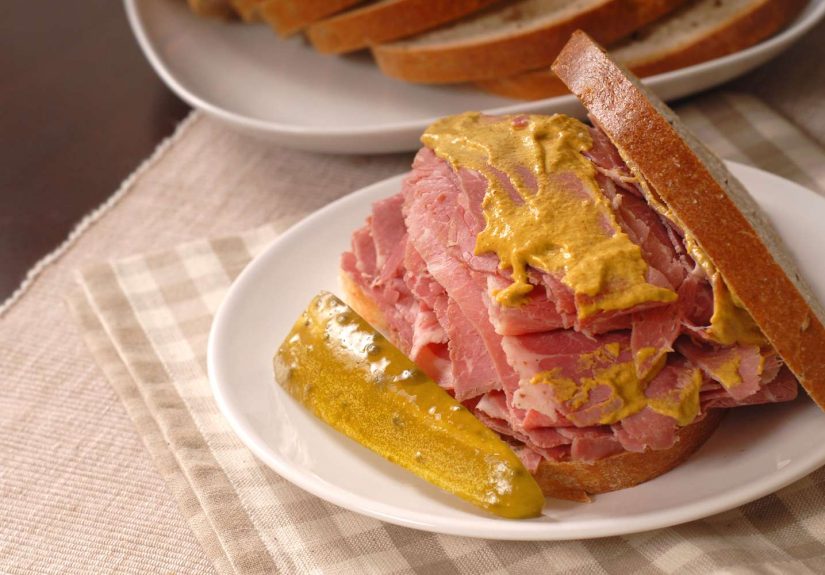
Sandwich mode
- Rye bread, toasted
- Warm corned beef slices
- Swiss cheese
- Sauerkraut or slaw
- Mustard sauce (or a mix of mustard sauce + mayo for a quick “special sauce”)
Storage, Reheating, and Leftovers That Don’t Feel Like Leftovers
- Refrigerate: Store sliced meat in an airtight container up to 4 days. Keep a splash of cooking liquid with it to prevent drying.
- Freeze: Freeze portions up to 2–3 months. Thaw overnight in the fridge.
- Reheat: Warm gently in a covered pan with a few spoonfuls of liquid, or wrap in foil and heat at 300°F until warmed through.
- Leftover ideas: Corned beef hash, omelets, loaded baked potatoes, quesadillas, or a salad that suddenly has “main character energy.”
Food Safety and Doneness Notes (Tender + Safe)
Corned beef is considered safe when it reaches 145°F internal temperature with a short rest time. But brisket is a tough cut, and many
cooks take it further (still gently) because tenderness improves with time. The sweet spot for eating is usually “fork-tender,” not
“technically warm.”
Common Mistakes (and How to Avoid Them)
1) Boiling hard instead of simmering
A rapid boil can tighten proteins and make slices drier. If you simmer on the stove, keep it gentle. In the oven, a covered braise naturally stays calmer.
2) Skipping the rest
Cutting immediately is like popping a water balloon with a knife: all the juices run. Resting helps the juices redistribute so your cutting board doesn’t
steal your dinner.
3) Not slicing across the grain
This is the difference between “wow, so tender” and “why is my jaw getting a workout?” Always across the grain.
4) Burning the glaze
Brown sugar goes from caramelized to charcoal quickly under a broiler. Stay close. This is not the moment to “just check one thing” on your phone.
Variations to Match Your Mood
- Spicy-sweet: Add a teaspoon of horseradish or a pinch of cayenne to the glaze or sauce.
- Smoky: Add smoked paprika to the glaze and serve with roasted cabbage instead of boiled.
- Maple twist: Replace 1–2 tablespoons of brown sugar with maple syrup for a softer sweetness.
- Honey mustard: Swap some brown sugar for honey and reduce water so it stays thick.
- Extra tang: Add a teaspoon of apple cider vinegar to the glaze to sharpen the finish.
Real-Life Kitchen Experiences and Lessons (Extra Notes From the “People Who Actually Cook” Department)
Let’s talk about what happens in real kitchenswhere foil tears, timers get ignored, and someone inevitably asks, “Is it done yet?” every 17 minutes.
The good news: corned beef is forgiving if you keep two rules in mindlow-and-slow for tenderness, and high heat only at the end
for that glossy brown sugar–mustard finish.
One of the most common “first-time corned beef surprises” is just how salty the package can smell when you open it. That’s normalit’s cured meat.
A quick rinse helps, and so does choosing a cooking liquid that isn’t overly salty (plain water or low-sodium broth). Another common discovery:
the spice packet is optional. Some cooks love that classic pickling-spice vibe; others prefer to skip it and let the mustard sauce do the talking.
Either way, you’re still going to end up with something that tastes like you planned dinner on purpose.
Texture-wise, people often expect corned beef to behave like a steak (hit a temperature, pull it, slice it, done). Brisket does not share that personality.
It’s more like a slow-burn novel: you don’t get the payoff until the later chapters. If it’s tough, it usually just needs more time.
That’s why “fork-tender” is such a useful cuewhen a fork slides in easily, the connective tissue has softened and the slices will be pleasant.
If you’re cooking for guests, a reliable strategy is to start earlier than you think you need. Corned beef holds well, reheats well, and
actually behaves better when you’re not trying to race the clock.
The glaze step is where people tend to get either very proud or mildly dramatic. Under the broiler, the glaze bubbles and turns glossy fast.
That’s exciting… until it becomes “smoke detector karaoke.” The fix is simple: keep the rack a little lower, watch closely, and pull it when you see
caramelized spotsnot when it becomes the color of a burnt marshmallow. If you’re nervous, do the 425°F bake method instead of broiling; it’s slower,
but it’s also calmer.
Then there’s slicingthe moment that separates the tender, deli-style experience from the “why is my dinner chewy?” experience.
In many kitchens, someone slices with the grain because it looks “right.” But brisket grains are sneaky; they run long and sometimes shift direction.
The practical trick cooks use: look for the lines, then cut so your knife crosses them like you’re making a tiny tic-tac-toe board.
Even thick slices can feel tender when cut properly.
Finally, the sauce. A brown sugar–mustard sauce looks simple, but it has a personality: it wants gentle heat and attention.
Cooks who rush it with high heat often learn what scrambled egg looks like in a mustard bath. Low heat and constant whisking solves that.
And once you have the sauce, people get creative: it becomes a dip for roasted potatoes, a drizzle on cabbage, or a sandwich spread that makes leftovers
feel brand new. Speaking of leftoverscorned beef has a second life. Hash is the obvious one, but it also shines in quesadillas, fried rice,
breakfast scrambles, or chopped into a “fancy” salad that somehow still tastes like comfort food.
If you take anything from these real-life notes, let it be this: corned beef doesn’t need perfection. It needs time, a watchful glaze moment,
and a sauce that’s sweet, sharp, and confident. Do that, and you’ll get slices that are tender, glossy, and wildly snackableaka the exact opposite
of “sad once-a-year corned beef.”
Conclusion
Corned beef with brown sugar and mustard sauce is the kind of recipe that feels traditional and upgraded at the same time: slow-cooked until tender,
finished with a caramelized glaze, and served with a tangy-sweet sauce that makes every bite brighter. Whether you keep it classic with cabbage and
potatoes or turn it into legendary sandwiches, this method gives you juicy slices, bold flavor, and leftovers worth fighting over.