Table of Contents >> Show >> Hide
- A Tiny Orchestra With Galactic Ambition
- Why Use Twelve Arduinos Instead of One?
- Why the Sound Feels So Delightfully Retro
- How the Build Turns Simplicity Into Spectacle
- What Makers Can Learn From This Arduino Music Project
- Why Projects Like This Matter in Maker Culture
- The Experience of Hearing and Building a 12-Arduino Orchestra
- Final Thoughts
- SEO Tags
Some projects are built to solve problems. Others are built because someone looked at a pile of microcontrollers and thought, “What if this became a tiny electronic symphony?” The 12-Arduino orchestra that plays a Star Wars fanfare falls squarely into the second category, and thank goodness for that. It is gloriously impractical, charmingly overengineered, and exactly the kind of maker project that reminds us why DIY electronics is so much fun.
At first glance, the idea sounds like a joke told by a soldering iron: twelve Arduino boards, a dozen small speakers, one famous movie theme, and enough MIDI coordination to make the whole thing feel like a pocket-sized pit orchestra. But the joke lands because the build actually works. More than that, it works in a way that reveals something important about Arduino music projects, polyphony, and the delight of using simple hardware to do something wildly theatrical.
If you love Arduino music, DIY electronic instruments, piezo buzzer projects, or just the sight of technology behaving like an enthusiastic marching band, this build hits the sweet spot. It is technical enough to teach you something, simple enough to understand, and nerdy enough to earn a standing ovation from anyone who has ever smiled at blinking LEDs making dramatic noises.
A Tiny Orchestra With Galactic Ambition
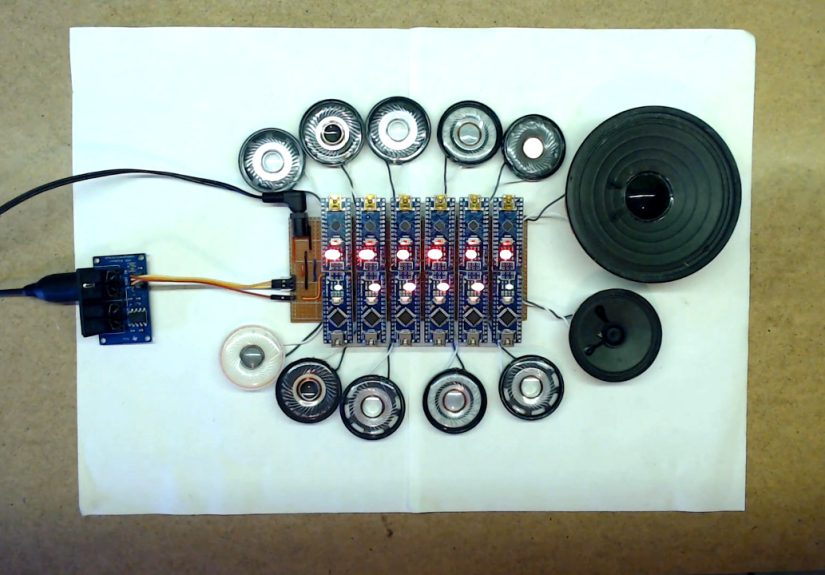
The magic of this project starts with its wonderfully straightforward premise. Instead of asking one Arduino to do everything, the maker splits the musical workload across twelve boards. Each Arduino handles its own part, listens for MIDI note data, and plays what it is told through a small speaker. Together, the boards act like a lo-fi orchestra, delivering a recognizable Star Wars fanfare with all the confidence of a brass section and all the tonal purity of a cheerful 8-bit arcade cabinet.
That contrast is exactly what makes the project so entertaining. The music itself is cinematic, triumphant, and larger than life. The hardware, on the other hand, is humble: Arduino Nanos, basic wiring, little speakers, resistors, and a communication scheme that is more practical than glamorous. The result is not smooth symphonic realism. It is something better for maker culture: a crunchy, chiptune-flavored interpretation that proudly shows its seams.
This is not a digital trick pretending to be a real orchestra. It is twelve tiny note generators doing their best, and their best is surprisingly lovable. If a full concert hall is a star destroyer, this project is a squadron of determined droids flying in formation and somehow nailing the finale.
Why Use Twelve Arduinos Instead of One?
Because sometimes the easiest route to polyphony is not elegance. It is multiplication.
Arduino boards are fantastic for simple sound output, especially when you use the familiar tone() function. But simple sound is the key phrase here. A basic Arduino melody setup is great for beeps, scales, alarms, and single-line tunes. Once you want multiple notes at once, things get trickier. Chords and layered arrangements push beyond what a bare-bones one-board melody sketch does comfortably. So this project takes a wonderfully old-school approach: if one board plays one voice cleanly, then twelve boards can play twelve voices together.
That idea echoes the spirit of early synthesizer design. Before compact digital magic boxes made everything neat, designers often handled polyphony by stacking tone-generating circuits. This Arduino orchestra revives that logic in a modern hobbyist form. Each board becomes one musician in the pit. Nobody is trying to be a full symphony by themselves. They just have to hit their notes on cue and avoid embarrassing the section.
It is a clever workaround because it turns a limitation into a feature. Instead of apologizing for what a small microcontroller cannot do alone, the project lets many of them do it together. In maker terms, that is not a bug. That is the entire plot.
MIDI Does the Conducting
A multi-board music build would collapse into chaos without coordination, and this is where MIDI earns its conductor’s baton. MIDI is wonderfully suited to projects like this because it sends note information efficiently and predictably. In this orchestra, note data is distributed by channel so each Arduino knows which musical line belongs to it. One board is not improvising while another is still looking for the beat. Everyone receives their marching orders and plays their assigned role.
That channel-based structure matters more than it might seem. It lets the project behave like an arranged ensemble rather than a cluster of buzzers yelling in a shoebox. Roughly half of the boards can cover the higher parts while the others handle the lower lines, creating separation, texture, and the illusion of a fuller arrangement. No one would mistake it for a real brass-and-strings performance, but your ears still register the layered intent. That is the difference between random beeping and music.
Why the Sound Feels So Delightfully Retro
If you are imagining a lush orchestral recording, adjust your expectations by several parsecs. The tones produced in a project like this are simple, square-wave style notes sent to small transducers or speakers. That gives the performance its unmistakable character: thin, direct, bright, and charmingly synthetic. It does not bloom like a film score. It bounces. It chirps. It struts.
And honestly, that is part of the appeal. The Star Wars fanfare is already bold and easy to recognize, which makes it perfect for a stripped-down electronic arrangement. Even when the timbre is reduced to buzzy fundamentals, the melody still carries the dramatic shape. Your brain fills in the missing grandeur. The hardware provides the skeleton; pop culture memory adds the cape.
There is also something undeniably funny about hearing heroic music emerge from a row of tiny boards with flashing LEDs. The project feels like a crossover episode between a conservatory recital and a workbench covered in jumper wires. It has the emotional ambition of a blockbuster ending and the sonic texture of a very confident toaster. That contrast is not a weakness. It is the punch line and the beauty of the whole thing.
How the Build Turns Simplicity Into Spectacle
One of the smartest aspects of the project is that the hardware is conceptually simple even though the total system looks elaborate. Each Arduino only needs a few essential connections: power, ground, a MIDI input path, and an output pin for sound. Repeating that structure twelve times creates a visual impact that is far grander than the difficulty of each individual unit.
This is a classic maker move. You take one understandable building block and replicate it until people back up two steps and say, “Wait, why are there so many?” Suddenly a beginner-friendly idea becomes a conversation piece. It is the same reason wall-sized LED arrays, floppy-drive instruments, and robot percussion projects capture attention. Repetition creates theater.
There is also a practical lesson here for hobbyists. You do not always need exotic parts to make something memorable. You need a solid concept, enough patience to organize the wiring, and a willingness to embrace the charm of visible construction. In fact, this project might be less lovable if it were too polished. A perfectly hidden enclosure would remove some of the joy. Half the fun is seeing the little boards lined up like electronic musicians waiting for their cue.
The Arrangement Matters as Much as the Electronics
Anyone can make a buzzer beep. Turning that into a performance is a different job entirely. The musical arrangement has to respect the strengths and weaknesses of the hardware. Notes need to be assigned sensibly. Parts need to be balanced. The timing has to be tight enough that the result sounds intentional rather than like a drawer full of alarm clocks arguing.
That is why the Star Wars fanfare is such a smart choice. It is famous, rhythmically assertive, and melodically bold. Even on simple hardware, the shape survives. The tune does not require subtle dynamics to be recognizable. It just needs accurate pitches, decent timing, and enough simultaneous voices to suggest that something bigger is happening than a single melody line. The project delivers exactly that.
What Makers Can Learn From This Arduino Music Project
Beyond the smiles and spaceship vibes, this build offers real lessons for anyone interested in Arduino sound projects.
1. Constraints Can Spark Better Ideas
Instead of fighting the limitations of one board, the project reframes the problem. Want more voices? Add more players. This is a useful mindset far beyond Arduino music. When a tool cannot do everything elegantly, sometimes the better answer is modular design instead of brute force.
2. MIDI Is a Superpower for DIY Instruments
MIDI keeps the system organized. It lets the creator assign musical roles cleanly and makes the build more scalable. Once you understand note messages, channels, and timing, a whole world of custom instruments becomes possible. MIDI is less flashy than a speaker cone, but it is the reason the show starts on time.
3. Simplicity Scales Beautifully
A single board playing a tune is cute. Twelve doing it together becomes a performance. If you are designing a maker project for a classroom, workshop, or video demo, repeating a small functional unit can create a far bigger impression than chasing a complicated all-in-one design.
4. Imperfection Has Personality
Modern audio tools can produce pristine results. This project goes the opposite direction and wins because of it. The rough edges give it charm. The buzzy timbre, visible wiring, and slight absurdity of the setup make it memorable. In a world full of clean digital polish, a quirky Arduino orchestra feels refreshingly human.
Why Projects Like This Matter in Maker Culture
Not every build needs to be optimized for commercial use, industrial efficiency, or daily practicality. Some projects matter because they demonstrate curiosity in public. They show how technical ideas can become playful, visible, and shareable. A 12-Arduino orchestra is not trying to replace a synthesizer workstation. It is doing something arguably more important: turning electronics into a story.
It also helps bridge audiences. Beginners can look at it and understand the core idea. Experienced makers can appreciate the routing, arrangement, and coordination. Music fans can enjoy the recognizable tune. Science-fiction fans get the instant delight of hearing familiar fanfare blasted out by tiny controllers that look like they were assembled in a rebel workshop. Everyone has an entry point.
That is the sweet spot for great DIY content. It teaches without lecturing, performs without pretending to be professional gear, and invites people to imagine what they might build next. Maybe not everyone will create a twelve-board orchestra. But plenty of people will look at it and think, “I could make a three-board harmony machine,” or “I want to try a MIDI-controlled buzzer choir,” or “I suddenly need an unreasonable number of Arduino Nanos.” That is how good projects spread.
The Experience of Hearing and Building a 12-Arduino Orchestra
There is a special kind of joy that only appears when a project is both slightly ridiculous and completely sincere. A 12-Arduino orchestra sits right in that sweet spot. If you have ever built something musical from simple electronics, you know the feeling: first comes skepticism, then cautious optimism, then one glorious moment when the hardware actually makes something recognizable and your whole brain lights up like a control panel.
Imagine standing over the workbench before the performance begins. The boards are lined up in rows, each one looking innocent enough on its own. A single Nano with a speaker attached does not seem particularly dramatic. It is the electronic equivalent of one kazoo player clearing their throat. But then you step back and notice there are twelve of them. Suddenly the project has stage presence. It is no longer one little experiment. It is a tiny army of coordinated beepers preparing to do cinema.
Then the fanfare starts.
The first emotional reaction is usually laughter, and that is not a criticism. It is delight. The sound is so earnest, so crunchy, so determined, that it becomes impossible not to grin. These are not lush strings and triumphant brass. These are brave little square waves charging into battle with whatever dignity they can carry. Yet the tune lands anyway. You recognize the shape instantly. Your brain does the rest. Suddenly the room feels less like a desk with jumper wires and more like a garage that accidentally opened a portal to a very low-budget space opera.
Building something like this is fun in a different way than buying a finished instrument. A polished product hides the labor. A project like this lets you enjoy every step: sorting boards, labeling channels, testing speakers, chasing wiring mistakes, tweaking note assignments, and feeling disproportionately proud when one stubborn line finally behaves. You earn the performance note by note. Even the troubleshooting becomes part of the story. One board is late? That is not a failure; that is your percussion section having opinions.
There is also a surprisingly social quality to a build like this. People who normally do not care about microcontrollers suddenly care very much when the microcontrollers begin playing movie music. Friends lean in. Coworkers wander over. Someone inevitably asks whether it can play something else. Someone else asks why there are twelve boards instead of one. Before long, you are not just showing off a gadget. You are talking about sound, code, arrangement, and creative problem-solving without sounding like you are giving a lecture. The project becomes a conversation starter disguised as a nerdy stunt.
And perhaps that is the best part of the experience. A 12-Arduino orchestra reminds you that technology can still feel handmade, surprising, and a little goofy. It proves that delight does not require premium components or perfect fidelity. Sometimes all you need is a good tune, a pile of modest hardware, and the willingness to follow an absurd idea until it starts making music. When it works, even for a minute, it feels less like running code and more like conducting a tiny rebellion against boring electronics.
Final Thoughts
The 12-Arduino orchestra that plays a Star Wars fanfare is a perfect example of what makes maker projects memorable. It solves a technical challenge with a modular idea, turns simple sound generation into a layered performance, and embraces its own eccentricity instead of sanding it away. It is educational, funny, and strangely triumphant.
If you are into Arduino music projects, MIDI experiments, piezo buzzer builds, or DIY electronic orchestras, this concept is more than entertaining. It is instructive. It shows that musical complexity does not always come from one powerful device. Sometimes it comes from a team of tiny devices, each doing one small job well and trusting the arrangement to make them sound bigger together.
In other words, the force is strong with modular design.