Table of Contents >> Show >> Hide
- Why “nectar plants” are the MVPs of a pollinator-friendly garden
- Quick rules for a pollinator buffet (that still looks intentional)
- The 13 colorful nectar plants (with practical growing notes)
- 1) Butterfly Milkweed (Asclepias tuberosa)
- 2) Purple Coneflower (Echinacea purpurea)
- 3) Wild Bergamot / Bee Balm (Monarda fistulosa)
- 4) Anise Hyssop (Agastache foeniculum)
- 5) Blazing Star / Gayfeather (Liatris spp.)
- 6) Cardinal Flower (Lobelia cardinalis)
- 7) Mountain Mint (Pycnanthemum spp.)
- 8) Goldenrod (Solidago spp.)
- 9) New England Aster (Symphyotrichum novae-angliae)
- 10) Black-Eyed Susan (Rudbeckia hirta)
- 11) Sunflower (Helianthus spp.)
- 12) Zinnia (Zinnia elegans)
- 13) Lavender (Lavandula spp.)
- How to combine these plants so pollinators always have options
- Plants that get credit but need a warning label
- Real-world “garden reality checks” (so you don’t blame the bees)
- Experience-based insights gardeners commonly notice
- Conclusion: make your yard the place pollinators actually want to be
- SEO Tags
If your garden feels a little too quietlike a party where nobody showed upyour flowers may be pretty but not
particularly useful. Pollinators (bees, butterflies, hummingbirds, moths, and even some very underappreciated
flies) don’t care about “designer landscaping.” They care about food. Specifically: nectar (energy) and pollen (protein).
The good news: you can build a full-on pollinator buffet with plants that are colorful, widely available in the United States,
and easy to grow. The even better news: when you do it right, your yard gets louderin the best way. Think: bumblebee
karaoke, butterfly confetti, and hummingbirds doing tiny aerial stunts like they’re auditioning for an action movie.
Why “nectar plants” are the MVPs of a pollinator-friendly garden
Nectar plants are flowering plants that produce sugary nectarbasically the sports drink of the pollinator world.
When you plant a variety of nectar-rich blooms, you help pollinators find fuel from spring through fall, especially during
“nectar gaps” when not much is blooming.
One important note (without turning this into a lecture): nectar is only part of the life cycle for many pollinators.
Butterflies, for example, also need host plants for caterpillars. That’s why a few plants belowlike milkweedpull
double duty: nectar for adults and leaves for hungry baby bugs.
Quick rules for a pollinator buffet (that still looks intentional)
1) Aim for “something blooming” from spring to fall
Pollinators don’t only show up in June. Early spring blooms help emerging bees. Late-summer and fall blooms help migrating
monarchs and other insects stock up for winter. A garden with continuous bloom is like keeping the kitchen open.
2) Plant in clumps, not confetti
A single flower here and there is like scattering potato chips across a football field. Clumps make for efficient foraging
and get noticed faster.
3) Skip the “perfectly sterile” look
Many native bees nest in the ground. A yard smothered in landscape fabric and thick mulch can be an obstacle course.
Leave a few small patches of bare or lightly covered soil, and don’t panic if you see solitary bees coming and going.
They’re neighbors, not villains.
4) Avoid pesticides whenever possible
If the goal is “welcome, pollinators,” then broad-spectrum insecticides are basically the opposite of an invitation.
Use integrated pest management (IPM), hand-pick pests, and lean on biodiversity. A balanced garden often solves problems
with fewer chemicals and more helpful insects.
The 13 colorful nectar plants (with practical growing notes)
These picks are popular because they work. Many are native to regions of the U.S., and even the non-native favorites
are included only when they reliably provide nectar and behave well in home gardens.
1) Butterfly Milkweed (Asclepias tuberosa)
Color: fiery orange (sometimes yellow) • Best for: butterflies, native bees • Bonus: monarch host plant
Butterfly milkweed is the extrovert of the milkweed worldbright, cheerful, and not afraid of summer heat. It thrives in full sun and
well-drained soil, and once established it can handle dry spells like a champ. Pollinators love the clustered blooms, and monarchs
rely on milkweed as a host plant for caterpillars.
Design tip: Pair it with purple coneflower and blazing star for an orange-purple combo that looks intentional and
performs like a pollinator magnet.
2) Purple Coneflower (Echinacea purpurea)
Color: pink-purple • Best for: bees, butterflies • Bonus: seed heads feed birds later
Coneflowers are sturdy, forgiving, and basically impossible to make look “wrong” in a garden. Their big daisy-like blooms offer
easy access to nectar and pollen. Leave a few seed heads standing in fall, and you’ll also feed finches and other birds.
Pro move: Plant 3–7 in a group for a bold look and better pollinator traffic.
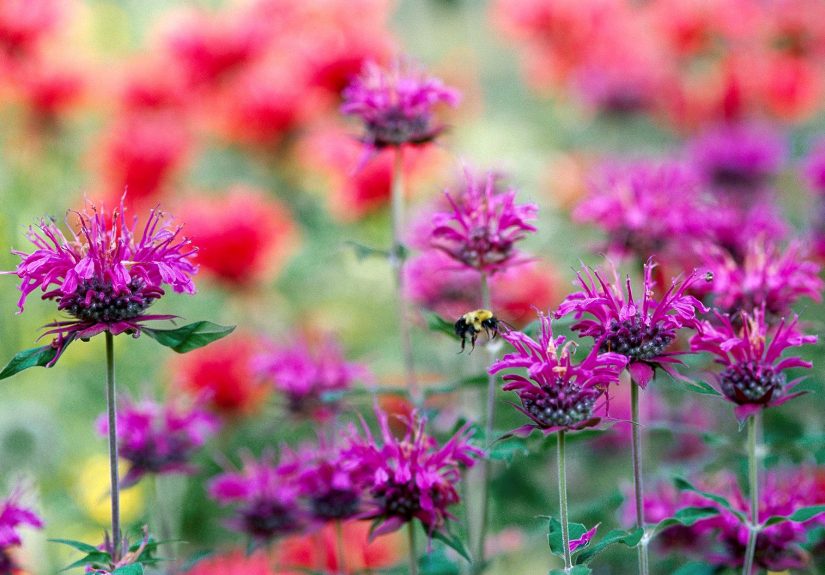
3) Wild Bergamot / Bee Balm (Monarda fistulosa)
Color: lavender-pink • Best for: bees, butterflies, hummingbirds • Vibe: cottage-garden chaos (the good kind)
Bee balm is famous for bringing in pollinators like it’s hosting a backyard music festival. The flowers are nectar-rich, and hummingbirds
show up like tiny, furious VIP guests. Give it sun to part sun and decent airflow.
Keep it happy: If powdery mildew shows up, thin the clumps, water at the base, and avoid crowding.
4) Anise Hyssop (Agastache foeniculum)
Color: violet-purple spikes • Best for: bees, butterflies, hummingbirds • Bonus: leaves smell like licorice
Anise hyssop blooms for a long stretch and stays busy with pollinator activity. It’s a reliable “workhorse” nectar plant, and it fits
beautifully into mixed borders. It prefers full sun and soil that drains well.
Specific example: If you want a pollinator strip along a fence, alternate anise hyssop and coneflower in repeating groups.
You’ll get a long bloom season and a tidy rhythm that looks designed.
5) Blazing Star / Gayfeather (Liatris spp.)
Color: purple-magenta • Best for: butterflies, bees • Superpower: vertical drama without being fussy
Blazing star sends up fuzzy-looking flower spikes that butterflies can’t resist. It’s also great for adding height without shading
everything else. Many species thrive in full sun and average to dry soil once established.
Garden styling: Use it as a “punctuation mark” behind lower plants like black-eyed Susan.
6) Cardinal Flower (Lobelia cardinalis)
Color: bold red • Best for: hummingbirds • Best conditions: moist soil (it’s not a desert plant)
If hummingbirds had a favorite restaurant, cardinal flower would be on their “go here weekly” list. Those red blooms are shaped for
hummingbird feeding, and the plant shines near rain gardens, downspouts (where water collects), and pond edges.
Tip: In hotter regions, give it afternoon shade and consistent moisture for best performance.
7) Mountain Mint (Pycnanthemum spp.)
Color: pale lavender-white • Best for: “everything with wings” • Bonus: aromatic foliage, tough as nails
Mountain mint is the plant you add when you want results fast. It’s famous for attracting a huge diversity of pollinatorsbees,
butterflies, beneficial wasps, and more. It’s hardy, drought-tolerant once established, and not picky.
Heads-up: Some types spread. Plant it where it can expand a bit, or edge it with a spade in spring.
8) Goldenrod (Solidago spp.)
Color: golden yellow • Best for: late-season bees and butterflies • Myth-busting: often blamed for allergies unfairly
Goldenrod blooms when many gardens start winding down. That timing makes it a crucial nectar source for late summer and fall. It’s also
one of the most unfairly misunderstood plantspeople often blame it for hay fever when ragweed is usually the real culprit.
Best use: Put it toward the back of a border, and pair with asters for a fall finale that looks like fireworks.
9) New England Aster (Symphyotrichum novae-angliae)
Color: purple, pink, sometimes blue-toned • Best for: late-season pollinators • Why it matters: fall nectar is survival fuel
Asters are a “save the season” plant: they bloom late, they’re colorful, and pollinators swarm them when other flowers are finished.
If you want your garden to support pollinators beyond summer, asters are non-negotiable.
Simple maintenance: Pinch stems in early summer for a bushier plant with more blooms.
10) Black-Eyed Susan (Rudbeckia hirta)
Color: sunny yellow with dark centers • Best for: bees, butterflies • Strength: heat-tolerant and cheerful
Black-eyed Susan is like the friend who’s always in a good mood. It blooms for a long stretch, fills space quickly, and brings in a steady
stream of pollinators. It also plays nicely with other plantsbig win.
Design tip: Mix with purple coneflower and aster for a classic “prairie palette” that blooms across seasons.
11) Sunflower (Helianthus spp.)
Color: bright yellow (and beyond) • Best for: bees and beneficial insects • Bonus: seeds for birds, drama for you
Sunflowers offer big, open landing pads and lots of floral resources. Annual sunflowers are easy from seed, and perennial types can provide
repeat performance year after year. They’re also a great “gateway plant” if you’re new to pollinator gardening: plant seeds, water, enjoy
compliments.
Specific example: Plant a short sunflower variety behind zinnias in a sunny bed for a layered, colorful nectar zone.
12) Zinnia (Zinnia elegans)
Color: basically every color except “boring” • Best for: butterflies, bees • Best feature: nonstop summer color
Zinnias are an annual, but they earn their keep. They bloom fast, bloom long, and butterflies tend to treat them like a layover lounge.
For pollinators, single and semi-double varieties are often more accessible than heavily double, pom-pom styles.
Easy care: Full sun, moderate watering, and deadheading for more blooms. Bonus: they’re great cut flowers.
13) Lavender (Lavandula spp.)
Color: purple-blue • Best for: bees (especially bumblebees) • Best conditions: sun + excellent drainage
Lavender is the plant equivalent of a clean shirt and good manners: it shows up, looks nice, smells amazing, and attracts bees.
In humid areas, airflow mattersgive it space and don’t overwater. In colder climates, choose a hardy variety and avoid soggy winter soil.
Container win: If your native soil is heavy clay, grow lavender in a pot with gritty, fast-draining mix.
How to combine these plants so pollinators always have options
Create a “bloom calendar” in three acts
- Early season: Start with plants that wake up earlier in your region (many gardens add spring bulbs and early natives as support).
- Mid-summer: Coneflower, bee balm, anise hyssop, blazing star, black-eyed Susan, zinnia, sunflower.
- Late season: Goldenrod and asters carry the garden into fall when pollinators really need fuel.
Make it look designed (even if you’re improvising)
Repeat plants in groups, and repeat colors across the bed. For example, echo purple three times (coneflower + blazing star + aster),
then weave in yellow (black-eyed Susan + goldenrod) and add a “wow” accent (butterfly milkweed or cardinal flower).
The result looks intentional and feeds pollinators for months.
Plants that get credit but need a warning label
You may see butterfly bush (Buddleja davidii) recommended as a pollinator plant because butterflies do visit it. However, in parts of the U.S.
it can behave invasively and spread into natural areas. If you’re determined to grow it, look for sterile cultivars andmore importantlypair
it with native nectar plants and host plants so you’re supporting whole life cycles, not just offering a sugary snack.
Real-world “garden reality checks” (so you don’t blame the bees)
Don’t panic if your first year is quiet
Pollinators find gardens faster when you plant clumps, reduce pesticide use, and let the space develop. Some perennials also spend their first
year building roots. That’s not failurethat’s the plant quietly preparing to show off next season.
Double flowers can be less useful
Some heavily bred, extra-petaled blooms look incredible but hide nectar and pollen behind layers of petals. If your goal is pollinator support,
mix in single-flower varieties that are easier to forage.
Experience-based insights gardeners commonly notice
Gardeners who shift from “random pretty flowers” to a true pollinator patch often describe the change as flipping a switch. The first surprise is
usually the sound. On a warm morning, a clump of anise hyssop or mountain mint can hum like a tiny engineespecially when bumblebees show up.
That’s when you realize pollinators don’t just visit; they can become regulars with a predictable schedule.
Another common observation is that color really seems to matter. While pollinators don’t read paint swatches, many gardeners notice heavy traffic
on purples and blues (anise hyssop, lavender, asters), then consistent action on yellows (black-eyed Susan, goldenrod), with bright orange and red
acting like neon signs for butterflies and hummingbirds (butterfly milkweed and cardinal flower). When these colors are repeated in clumps rather than
sprinkled around, visitation tends to look less random and more like a steady flowlike you accidentally opened the most popular café in town.
People also report that the “mid-summer slump” is real. Early plantings often focus on June blooms, and thenright when summer heat peaksthere can be
a gap where the garden looks fine but doesn’t offer enough nectar variety. That’s where long bloomers and overlap plants earn their status. Zinnias,
coneflowers, and anise hyssop often bridge that gap, and blazing star can spike interest at just the right moment. Once gardeners plug the slump,
the garden feels alive for longer, not just in a “pretty” way but in a “working ecosystem” way.
There’s also a learning curve around tidiness. Many folks start out mulching heavily to control weeds, only to discover that thick mulch and landscape
fabric can reduce nesting opportunities for ground-nesting bees. After experimenting, gardeners often land on a middle ground: mulch new plants lightly
while they establish, then shift to “living mulch” (low groundcovers), leaf litter in less formal areas, and small patches of exposed soil in sunny spots.
The garden still looks cared for, but it also becomes usable habitat.
Finally, gardeners frequently notice that pollinator planting can have a side benefit: fewer pest problems over time. When you attract more beneficial
insectshoverflies, parasitic wasps, lady beetlesyour garden can become more balanced. That doesn’t mean pests vanish (this is gardening, not magic),
but many people find they’re reaching for sprays less often because the ecosystem is doing more of the work. The “experience” becomes less about fighting
nature and more about steering it: planting the right flowers, watching who shows up, and making small adjustments each season.
Conclusion: make your yard the place pollinators actually want to be
A pollinator-friendly garden doesn’t have to look wild or complicated. With these 13 colorful nectar plants, you can design a space that blooms across
seasons, supports a range of pollinators, and still looks like you planned it on purpose. Start small, plant in clumps, aim for continuous bloom, and let
your garden become a living, buzzing, fluttering ecosystemone flower at a time.