Table of Contents >> Show >> Hide
- Before You Fall in Love With a Tile: 6 Quick Rules That Save Regret
- 20 Beautiful Bathroom Tile Design Ideas
- 1) Large-Format Wall Tile for a Spa-Like, Minimal-Grout Look
- 2) Large-Format Floor Tile That Visually Expands the Room
- 3) Classic Subway Tile in a Fresh Layout (Running Bond, But Make It Chic)
- 4) Vertical Stack Subway Tile to Make Walls Feel Taller
- 5) Herringbone Shower Wall for Movement and “Designer Energy”
- 6) Chevron Floor Tile That Feels Tailored and Modern
- 7) Hexagon Tile Floors for Vintage Charm (That Still Feels Current)
- 8) Penny Tile Floors for Texture, Grip, and Instant Personality
- 9) Checkerboard Tile (Classic Black-and-White or Soft Modern Neutrals)
- 10) Terrazzo-Look Porcelain for a Retro-Modern, Low-Maintenance Win
- 11) Marble-Look Porcelain Walls for “Luxury” Without the High-Maintenance Drama
- 12) Zellige (or Handmade-Look) Wall Tile for Texture and Soul
- 13) Fish Scale (Scallop) Tile for a Soft, Playful Feature Wall
- 14) Fluted or 3D Textured Tile for Subtle Drama
- 15) A “Tile Rug” Inset on the Floor (Pattern Without Commitment)
- 16) Two-Tone Wainscot Tile (Half Wall) for a Tailored, Classic Bathroom
- 17) Color-Drenched Tile Walls for a Bold, Wrapped-In Style
- 18) Mixed Shapes, Same Color (A Quiet Way to Add Depth)
- 19) A Contrasting Shower Niche That Becomes the “Jewelry”
- 20) Linear Drain + Large-Format Shower Floor Tile (Sleek and Modern)
- Bonus: How to Mix Wall Tile and Floor Tile Without Making It Weird
- Practical “Don’t Regret It Later” Notes (Because Tile Is a Commitment)
- Experiences and Lessons Learned From Real Bathroom Tile Projects (Extra 500+ Words)
- Conclusion
Bathroom tile is basically the outfit your bathroom wears every single day. And unlike your “I’ll just throw on sweatpants”
phase, tile has a long memory. Pick the right look and your bathroom feels custom, clean, and quietly expensive. Pick the
wrong look and… well, let’s just say some grout choices haunt people longer than bad bangs.
The good news: you don’t need a mansion-sized primary suite to get a show-stopping tile moment. With smart wall tile design,
practical bathroom floor tile choices, and a few layout tricks, you can make a tiny bath feel taller, brighter, and more
“boutique hotel” than “rental from 2009.”
Before You Fall in Love With a Tile: 6 Quick Rules That Save Regret
1) Put safety on the mood board
Floor tile should be chosen for real-life wet feet, not just your camera roll. Look for slip-resistant finishes (often matte
or lightly textured) for bathroom flooring and shower floors, and avoid super glossy tile underfoot unless you enjoy
practicing interpretive skating.
2) Scale matters (especially in small bathrooms)
Big tiles can make a small bathroom feel calmer because there are fewer grout lines breaking up the view. Small tiles can be
magical tooespecially on shower floorsbecause they conform to slopes and add traction. Translation: you can mix sizes and
still be a design genius.
3) Grout is not an afterthought (it’s the tile’s eyeliner)
Matching grout creates a softer, seamless look. Contrasting grout makes patterns pop. Lighter grout can show stains more
easily, darker grout can be more forgiving (and still stylish). Either way, grout affects the whole vibeso pick it on purpose.
4) Choose the right material for the job
Porcelain is dense and durablegreat for floors and heavy-use bathrooms. Ceramic is often easier to cut and can be fantastic
on walls. Natural stone looks luxe but may require sealing and more maintenance. If you want “marble energy” without “marble
upkeep,” marble-look porcelain is your best friend.
5) Make transitions intentional
If you’re using different tiles on walls and floors, connect them with a shared color tone, a repeated shape, or a trim detail.
That’s how you get “layered designer” instead of “why does this look like three bathrooms arguing?”
6) Order samples and look at them in your actual bathroom
Tile changes dramatically under different lightingespecially glossy finishes, handmade-look tiles, and anything with variation.
Check samples in morning light, evening light, and your “I’m half-asleep at 6 a.m.” overhead lighting.
20 Beautiful Bathroom Tile Design Ideas
1) Large-Format Wall Tile for a Spa-Like, Minimal-Grout Look
Want the clean, serene look that makes you feel like you should own matching linen robes? Use large-format porcelain on shower
walls or full-height walls. Fewer grout joints means less visual “grid,” less cleaning, and more of that smooth, modern flow.
- Best for: Modern, transitional, and hotel-inspired bathrooms
- Pro tip: Keep grout close to the tile color for a seamless finish.
2) Large-Format Floor Tile That Visually Expands the Room
Large floor tiles (think 12×24 and beyond) can make bathrooms feel bigger because the surface reads as broader and quieter.
This is especially effective in small bathrooms where lots of tiny grout lines can look busy.
- Best for: Small baths, powder rooms, and minimalist designs
- Pro tip: Choose a matte finish for a calm look and better traction.
3) Classic Subway Tile in a Fresh Layout (Running Bond, But Make It Chic)
Subway tile is classic for a reason: it’s affordable, versatile, and works with almost any style. The trick is in the details
edge trim, grout color, and layout. Run it halfway up the wall like a wainscot, or take it to the ceiling for a cleaner silhouette.
- Best for: Traditional, modern farmhouse, timeless remodels
- Pro tip: A slightly warm white looks less “clinical” than bright optic white.
4) Vertical Stack Subway Tile to Make Walls Feel Taller
If your bathroom ceiling feels low, vertical stack tile is a simple optical trick. Long rectangular tiles installed vertically
draw the eye upward. It’s the design equivalent of standing up straight in photos.
- Best for: Short ceilings, narrow bathrooms
- Pro tip: Use a slightly contrasting grout to show off the geometry without going full graph-paper.
5) Herringbone Shower Wall for Movement and “Designer Energy”
Herringbone tile patterns instantly feel intentional. Use it on one shower wall as a feature, or run it behind the vanity as a
backsplash-like moment. It adds motion without needing a loud color.
- Best for: Transitional bathrooms, statement showers
- Pro tip: Keep the tile simple if the pattern is complexlet the layout be the star.
6) Chevron Floor Tile That Feels Tailored and Modern
Chevron reads slightly sharper than herringbone because the “V” shape is more pronounced. It’s great for floors when you want
pattern without a busy print. In neutral colors, it still feels calmjust elevated.
- Best for: Modern, Scandinavian, contemporary
- Pro tip: Use a grout color that blends for a more refined, less high-contrast look.
7) Hexagon Tile Floors for Vintage Charm (That Still Feels Current)
Hex tile has a long history in bathrooms and still looks fresh today. Go classic with small white hex and dark grout, or make
it modern with oversized hex in a stone-look porcelain.
- Best for: Vintage-inspired baths, classic remodels, eclectic spaces
- Pro tip: Pair hex floors with simpler wall tile to keep the room from feeling too busy.
8) Penny Tile Floors for Texture, Grip, and Instant Personality
Penny tile is small, charming, and surprisingly practical. All those grout lines can add traction, which makes it popular for
shower floors and bathroom flooring. It’s also a perfect place to sneak in colorsage green, dusty blue, charcoal, you name it.
- Best for: Shower floors, vintage looks, playful modern baths
- Pro tip: Choose a grout color you can live withpenny tile has a lot of grout, and it will be seen.
9) Checkerboard Tile (Classic Black-and-White or Soft Modern Neutrals)
Checkerboard floors are timeless and instantly graphic. If black-and-white feels too bold, try warm gray and cream, or even
two tones of the same color for a subtler check. It’s a pattern that reads “designed” even with simple fixtures.
- Best for: Traditional, Parisian-inspired, vintage-meets-modern bathrooms
- Pro tip: Use larger squares in larger bathrooms; smaller checks can feel busy in tight spaces.
10) Terrazzo-Look Porcelain for a Retro-Modern, Low-Maintenance Win
Terrazzo is back, and it plays nicely with modern bathrooms. Porcelain versions deliver that speckled, cheerful look with
easier care than many traditional materials. Terrazzo-look floor tile also hides everyday dust and water spots better than
solid colors. (A design miracle.)
- Best for: Mid-century modern, playful contemporary, family bathrooms
- Pro tip: Pull one accent color from the terrazzo for towels or paint to make it feel cohesive.
11) Marble-Look Porcelain Walls for “Luxury” Without the High-Maintenance Drama
Marble is gorgeousbut it can be more maintenance than some homeowners want. Marble-look porcelain gives you the veining and
elegance with strong durability. Use it on shower walls, full-height vanity walls, or even the bathroom floor if you choose
the right slip-resistant finish.
- Best for: Classic luxury, modern glam, spa bathrooms
- Pro tip: Align veining thoughtfully from tile to tile for a high-end “slab” effect.
12) Zellige (or Handmade-Look) Wall Tile for Texture and Soul
Handmade-look tiles have variation, depth, and an artisanal shine that makes walls feel alive. Zellige-style tile is popular
for showers and bathroom backsplashes because the imperfect surface catches light beautifullylike your bathroom is softly
sparkling without trying too hard.
- Best for: Warm modern, Mediterranean, eclectic, modern traditional
- Pro tip: Plan for natural variation and a less “perfect grid”that’s the point.
13) Fish Scale (Scallop) Tile for a Soft, Playful Feature Wall
Scallop tile adds curve and whimsy. Use it as a shower accent, behind the vanity, or in a niche. In a glossy glaze, it feels
beachy and bright; in matte, it’s more modern and graphic.
- Best for: Powder rooms, kids’ baths, statement moments
- Pro tip: Keep surrounding tiles quiet so the scallop shape stays special.
14) Fluted or 3D Textured Tile for Subtle Drama
Want interest without a loud pattern? 3D tiles (ribbed, wave, fluted) create shadow and depth on bathroom walls. They’re
especially striking on a single feature wall or behind a floating vanity with good lighting.
- Best for: Modern bathrooms, sculptural minimalism
- Pro tip: Use directional lighting (sconces) to emphasize texture.
15) A “Tile Rug” Inset on the Floor (Pattern Without Commitment)
A tile rug is a bordered inset that mimics the look of an area rugwithout the soggy fabric. It’s a great way to add pattern
in the center of the bathroom floor while keeping the perimeter more neutral.
- Best for: Larger bathrooms, vintage-inspired designs, transitional spaces
- Pro tip: Choose a pattern that ties to your wall tile color family for a polished look.
16) Two-Tone Wainscot Tile (Half Wall) for a Tailored, Classic Bathroom
Tile the lower half of the wall in one color and the upper half in anotheror pair tile with paint above. This creates a
classic, structured look that’s also practical (tile where splashes happen, paint where it doesn’t).
- Best for: Family bathrooms, traditional homes, transitional updates
- Pro tip: A simple trim piece (bullnose or metal edge) makes the transition look intentional.
17) Color-Drenched Tile Walls for a Bold, Wrapped-In Style
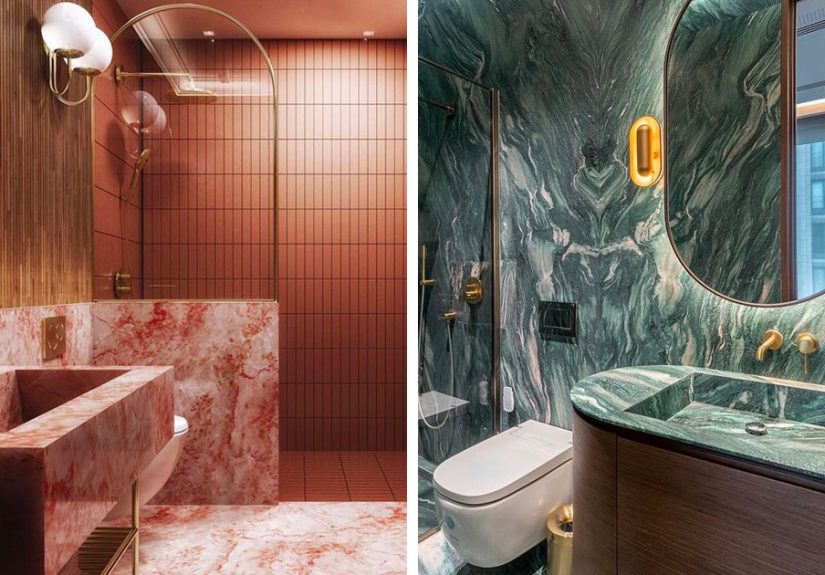
If you love a saturated look, take one tile color up the wallsespecially in a shower. Deep green, navy, terracotta, or smoky
charcoal can feel cozy and dramatic when balanced with lighter fixtures and good lighting.
- Best for: Powder rooms, moody spa bathrooms, statement showers
- Pro tip: Keep grout close in color to avoid a “grid” effect unless that’s your intentional aesthetic.
18) Mixed Shapes, Same Color (A Quiet Way to Add Depth)
Use different tile shapes in the same color familyfor example, a white subway wall tile paired with a white hex floor tile.
The variation comes from geometry, not chaos. It’s subtle, textured, and timeless.
- Best for: Anyone who wants personality without loud colors
- Pro tip: Repeat one finish (all matte or all glossy) for cohesion.
19) A Contrasting Shower Niche That Becomes the “Jewelry”
A shower niche is functional storagebut it can also be a design moment. Tile it differently than the shower walls: a mosaic,
a darker shade, a glossy accent, or a pattern. Frame it with a trim detail for a crisp, finished look.
- Best for: Showers that need a focal point
- Pro tip: Pick one accent tile and repeat it elsewhere (a vanity backsplash, a small strip) so it feels intentional.
20) Linear Drain + Large-Format Shower Floor Tile (Sleek and Modern)
Traditional center drains require a slope from multiple directions, which often makes small mosaic tiles easier on shower
floors. A linear drain can allow a single-plane slope, opening the door to larger-format tile on the shower floor for a sleek,
modern look. It’s a “pro-level” detail that can totally change the vibe.
- Best for: Contemporary bathrooms, curbless showers, minimalist design
- Pro tip: Work with an experienced installerdrain placement and slope details matter.
Bonus: How to Mix Wall Tile and Floor Tile Without Making It Weird
Mixing bathroom wall tile and bathroom floor tile is where great design happens. It’s also where perfectly nice people end up
staring at their renovation like, “Why does this feel slightly… loud?” Here are three easy formulas that work:
- Formula A (Calm + Character): Neutral large-format walls + patterned floor tile (terrazzo, checkerboard, or geometric).
- Formula B (Statement Wall): Bold shower wall tile + simple floor tile in a coordinating color.
- Formula C (Texture Play): Same color family everywhere, but different shapes (subway walls + hex floors).
Practical “Don’t Regret It Later” Notes (Because Tile Is a Commitment)
Shower floor tile size and slope
Shower floors must slope to the drain, and smaller tiles (often mosaics) conform more easily to that slope with fewer awkward
cuts. If you want a larger tile on the shower floor, talk to your installer earlydrain type and slope strategy can make or
break the result.
Pick grout like you pick jeans: for real life
White grout is beautiful, but it’s also honest. Very honest. If your bathroom gets heavy use, consider a slightly deeper
grout tone, or explore higher-performance grout options for wet areas. Your future selfholding a scrub brushmay write you
a thank-you note.
Experiences and Lessons Learned From Real Bathroom Tile Projects (Extra 500+ Words)
If you’ve ever renovated (or even just watched someone renovate), you know the tile decisions are where confidence goes to
“take a quick walk” and sometimes never returns. After reviewing countless bathroom tile design ideas and the common pain
points homeowners talk about, a few experience-based lessons show up again and againno matter the style, budget, or whether
the bathroom is tiny or spa-sized.
First: tile samples are not optional. People frequently fall in love with a tile under showroom lighting, then bring it home
and realize it reads cooler, darker, glossier, or busier in their actual bathroom. The most common surprise is how grout lines
change everything. A tile that looked soft and calm can suddenly look like graph paper once it’s installed with contrasting
grout. On the flip side, some “boring” tiles become stunning when the grout blends and the surface reads as one continuous
material. The experience-based move is to sample both tile and grout. Put them in the shower, near the vanity, and on
the floor. Check morning light, evening light, and your brightest overhead setting (a.k.a. the lighting that makes everyone
look like they forgot to sleep).
Second: shower floors are their own universe. Many homeowners start with the dream of big, sleek tiles everywhereuntil they
learn the shower floor needs slope and traction. That’s why you so often see small mosaics, penny tile, or hex mosaics in
showers: they’re practical, and they can look incredible. The most satisfying projects tend to embrace this reality and make
the shower floor a design moment, not a compromise. A classic example is a calm, stone-look porcelain on shower walls paired
with a small-format mosaic in a coordinating color on the floor. It feels intentional and “high-end,” not accidental.
Third: layout is where good tile becomes great tile. Homeowners who are happiest with their finished bathrooms usually made a
few key layout decisions early: where the feature wall goes, where the tile stops (and why), and how edges are finished.
A shower niche tiled in an accent mosaic looks sharp when it’s framed cleanly and aligned with grout joints. A half-wall
wainscot looks “built-in” when the top line hits a logical height and the trim is consistent. Even simple subway tile feels
custom when the starting point is planned so you don’t end up with awkward slivers at the ceiling or corners. In other words:
the most memorable bathrooms weren’t necessarily the ones with the most expensive tilethey were the ones with the best plan.
Fourth: cleaning reality eventually arrivesso design for it. Glossy tiles can be gorgeous, but they may show water spots.
Tiny tiles can be charming, but they can mean more grout lines. Light grout can look crisp, but it may need more upkeep. The
bathrooms that stay looking “fresh” tend to use smart combinations: slip-resistant matte tile on floors, a wall tile finish
that doesn’t scream every splash, and grout colors chosen with actual household behavior in mind. (If you have kids, pets, or
a partner who believes towels are “optional décor,” plan accordingly.)
Finally: order extra tile. Tile batches can vary slightly, and it’s a pain to match later if you need repairs. A small stash
of extra tile and grout color information can turn future fixes from “full panic” into “mild inconvenience.” If you take
nothing else from these shared experiences, take this: tile is permanent enough that a little extra planning is almost always
cheaper than regret.
Conclusion
Beautiful bathroom tile design is a mix of style and strategy: choose the right scale, pick finishes that work in wet areas,
and use layout patterns to create movement (or calm). Whether you go bold with terrazzo-look porcelain, timeless with hex
floors, or artisanal with handmade-look wall tile, the best bathrooms feel cohesive, practical, and unmistakably you.