Table of Contents >> Show >> Hide
- Why Latitude and Longitude Still Matter
- Method 1: Use Digital Tools Like GPS, Google Maps, and Google Earth
- Method 2: Read a Paper Map or Topographic Map
- Method 3: Use Celestial Navigation
- Which Method Is Best?
- Tips for Getting Coordinates Right Every Time
- Conclusion
- Practical Experiences With Latitude and Longitude
Latitude and longitude sound like the kind of terms you only hear in geography class, on a ship captained by someone named Bartholomew, or while fighting with a hiking app that suddenly forgets where Earth is. But these coordinates are still one of the simplest and smartest ways to describe an exact location. Whether you are dropping a campsite pin, checking a property boundary, reading a topographic map, or pretending to be a very organized explorer, knowing how to determine latitude and longitude is a genuinely useful skill.
At their core, latitude and longitude are Earth’s built-in address system. Latitude tells you how far north or south you are from the Equator. Longitude tells you how far east or west you are from the prime meridian. Put the two together, and you can pinpoint almost any place on the planet with surprising accuracy.
The good news: you do not need to become a full-time navigator with a brass telescope and a dramatic beard. In most situations, there are three practical ways to determine latitude and longitude: with digital tools, with a paper map, or with celestial navigation. One is fast, one is dependable when the signal disappears, and one makes you feel like you deserve your own documentary.
Why Latitude and Longitude Still Matter
Before diving into the methods, it helps to know what you are actually measuring. Latitude is measured north or south of the Equator, from 0 degrees to 90 degrees. Longitude is measured east or west of the prime meridian, from 0 degrees to 180 degrees. These lines form a grid across Earth, allowing a location to be expressed as a pair of coordinates.
You will usually see coordinates written in one of three formats:
- Decimal degrees (DD): 40.7128, -74.0060
- Degrees, minutes, seconds (DMS): 40°42’46″N, 74°00’22″W
- Degrees and decimal minutes (DMM): 40°42.767’N, 74°00.367’W
All three formats can describe the same place. The only catch is that you have to keep the order and symbols straight. Latitude comes first. Longitude comes second. Swap them, and your “quick trip to the trailhead” can become “surprise, you are in the ocean now.”
Method 1: Use Digital Tools Like GPS, Google Maps, and Google Earth
The fastest way to find coordinates
If you want the easiest way to determine latitude and longitude, digital tools win by a mile. Smartphones, vehicle navigation systems, handheld GPS units, and online mapping platforms can all give you coordinates in seconds. For most people, this is the everyday method because it is fast, accessible, and accurate enough for travel, outdoor recreation, delivery locations, and general navigation.
Modern GPS works by receiving signals from satellites and calculating your position on Earth. In simple terms, your device listens to multiple satellites, measures timing differences, and uses those measurements to figure out where you are. That is why your phone can tell you exactly where you are standing while you are still trying to figure out where you parked.
How to do it
One of the easiest options is a map platform such as Google Maps. On a desktop computer, you can right-click a location on the map to reveal coordinates. If you already know a set of coordinates, you can type them into the search bar and jump straight to that location.
Google Earth gives you a little more flexibility if you want to work visually. You can display coordinates in decimal degrees, degrees-minutes-seconds, degrees-decimal-minutes, or even UTM. That makes it especially handy if you are moving between consumer maps, GIS tools, or outdoor navigation systems.
Dedicated GPS devices are also useful, especially when you are hiking, boating, overlanding, or working in areas with limited cell service. Many handheld units let you save waypoints, switch coordinate formats, and export positions for later use. If your activity involves mud, weather, steep terrain, or the possibility of dropping your device into a creek, a real GPS unit still earns its keep.
When digital tools work best
This method is ideal when you need speed and convenience. It is great for road trips, travel planning, real estate site checks, outdoor recreation, and sharing an exact point with someone else. It is also perfect when you are using satellite imagery or zoomed-in digital maps to identify a very specific location, such as a trail junction, parking lot entrance, boat ramp, or survey marker.
Common mistakes to avoid
The biggest mistake is mixing formats. A coordinate in decimal degrees does not look like one in DMS, and some apps are picky about punctuation. Another classic error is forgetting that west and south values are often negative in decimal format. That tiny minus sign may look innocent, but it can move your point thousands of miles. Also, be aware of your datum or map reference system when precision matters. Most everyday tools use WGS 84, but professional workflows may require a different setting.
Method 2: Read a Paper Map or Topographic Map
The no-battery, no-excuses method
Paper maps may not buzz, blink, or demand a software update, but they are still one of the most reliable ways to determine latitude and longitude. If you know how to read the grid, a paper map can give you coordinates even when your phone battery is clinging to life at 2 percent and making poor decisions.
Topographic maps are especially useful because they often include coordinate markings around the edges and sometimes additional grid systems such as UTM. On many USGS maps, you can use the printed coordinate information in the margins, locate your point, and interpolate the position between lines or ticks. In plain English, that means you estimate the location between marked intervals. It sounds fancier than it is.
How to determine coordinates from a map
Start by identifying the map’s coordinate system. Many maps show latitude and longitude along the border. Others include UTM tick marks or full grid lines. Once you know the system, find your point on the map and read the nearest coordinate references on the edges. Then estimate the point’s position between them.
For example, if your location sits halfway between two longitude marks, you can estimate the midpoint value. The same goes for latitude. With practice, you can get surprisingly close. If you need more precision, a map ruler, coordinate reader, or gridded overlay helps refine the result.
This approach is especially useful on backcountry trips, fieldwork assignments, land navigation exercises, and educational settings where understanding the map matters as much as the answer. It also teaches spatial awareness in a way that digital tools often hide. A paper map forces you to think about terrain, scale, distance, and orientation instead of tapping the screen and trusting the electronic wizardry.
Why topo maps are so valuable
A topographic map does more than give you coordinates. It shows contour lines, waterways, roads, landmarks, and elevation patterns. That extra detail matters when you need context. A coordinate is useful. A coordinate plus terrain awareness is useful and smart.
Paper maps are also excellent backups. Even if you prefer digital tools, carrying a printed topo map for remote trips is a wise move. It will never lose signal, overheat, or decide it needs to restart in the middle of nowhere.
The tradeoff
Map-based coordinate reading is slower than using GPS, and it takes practice. You also need the right map scale for the job. A small-scale map can help you understand the region, but it will not give the same precision as a detailed topo sheet. Still, for reliability and skill-building, this method remains a classic.
Method 3: Use Celestial Navigation
The old-school method that still deserves respect
Now we get to the glamorous one. Celestial navigation is the method of determining position by observing the Sun, Moon, stars, or planets. It is older than satellites, older than your favorite mapping app, and much harder to blame on weak Wi-Fi.
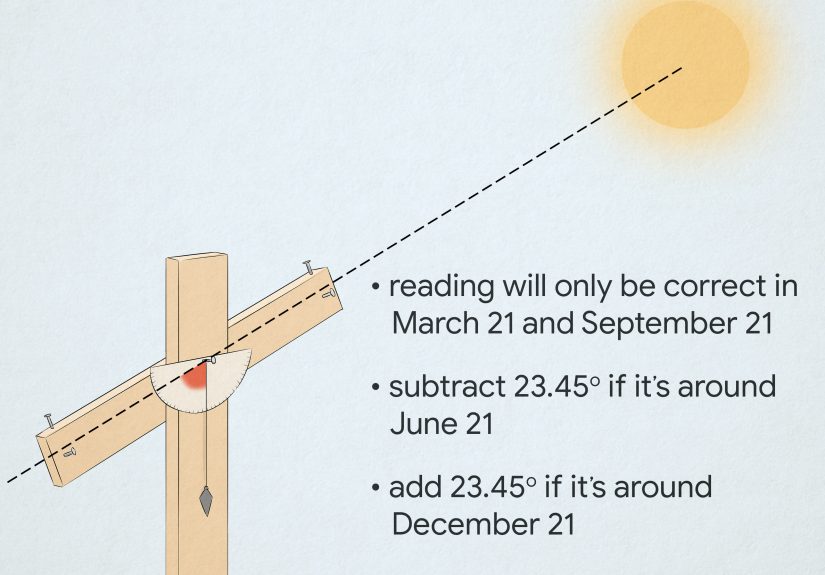
Historically, determining latitude was easier than determining longitude. In the Northern Hemisphere, the height of Polaris above the horizon gives a close approximation of your latitude. Longitude is trickier because it depends on accurate timekeeping. That was a major problem for navigators for centuries and one of the reasons marine chronometers became such a big deal.
How celestial navigation works
The basic process involves measuring the altitude of a celestial body above the horizon, often with a sextant, then comparing that observation with astronomical data. Those calculations help create a line of position. When multiple observations are combined, the lines intersect to produce a fix, which gives you latitude and longitude.
That may sound intimidating, and to be fair, it is not exactly a casual lunch-break hobby for most people. But the principle is elegant. You use the sky as your reference system. With the right tools, tables, and timing, Earth’s position under the heavens can reveal your own.
When it still matters
Celestial navigation is still relevant in maritime training, naval operations, survival education, and serious navigation practice. It is valued as an independent backup to satellite-based systems. If electronics fail, the sky keeps showing up for work.
Even if you never plan to use a sextant in real life, understanding celestial navigation gives you a deeper appreciation for how location was determined before modern technology. It also reminds you that latitude and longitude are not just numbers in an app. They are part of a long human effort to answer one stubborn question: “Where am I, exactly?”
Which Method Is Best?
| Method | Best For | Main Strength | Main Limitation |
|---|---|---|---|
| Digital tools and GPS | Everyday use, travel, outdoor recreation | Fast and convenient | Depends on device power and settings |
| Paper maps and topo maps | Backcountry travel, fieldwork, backup navigation | Reliable and battery-free | Requires practice and interpolation |
| Celestial navigation | Maritime backup, training, advanced navigation | Works independently of satellites | Complex and time-sensitive |
If your goal is everyday convenience, digital tools are the winner. If your goal is resilience, paper maps are essential. If your goal is mastering the deeper art of navigation, celestial navigation is the gold-star method that separates casual map users from people who probably own a sextant and know where it is.
Tips for Getting Coordinates Right Every Time
- Always enter latitude first, then longitude.
- Check the format: DD, DMS, or DMM.
- Do not forget negative values for west and south in decimal degrees.
- When precision matters, verify the datum or coordinate reference system.
- Carry a backup method if you are traveling in remote areas.
- Practice reading coordinates before you actually need them under pressure.
Conclusion
Knowing how to determine latitude and longitude is one of those skills that feels oddly impressive and turns out to be genuinely practical. You can do it the modern way with GPS and digital maps, the dependable way with a paper topographic map, or the legendary way with celestial navigation. Each method has a different personality, but all three lead to the same result: an exact place on Earth described with clarity.
If you only use one method, digital mapping will likely cover most of your needs. But if you want to be prepared, confident, and just a little harder to get lost, it is worth learning the map-based method too. And if you want to impress everyone at the campsite, learn enough celestial navigation to casually mention Polaris and watch the room go quiet.
Practical Experiences With Latitude and Longitude
In real-world situations, the value of coordinates becomes obvious very quickly. Hikers often discover this first. A trail app may show a dot on the screen, but when the trail forks, signage disappears, and the tree cover thickens, the actual coordinates become more useful than a vague blue blob. A saved waypoint for a trailhead, water source, or campsite can make the difference between a calm return and an awkward extra hour of wandering while pretending you are “just exploring.”
Boaters and paddlers have similar experiences. On the water, landmarks can look different from every angle, and shorelines are not always as helpful as they seem. Coordinates are clean, precise, and easy to share. If a marina, dock, fishing spot, or hazard is saved correctly, getting back to it is much easier. That is one reason marine navigation still treats coordinates with great respect. Water has a way of punishing casual guesses.
Travelers also benefit more than they expect. In rural areas or developing locations, a street address can be vague, inconsistent, or flat-out unhelpful. A host might say, “Turn left at the old store, then keep going until you see a yellow gate,” which is charming but not exactly surgical. Coordinates solve that problem. They cut through unclear directions and let you arrive where you intended, not three farms over.
Field professionals use latitude and longitude constantly. Survey teams, environmental researchers, inspectors, utility crews, and search-and-rescue personnel rely on coordinates because they create a common language. Instead of arguing over which “big hill” or “north entrance” someone means, a coordinate gives an exact reference point. That precision saves time, reduces mistakes, and improves communication between teams using different maps or devices.
Even in everyday life, coordinates quietly show up more often than people notice. They are used in ride-sharing systems, weather mapping, real estate platforms, drone planning, geotagged photos, emergency response, and outdoor recreation apps. Many people use them without thinking about them. Learning how to read and determine them simply removes the mystery. Suddenly, the numbers are no longer abstract. They are understandable, usable, and practical.
There is also a confidence boost that comes with knowing more than one method. When people rely only on a phone app, location can feel like magic until the magic fails. But once you understand how coordinates work on a map and how they relate to the real world, navigation becomes less fragile. You are no longer just following directions. You are interpreting space.
That is really the best experience of all. Latitude and longitude turn the world from a vague backdrop into something measurable and readable. They help you move through unfamiliar places with more control, more accuracy, and a lot less guesswork. And honestly, there is something deeply satisfying about looking at a set of coordinates and knowing they are not random numbers. They are a precise answer to one of humanity’s oldest questions: where, exactly, am I?