Table of Contents >> Show >> Hide
- What Counts as “Silent Horror” Here?
- 10. Le Manoir du Diable (1896)
- 9. Bluebeard (1901)
- 8. The Haunted Curiosity Shop (1901)
- 7. The Infernal Cauldron (1903)
- 6. Frankenstein (1910)
- 5. L’Inferno (1911)
- 4. Dr. Jekyll and Mr. Hyde (1912–1920)
- 3. The Student of Prague (1913)
- 2. The Avenging Conscience (1914)
- 1. The Cabinet of Dr. Caligari (1920)
- How to Watch These Silent Horrors Without Falling Asleep
- Experiences and Takeaways from Exploring the Oldest Silent Horror Movies
Before chainsaws, jump scares, and orchestras blasting your eardrums, horror was eerily quiet.
In the early days of cinema, filmmakers had no synchronized sound, no digital effects, and no
ratings board to blame things on. All they had were painted sets, practical tricks, and the
unnerving power of suggestion. The result? Some of the strangest, most imaginative horror movies
ever put on film and a handful of them are still with us more than a century later.
The phrase “horror movie” didn’t really take off until the 1930s, but the roots of the genre go
all the way back to the 1890s. Short “trick films” used camera magic to conjure ghosts, demons,
skeletons, and other supernatural weirdness long before anyone heard Dracula hiss on screen.
Many of those fragile reels have been lost or destroyed, yet a surprising number survive
cleaned up, restored, and ready to creep out modern audiences who thought black-and-white meant “boring.”
This list rounds up ten of the oldest surviving silent horror movies that you can still watch today.
They range from three-minute devil sketches to full-length nightmares that paved the way for
everything from film noir to modern psychological horror. Think of it as a horror-history field trip,
only with more demons and fewer permission slips.
What Counts as “Silent Horror” Here?
Because early filmmakers weren’t labeling their work as “horror,” historians usually look for certain
ingredients: supernatural beings, gothic settings, macabre violence, psychological terror, or
imagery built to disturb instead of just amuse. Some of the films below mix horror with fantasy or
even slapstick comedy, but their demons, murders, ghosts, and downright hellscapes earn them a place
in the horror family tree.
We’ll move from the late 1890s up to 1920, stopping at landmark titles that still exist in some form
today. If you’re a fan of Nosferatu and The Phantom of the Opera, this is the older,
weirder crowd they hang out with at family reunions.
10. Le Manoir du Diable (1896)
The devil, a bat, and possibly the first horror movie ever
Also known as The House of the Devil or The Haunted Castle, this three-minute gem from
French filmmaker Georges Méliès is often cited as the first horror film. A bat flutters into a castle,
transforms into the demon Mephistopheles, and suddenly the screen fills with cauldrons, skeletons,
ghosts, witches, and other Halloween decorations come to life. It’s less “scream in terror” and more
“grin at the chaos,” but the DNA of cinematic horror is all here transformation, the supernatural,
and the joy of scaring people just a little.
Méliès was a magician before he was a director, and it shows. Early audiences weren’t just watching a
story; they were watching special effects wizardry at a time when most people had never even seen a
film before. The movie was believed lost for decades until a print turned up in New Zealand in the 1980s,
giving horror buffs a chance to revisit where it all (probably) began.
9. Bluebeard (1901)
A fairy tale becomes a proto-serial killer story
Méliès returned to the macabre with Bluebeard, adapting Charles Perrault’s fairy tale about a
rich nobleman whose wives keep mysteriously “disappearing.” On screen, this turns into a surprisingly
grisly moral fable. Bluebeard hands his new bride a key and forbids her from opening one particular room.
Naturally, she opens it the moment he leaves and discovers the bodies of his previous wives hanging from hooks.
Technically it’s still a fantasy film, packed with theatrical staging and playful tricks, but the
imagery of a secret murder chamber feels startlingly modern. If you’ve ever watched a true-crime documentary
and thought, “Wow, this is messed up,” Bluebeard is basically your great-great-grandparent in cinematic form.
8. The Haunted Curiosity Shop (1901)
When your inventory starts haunting you
Directed by British filmmaker Walter R. Booth, The Haunted Curiosity Shop is what happens when
a magician and an antique store get thrown into a blender. An elderly shopkeeper is tormented by his own
merchandise as skeletons, disembodied heads, and ghostly figures appear, vanish, and transform in rapid-fire
succession. It’s essentially a live-action haunted house attraction in under three minutes.
Booth came from the world of stage magic, and the film is basically an excuse to show off visual tricks:
substitution splices, jump cuts, and clever in-camera effects. There’s no blood, no stabbing, and no
screaming victims, but the sense of objects turning against their owner taps into a fear that horror
still loves the feeling that the everyday stuff around you is suddenly not on your side.
7. The Infernal Cauldron (1903)
Hand-painted hellfire and a very bad day for three victims
Méliès again dives into demonic territory with The Infernal Cauldron. A horned demon tosses
victims into a boiling cauldron, jets of fire explode, and the unlucky souls reappear as glowing ghosts
who torment their tormentor. The surviving prints are hand-colored, meaning each frame was painstakingly
painted, giving the flames and spirits a vivid, otherworldly glow.
Beyond the spectacle, this short is a neat early example of cosmic justice: the villain ends up getting
a taste of his own cauldron. It’s barely over a minute long, but the combination of color, fantasy, and
punishment-from-beyond-the-grave sets a tone that later horror films would echo on a much larger scale.
6. Frankenstein (1910)
Thomas Edison’s surprisingly weird monster movie
Long before Universal Pictures gave us the flat-headed, bolt-necked creature, Edison’s studio produced a
loose, 12-minute adaptation of Mary Shelley’s Frankenstein. Instead of elaborate lab equipment,
we get a cramped chamber where the creature appears to grow out of a bubbling mass of organic goo
a sequence that still looks bizarre and unsettling over a century later.
The film softens the novel’s themes and wraps things up with a more sentimental resolution, but it was
controversial enough in its day to prompt worries about “shocking” audiences. For decades, it seemed
lost, until a private collector revealed a surviving print in the 1980s. Today you can watch it and
see some of the earliest cinematic attempts to visualize man-made monstrosity no CGI required.
5. L’Inferno (1911)
Dante’s hell as a full-blown horror spectacle
Italy’s L’Inferno isn’t just an early horror-adjacent movie; it’s one of cinema’s first feature-length
hits. Running over an hour, it adapts the “Inferno” section of Dante’s Divine Comedy, marching its
protagonist through circles of hell filled with demons, giants, damned souls, and some frankly ambitious
special effects for 1911.
Audiences at the time were stunned. The film was a major international success and reportedly earned more
than $2 million in the United States alone a massive figure for its era. With its elaborate sets and
painterly tableaus inspired by Gustave Doré’s illustrations, L’Inferno plays like a collision
between horror, religious art, and nightmare fuel. You don’t just watch it; you feel like you’re touring
a very old, very unsettling art installation.
4. Dr. Jekyll and Mr. Hyde (1912–1920)
Multiple doubles, one enduring horror archetype
Robert Louis Stevenson’s tale of split personality was catnip for early filmmakers. Between 1908 and 1920,
more than ten different adaptations of Dr. Jekyll and Mr. Hyde hit the silent screen. Some of the
earliest versions are now lost, but survivors from 1912 and 1913 show how directors used simple makeup and
editing tricks to convey transformation from respectable doctor to murderous alter ego.
The most famous silent take is the 1920 version starring John Barrymore, whose contorted facial expressions
and physical performance do much of the work that later films would hand off to special effects teams. These
silent versions cemented the “respectable by day, monstrous by night” trope that horror and superhero stories
still lean on heavily. Every time a character says, “I’m not myself lately,” they owe a little debt to Jekyll and Hyde.
3. The Student of Prague (1913)
When you literally lose yourself in a deal with the devil
The Student of Prague follows Balduin, a poor student who makes a Faustian bargain with a mysterious
stranger. In exchange for wealth, the stranger claims something from his room and casually walks off with
Balduin’s reflection from the mirror. Soon, a doppelganger stalks the city, ruining Balduin’s life and
sabotaging his attempts at love.
This German film is often described as one of the first major art films and a key precursor to German
Expressionism. The dual-role trick photography, eerie doubles, and themes of identity, guilt, and the uncanny
had a massive influence on later horror and psychological thrillers. If you’ve ever watched a movie where
a character is haunted by their darker self, this is one of the earliest cinematic blueprints.
2. The Avenging Conscience (1914)
Edgar Allan Poe gets the full nightmare treatment
Directed by D. W. Griffith, The Avenging Conscience mixes elements of Poe’s “The Tell-Tale Heart”
and “Annabel Lee” into a story about a young man who murders his overbearing uncle and then slowly loses
his sanity. As his guilt grows, he’s plagued by visions, hallucinations, and ghostly apparitions all
rendered with inventive superimpositions and symbolic imagery.
It’s part crime story, part psychological horror, and part moral lesson about what happens when you try
to wall up your problems (and your relatives) instead of dealing with them. The movie also shows how quickly
silent cinema moved from simple tricks to complex inner lives; the real monster here isn’t a demon or a
vampire, but the human conscience itself chewing away at the protagonist’s mind.
1. The Cabinet of Dr. Caligari (1920)
The crooked masterpiece that rewired horror
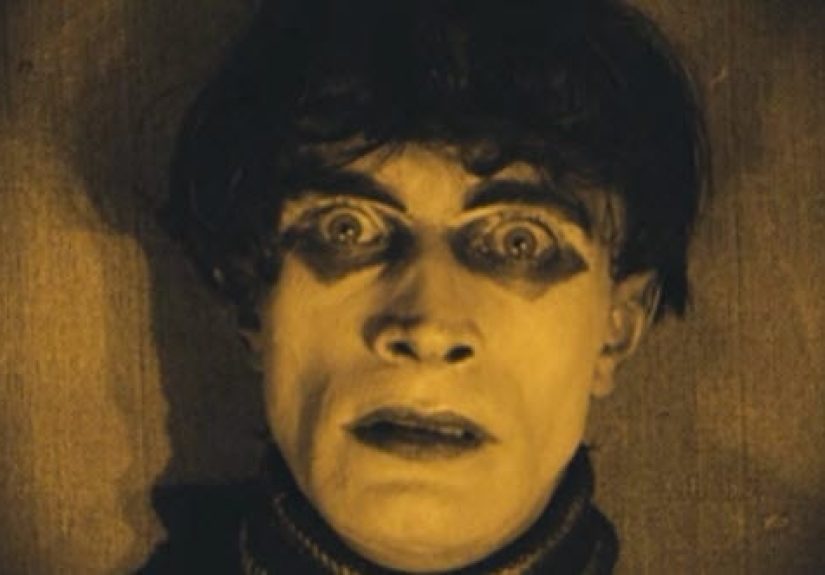
If early silent horror was a laboratory, The Cabinet of Dr. Caligari is the experiment that
escaped and took over the genre. Set in a small town plagued by murders, the film centers on a sinister
showman, Dr. Caligari, and his somnambulist, Cesare, who supposedly sleeps in a coffin-like cabinet and
can predict the future. Things go very badly from there.
What makes the film legendary is its visual style. Buildings tilt at impossible angles, shadows are painted
directly onto the sets, and even windows and streets look like they were designed by someone who had a
heated argument with geometry. That warped world reflects the story’s focus on insanity, manipulation,
and unreliable perception. Scholars still argue about whether this is the first “true” horror film, but
everyone agrees it had a huge impact on everything from film noir to modern psychological thrillers.
Watching Caligari today still feels like stepping into a fever dream one that quietly whispers,
“Are you sure you can trust what you’re seeing?” A century later, that question remains one of horror’s
favorite tools.
How to Watch These Silent Horrors Without Falling Asleep
Let’s be honest: if your idea of a “slow burn” horror movie is something from the 2000s, a three-minute
Méliès short might feel like someone’s very elaborate TikTok cosplay. But these films are easier to enjoy
once you tweak how you watch them.
- Treat them like visual theater, not modern movies. Early filmmakers thought in terms of
stage tableaux. Instead of rapid editing, you get carefully composed scenes. Give yourself permission to
just sit with the image and soak in the details. - Experiment with music. Many public-domain versions come with new scores, but you can also
try different soundtracks classical, ambient, or even slow, eerie electronic music. Silent films change
personality depending on what you play underneath. - Watch in short bursts. The early films on this list are only a few minutes long. Pair a few
together as a “silent horror sampler” instead of forcing yourself through a marathon of slow pacing if
you’re new to older cinema. - Lean into the weirdness. Painted shadows, theatrical acting, and elaborate costumes may
feel exaggerated. That’s the point. You’re not just watching old movies; you’re watching people invent the
language of horror in real time.
Experiences and Takeaways from Exploring the Oldest Silent Horror Movies
Spending time with these early silent horror films is less like binge-watching a modern franchise and more
like wandering through a haunted museum. Each title feels like an exhibit some tiny and playful, some huge
and overwhelming and together they map out how fear slowly learned to speak the language of cinema.
One of the first things viewers usually notice is just how physical these movies are. Without spoken
dialogue, actors rely on exaggerated posture, facial expressions, and gesture. In Frankenstein (1910),
the creature’s jerky movement and clawing motions convey discomfort and monstrosity far better than any
jump scare could. In The Cabinet of Dr. Caligari, Cesare’s sleepwalking glide across the screen feels
more like a living shadow than a person in makeup. The horror lives in bodies, not in sound design.
Another surprise is just how inventive the visuals are. Modern audiences tend to assume older equals “simpler,”
but the opposite is often true. Méliès and Booth were pulling off multi-layered illusions, double exposures,
and hand-colored flames at a time when film stock itself was experimental. Watching The Infernal Cauldron
with its painted bursts of fire or L’Inferno with its towering demons and swirling circles of the damned
can feel oddly more imaginative than some modern CGI-heavy blockbusters. With limited tools, every effect had to be
carefully planned and crafted.
There’s also a very specific kind of creepiness that comes from the age of these films. The flicker of
damaged prints, the slightly uneven frame rates, and the occasional missing frames all contribute to a
feeling that you’re peeking into a world that wasn’t meant to survive this long. Seeing actors in 1896
dress up as devils and skeletons, knowing everyone on screen is long gone, gives the imagery an extra
layer of ghostliness. The movies themselves become haunted objects.
For horror fans used to modern pacing, the key is reframing expectations. Instead of asking, “Is this scary by
today’s standards?” try asking, “What were these filmmakers trying to do with the tools they had?” The Student
of Prague might not make you jump out of your seat, but the concept of literally losing your reflection and
watching it walk off to ruin your life taps into the same identity fears that fuel today’s psychological horror.
There’s also a lot of pleasure in tracing influences. The painted shadows and twisted sets of
Caligari echo in later film noir and even in the way some modern horror shows nightmarish mental states.
The guilt-ridden hallucinations in The Avenging Conscience foreshadow countless stories in which murderers
are haunted by what they’ve done. L’Inferno’s grand depiction of hell pops up again every time a filmmaker
tries to visualize damnation as more than just a generic fiery cave.
Finally, watching these films can reconnect you with the playful side of horror. Early audiences weren’t necessarily
expecting to be traumatized; they wanted to be amazed, spooked, and entertained. When Méliès makes a skeleton
appear and vanish or when a gaudy devil trips over his own theatrics, you’re reminded that horror has always had
a mischievous streak. That balance between fear and fun is something modern horror sometimes forgets, and it’s
refreshing to rediscover it in grainy black-and-white.
If you’re building a horror watchlist, sprinkling in a few of these silent-era relics adds depth and context to
everything else you love. They won’t replace your favorite modern scream-fests, but they’ll give you a richer sense
of where the genre came from and more than a few images that will stubbornly linger in your mind long after the
closing title card fades to black.