Table of Contents >> Show >> Hide
- 1) Grommet-Top Curtains (Especially the Shiny Silver Kind)
- 2) Overly Ornate Valances and Swags (The “Wedding Cake” Topper)
- 3) Fussy Ruffles and Balloon-Style Top Treatments
- 4) Curtains That Are Too Short (AKA “High-Waters for Your Windows”)
- 5) Exposed, Skinny, Super-Obvious Hardware That Looks Like an Afterthought
- 6) Flat, Bare-Bones Panels With No Fullness, No Lining, and No Layering
- How to Update Your Curtains Without Starting From Scratch
- Conclusion: A Modern Window Doesn’t Need DramaJust Good Styling
- Real-World Experiences With Outdated Curtain Styles (And What People Learn Fast)
Curtains are basically your home’s eyeliner: when they’re right, everything looks lifted, expensive, and mysteriously well-rested.
When they’re wrong, the room can feel a little… “I still have a landline.” And to be fair, curtain trends move quietly.
One day your window treatments are doing the most in a good way; the next day they’re doing the most like a soap opera close-up.
The good news: updating curtains is one of the fastest ways to make a space feel current without remodeling anything or selling a kidney.
The even better news: you don’t have to banish every “dated” detail forever. Designers aren’t the Curtain Police (usually).
But certain styles tend to read old-fashioned because they look mass-produced, interrupt the room’s proportions, or feel overly fussy compared to today’s cleaner,
more tailored vibe.
Below are six curtain styles designers commonly flag as outdatedand what to do instead if you want your windows to look intentional, polished,
and like they definitely have their life together.
1) Grommet-Top Curtains (Especially the Shiny Silver Kind)
Why designers say it dates a room
Grommet-top curtains (those metal-ring holes that slide straight onto the rod) are convenient, sure. They’re also one of the quickest ways to make a room feel
“builder-grade.” The rings often read mass-produced, and the fabric tends to hang in rigid, repetitive foldslike it’s trying to be elegant but can’t stop
thinking about the return policy.
Try this instead
If you want a more elevated look, go for a tailored header: pinch pleats, tailored pleats, inverted pleats, or ripple fold. These styles create consistent,
soft waves and make even affordable fabric feel more custom. Bonus: they stack back neatly when open, so your window doesn’t look like it’s wearing a scrunchie.
Quick fix if you already own them
If replacing isn’t in the budget, you can sometimes “upgrade the vibe” by hanging panels from drapery rings and hooks (instead of feeding the rod through the
grommets). It won’t magically turn them into couture drapery, but it can soften the look and improve how they hang.
2) Overly Ornate Valances and Swags (The “Wedding Cake” Topper)
Why designers say it dates a room
Heavy valances, swags, jabots, tasselsanything that looks like it required a team of seamstresses and a soundtrackcan make a room feel visually crowded.
These styles often block natural light and pull attention to the top of the window in a way that feels more “formal dining room, 1996” than “fresh and airy.”
Try this instead
If you love a top treatment (and you’re not alone), choose a simplified version: a tailored valance, a clean cornice, or a banded valance in a modern fabric
and pattern. Another popular swap is a Roman shade paired with simple side panelsstill layered, still cozy, but much less “I came with matching wallpaper.”
Quick fix if you already own them
Remove the extra layers (tassels, cascades, dramatic side jabots) and keep just a streamlined valance. Or repurpose the fabric as a café curtain in a kitchen,
where a little charm looks intentional.
3) Fussy Ruffles and Balloon-Style Top Treatments
Why designers say it dates a room
Ruffles and balloon valances can skew “country cute” fasteven in rooms that aren’t trying to cosplay as a quaint B&B. The extra gathers add bulk at the
window, and in many modern homes (open plans, simpler trim, taller ceilings), that bulk can feel out of scale.
Try this instead
If you like softness, keep itbut simplify it. Think: flat panels in a textured fabric, a relaxed Roman shade, or a café curtain with crisp hems.
Want some romance without the frills? Add a subtle trim, banding, or a small-scale pattern rather than literal ruffles.
Quick fix if you already own them
Pair a “cute” top treatment with cleaner surroundings: solid side panels, modern hardware, and minimal decor nearby. It’s the styling equivalent of wearing
a vintage blouse with modern jeansstill you, just updated.
4) Curtains That Are Too Short (AKA “High-Waters for Your Windows”)
Why designers say it dates a room
Curtains that hover several inches above the floor can make ceilings look lower and the window look smaller. It’s one of those tiny details your brain notices
even if you don’t. The room ends up feeling slightly unfinishedlike someone paused the decorating mid-step to answer the door and never came back.
Try this instead
Most designers prefer panels that either “kiss” the floor (a clean, tailored look) or skim just above it for practicalityespecially in high-traffic homes.
If you love drama, a slight puddle can work in more traditional spaces, but it should look intentional, not accidental.
Quick fix if you already own them
- Hang the rod higher and use rings to drop the panels a bit.
- Add a coordinating fabric band at the bottom (it can look like custom trim).
- Swap to longer panelsmany off-the-shelf curtains come in extra lengths that instantly improve proportions.
5) Exposed, Skinny, Super-Obvious Hardware That Looks Like an Afterthought
Why designers say it dates a room
Curtain hardware can absolutely be decorativebut “exposed hardware” becomes a problem when it looks cheap or overly busy: thin rods, flashy finishes,
clunky brackets, and finials that scream “I was popular when flat-screen TVs were 32 inches.” When the hardware dominates in a not-cute way, it drags the whole
window treatment down.
Try this instead
For a modern look, many designers prefer either low-profile rods with clean lines or drapery tracks that practically disappear.
If you want the rod to be a feature, go intentional: a thicker rod, warm metals, wood tones, or a finish that complements your lighting and cabinet hardware.
“Purposeful” is the goal. “Last-minute” is the enemy.
Quick fix if you already own them
Upgrade only the rod and brackets (often cheaper than new curtains). Even basic panels look better on sturdier hardware with a finish that matches the room.
6) Flat, Bare-Bones Panels With No Fullness, No Lining, and No Layering
Why designers say it dates a room
One skinny panel per side, unlined, with fabric so thin it looks permanently tiredthis is the curtain equivalent of a flimsy paper plate at a dinner party.
It works, technically, but it doesn’t feel finished. When curtains lack fullness, they don’t drape; they cling. And when they’re unlined, they can look
wrinkly, see-through, and less substantial.
Try this instead
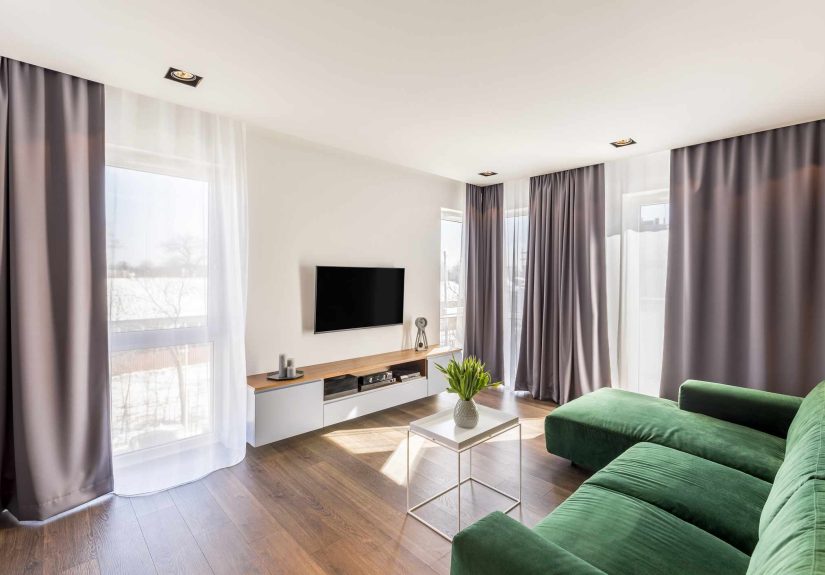
Aim for generous width and a more layered effect. Designers often recommend total curtain width that’s about 2 to 2.5 times the window width for a rich,
gathered look when closed. Add lining (blackout or privacy lining) to improve drape and longevity. Consider layering: a sheer underneath for daytime light and
privacy, plus a heavier panel for evening coziness.
Quick fix if you already own them
- Add more panels (yes, more fabric is often the “expensive” secret).
- Use a double rod to layer sheers behind what you already have.
- Try clip rings to help train the fabric into nicer folds.
How to Update Your Curtains Without Starting From Scratch
Hang them higher and wider
This is the fastest illusion trick in home design: mount the rod higher than the window frame (often closer to the ceiling) and extend it wider than the window
so panels can sit mostly on the wall when open. Result: windows look larger, ceilings look taller, and the room instantly feels more “designed.”
Choose a “quiet luxury” fabric strategy
You don’t have to buy rare unicorn linen woven by moonlight. But you do want fabric with some body: linen blends, cotton velvet, textured weaves,
performance fabrics that don’t wrinkle at the sight of humidity. If you love neutrals, pick them with intentionwarm whites, sandy beiges, soft taupes,
muted olivesplus texture so it doesn’t read flat.
Add trim like you mean it
A simple border (tape trim, banding, or contrast edge) can make curtains look custom. This works especially well if your panels are plain but the room needs
a little personality. The secret is restraint: one great detail beats twelve “cute” ones.
Decide what you want the curtains to do
Are you blocking light, adding privacy, softening acoustics, or just framing a view? Your function affects your style:
blackout lining for bedrooms, sheers for living spaces, café curtains for kitchens, and layered solutions for rooms that do everything at once.
When function and style align, your windows look intentionalnot accidental.
Conclusion: A Modern Window Doesn’t Need DramaJust Good Styling
If your curtains are giving “outdated,” it’s rarely because curtains are inherently uncool. It’s usually the details: clunky grommets,
overly ornate toppers, ruffles that overpower the room, awkward lengths, hardware that looks like a placeholder, or panels that feel too skimpy to finish the job.
The modern alternative isn’t “no curtains forever”it’s tailored headers, better proportions, richer texture, and layering that looks effortless (even if you
definitely measured three times and whispered a small prayer while drilling).
Start with the easiest win: correct length and better rod placement. Then upgrade header style, fullness, and fabric. Little changes at the window have a big
ripple effectbecause when your windows look polished, the whole room suddenly looks like it got a raise.
Real-World Experiences With Outdated Curtain Styles (And What People Learn Fast)
One of the most common “curtain wake-up calls” happens right after a move. Someone buys a home that’s otherwise adorablegreat floors, good light, decent paint
and then they notice the windows. The living room is wearing heavy swags like shoulder pads for glass. The bedroom has grommet panels with shiny rings that
reflect light like tiny mirrors. The kitchen valance is gathered into a pouf that looks suspiciously like it has its own opinion about your life choices.
It’s not that any of it is offensive; it’s that the room instantly feels locked into a specific era.
In rentals, the experience is often the opposite problem: the curtains are minimal to the point of sadness. Thin panels, too narrow, hung too low,
and stopping three inches above the floor like they’re afraid of commitment. People usually describe the space as “fine, but not finished.” The moment they
hang longer panels and raise the rod, the room feels taller and calmerlike it finally exhaled. Even if the furniture stays exactly the same,
that one change can make the place feel less temporary.
Another frequent story: the “I thought neutrals were safe” moment. Someone picks plain beige curtains to avoid making a mistakeonly to discover the curtains
don’t add warmth or elegance. They add… nothing. In photos, the panels disappear into the wall. In real life, they look a bit like showroom placeholders.
The fix people love most isn’t always bold color; it’s texture and depth. A lined fabric with a gentle weave, a soft stripe, a subtle trim,
or a layered sheer behind it adds dimension without turning the room into a circus. The space still feels calmjust more considered.
Homes with pets and kids bring a different kind of realism. Floor-kissing curtains look gorgeous, until your dog treats them like a napkin after drinking water.
That’s when people learn the difference between “designer perfect” and “designer practical.” A slight skim above the floor can be the sweet spot:
polished, but not constantly collecting fur, dust, and mystery stains. And if blackout curtains are needed for sleep, many households discover layering is the
real herosheers for daytime, heavier panels at nightbecause you can get privacy and light without living in a cave.
Then there’s the “hardware regret” experience. People will spend time choosing fabric, color, and length… and then grab the cheapest rod available.
Suddenly, the whole window looks wobbly, the panels snag, and the finials feel like costume jewelry. Upgrading hardwareeven just to a sturdier rod in a finish
that matches the roomoften makes the existing curtains look better overnight. It’s the sneaky lesson: the rod isn’t just a tool; it’s part of the outfit.
Finally, many curtain makeovers end with a surprisingly emotional win: the room starts to feel more “theirs.” Outdated styles can make a home feel inherited,
staged, or stuck. When people switch to a tailored header, improve fullness, and get the length right, the windows stop competing with the room and start
framing it. The space feels intentionallike someone is steering the ship. And for a home, that’s the whole point.