Table of Contents >> Show >> Hide
- It Started as a Great Tank Family, Then the M1A1 Turned the Volume Up
- Firepower: The 120 mm Gun Changed the Whole Mood
- Protection: The M1A1 Was Built to Keep Crews Alive
- Mobility: The Heavyweight That Moved Like It Had a Grudge
- The Real Secret: The M1A1 Was a System, Not Just a Tank
- Combat Reputation: Desert Storm, Baghdad, Fallujah, and Beyond
- Urban Warfare Upgrades Made the M1A1 Even Meaner
- Badass Does Not Mean Perfect
- Why the M1A1 Still Feels Legendary
- Real-World Experience: Why Crews and Observers Remember the M1A1 So Vividly
- Conclusion
Note: This is clean, publish-ready HTML body content in American English. Inline citations and source URLs are intentionally omitted for easier web publishing.
Some military machines earn respect. The M1A1 Abrams earns mythology. It is the kind of tank people talk about with a grin, a raised eyebrow, and the sort of tone usually reserved for muscle cars, heavyweight boxers, and that one friend who somehow wins every argument without ever sounding rushed. The M1A1 Abrams is not famous because it looks cool in photos, though it absolutely does. It is famous because it combined brutal firepower, serious protection, shocking speed for something so massive, and a battlefield reputation that made enemies nervous and crews confident.
And that, really, is the heart of the Abrams mystique. The M1A1 is not “badass” in the cartoon sense. It is badass in the engineering sense. It was built to hit hard, survive punishment, move faster than a vehicle that size has any business moving, and keep its crew alive long enough to do all of that again. In military hardware, that is the difference between a machine that looks impressive on a brochure and one that becomes a legend in field manuals, war stories, and armored-unit culture.
It Started as a Great Tank Family, Then the M1A1 Turned the Volume Up
The Abrams family first entered service in 1980, but the M1A1 is the version that really gave the platform its heavyweight reputation. By the mid-1980s, the U.S. Army had taken the original formula and made it meaner. The M1A1 brought in the 120 mm smoothbore cannon, improvements to armor, and an upgraded nuclear, biological, and chemical protective system. In plain English, it got a bigger punch, better protection, and more confidence in awful environments. That is not a tune-up. That is a glow-up with a steel attitude.
What made the M1A1 special was that it did not improve just one thing. A lot of military vehicles are basically compromise machines on tracks, wheels, or wings. They do one thing brilliantly and ask everyone else to politely ignore the downside. The M1A1 was different. It was designed as a total package. Firepower, mobility, protection, optics, and crew survivability were all treated like priorities, not afterthoughts. That is why the tank’s reputation stuck. It did not win admiration with a single flashy gimmick. It won it by being frighteningly complete.
Firepower: The 120 mm Gun Changed the Whole Mood
A bigger gun, a bigger statement
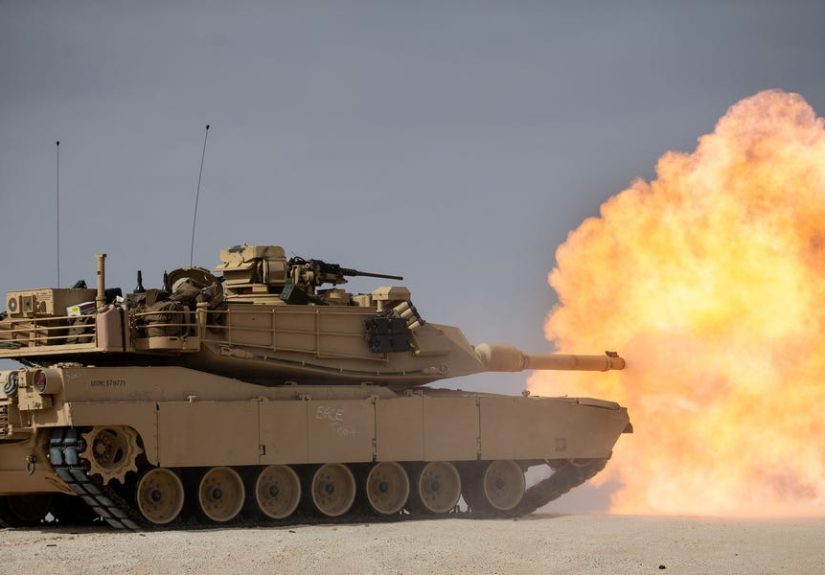
The M1A1’s 120 mm smoothbore cannon is one of the biggest reasons the tank still gets talked about like a legend. When that gun replaced the earlier 105 mm setup, the Abrams was no longer just a strong Western tank. It became a platform that screamed overmatch. Against opposing armor, the message was simple: the M1A1 was built to end the conversation first.
But raw caliber is only part of the story. Tanks are not judged by brochure stats alone. A gun matters because of what it can actually do under pressure, while moving, in lousy visibility, with stress doing cartwheels in the crew compartment. This is where the Abrams became genuinely intimidating. Its fire-control system, stabilization, and optics helped crews shoot accurately on the move and engage at long range. In practical terms, that meant the M1A1 was not just heavily armed. It was heavily armed and unusually good at putting that firepower where it needed to go.
It could fight when conditions got ugly
Night, smoke, dust, poor visibility, fast movement, battlefield chaos; the M1A1 was built for all of it. Thermal sighting gave crews the ability to detect and engage targets in conditions that made older tanks feel half-blind. This was a huge deal. A tank that can see clearly when the battlefield gets messy is a tank that controls tempo. The M1A1 did not need a perfect day. It did not need postcard weather. It just needed a mission.
That capability mattered enormously in real combat. One of the recurring lessons from Abrams service is that the tank’s combination of gun, stabilization, and sighting let crews start engagements earlier and with greater confidence. That is the kind of advantage that changes outcomes fast.
Protection: The M1A1 Was Built to Keep Crews Alive
Here is where the Abrams became more than just a bruiser. A lot of tanks can fire hard. The great ones also protect the humans inside the box. The M1A1 gained part of its fearsome reputation because its survivability design was taken seriously from the start.
That included improved armor, fire-suppression systems, NBC protection, and one of the most important design choices in modern tanking: separating main-gun ammunition from the crew area with armored barriers and blow-out panels. That sounds technical, because it is. But the logic is beautifully simple. If the ammunition is hit, the tank should do everything possible to vent the blast away from the crew instead of turning the vehicle into a metal coffin. In tank design, that is the difference between clever and compassionate.
During the Persian Gulf War, the Abrams earned high marks for survivability. Reports from that war found that enemy forces destroyed no Abrams tanks outright in direct combat, even though some Abrams were damaged, disabled, or lost to friendly fire. That is not a magic-force-field claim. It is a reminder that the tank’s protection scheme worked the way it was supposed to work. Crews reported confidence in the vehicle, and battlefield assessments credited features like armor, fire suppression, and survivability-focused design for helping keep people alive.
That sort of confidence matters. Tank crews do not hand out praise lightly. They live inside the machine. They know every vibration, every smell, every maintenance headache, every weird noise at the worst possible moment. So when crews trust a tank, that trust is earned. The M1A1 earned it.
Mobility: The Heavyweight That Moved Like It Had a Grudge
The M1A1 is a massive main battle tank, yet one of its defining traits is speed and agility. That sounds almost rude to physics, but the Abrams made it work. The family’s 1,500-horsepower gas turbine engine gave the vehicle startling acceleration and strong mobility, helping it reach road speeds around 42 mph and maintain impressive cross-country performance for something in the 70-ton neighborhood.
This is one reason the Abrams felt different from the outside and from inside the crew compartment. It was not a slow, plodding bunker. It was a fast, violent answer to the question, “What if a fortress decided to sprint?” That mobility mattered tactically. It let crews reposition, exploit gaps, maneuver aggressively, and keep pressure on opposing forces. In armored warfare, movement is not decoration. Movement is survival, initiative, and shock effect all rolled together.
And yes, shock effect deserves its own applause. The M1A1’s whole battlefield personality is built around it. Big gun. Thick armor. Fast acceleration. Loud turbine. Heavy profile. There is a psychological dimension to that package. The tank does not merely show up; it announces itself like a thunderstorm with paperwork.
The Real Secret: The M1A1 Was a System, Not Just a Tank
What separates iconic tanks from merely good ones is rarely a single component. It is how everything works together. The M1A1 combined a hard-hitting main gun, solid optics, armor, fire suppression, mobility, and a four-person crew layout that supported sustained operations. That crew arrangement matters more than it gets credit for. The commander commands, the gunner guns, the loader loads, and the driver focuses on movement. Everyone has a job, and the whole machine benefits from that division of labor.
It also meant the M1A1 could absorb stress better as a fighting platform. In real-world conditions, especially in high-tempo operations, little efficiencies become big advantages. A reliable loader matters. A driver who is not overloaded matters. A commander who can keep the bigger tactical picture in mind matters. The Abrams was engineered around the idea that war punishes confusion and rewards smooth teamwork.
That is why people sometimes talk about the M1A1 as if it had a personality. In a way, it does. Its personality is competence.
Combat Reputation: Desert Storm, Baghdad, Fallujah, and Beyond
The M1A1 did not build its reputation in a vacuum. It built it in operations where performance mattered more than theory. In Desert Storm, Abrams units posted strong readiness and high praise from commanders, crews, and maintainers. Combat-ready rates topped 90 percent during the ground war in some reporting, and the tank’s mix of mobility, lethality, and survivability impressed the people who actually had to use it.
Then came urban warfare, which is where a lot of “perfect on paper” systems discover they have the emotional resilience of a folding chair. The Abrams, including M1A1s in Marine service, proved it could still matter in cities. In Baghdad and Fallujah, heavy armor offered overwatch, intimidation, protected firepower, and support for infantry in brutally complex environments. Later research on battles like Sadr City also underscored how Abrams tanks remained relevant in intense urban fighting.
This is important because tanks are often criticized as relics whenever war stops looking like a giant desert duel between armored formations. The Abrams spent years responding to that criticism by continuing to be useful. Not glamorous. Useful. And in military history, useful ages better than trendy.
Urban Warfare Upgrades Made the M1A1 Even Meaner
The M1A1 was originally optimized for large-scale armored warfare, but the Army did something smart: it adapted instead of pretending the world would stay the same. The Tank Urban Survivability Kit, or TUSK, was developed to improve the Abrams in city fighting. The package added features aimed at better flank protection, improved crew survivability, and stronger closed-hatch fighting capability. For the M1A1 specifically, one of the notable additions was a remote firing night sight for the commander’s .50-caliber machine gun.
That matters because urban combat is a nasty puzzle. Threats come from odd angles. Streets channel movement. Rooftops become problems. Windows become mysteries. A tank built for open maneuver has to become more adaptable, more observant, and more crew-protective. TUSK did not turn the M1A1 into a different vehicle. It made an already fearsome tank more practical for the city, which is a very Abrams thing to do.
Badass Does Not Mean Perfect
Now for the honest part. The M1A1 had a downside, and it was not a small one. It loved fuel with the kind of enthusiasm usually seen in teenagers near a refrigerator. The gas turbine engine delivered speed and power, but it also created a big logistics burden. During the Gulf War, refueling was a constant concern. Reports described frequent fuel stops, heavy consumption, and air-filter maintenance headaches in harsh desert conditions.
So no, the Abrams was never magic. It was expensive to support, thirsty in the field, and demanding in ways that required a serious logistics tail. Sand and dust were not polite to it. Maintenance mattered. Supply mattered. Planning mattered. In that sense, the M1A1 was a classic high-performance machine: glorious when fed properly, grumpy when neglected.
But here is the key point. The fuel appetite was not evidence that the tank was overhyped. It was evidence that the tank’s performance came at a cost. That cost was real. So was the payoff. The Abrams was, and is, a lesson in trade-offs done deliberately rather than accidentally.
Why the M1A1 Still Feels Legendary
The M1A1 Abrams still has one of the best reputations of any modern tank because it delivered the things that actually matter when the day gets ugly. It could hit hard. It could move fast. It could protect its crew. It could fight in bad visibility. It could survive punishment. It could adapt to new environments. And perhaps most importantly, the people who used it tended to come away with respect for it.
That is how legends are made in military history. Not by slogans. Not by fanboy energy. Not by dramatic posters with too much smoke in the background. Legends come from repeated proof under pressure. The M1A1 earned its reputation the old-fashioned way: by showing up, doing the job, and making a lot of other armored vehicles look like they brought the wrong résumé.
Real-World Experience: Why Crews and Observers Remember the M1A1 So Vividly
One reason the M1A1 Abrams still lives rent-free in so many military conversations is that people did not just study it. They experienced it. And those experiences tend to be unforgettable in exactly the way you would expect when 70-plus tons of armor, steel, noise, optics, and turbine power become part of daily life.
For crews, the M1A1 was often remembered as a machine that inspired confidence before the first round was ever fired. Gulf War reporting repeatedly emphasized how tankers valued its reliability, mobility, lethality, and survivability. That combination matters psychologically. When a crew believes the tank can move, shoot, communicate, and take punishment, it changes how boldly that crew can operate. Confidence does not replace training, but it amplifies it. The Abrams gave crews reason to believe they could push harder and survive longer than they might in a lesser vehicle.
Then there was the physical sensation of the tank itself. The Abrams is heavy, but it does not behave like a sluggish museum piece. Its turbine engine gave it punchy acceleration that felt startling for a vehicle of its size. That mismatch between mass and movement is part of why the tank left such a vivid impression. An observer sees a giant armored block. Then it moves with urgency, and suddenly everyone nearby updates their understanding of what “heavy” can mean. It is a little like watching a rhinoceros discover track-and-field.
Crews also experienced the M1A1 as a workplace, and that is an important part of the story. The tank demanded teamwork. Driver, loader, gunner, commander; each role mattered, and the tank rewarded disciplined crews. In good units, the M1A1 was not just a weapon system. It was a culture machine. It built routines, language, standards, and a particular kind of dark humor that armored communities know well. The tank was powerful, but it was also maintenance-hungry and fuel-hungry, so respect for it came with a side order of grease, exhaustion, and constant attention. Tankers admired it, but they also knew it was not some magical creature that took care of itself.
Urban operations added another layer to the experience. In places like Fallujah, the M1A1 did more than smash targets. It provided protected overwatch, visible presence, and reassurance to friendly forces moving through dangerous streets. For infantry, having an Abrams nearby often changed the emotional geometry of the battlefield. The tank brought sensors, armor, intimidation, and immediate fire support. It was not subtle, but subtlety is overrated when the alternative is getting pinned down by something awful in a concrete maze.
Even its farewell left a mark. When Marine Corps M1A1 tanks departed Camp Lejeune in 2020 as the Corps ended its tank era, the tone around the event was not clinical. It was emotional. Marines spoke about the machine with affection, pride, and a sense of identity. That says a lot. People do not form that kind of bond with equipment that merely exists. They form it with equipment that has carried them, protected them, frustrated them, impressed them, and become part of who they are. That is a big reason the M1A1 Abrams still feels larger than life. It was never just hardware. To the people around it, it was presence.
Conclusion
The M1A1 Abrams is such a badass tank because it brought together the four things armored warfare dreams about and rarely gets in one package: major firepower, serious crew protection, aggressive mobility, and a combat record that backed up the design. It was not flawless, and it definitely was not cheap to feed. But nobody remembers legends because they were fuel-efficient. They remember them because they changed the mood of the battlefield the second they arrived.
The M1A1 did exactly that. It was powerful without being flimsy, fast without being fragile, and intimidating without being a paper tiger. It fought in open desert, adapted to cities, and earned the trust of crews who had every reason to be skeptical of anything that did not perform. That is why the tank still has an aura. The M1A1 Abrams was not just a strong tank for its era. It was the kind of tank that made its era look built around it.