Table of Contents >> Show >> Hide
- Who Are the Tharu, and Why Does Their Story Matter?
- What the Tattoos Meant
- How the Tattoos Were Made
- Why the Tradition Is Fading
- What Documentation Can and Cannot Do
- The Last Tattooed Women Are Not Just a Vanishing Image
- Field Notes: The Experience of Documenting the Last Tattooed Women of the Tharu Tribe
- Conclusion
Some stories arrive with a camera. Others arrive with a lump in your throat.
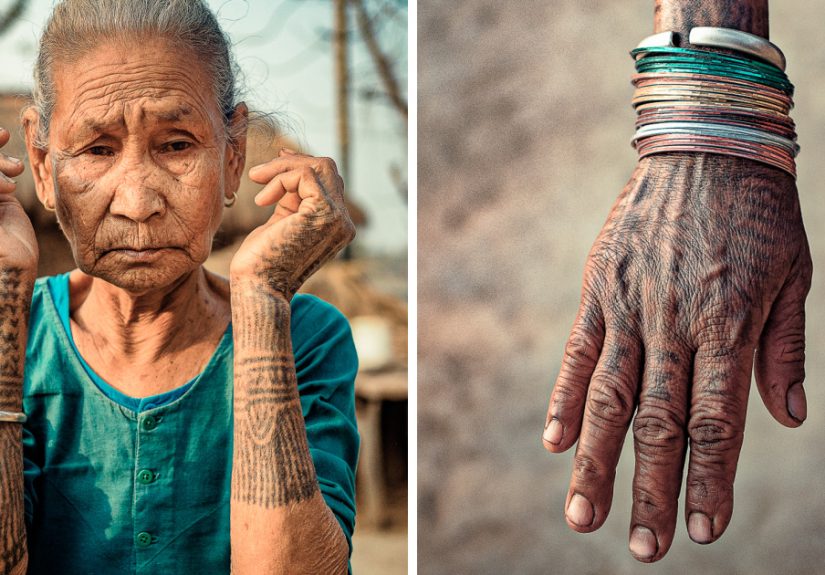
That is what happens when you begin looking at the last tattooed women of the Tharu tribe. At first, the images are what catch you: dark blue-black patterns climbing up arms and legs, dots and lines arranged with the confidence of a language that never needed translation. Then the deeper truth lands. These are not just tattoos. They are memory, beauty, ritual, identity, survival, and belief written directly onto the body.
The Tharu are an Indigenous people of the Terai lowlands of southern Nepal and northern India, and their culture has long been shaped by forests, farming, village life, and community traditions. For generations, tattooing was woven into that world. In some Tharu communities, girls and women were tattooed as part of beauty culture. In others, tattoos marked maturity, marriageability, purity, belonging, or spiritual protection. Some elders also carried stories that tattooing could protect girls from abduction or exploitation by making them less desirable to powerful outsiders. In other words, there was never just one explanation. There was a whole constellation of them.
That complexity is exactly what makes this story worth documenting. It is also what makes it easy to get wrong. The internet loves a tidy caption. The Tharu story refuses to be reduced to one. Good. Culture should be harder to flatten than a social media carousel.
Who Are the Tharu, and Why Does Their Story Matter?
The Tharu are one of the largest Indigenous communities in Nepal, historically rooted in the Tarai, or Terai, the warm, fertile plains at the foot of the Himalayas. They have their own languages, rituals, cuisine, agricultural knowledge, and artistic traditions. For centuries, they lived in a region once feared for malaria, which helped shape the social geography of the plains. Later, when malaria control transformed the region, migration, modernization, state policy, education, tourism, and outside influence began changing Tharu life at high speed.
That larger history matters because tattooing did not disappear in a vacuum. It faded in the same way many traditional practices fade: not all at once, not because one generation suddenly stopped caring, but because social conditions changed. Schooling expanded. Marriage norms shifted. The beauty ideal changed. Younger women faced ridicule for older styles of tattooing. Modern tattoo culture arrived with electric machines, global trends, and entirely different motivations. Suddenly, ancestral ink had competition from dragon sleeves, English words in cursive, and the universal human urge to make regrettable decisions at age nineteen.
To document the last tattooed women of the Tharu tribe, then, is not simply to photograph elders. It is to witness a cultural threshold. These women are living archives.
What the Tattoos Meant
One of the most important things to understand about Tharu tattoos is that meaning varied by region, family tradition, and personal memory. Ask five women why tattooing mattered, and you might hear five answers that overlap without perfectly matching. That is not inconsistency. That is culture doing what culture does.
Beauty and Adornment
For many women, tattoos functioned like permanent jewelry. They decorated the skin the way bangles, cloth, or ornaments decorated the body. Some motifs were chosen because they were beautiful, plain and simple. And honestly, beauty has always been an underrated historical force. Entire customs survive because people think, “Yes, that looks right.”
Patterns often included lines, crosses, dots, botanical elements, peacocks, household objects, and symbolic forms connected to everyday life. The designs were not random. They echoed the natural world, domestic labor, village values, and spiritual imagination. A tattoo could be aesthetic and meaningful at the same time, which is probably more than can be said for most throw pillows.
Marriage, Maturity, and Social Belonging
In some Tharu communities, tattooing was tied to adulthood and marriage. Older accounts suggest that certain tattoos, especially on the legs, were expected before marriage, and women without them could be treated as incomplete, unready, or even impure in ritual settings. Some women remembered tattooing as a social requirement. Others recalled it as an ordinary part of growing up. Either way, it was embedded in the structure of communal life.
That detail matters because it reveals something larger: tattoos were not always an individual statement. In many traditional settings, they were social text. They helped signal who you were, where you belonged, and whether you fit within the moral map of the village.
Protection, Spiritual Belief, and the Afterlife
Tharu tattoo traditions also carried spiritual associations. Some women described tattoos as something that remained with a person after death, unlike clothing or jewelry. In that belief, ink became the one possession that could accompany a woman beyond cremation. Other stories held that tattoos could help in the journey to heaven, preserve beauty in the afterlife, or symbolize purity and readiness for sacred life-cycle events.
There are also oral histories connecting tattooing to protection. In some tellings, tattoos were believed to reduce the risk of girls being taken by powerful men. Whether told as warning, memory, or legend, the story speaks to a world in which women’s bodies were both vulnerable and fiercely defended by cultural practice.
That is why these tattoos feel so emotionally charged today. They were never just decoration. They were strategy, identity, cosmology, and inheritance all at once.
How the Tattoos Were Made
This was not a quick appointment in a spotless studio with a playlist and a ring light. Traditional Tharu tattooing was slow, painful, communal, and intensely physical. Older descriptions mention hand-poked methods using needles, natural black pigment from lamp soot, and materials such as mustard oil. Women sometimes remembered the process as so painful that people fainted. That pain was not incidental; it was part of the rite, part of the seriousness of what was being done.
There were specialist tattoo artists, and in some places girls also learned from one another in everyday village settings. The process demanded patience, endurance, and a willingness to accept pain in exchange for beauty, status, belonging, or spiritual value. Today, when modern tattoo culture often centers on personal taste, this older system can feel almost shocking in its social depth.
And yet the women who carry these tattoos rarely describe themselves as victims of the practice alone. Many speak about the markings with pride, familiarity, humor, and matter-of-fact respect. That balance is important. A painful tradition is still a tradition people may love.
Why the Tradition Is Fading
The simplest answer is modernity, but that word is too broad to do the job by itself. The decline of Tharu tattooing is really the result of many overlapping changes.
Younger generations have grown up with schooling, migration, wage labor, urban contact, and new ideals about beauty and self-expression. Traditional tattoo artists are harder to find. Social pressure has shifted direction: what was once expected can now be mocked. Some younger Tharu women see the old tattoos as old-fashioned, too painful, or too permanently tied to a rural life they no longer want. Others may admire the tradition without wanting to wear it on their own bodies.
That does not mean the culture is dead. It means the form is changing. Traditional knowledge may move from skin to photographs, exhibitions, oral storytelling, museum collections, archives, activist art, and cultural revival projects. But something does change when a living practice becomes mainly something to be remembered rather than routinely lived.
That is the bittersweet edge of documentation. A photograph can preserve the image of a culture, but it cannot fully preserve the conditions that made the culture ordinary.
What Documentation Can and Cannot Do
There is a temptation, when documenting Indigenous women with striking tattoos, to turn them into symbols first and people second. That is the trap. The right way to approach this story is not as a hunt for “exotic last survivors,” but as an encounter with women whose bodies carry histories that deserve context and dignity.
Good documentation does three things. First, it listens before it explains. Second, it resists reducing a whole tradition to a single dramatic anecdote. Third, it makes room for the women themselves to define what the tattoos meant. Some emphasize beauty. Some emphasize custom. Some emphasize faith. Some simply say, “That was how things were done.” Any honest portrait needs space for all of that.
Documentation also creates a record for younger generations. For Tharu communities thinking about preservation, photography and storytelling can serve as bridges between elders and youth. A girl who does not want traditional tattoos may still want the stories, motifs, songs, and memory of the women who wore them. Culture is not only what continues unchanged. It is also what gets carried forward in altered form.
The Last Tattooed Women Are Not Just a Vanishing Image
It is easy to describe these women as the “last tattooed women of the Tharu tribe” and stop there. But that phrase, while emotionally powerful, needs care. “Last” can make people sound like museum pieces waiting to disappear. They are not. They are elders, workers, mothers, storytellers, believers, and witnesses to rapid change. Their tattoos matter not because they are quaint relics, but because they expose the full emotional range of tradition: pride, pain, beauty, obligation, discipline, memory, and loss.
That is what makes this story larger than tattooing. It is about what happens when a community’s visual language starts to fade from daily life. It is about how women’s bodies can hold social history more honestly than official records. It is about the tension between preservation and reinvention. Most of all, it is about respect. If you are lucky enough to hear these women speak about their tattoos, the correct response is not curiosity alone. It is gratitude.
Field Notes: The Experience of Documenting the Last Tattooed Women of the Tharu Tribe
What stays with me most is not the first close-up of the tattoos. It is the feeling in the room when conversation begins. At first there is often a little distance, the natural pause between strangers, the moment when everyone quietly decides whether this is going to be respectful or annoying. Cameras can make that pause sharper. They can also make it worse if the person holding one acts like they have arrived to “capture” something rare. Nobody wants to be treated like an artifact before breakfast.
But once the women begin talking, everything changes. The tattoos stop being visual patterns and start becoming sentences. One line on the arm is suddenly about girlhood. A motif on the leg turns into a story about marriage. A mark near the wrist opens a memory about friendship, pain, laughter, and the long afternoon when several girls sat together and endured the needle because that was what women before them had done. What looked permanent on the skin becomes fluid in the telling, full of nuance, contradiction, and personality.
There is also a strange emotional double exposure in the experience. On one level, you are admiring beauty: the rhythm of the designs, the confidence of the placement, the way age has softened but not erased the ink. On another level, you are very aware that what you are seeing is tied to loss. These women are not merely carrying a tradition; they are carrying one that is no longer being practiced in quite the same way. That creates a tenderness in every frame. You are documenting presence, but you are also documenting absence hovering nearby.
What surprised me most was how often the mood could turn light. The story is serious, yes, but the women are not solemn symbols standing around waiting to represent history. They laugh. They joke. They tease each other. One woman might explain a motif with pride, while another shrugs and says she mostly got it because everybody else did. That honesty is part of the beauty. Culture is not a perfect speech prepared for outsiders. It is messy, funny, inconsistent, deeply human.
And then there is the quiet ethical pressure of the work. How do you show admiration without romanticizing hardship? How do you describe tradition without pretending it was always gentle? How do you honor beauty without turning real people into a mood board? Those questions never fully go away, and maybe they should not. They are what keep documentation honest.
By the end, the biggest lesson is simple: the tattoos are extraordinary, but the women are more extraordinary still. They are not important because they preserve a disappearing art form. The art form is important because it reveals something about them: endurance, memory, dignity, and the ability of ordinary people to hold history in ways books often cannot. Long after the photos are taken, that is the part that lingers. Not just the ink, but the intelligence and gravity behind it. The realization that documentation, at its best, is not about taking something away. It is about learning how to stand still long enough for someone else’s history to meet you.
Conclusion
The story of the last tattooed women of the Tharu tribe is not a simple tale of a “lost tradition.” It is a living lesson in how culture survives, changes, sheds skin, and sometimes leaves its deepest meanings in the hands of elders. Tharu tattoos were never just body art. They carried beauty, social identity, ritual belonging, spiritual belief, and the weight of women’s lived experience. Documenting them matters because it helps preserve more than an image. It preserves voice, context, and memory.
If there is one thing to take from this story, it is this: the tattoos may be fading from younger skin, but the meaning behind them still deserves to be seen, heard, and remembered with care.