Table of Contents >> Show >> Hide
- What Is a Self-Portrait, Really?
- Why This Prompt Hits So Hard
- Choose Your Medium (a.k.a. Pick Your Flavor of Chaos)
- The Quick-Start Method: A Self-Portrait in 20–30 Minutes
- Want a Symbolic Self-Portrait? (Yes, You Do.)
- Photography Self-Portraits That Feel Like Art (Not a Timer Panic)
- Common Self-Portrait Mistakes (and How to Fix Them Without Crying)
- A Mini Example: Three “Hey Pandas” Self-Portrait Ideas
- Conclusion: Your Self-Portrait Is Allowed to Be You
- Experience Notes: What People Learn When They Actually Do the “Hey Pandas” Self-Portrait Prompt (About )
A fun, surprisingly deep guide to making a self-portrait that looks like you (and not your distant cousin who lives inside a potato).
“Hey Pandas, draw your self portrait.” Four words that sound like a wholesome art prompt… and a mild threat from a very polite museum security guard. But that’s exactly why it works. A self-portrait is one of the few creative projects that’s always available, doesn’t require a special occasion, and comes with built-in subject matter (hi, it’s you).
The best part? Self-portraiture has no single “right” style. It can be realistic, messy, symbolic, funny, moody, glamorous, or “I drew this in two minutes and somehow it captured my entire personality.” It’s art, not a passport photo. And if your eyebrows come out uneven, congratulationsyou’re officially practicing accuracy.
This article is your studio-side pep talk and practical playbook: what a self-portrait really is, how artists use it to show identity (not just cheekbones), and a step-by-step process for drawing or photographing yourself without spiraling into existential questions like, “Do I always look like that?”
What Is a Self-Portrait, Really?
At its simplest, a self-portrait is a portrait of yourself made by you. That definition is delightfully straightforwardand also wildly flexible. Self-portraits can be paintings, drawings, photographs, collages, comics, digital illustrations, sculptures, poems, or a dramatic shadow on the wall that says, “I am the main character and also the lighting is terrible.”
The key idea: a portrait isn’t only about recording features. Great portraiture suggests presencesomething about who a person is, not just what they look like. That’s why self-portraiture shows up again and again in art history and classrooms: it’s a direct, personal way to explore identity, mood, and story.
Self-Portrait vs. Selfie: Same Family, Different Vibes
A selfie usually aims for quick capture. A self-portrait aims for intentional expression. You can absolutely take a self-portrait with a camera, but the mindset changes: you’re not just snapping proof you were thereyou’re composing meaning. You’re the model and the director. That’s a lot of jobs for one face, but you’ve got this.
Why This Prompt Hits So Hard
“Hey Pandas” challenges work because they lower the stakes. You’re not auditioning for a gallery. You’re joining a playful community prompt: Just draw yourself. That’s literally it. And that simplicity is sneakyin a good way. A self-portrait can be:
- A mirror: “Here’s what I look like today.”
- A mood board: “Here’s what it feels like to be me.”
- A symbol: “Here’s my identity told through objects, colors, or a metaphor.”
- A comedy special: “Here’s me, but drawn like a medieval manuscript creature.”
And because your subject is always available, it’s also one of the best ways to build consistent art practicewhether you have five minutes or fifty.
Choose Your Medium (a.k.a. Pick Your Flavor of Chaos)
Option A: Pencil or Pen
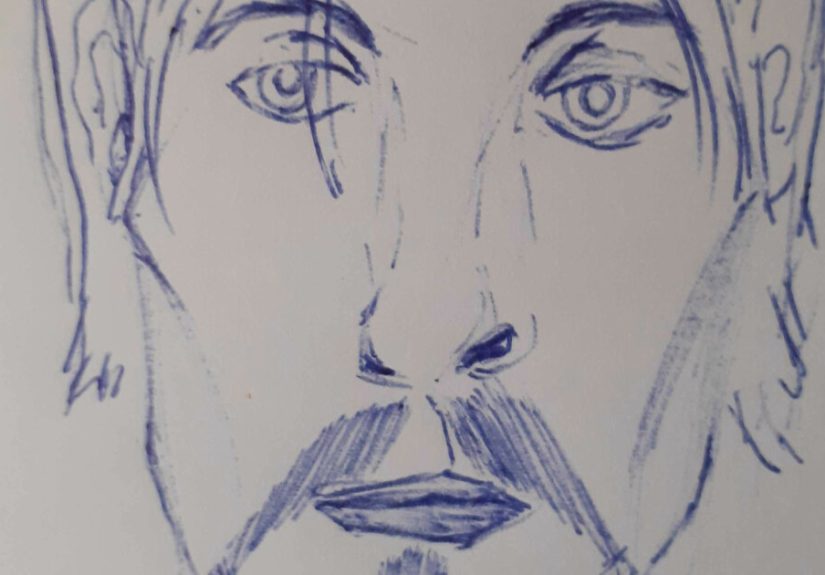
Classic, portable, forgiving. Pencil lets you adjust proportions without committing to a life sentence. Pen forces bravery (and turns “mistakes” into “style choices,” which is the most powerful spell in art).
Option B: Paint
Paint is amazing for emotion and atmosphere. It also encourages you to stop thinking in outlines and start thinking in shapes and values. If your goal is “expressive” rather than “photoreal,” paint is your best friend.
Option C: Digital Illustration
Digital tools make experimentation cheap: layers, undo, color testing, and quick stylization. If you want a graphic look, a minimal vector portrait, or an illustrated avatar, digital is the smoothest path.
Option D: Photography
Photography can still be self-portraiture when it’s intentional. Lighting, wardrobe, pose, framing, and timing can tell a story just as strongly as brushstrokes. If you’re camera-shy, start with silhouettes, partial framing, or hands-and-objects compositions.
The Quick-Start Method: A Self-Portrait in 20–30 Minutes
Here’s a process that’s beginner-friendly, non-precious, and surprisingly effective. You can do this with a mirror, your phone camera, or a photo reference.
Step 1: Set up your reference
- Mirror route: Best for “live” observation and subtle expression changes. Harder because you’re constantly moving (yes, blinking counts).
- Photo route: Best for consistency. Take a simple photo with clear lighting and a neutral expression first, then get weird later.
Step 2: Start with the big shapes
Begin with an egg-ish head shape (don’t panicmost heads start as suspicious eggs). Add a center line and an eye line to orient the face. Work from large to small: head shape → hair mass → jaw/cheeks → feature placement. This is how you avoid the classic mistake of spending 18 minutes rendering a single eyelash… only to discover the eye is in the wrong zip code.
Step 3: Measure proportions (without becoming a math wizard)
Proportion is the backbone of likeness. You don’t need fancy toolsjust compare angles and distances. One practical method is to measure relative widths (like “eye-to-eye distance” compared with “face width”) and check alignment: corners of the mouth often relate to pupils; nose width relates to inner eye corners; ears line up with brow and nose lines (varies by person). Don’t memorize rules as commandmentsuse them as starting points, then adjust to your actual face.
Step 4: Build values (the secret sauce)
If you want your portrait to feel dimensional, squint at your reference and look for big light-and-shadow shapes. Shade those first. Details come last. Value does more for likeness than perfect outlinesbecause humans recognize faces through contrast patterns.
Step 5: Add one “identity detail”
Pick a detail that makes the portrait feel like you: freckles, a scar, a specific hairstyle, your favorite hoodie, a pair of glasses, or even a background object that tells a story. This step transforms “a face” into “a person.”
Want a Symbolic Self-Portrait? (Yes, You Do.)
A symbolic self-portrait is where you depict yourself through metaphorobjects, colors, settings, or visual themes that represent your identity. This approach is gold if you don’t love drawing faces yet, or if you want something more narrative than literal.
Three easy symbolic formulas
- “Two sides of me”: Split the page into contrasting halves (calm vs. chaotic, public vs. private, day vs. night).
- “Me as a room”: Draw a space that represents youwhat objects are present, what’s on the walls, what’s hidden in drawers?
- “Me as a creature”: Make an avatar animal (panda optional but strongly on theme) and exaggerate traits you identify with.
Symbolic portraits are also a favorite in education settings because they connect artmaking with reflection, writing, and identity exploration.
Photography Self-Portraits That Feel Like Art (Not a Timer Panic)
If you’re going the camera route, your biggest upgrades come from lighting and intent. Great self-portraits often take patience because you’re handling multiple roles at once: subject, photographer, stylist, and editor.
Try these three setups
- Window light: Stand near a window with soft daylight. Face the light for clarity; turn sideways for drama.
- Backlit silhouette: Put a bright light behind you and expose for the background. Instantly moody, instantly flattering.
- Object storytelling: Photograph yourself holding something meaningful (book, instrument, work tool, heirloom). Narrative in one frame.
Pro tip: take 20 photos, keep 2. That’s not failurethat’s the normal process of directing a shoot where the model refuses to stop being alive.
Common Self-Portrait Mistakes (and How to Fix Them Without Crying)
1) “Why does it look like me… but also not me?”
Usually proportion drift. Fix it by flipping the image (mirror the drawing or use a phone flip). Fresh eyes catch alignment issues fast.
2) Over-detailing too early
If you render eyelashes before you’ve nailed head angle and feature placement, you’re decorating the wrong house. Start big; detail later.
3) Flat shading
Use larger value shapes first. Identify the darkest darks and lightest lights. Add midtones. Faces pop when values are organized.
4) Forgetting expression
A neutral face can work, but expression adds story. Even subtle choicesraised eyebrow, soft smile, tired eyescommunicate personality.
A Mini Example: Three “Hey Pandas” Self-Portrait Ideas
Idea 1: “A Little Bit Stylized”
Draw yourself in a simplified stylebig shapes, fewer details, bold outline. Keep one feature accurate (your nose shape, your smile, your hairline). Stylization works best when it’s selective, not random.
Idea 2: “Two-Truths Portrait”
Make two versions: one that shows how people usually see you, and one that shows how you feel inside. Same face, different color palette and symbols.
Idea 3: “No-Face, All-Identity”
Don’t draw your face at all. Draw hands, posture, clothing, and objects that represent you. It’s still a self-portraitbecause it’s still self-revealing.
Conclusion: Your Self-Portrait Is Allowed to Be You
The point of “Hey Pandas, Draw Your Self Portrait” isn’t to produce a flawless likeness. It’s to practice seeingseeing your shapes, your values, your expressions, and your identity. You can go realistic or symbolic, pencil or camera, serious or funny. The win is finishing something that feels honest.
So grab a mirror, a reference photo, or a timer. Start with big shapes. Measure just enough to keep your features from wandering off. Add one detail that’s unmistakably you. Then sign it like you mean itbecause you just made art out of a human being. Conveniently, you had one nearby.
Experience Notes: What People Learn When They Actually Do the “Hey Pandas” Self-Portrait Prompt (About )
Here’s the funny truth about self-portrait challenges: the drawing isn’t the hardest part. The hardest part is staying in the chair. The moment you decide to draw yourself, your brain becomes a professional critic with a megaphone. It will notice asymmetry you have never noticed before. It will ask why your nose looks different from different angles. It will demand to know whether your eyebrows have always been in a passive-aggressive relationship.
The first experience many people report is the “mirror paradox.” A mirror gives you a moving target: you blink, you breathe, you tilt your head without noticing. That’s why beginners often feel more confident using a photo referencebecause the face stays still and you can focus on proportion. But the mirror has a superpower: it captures your live expression. Even a tiny shift in the eyes can change the whole portrait from “posed” to “present.” A practical compromise is to take a photo, then keep a mirror nearby for quick reality checks, like verifying how your hair actually sits in three dimensions.
The second common experience is discovering that likeness lives in big decisions, not tiny details. People expect the magic to happen in the eyelashes, the skin texture, the perfect highlight on the lip. Then they try squinting at their work (or flipping it) and realize: the head angle is off, the jaw is a little too narrow, the eyes are slightly too high. Fixing those big shapes often “snaps” the portrait into place faster than adding more detail. It’s a humbling momentand also strangely empowering. Because it means you can improve quickly by practicing the fundamentals.
Another big learning: symbolic portraits can feel more honest than realistic ones. When people don’t love drawing faces, they often assume they’re “not good at self-portraits.” But then they try an identity-based versionmaybe a split portrait showing two moods, or a background filled with meaningful objectsand suddenly the piece feels personal. It’s still a self-portrait because it describes the self. In many cases, these are the portraits viewers connect with most, because the story is readable even if the likeness is stylized.
Photography-based self-portraits bring their own lessons. The experience is less “Can I draw this nose?” and more “Why is lighting such a powerful liar?” One day, window light makes your face look cinematic. The next day, overhead light turns you into a haunted dumpling. People quickly learn to control variables: face the window, avoid harsh ceiling lights, simplify the background, and embrace a slower process. Self-portrait photography rewards patience because you’re both the subject and the crew. The wins feel different, too: a single frame can communicate mood through posture and shadow in a way that feels immediate.
The most important experience, though, is the emotional one: self-portraits create a record. If you repeat the “Hey Pandas” prompt every few months, you end up with a tiny timeline of yourselfstyles you tried, moods you were in, changes you didn’t notice day-to-day. Over time, people stop obsessing over perfection and start noticing growth. And that’s the sneaky gift of the challenge: it trains your eye, yesbut it also trains your relationship with your own image. You get better at looking, better at translating, and better at saying, “This is me today,” with a little more kindness.