Table of Contents >> Show >> Hide
- The Loft That Started the Conversation
- Industrial Bones, Warm Daily Life
- A Kitchen That Acts Like Architecture
- Lighting: The Make-or-Break Detail in a Loft
- Wood Where You Want Warmth, Steel Where You Need Strength
- Why This Renovation Feels So Current
- Steal These Ideas: A Loft Renovation Checklist That Actually Helps
- Radiant Heat + Concrete Floors: A Practical Love Story
- The Big Takeaway: Loft Design Is About Editing, Not Adding
- Experiences That Come With Renovating (or Living In) a Paris Loft
- Conclusion
Paris has a special talent for making the impossible look effortless. A 200-year-old building gets a modern kitchen without losing its soul. A former factory becomes a family home without pretending it was always meant to be one. A stair turns into sculpture, a mezzanine turns into an extra floor, and suddenly “loft living” stops sounding like a real-estate buzzword and starts feeling like an actual lifestyle.
This is the story of one particularly sharp Paris renovation: a 1,700-square-foot loft tucked inside an old industrial shell, redesigned by a young architect building his reputationand doing it with the kind of calm confidence that says, “Yes, we’re adding a 40-foot beam, and no, we’re not panicking about it.”
The Loft That Started the Conversation
Let’s set the scene. The loft sits in Paris’s 19th arrondissement, in a building that once had a working life (specifically, a former candy factory). It isn’t a tiny garret with a romantic view of a chimney. It’s a real lofthigh ceilings, serious volume, and the kind of footprint that begs for a plan that’s more thoughtful than “put the couch… somewhere.”
The architect behind the project, Nicolas Sisto, was in his early thirties when he completed the renovation for a friend. He founded his studio in 2012, and his background in photography shows up in the way the space frames light, long views, and crisp contrasts. The result isn’t just “minimal.” It’s editedas if the apartment itself went through a very chic closet clean-out and didn’t keep a single “maybe someday” item.
A loft plan that respects the volume (and the people living in it)
One of the smartest decisions here is how the renovation treats the loft’s height as usable real estate. Instead of leaving the upper level as a token sleeping perch, the design extends the mezzanine to carve out a real second layer of living: spaces that feel separate without turning the loft into a maze.
- Up top: the main bedroom, a guest room, and an officebecause even Paris has discovered remote work.
- Down below: two kids’ rooms are tucked off the kitchen, turning what could have been “loft chaos” into a family-friendly layout.
And then there’s the stair. Not a ladder. Not a spiral that requires Pilates-level core strength. A proper stair with presence, anchored by a 40-foot metal beam that makes the whole move possible. It’s structural, yesbut it also reads like a design statement. In a loft, that’s the dream: the practical stuff gets to be beautiful.
Industrial Bones, Warm Daily Life
Industrial conversions can go two ways. Either they keep every gritty detail and the place starts feeling like an art gallery that forgot to install a toothbrush holderor they get renovated so aggressively that the building’s history becomes a rumor.
This loft lands in the sweet spot: it keeps the clarity and scale that industrial buildings do best, then layers warmth in deliberate, livable ways. You see it in the materials, in the lighting, and in the “human” momentslike a cotton hammock hanging near the main living space. (In a Paris apartment. A hammock. The confidence!)
Concrete floors, but make them cozy
The floors are white concrete, which gives the loft a seamless, gallery-like calm. But concrete can be cold and unforgivingespecially in a place where winter is damp enough to make you question your choices.
The fix is both practical and luxurious: radiant floor heating. It’s the kind of comfort upgrade that doesn’t shout, but you feel it every time you step out of bed and your feet don’t instantly write a complaint letter.
A Kitchen That Acts Like Architecture
In open-plan lofts, the kitchen isn’t just a kitchen. It’s a major visual anchor. If it looks cluttered, the entire space feels cluttered. If it looks sharp, the whole loft looks sharper.
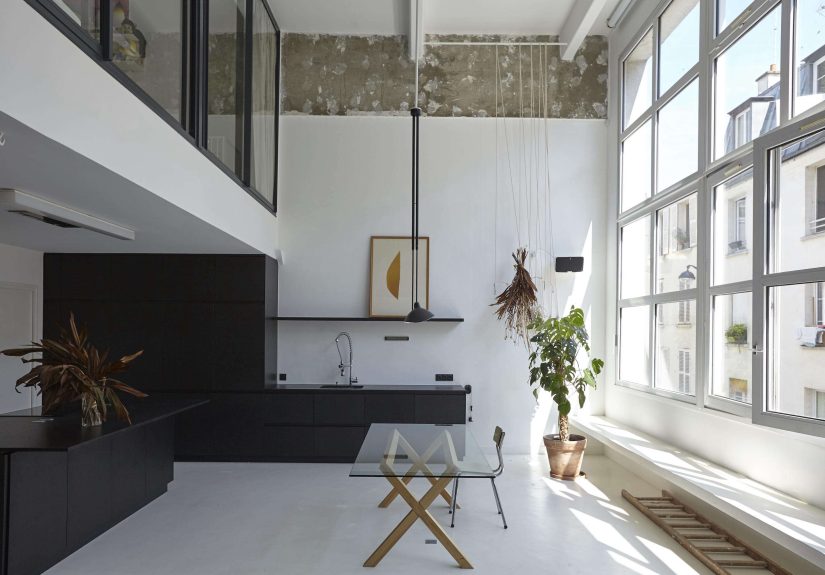
Here, the kitchen is custom and unapologetically bold: black wood paired with Zimbabwe black granite for the cabinetry and counters. It reads almost monolithicless “kitchen set” and more “built-in object.”
Hidden storage: the secret ingredient
What makes this kitchen work isn’t only the color paletteit’s the discipline. Pantry storage is integrated, and even the refrigerator is panel-ready, tucked behind the same dark, stone-forward face. When everything aligns, the kitchen stops competing with the living area and starts behaving like a wall of architecture.
And because a loft is basically one big room that can overhear your life, the functional details are handled cleanly:
- Built-in ovens and induction cooking keep the island streamlined.
- Integrated outlets in the countertop make the space usable without visual chaos.
- A commercial-style faucet leans practical and adds a subtle, pro-kitchen attitude.
There’s even a rope system designed to hang dried flowers and air plantsproof that minimalism doesn’t mean “sterile.” It means the decor has to earn its place.
Lighting: The Make-or-Break Detail in a Loft
Lofts can be bright, but they can also be tricky. Light bounces differently in big volumes, and a single overhead fixture can make the place feel like a well-designed parking garage. (Not the vibe.)
This renovation treats lighting like a layer of architecture. A standout piecea Serge Mouille ceiling lampwas adapted to suit the loft’s new height, reinforcing a key loft principle: scale matters. If you upgrade your volume, your lighting has to come with you.
Even the stair gets its own lighting moment: an inset banister paired with LED lighting on motion detection. That’s not just cool; it’s daily-life smart. Midnight water runs shouldn’t require a full sunrise in the living room.
Wood Where You Want Warmth, Steel Where You Need Strength
One of the most consistent patterns across great loft renovationswhether in Paris, New York, or anywhere with former industrial spaceis the balance of hard materials and softening elements. Steel and concrete give structure and crispness. Wood adds human warmth.
Upstairs, the flooring shifts to wide-plank firan intentional change that helps the mezzanine feel like its own zone rather than a continuation of the main level. When you’re designing a loft, transitions like that are how you create “rooms” without walls.
Small DIY touches keep it from feeling too polished
Luxury isn’t always about expensive objects. Sometimes it’s about cleverness with restraint. A headboard made from a repurposed IKEA kitchen countertop is the kind of detail that keeps the space grounded. It says, “We’re serious about design, but we’re not allergic to reality.”
Same with a bedside table solution that’s more “found object” than formal furniturea mirrored plexiglass stool typically used for shop displays. In a loft, these moves matter: they stop the space from turning into a showroom.
Why This Renovation Feels So Current
Design trends come and go, but a few big ideas have been consistent across the best renovations featured by major interiors publications in recent years:
- Flexible zones over fixed rooms: Mezzanines, half-walls, curtains, and glass partitions define space without killing light.
- Utility made beautiful: Storage, stairs, and built-ins are treated like design features, not afterthoughts.
- Material honesty: Concrete looks like concrete. Steel looks like steel. Wood looks like wood. No fake “farmhouse industrial” cosplay.
- Calm palettes with texture: When the envelope is neutral, the shapes, shadows, and surfaces carry the interest.
This Paris loft nails all of it. It’s minimal, but not empty. Industrial, but not harsh. Family-friendly, but still cool enough that you’d expect a design editor to casually wander through “just to take a look.”
Steal These Ideas: A Loft Renovation Checklist That Actually Helps
If you’re renovating a loftor even just trying to make an open-plan apartment feel betterthis project offers a playbook worth borrowing. Here are the moves that translate, even if your “Paris loft” is actually a third-floor walk-up in Cleveland.
1) Design the circulation before you design the furniture
In lofts, the path you take through the space becomes part of the architecture. The stair isn’t only vertical movement; it’s a visual spine. Map your routes first: entry to kitchen, kitchen to living, living to sleeping, sleeping to bath. If those paths feel intuitive, the whole place feels calmer.
2) Let one element do the heavy lifting (visually)
Here, the kitchen’s black granite presence anchors the main level. In other lofts, it might be a sculptural stair, a wall of built-ins, or a dramatic archway. Pick one statement element and make it excellent. Then let everything else support it. A loft with five “main characters” is just a group chat of design arguments.
3) Add storage until you think you’re donethen add a little more
Open-plan spaces don’t forgive clutter. Hidden pantry storage and integrated appliances aren’t just fancythey’re functional. If you can’t hide the practical stuff, the loft will always look “mid-renovation,” even when it’s finished.
4) Use material shifts to create zones
Concrete downstairs, wood upstairs: that transition reinforces the idea of separate areas without adding walls. Even a change in rug texture or ceiling treatment can create that same effect in smaller spaces.
5) Treat lighting like furniture
Lofts need layered lighting: statement fixtures for scale, task lighting for real life, and subtle accent lighting for depth. Bonus points for motion-activated stair lighting, because your toes deserve safety.
Radiant Heat + Concrete Floors: A Practical Love Story
Let’s talk comfort, because aesthetics don’t matter if your home feels like a stylish refrigerator. Concrete floors are durable and visually clean, but they’re also notorious for feeling coldespecially without a heating strategy.
Radiant floor heating is a popular solution because it warms from the floor up, helping reduce cold spots and drafts. It can be hydronic (hot water through tubing) or electric (heating cables/mats), and the best fit depends on whether you’re doing a major renovation or a smaller retrofit.
Why people love it
- Even warmth: The heat source is spread out, so you don’t get “hot corner, cold corner” drama.
- Quiet operation: No blowing air, no duct noise, no “why is the vent yelling?” moments.
- Design freedom: No radiators to place, no bulky vents dictating furniture layout.
What to think about before committing
- Upfront cost: It can be more expensive to install, especially if you’re retrofitting.
- Floor build-up: Some systems add thickness, which can affect transitions and doors.
- Planning matters: You want insulation where needed so heat goes up into the room instead of disappearing into the structure.
In this Paris loft, radiant heating paired with a clean concrete finish is a perfect match: modern, durable, and secretly indulgentlike ordering dessert and calling it “architectural research.”
The Big Takeaway: Loft Design Is About Editing, Not Adding
If you remember one thing from this renovation, let it be this: a loft succeeds when the design clarifies the space instead of cluttering it. The best choices here aren’t loudthey’re decisive.
- The mezzanine extension turns volume into function.
- The steel beam makes the stair possible and turns structure into style.
- The black granite kitchen reads like architecture, not cabinetry.
- Hidden storage keeps the open plan livable.
- Material shifts and lighting layers make “one big room” feel like a home.
That’s the magic trick: the loft feels bigger because it’s better organized, not because it’s stuffed with clever gadgets. In the hands of a young architect with a sharp eye, a former factory becomes something more than a cool shellit becomes a place where daily life actually fits.
Experiences That Come With Renovating (or Living In) a Paris Loft
To close, let’s get real about the lived experience side of a Paris loft renovationthe stuff glossy photos can’t show, but homeowners and designers talk about the minute the camera leaves. These are the moments that tend to show up again and again, especially in high-ceiling, open-plan spaces where every decision echoes (sometimes literally).
First: you learn quickly that “open plan” is not the same thing as “no plan.” In a loft, sound travels like it’s auditioning for a musical. If the kitchen is next to the living room, and the living room is basically next to everything, you’ll notice how appliances, footsteps, and even phone calls bounce around. That’s why so many successful loft renovations invest in zoningmezzanines, partial walls, soft textiles, rugs, curtains, and layered lighting. The goal isn’t to break the loft into tiny boxes; it’s to give your brain a sense of “areas” so the space feels restful instead of relentlessly public.
Second: stairs become part of your personality. People love to talk about stair design because it’s visually dramatic, but the daily experience is what matters. A well-designed stair makes the upstairs feel like a real level, not a novelty perch. It also changes how you use the loft: you’re more likely to treat the mezzanine as an office, reading nook, or guest zone when getting up there doesn’t feel like scaling a ship’s ladder. And if the stair includes thoughtful lightingespecially motion-activated elementsyour late-night routine becomes safer and calmer. That tiny detail can honestly feel like luxury.
Third: storage is the emotional support system of loft life. In a traditional apartment, you can hide clutter behind doors in separate rooms. In a loft, everything is in the same visual conversation. A jacket tossed over a chair becomes “living room decor.” A blender left out becomes “kitchen installation art.” That’s why integrated pantry storage, panel-ready appliances, and built-ins can feel less like design vanity and more like mental health support. When storage is planned, the loft looks serene without you having to do a daily panic-clean before guests arrive.
Fourth: you start respecting materials in a very practical way. Concrete floors look amazing, but you feel them. If they’re unheated, winter mornings can be brutal. With radiant heating, that same floor becomes a comfort feature you talk about the way people talk about good coffee: with surprising affection. Similarly, dark stone kitchens look sleek, but you learn the maintenance realitieswiping fingerprints, choosing the right cleaners, and appreciating why designers obsess over finishes that age well. In other words, the loft teaches you that “beauty in utility” isn’t just a tagline; it’s a survival strategy.
Fifth: you discover that loft living changes your habits. People often report that they become more intentionalabout what they own, what they display, and what they buy. In an open plan, every object has more visual weight, so you naturally edit. You also use furniture differently: a dining table becomes a desk; a sofa area becomes a social hub; a guest zone might be a curtain away from your everyday life. Flexibility stops being an abstract idea and becomes the reason the loft works for real humans, not just magazine spreads.
Finally: there’s a quiet pride that comes from making a historic shell work for modern life. Paris renovations, especially in older or industrial buildings, often involve constraintsstructure, light, plumbing routes, and the simple fact that everything has to fit without ruining what makes the building special. When the renovation succeeds, you don’t just get a pretty home. You get a space that feels both timeless and completely yours. And that’s the ultimate “young architect on the up” move: not chasing trends, but designing something that lives well.
Conclusion
A renovated Paris loft at its best is a balancing act: industrial clarity with domestic comfort, bold moves with quiet restraint, and beauty that doesn’t get in the way of daily life. In this project, the decisions add up to a home that feels modern without feeling temporaryproof that the most compelling renovations aren’t about showing off. They’re about making space make sense.