Table of Contents >> Show >> Hide
- Why White Kitchens Ruled for So Long
- So, Are White Kitchens Finally Out?
- What’s Replacing the Classic All-White Kitchen?
- Why Homeowners Are Moving On From Stark White
- Who Should Still Choose a White Kitchen?
- How to Make a White Kitchen Look Current in 2026
- The Verdict: White Kitchens Aren’t Dead, But White-Kitchen Monotony Is
- Living With White Kitchens: The Real Experience Behind the Trend
For years, the white kitchen was the undisputed prom queen of home design. It was bright, photogenic, easy to style, and practically required if you wanted your kitchen to look like it belonged in a Nancy Meyers movie or a very enthusiastic real estate listing. White cabinets, white subway tile, white quartz, white walls, white everything. The look felt fresh, safe, and expensiveeven when your budget was giving “doing our best.”
But design trends, like sourdough starters and celebrity bob haircuts, rarely stay still forever. Over the last couple of years, designers and homeowners have started craving something cozier, more layered, and less sterile. Suddenly, the internet is full of warm woods, creamy paint colors, moody green cabinets, slab backsplashes, and kitchens that look like actual humans use them. Which raises the obvious question: after decades of popularity, are white kitchens finally out?
The short answer is nobut the old version of the white kitchen absolutely is. The bright, flat, all-white kitchen that once symbolized modern taste is no longer the automatic gold standard. What is replacing it is not the total death of white, but a smarter, warmer, more textured evolution of it. In other words, white kitchens are not getting canceled. They are getting a personality transplant.
Why White Kitchens Ruled for So Long
White kitchens did not dominate by accident. They solved a lot of design problems all at once. White reflects light, which makes smaller kitchens feel larger and darker kitchens feel less cave-like. It works with nearly every cabinet style, from traditional inset doors to sleek flat panels. It also pairs nicely with almost any countertop, flooring, metal finish, or paint color, which makes it an easy long-term choice for homeowners who do not want to redo an expensive renovation every seven years.
That versatility mattered. Kitchens are one of the most expensive spaces in a home to remodel, so people gravitated toward a look that felt broadly appealing and unlikely to offend future buyers. White also became deeply associated with cleanliness, order, and visual calm. In the age of open-concept homes, when kitchens became the centerpiece of family life, a white palette offered a clean backdrop that flowed easily into dining and living areas.
Then came the modern farmhouse boom, and white kitchens went from popular to nearly unavoidable. White Shaker cabinets, subway tile, matte black hardware, and butcher-block accents became the formula. It was attractive, familiar, and easy for builders, flippers, and homeowners to replicate. The problem with any formula, though, is that eventually everyone can recognize it from across the room.
So, Are White Kitchens Finally Out?
Not exactly. White kitchens are no longer the trendiest option in the room, but they are still one of the most enduring. What is fading is the ultra-crisp, one-note, all-white kitchen that can feel a little too perfect, a little too flat, and, in the worst cases, a little too much like a boutique dental office with bar stools.
Designers are making an important distinction here. A white kitchen as a concept is still classic. A stark white kitchen with little contrast, little texture, and zero warmth is what feels dated. That difference matters. It is the reason so many experts are saying white is not “out,” while also admitting that the all-white look has lost its grip on the design world.
In fact, current kitchen trend reporting points to a more nuanced reality. White remains a major player, but it is no longer the automatic first choice. According to the 2026 U.S. Houzz Kitchen Trends Study, wood cabinetry has now edged out white in renovated kitchens, with wood chosen by 29% of homeowners and white by 28%. That is not a dramatic collapse. It is more like white being nudged off the throne and told, politely, to scoot over. Off-white remains strong too, which tells you homeowners are not abandoning light kitchensthey are just softening them.
What’s Replacing the Classic All-White Kitchen?
1. Warm Whites and Creamier Paint Colors
The first shift is subtle but important: today’s whites are warmer. Instead of cold, blue-based whites and icy gray undertones, homeowners are choosing creamy shades with hints of beige, yellow, pink, or taupe. These colors still read as white, but they feel softer, more lived-in, and far less clinical.
This change sounds small until you see it in person. A stark white kitchen can bounce light in a way that feels sharp and hard. A warm white kitchen softens the room and plays better with natural wood, aged brass, handmade tile, and stone with movement. It is the same basic category, but with much better bedside manner.
2. Wood Cabinetry and Natural Texture
If there is one design force currently shoving the all-white kitchen out of the spotlight, it is wood. Light oak, medium wood tones, walnut, and even honey oak are back in the conversation. After years of painted cabinetry dominating the market, homeowners are rediscovering what wood brings to a kitchen: warmth, grain, variation, and a sense of permanence.
Wood cabinets also work beautifully with the broader shift toward natural materials. People want kitchens that feel grounded and tactile, not flat and mass-produced. That is why even white kitchens are now being mixed with wood hoods, wood islands, floating shelves, trim details, or lower cabinets in stained finishes. Designers are not necessarily replacing every white cabinet with timber, but they are using wood to break up the sameness and add soul.
3. Two-Tone Cabinetry
Another big replacement for the full white-on-white look is the two-tone kitchen. This often means creamy white upper cabinets paired with wood, green, blue, or earthy lower cabinets. It is a practical move as much as a style move. Lower cabinets get kicked, bumped, scuffed, and generally treated like they owe the household money. Darker or wood-toned lowers tend to hide wear better while still keeping the overall room bright.
Two-tone kitchens also solve the “boring box” problem. They create contrast, make islands feel more furniture-like, and help kitchens blend more naturally with adjacent living spaces. White is still thereit is just no longer carrying the entire design on its back.
4. Backsplashes That Actually Do Something
For years, the standard white kitchen playbook called for white subway tile and a respectful silence. Now backsplashes are expected to contribute. Homeowners are choosing slab backsplashes, handmade-look tile, warmer stone, earthy greens, zellige-inspired finishes, and bolder patterns that add movement and character.
This is one of the clearest signs that the all-white kitchen is evolving. In older white kitchens, the backsplash often disappeared into the background. In newer ones, it is doing real design work. It adds contrast, connects the kitchen to the rest of the home, and keeps the space from feeling too sterile. Think of it as the accessory that finally learned how to talk.
5. More Detailed Cabinet Profiles and Softer Shapes
Simple Shaker cabinets helped define the white-kitchen era, but now designers are reaching for more variety. Inset doors, beaded details, fluting, reeding, curved island corners, and furniture-like millwork are helping kitchens feel more custom. Even when the cabinetry is white, the silhouette is richer and more intentional.
This matters because one of the biggest criticisms of older all-white kitchens is that they can feel visually flat. Detailed millwork gives the eye more to enjoy without requiring loud color. It is a smart way to keep a pale kitchen timeless while making it look current.
6. English, Transitional, and Traditional Influence
Another reason white kitchens feel different now is that the dominant style language has changed. The design world is leaning away from hard minimalism and builder-grade farmhouse sameness, and toward English-inspired kitchens, transitional kitchens, and updated traditional spaces. These styles tend to favor natural materials, layered finishes, collected details, and a bit of imperfectionall things that challenge the old “everything must be bright white and perfectly uniform” approach.
That is why you are seeing more scullery-style storage, unfitted furniture pieces, aged metals, freestanding hutches, skirted sinks, richly veined stone, and warmer paint tones. A white kitchen can absolutely still fit within this world, but it has to bring more depth to the party.
Why Homeowners Are Moving On From Stark White
The biggest reason is emotional, not technical. People want their homes to feel personal. The old all-white kitchen was aspirational partly because it photographed beautifully and looked clean from every angle. But in real life, many homeowners began to feel that these spaces were too perfect, too expected, and a little disconnected from the way people actually live.
There is also a growing appetite for warmth. After years of gray, white, and black dominating interiors, richer and earthier palettes are starting to feel more comforting. Wood, cream, green, taupe, brass, and textured stone all help kitchens feel less like staged showrooms and more like rooms where conversations happen, cookies burn, homework gets spread everywhere, and someone is always asking where the scissors went.
In other words, the move away from all-white kitchens is not really a rejection of white itself. It is a rejection of blankness.
Who Should Still Choose a White Kitchen?
Plenty of people. White kitchens still make sense if you love a bright, classic look and want maximum flexibility over time. They are especially useful in small kitchens, low-light spaces, and homes where the kitchen opens directly into several other rooms. White can also be a smart choice if resale value is on your mind and you prefer a neutral foundation that future owners can style in different ways.
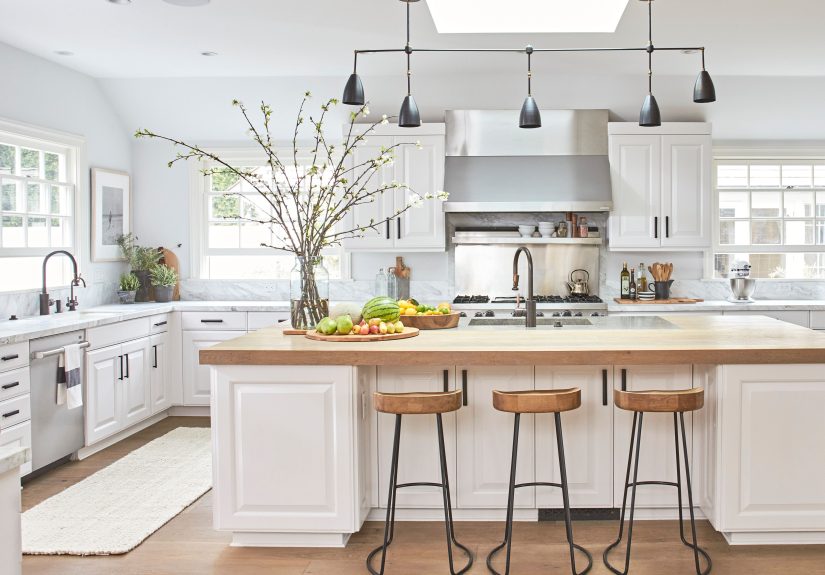
The key is simply to avoid making the room feel too flat. Choose a warmer white. Add wood somewhere. Bring in textured stone, a more interesting backsplash, mixed metals, or cabinet profiles with dimension. A current white kitchen is not an all-white kitchen in the old sense. It is a layered kitchen that happens to use white as one of its main ingredients.
How to Make a White Kitchen Look Current in 2026
If you already have a white kitchen, there is no need to panic and start pricing walnut cabinets at midnight. Most white kitchens can be updated without a full gut renovation.
Start with the paint tone. If your cabinets are a cold, bright white, warming up the wall color can make a huge difference. Swap in aged brass, brushed nickel, or darker metal hardware with a more jewelry-like feel. Add warmth with wooden stools, cutting boards, shelving, or a vent hood detail. Consider painting the island or lower cabinets in a grounded color. Upgrade the backsplash to something with texture, color variation, or larger-scale stone veining. And if your kitchen is all hard lines, a curved light fixture, rounded stools, or a softer edge on the island can make the room feel instantly less rigid.
The goal is not to erase the white. It is to give it company.
The Verdict: White Kitchens Aren’t Dead, But White-Kitchen Monotony Is
So, are white kitchens finally out? The most honest answer is this: the classic white kitchen is still alive, but the era of treating stark all-white as the only stylish option is over. White has moved from trend to baseline. It is no longer the star of every kitchen fantasy, but it remains a dependable classic when used thoughtfully.
The new dream kitchen is warmer, more personal, and more textured. Sometimes that means wood cabinets instead of white. Sometimes it means white uppers with green lowers. Sometimes it means a creamy painted kitchen with a dramatic slab backsplash and unlacquered brass. The common thread is not a specific color. It is character.
And honestly, that is probably for the best. White had a legendary run. But even legends look better with a little dimension.
Living With White Kitchens: The Real Experience Behind the Trend
Spend enough time around white kitchens and you start to understand why the debate gets so emotional. On paper, white seems foolproof. In real life, it is a little more complicatedand much more interesting. A white kitchen can feel magical at 8 a.m. when sunlight hits the counters and the whole room looks awake before you are. It can also feel mildly judgmental at 8:14 a.m. when coffee grounds, bread crumbs, and last night’s pasta sauce suddenly become visible like they have been personally highlighted by the universe.
That is part of the white-kitchen experience nobody mentions in the dreamy renovation photos. White looks clean, but it also demands clean. It is less forgiving of fingerprints, splatters, smudges, and the mysterious streak that appears on a cabinet door even though no one in the house will admit touching it. For neat freaks, that visibility can feel satisfying. For busy families, it can feel like the kitchen is constantly snitching.
There is also the emotional experience of being in the room. A bright white kitchen can feel open, airy, and calm. That is the upside. The downside is that if the room lacks texture, contrast, or warmth, it can feel strangely impersonalbeautiful, but untouchable. You know the vibe: the kind of kitchen that makes guests wonder whether they are allowed to set down a grocery bag without signing a waiver first.
By contrast, the newer white kitchens people are gravitating toward feel easier to live with. Warm whites soften the light. Wood tones make the room feel relaxed. A green island, a creamy backsplash, or aged brass hardware can take a kitchen from “showroom nice” to “please stay for soup.” These details matter because kitchens are not just visual spaces. They are emotional spaces. They hold routines, conversations, rushed breakfasts, holiday baking, midnight snacks, and all the ordinary little moments that end up becoming family memory.
That is why so many homeowners are rethinking the old all-white formula. It is not just about what photographs well. It is about what feels good on a random Tuesday. A kitchen with some warmth and variation tends to feel more forgiving, more grounded, and more human. It asks less perfection of the people using it.
In that sense, the white-kitchen shift is really a lifestyle shift. People still want brightness and timelessness, but they also want comfort. They want a kitchen that looks polished without feeling precious. They want it to survive spaghetti night, science-project cleanup, and a friend dropping by for coffee without looking emotionally overwhelmed. White can still absolutely do thatbut usually not all by itself.
So when people ask whether white kitchens are out, the answer often comes down to experience. Not trend forecasts. Not social media. Experience. Homeowners are discovering that the best kitchens are not the ones that look the most perfect from across the room. They are the ones that still feel welcoming after the dishes pile up, the dog wanders in, and real life starts doing what real life does.