Table of Contents >> Show >> Hide
- What it is (and why it’s not just a novelty)
- Why a backgammon tablecloth works ridiculously well for hosting
- How to style the board without turning dinner into a geometry lesson
- Game-night table setup: a practical checklist
- Choosing the right size: tablecloth drop explained
- Fabric & care: keeping it gorgeous in the real world
- Napkins that behave: folding, placement, and table manners you can actually live with
- Is it worth it? A quick cost-per-night way to think about it
- Conclusion: the easiest way to host longer, better nights
- Experiences: what hosting feels like with a playable tablecloth (about )
Some people collect crystal. Some collect vinyl. And some of us collect reasons to keep everyone at the table just a little longer.
The Agazia Backgammon Tablecloth And Napkins belongs to that last category: it’s table linen that quietly says,
“Dessert can waitroll the dice.”
At first glance, it reads like elevated, tailored tabletoptrim, clean lines, and that “someone here knows what a mitered corner is” energy.
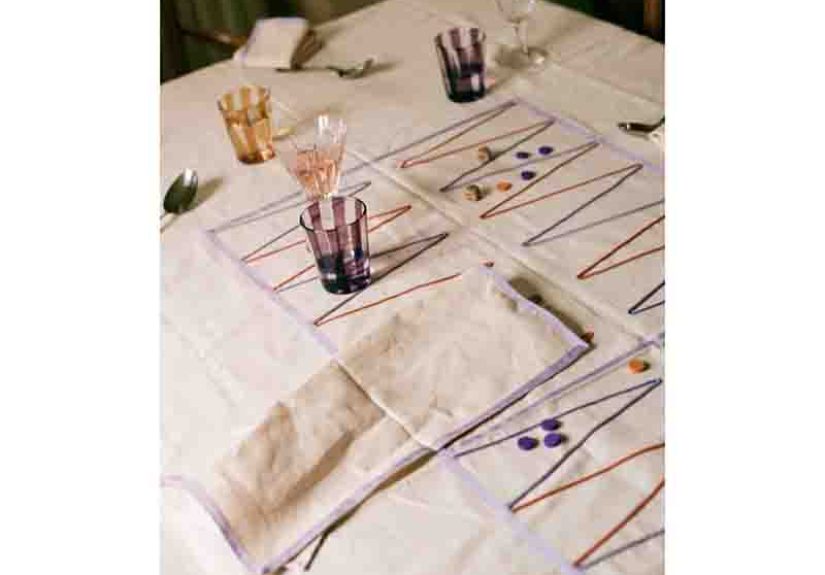
Then you notice the layout: it’s a backgammon board you can serve dinner on. Suddenly your dining room has a plot twist.
And honestly? Hosting could use more plot twists.
What it is (and why it’s not just a novelty)
The Agazia set is described as a custom-made tablecloth with matching napkins created by the Roman atelier Le Tre Sarte,
positioned as a multi-purpose decor piece that lets you move from meal to game without clearing the table first.
It’s also noted as being made using leftover/deadstock fabricmeaning the material is sourced from unused textiles that would otherwise be discarded,
giving the set a sustainability angle without sacrificing the “special occasion” feel.
The name “Agazia” shows up across a small family of backgammon-themed pieces from the same makers, and the collection includes variations.
For example, one version is presented as a backgammon tablecloth that comes with dice, checkers, and a rule cardso it’s not merely inspired by the game;
it’s meant to be playable. Other listings show different sizes and materials (including embroidered linen in a larger tablecloth format),
which is a fancy way of saying: your table has options.
Quick specs you’ll want to know before you fall in love
- Concept: Backgammon-board tablecloth + coordinating napkins, designed to go from dinner to gameplay.
- Maker: Roman atelier Le Tre Sarte (handmade, small-batch approach).
- Materials: Described in various listings as cotton/deadstock fabric; other versions are listed as embroidered linen.
- Playability: At least one version includes dice, checkers, and a rule card (so you can actually play).
- Vibe: “Design-object linens” that still function as real linens (not a flimsy printed party cloth).
Why a backgammon tablecloth works ridiculously well for hosting
The best hosting pieces do two jobs at once: they look great and they reduce friction. A game-board tablecloth does exactly that.
It gives guests something to do that’s naturally social, low-pressure, and doesn’t require anyone to be “good at games” to have fun.
Backgammon, especially, is perfect for this because it’s turn-based (no frantic chaos), the pieces are tactile, and you can pause mid-game
without ruining anyone’s life.
There’s also a subtle psychology win: people linger when the table feels like a destination. If your table says “we’re done here,”
folks drift to their phones or the couch. If your table says “there’s a game literally built into the linens,” you’ve created a second act.
That’s how you get the good storieswithout scheduling a “mandatory fun” activity like a cruise director.
How to style the board without turning dinner into a geometry lesson
The trick is to treat the backgammon layout like a pattern, not a command. You want the board to read clearly enough to play,
but you don’t have to keep the entire surface bare like you’re staging a museum exhibit.
Style strategy: the “clear lanes” rule
Reserve a few open zones where pieces naturally travelthink of them as the board’s “runways.” Then place serving items
where they won’t interrupt gameplay. This is easier than it sounds because most game movement happens in predictable paths.
A slim carafe, a low snack bowl, or a small dish of olives can live happily near the edges.
Color stories that make it look intentional
- Fresh & modern: white plates, clear glassware, citrus (lemons, oranges), and one bold accent color repeated twice.
- Old-world dinner party: warm neutrals, taper candles, wood serving boards, and a slightly rumpled napkin fold (on purpose).
- Playful weekend: mismatched tumblers, bright snacks, and napkins folded simplybecause the “centerpiece” is the game.
Game-night table setup: a practical checklist
If the tablecloth is the stage, your job is to make sure the actors (your guests) don’t trip over props (your stuff).
Here’s a setup that keeps gameplay smooth and dinner comfortable.
1) Pick food that behaves
Backgammon involves hands. Food that requires forks, knives, and napkin origami at every bite will slow everything down.
Aim for “one-hand-friendly” appetizers and a main that’s easy to portion. Think skewers, sliders, grain salads, sheet-pan dinners,
or anything served in bowls that won’t spill with a casual elbow bump.
2) Keep drinks stable and low-profile
Use stemless glasses or shorter coupes if you’re worried about tipping. Put water on the table (always),
but consider keeping refills nearby so you don’t crowd the board with pitchers and tall bottles.
3) Create a tiny “piece parking” spot
A small tray or shallow bowl near each player can hold captured checkers and dice between turns.
It prevents the classic hosting moment where a checker disappears into the same alternate dimension as missing socks.
4) Set expectations in one cheerful sentence
Try: “Eat first, then we’ll play whenever you feel like it.” This gives people permission to participate without pressure.
The tablecloth is an invitation, not a homework assignment.
Choosing the right size: tablecloth drop explained
The most common tablecloth mistake is buying a size that looks right in the package and wrong in real lifelike ordering pants online.
The key measurement is the drop (also called the drape): how far the cloth hangs over the edge of the table.
For casual meals, a shorter drop looks crisp and keeps fabric away from laps. For formal dining, a longer drop feels luxurious.
Many table-linen guides recommend roughly 6–8 inches of drop for casual setups, and around 15 inches for formal ones.
(You can go longer, but then you risk guests sitting on the cloth, which is a mood-killer.)
A simple size example
| Table size (L × W) | Drop goal | Suggested tablecloth size (L × W) |
|---|---|---|
| 60″ × 36″ | 8″ casual | 76″ × 52″ |
| 72″ × 40″ | 10″ “nice everyday” | 92″ × 60″ |
| 84″ × 44″ | 15″ formal | 114″ × 74″ |
If you’re buying a backgammon-designed cloth specifically for play, consider your table’s size and how much of the “board”
you want visible and reachable. A generous cloth can look gorgeous, but if the playing surface ends up draping too far,
you may prefer a size that keeps the board centered and accessible.
Fabric & care: keeping it gorgeous in the real world
Let’s talk about the real enemy of beautiful linens: not stains. Not wrinkles. It’s the belief that you have to treat table linens
like fragile museum artifacts. You don’t. You just need a simple system.
Cotton vs. linen (and why both can be right)
-
Cotton: generally more forgiving, easy to launder, and often more naturally stain-resistant in everyday use.
Great if your hosting style is “come as you are, but please admire my table.” -
Linen: durable, classic, and gets softer over time. Linen wrinklesthis is not a flaw; it’s linen’s personality.
If you like that relaxed, European rumple, linen is your soulmate.
Washing basics that won’t sabotage the fabric
Most reputable linen-care guidance boils down to this: use cool to lukewarm water, choose a gentle/permanent-press style cycle,
avoid harsh bleach, don’t overload the machine, and use low heat or air-dry when you can. Linen especially benefits from mild detergent
and lower temperatures to protect fibers and limit shrinkage.
Stain triage cheat sheet (because spills happen)
- Step 1: Blot, don’t rub. Rubbing spreads the stain and grinds it into fibers.
- Step 2: Work from the back when possible (it helps push the stain out rather than deeper in).
- Step 3: Use a pre-treater or appropriate solution, then launder according to the fabric’s care needs.
- Step 4: Avoid heat until the stain is gone. Dryers can “set” stains permanently.
Red wine, in particular, deserves its own paragraph because it has main-character energy. Many cleaning guides recommend immediate blotting
and using cool water with a mild dish-soap solution, then rinsing and laundering. The faster you act, the more likely you’ll win.
(Hosting is basically a series of tiny victories.)
Napkins that behave: folding, placement, and table manners you can actually live with
Matching napkins are what make the whole set feel “finished.” They also do a practical job during gameplay:
they keep hands clean so pieces don’t get slippery (and so your tablecloth stays nicer longer).
Placement made simple
For most place settings, put the napkin to the left of the plate or on the plate. If you’re doing multiple courses,
keep it consistent. The goal isn’t to impress a fictional royal but to help real humans find their napkins quickly.
Two folds that look good and don’t require an engineering degree
- The casual rectangle: Fold into thirds lengthwise, then in half. Clean, modern, and fast.
- The pocket fold: Great for tucking utensils, which keeps the board area less cluttered.
The “no elbows” rule (updated for modern life)
Classic etiquette advice generally discourages elbows on the table while eatingbut many modern etiquette sources acknowledge
that relaxed elbows between courses while conversing can be fine. In other words: don’t hover like a startled flamingo.
Be comfortable. Be present. Just don’t use your elbow as a catapult for mashed potatoes.
Is it worth it? A quick cost-per-night way to think about it
Pieces like the Agazia set tend to live in the “investment decor” category. The quickest way to evaluate that is:
how often will you realistically use it?
If you host four game nights a year and two holiday dinners, that’s six uses right away. If it becomes your signature piece
for birthdays, New Year’s, or “it’s Friday and we survived” dinners, the cost-per-night drops fast. And unlike a single-use
centerpiece, linens age well. They soften. They collect stories. They become your table.
Giftability (aka: the “wow, who are you?” present)
If you ever need a gift for someone who already owns everything, this is a good candidateespecially for:
design lovers, game-night households, newlyweds who like entertaining, or anyone trying to build “hosting identity.”
It’s functional, memorable, and far more original than yet another scented candle named after a fake place in Tuscany.
Conclusion: the easiest way to host longer, better nights
The Agazia Backgammon Tablecloth And Napkins is a clever blend of decor and experience.
It turns your table into a destination, stretches the evening naturally, and adds a playful ritual that doesn’t require
extra planning. Pair it with a good drop length for your table, keep the food “game-friendly,” and follow a simple care routine
(cool water, gentle cycle, smart stain triage). You’ll get a piece that’s not just prettyit’s a repeatable reason
for people to gather, laugh, and stay awhile.
Experiences: what hosting feels like with a playable tablecloth (about )
Here’s the funny thing about hosting: the moment you stop trying to “entertain” and start creating little anchors,
the night takes care of itself. A backgammon tablecloth is an anchor. You don’t have to announce a formal game tournament
(please don’t). You just set the table, let people eat, and watch what happens when the board is quietly waiting underneath
the plates like a secret.
One of the most common experiences hosts describe with game-night tables is how naturally the energy shifts after dinner.
Instead of the usual post-meal driftsomeone checking their phone, someone clearing plates a little too aggressivelyguests stay
oriented toward each other. The first person to notice the board usually says something like, “Wait… is this backgammon?”
And that question does the work for you. It starts a small cluster of conversation: who knows the rules, who last played, who
insists they’re “terrible but enthusiastic.” Suddenly, people are smiling at the table instead of looking past it.
You also get a surprisingly sweet benefit: mixed-age groups mingle better. Backgammon is familiar enough that many adults have
seen it somewhere (a grandparent’s house, a college dorm, a vacation rental), but it’s also simple enough to explain in a minute.
So you get this low-stakes teaching momentone guest shows another how to move, someone else jokes about “beginner’s luck,” and
before you know it, the room has a shared storyline. The tablecloth becomes a prop that encourages togetherness without forcing it.
Practically, the set changes how you serve. Hosts often learn quickly that low bowls and small plates are the heroes of the night:
they keep sightlines clear and prevent pieces from getting trapped behind a towering centerpiece. People tend to snack in smaller
bursts, which is perfect for turn-based play. And the napkins matter more than you’d think: players reach for them between turns,
keeping hands clean and the board fresher. That means fewer “oops, oily fingerprints” moments and more confidence using the linen again
next timebecause reusability feels good when it’s actually realistic.
The best “experience” payoff, though, is emotional: you end up with a house tradition that doesn’t require a lot of labor.
The tablecloth comes out and everyone knows what kind of night it is. Not fancy-stiff. Not chaotic. Just warm, playful, and
long enough to let the conversations deepen. Even if nobody finishes a full match, the board has already succeeded:
it kept people close, kept the room light, and gave the evening a second act. And that’s the hosting win you can repeat
all yearno elaborate planning, no perfect performance, just one beautiful surface that invites people to stay.