Table of Contents >> Show >> Hide
- Why Carbide Tipped Wood Turning Tools Are So Popular
- The Best Carbide Tipped Chisels You Actually Need
- What Makes the Best Wood Turning Tools “Best”?
- How to Choose a Carbide Tipped Chisel Set
- Common Mistakes to Avoid
- Best Use Cases for Carbide Tipped Wood Turning Tools
- Shop Experience Notes: What Using These Tools Actually Feels Like
- Final Thoughts
- SEO Tags
Walk into the world of woodturning and you will quickly meet two types of people: the ones who love sharpening almost as much as turning, and the ones who would rather skip that part entirely and get straight to the shavings. If you belong to the second group, carbide tipped wood turning tools may feel less like a purchase and more like a love letter from the tool gods.
These tools have become favorites for beginners, weekend makers, pen turners, bowl turners, and even experienced woodworkers who simply want a faster, lower-fuss workflow. Instead of constantly heading back to the grinder, you use replaceable carbide inserts that can be rotated when dull. Translation: more turning, less tinkering, and fewer moments of standing in your shop muttering at a sharpening jig.
But not all carbide tipped chisels are equal, and not every shape belongs in every project. The best setup is not a giant pile of shiny tools that drains your wallet. It is a smart, compact set that helps you rough, refine, detail, and finish with confidence.
In this guide, we will break down the best wood turning tools to buy, explain which carbide tipped chisels are actually worth it, compare the most useful cutter shapes, and show you how to choose a practical starter kit that works for bowls, pens, spindle work, boxes, and other wood lathe projects.
Why Carbide Tipped Wood Turning Tools Are So Popular
Traditional high-speed steel turning tools absolutely still matter. They are capable, versatile, and in skilled hands they can leave a spectacular surface. But carbide tipped turning tools solve several problems that frustrate new turners right away.
1. They are easier to learn
Most carbide tools are used flat on the tool rest, which simplifies presentation and reduces the learning curve. You do not have to obsess over rubbing a bevel, dialing in an exact grind, or remembering every handle angle before you make a cut. That makes carbide a friendly choice for people who want to build confidence quickly.
2. They save time
Sharpening is part of woodworking life, but it is also a reliable way to interrupt your momentum. Carbide inserts stay sharp longer than many beginners expect, and when they finally dull, you usually loosen a screw, rotate the insert to a fresh edge, and keep going. That is a beautiful sentence for anyone who values uninterrupted shop time.
3. They reduce gear creep
With traditional turning tools, you may also need a grinder, sharpening wheels, jigs, and some patience that was apparently issued to everyone except you. Carbide lets many beginners postpone that investment. If your goal is to start turning now instead of building a sharpening lab, carbide makes sense.
4. They shine in small-shop and hobby settings
For part-time turners, carbide tools are practical because they are low maintenance. If your lathe sessions happen on occasional evenings or Saturdays between real life obligations, it is nice when a tool works well even after sitting quietly for two weeks while you were busy being responsible.
The Best Carbide Tipped Chisels You Actually Need
If you are wondering which wood turning chisels belong in your cart first, start here. A useful carbide setup usually includes three core tools, with two optional additions depending on what you turn most often.
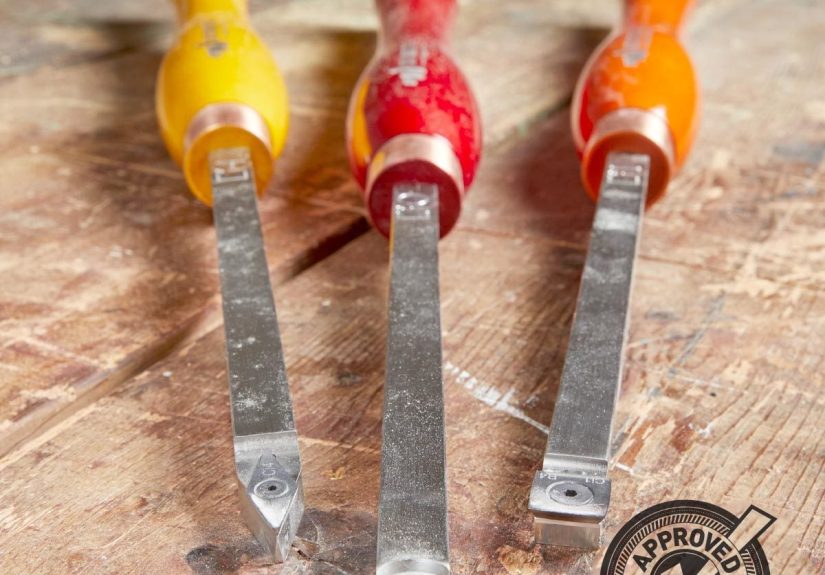
Square Cutter Rougher: Your Material-Removing Beast
If carbide turning tools had a pickup truck, the square cutter rougher would be it. This tool is designed to remove stock quickly, flatten areas, and tackle straight or gently curved surfaces. It is often the first carbide chisel you use when turning a blank round or hogging away waste on bowls and spindle projects.
A square or square-radius cutter is ideal for:
- Roughing square stock into a cylinder
- Removing bulk material fast
- Shaping outside bowl profiles
- Cutting tenons and straight sections
For many turners, this is the most-used carbide tool in the shop. If you buy only one carbide chisel first, buy a rougher. It does the heavy lifting, and heavy lifting is where your forearms earn their coffee.
Round Cutter Finisher: The Tool for Curves and Clean Surfaces
The round cutter finisher is the smooth talker of the set. It is better suited for flowing curves, concave areas, gentle shaping, and lighter finishing passes. When you want the tool to feel less aggressive and more controlled, the round cutter is often the answer.
It is especially useful for:
- Refining bowl interiors and exteriors
- Smoothing curved profiles
- Blending transitions
- Light finishing cuts
If the square rougher is the bulldozer, the round finisher is the paintbrush with muscles. It will not replace every tool in the world, but it often becomes the favorite for shaping elegant curves and getting a cleaner surface before sanding.
Diamond or Detail Cutter: Small Tool, Big Personality
The diamond cutter, sometimes sold as a detailer, is the carbide chisel you reach for when the work gets fussy. This tool excels in tight spaces, small grooves, crisp transitions, beads, coves, pommels, and fine decorative work.
It is a must-have for:
- Pen turning
- Detailing spindle projects
- Cutting small coves and beads
- Cleaning up tight inside corners
Beginners often underestimate the detail tool until they need it. Then suddenly it becomes the hero of the day, like the tiny Allen wrench you ignored until the entire project depended on it.
Negative Rake Cutter: The Secret Weapon for Tricky Materials
If you turn acrylic blanks, resin hybrids, very dense hardwoods, or hard-to-behave materials, a negative rake carbide cutter is worth serious consideration. These cutters are less aggressive than standard inserts, which helps reduce tear-out, chipping, and drama.
They are especially helpful when:
- Turning acrylics and resins
- Working with stabilized wood
- Finishing dense or brittle blanks
- Trying to get a cleaner surface with less grab
You do not always need negative rake cutters on day one, but once you start turning man-made materials or finicky hardwoods, they can save both your finish and your mood.
Hollower or Specialty Carbide Tool: Optional, but Very Handy
If you make hollow forms, vessels, or deeper boxes, a carbide hollower can be a smart addition. These tools are built to reach inside forms where straight tools become awkward. They are not essential for every shop, but they are useful when your projects move beyond simple bowls and spindles.
For most beginners, however, the best starter set is still the core trio: rougher, finisher, and detailer.
What Makes the Best Wood Turning Tools “Best”?
The best carbide tipped chisels are not necessarily the most expensive ones, and they are not automatically the tools with the flashiest handles or the most dramatic product names. In practice, the best wood turning tools usually share a handful of traits.
Comfortable handle length and balance
Longer handles offer more leverage on larger work, while shorter tools can feel nimble on pens and small spindles. The best fit depends on what you turn most often. If you do bowls, leverage matters. If you do pens, a smaller system may feel more natural.
Stable shaft design
Many turners prefer a flat-bottom or otherwise stable shaft because it registers well on the tool rest. That helps new users keep the tool controlled and reduces the chance of awkward catches. Stable tools are less exciting, and in woodturning that is usually a compliment.
Easy-to-replace inserts
A carbide tool is only as convenient as its insert system. Good tools let you rotate and replace inserts easily without hunting down obscure parts or performing tiny-finger surgery with a screw that rolls directly into a parallel universe.
Insert shape options
The more your system supports common cutter styles, the more adaptable it becomes. Square, round, and detail inserts cover most turning needs. Negative rake options are an excellent bonus.
Project-appropriate sizing
Full-size tools work well for bowls, platters, and furniture parts. Mid-size tools suit smaller spindle work and general hobby use. Mini systems are great for pens, ornaments, bottle stoppers, and other compact projects. Buying the wrong size is like bringing a snow shovel to frost a cupcake. Technically a tool was involved, but it was not the right one.
How to Choose a Carbide Tipped Chisel Set
If you are shopping for the best wood turning tools, resist the urge to buy every shiny object at once. Use your projects to decide.
Choose by project type
For bowls and larger blanks: prioritize a full-size square rougher and round finisher.
For pens and small spindle work: a detailer and mid-size finisher may get more use.
For mixed shop work: a three-piece set is the sweet spot.
Choose by skill level
Beginners usually benefit from carbide because it lowers the technical barrier. Intermediate turners often enjoy mixing carbide with traditional gouges. Advanced turners may use carbide for fast stock removal, certain finishing cuts, or hard materials while keeping HSS tools for delicate shaping.
Choose by maintenance preferences
If you hate sharpening, say it proudly. Carbide was made for you. If you enjoy sharpening and want maximum versatility, carbide can still be part of the lineup, but maybe not the whole lineup.
Common Mistakes to Avoid
Using the tool too aggressively
Carbide tools are user-friendly, but they are not magic wands. Light passes often produce a cleaner surface than pushing hard. If your lathe starts sounding like it is filing a complaint, back off.
Ignoring cutter geometry
Use the shape that matches the task. A square rougher can do a lot, but it is not the right answer for every fine detail. That is why the round and diamond tools exist.
Assuming carbide means no sanding
Nice try. Carbide can improve your surface, but sanding is still part of the process. The goal is less sanding, not zero sanding. Wood has a sense of humor too.
Buying bargain-bin sets without replacement support
Cheap carbide tools can be tempting, but if replacement cutters are hard to find or the screws strip easily, the bargain fades fast. Buy into a system with reliable replacement parts and common insert options.
Best Use Cases for Carbide Tipped Wood Turning Tools
These tools are especially strong in a few real-world situations:
- New woodturners learning tool control
- Hobbyists who do not want to build a sharpening station
- Pen turners who need crisp detail and small-scale control
- Bowl turners who want fast roughing and practical finishing tools
- Anyone turning resin, acrylic, or hybrid blanks
In other words, carbide tipped chisels are not just a trend. They are a genuinely useful category of wood lathe tools that solve real problems in real shops.
Shop Experience Notes: What Using These Tools Actually Feels Like
There is a reason carbide turning tools earn such loyal fans. The experience is surprisingly encouraging, especially for people who have bounced off traditional turning because the learning curve felt steeper than a roof in a snowstorm.
One of the first things many woodworkers notice is how quickly carbide tools make the lathe feel approachable. The presentation is simpler. The tool sits flat on the rest. The handle position feels easier to understand. Instead of wondering whether the bevel is rubbing correctly, you can focus on watching the cut, listening to the tool, and learning how the wood reacts. That shift alone can make a huge difference for beginners.
There is also a psychological benefit that does not get enough attention. When you are new to turning, every catch feels personal. A carbide tool often reduces that sense of chaos. It does not eliminate mistakes, but it makes the process feel more manageable. That helps you stay calm, and staying calm is one of the most underrated woodworking skills on earth.
On roughing work, the square carbide tool feels confident and direct. It chews through waste with satisfying efficiency, particularly on spindle blanks and the outside shaping of bowls. You begin to understand why so many hobby turners reach for it first. It is not subtle, and it is not trying to be. It is there to move wood out of the way so your project can happen.
The round finisher creates a different experience. It feels smoother, gentler, and more fluid on curves. This is usually the moment when beginners stop feeling like they are merely surviving woodturning and start feeling like they are actually shaping something. The tool glides more than digs, and the work begins to look intentional instead of accidental. That is a nice moment. You should enjoy it for at least seven seconds before immediately spotting a sanding scratch somewhere else.
The detail tool tends to surprise people. At first it looks small and maybe a little too specialized. Then you use it on beads, tight transitions, pen work, or tiny cleanup areas and suddenly it becomes the MVP. Good details make a project look crisp and finished, and this is where the diamond cutter earns its place.
Negative rake cutters create their own kind of relief. If you have ever turned acrylic or a resin hybrid blank and watched a standard cutter act just a little too eager, switching to negative rake can feel like the material finally decided to cooperate. The cut becomes calmer. Chipping is less dramatic. The surface often comes off the tool cleaner. It is not wizardry, but it can feel suspiciously close.
Over time, another pattern shows up: carbide tools make it easier to take short shop sessions. You can step into the garage for 30 or 40 minutes, make progress, and leave without spending half that time fussing with maintenance. For busy hobbyists, that matters. A tool that lowers setup friction gets used more often, and tools that get used more often are the ones that actually improve your skills.
That said, experienced turners often discover a balanced approach. Carbide is fantastic for fast shaping, easy learning, and certain materials, while traditional gouges may still win on ultimate finesse in some finishing situations. But that is not a weakness of carbide. It just means smart shops use the right tool for the job. And in plenty of shops, carbide tipped chisels do a very large share of the work.
Final Thoughts
If you want the best wood turning tools for a practical, frustration-free setup, start with carbide tipped chisels. A square rougher, round finisher, and diamond detailer cover the majority of projects most turners actually make. Add a negative rake cutter if you turn acrylics, resins, or very dense blanks, and consider a hollower later if your work moves into deeper forms.
The biggest advantage is not just convenience. It is momentum. Carbide tools help you spend more time learning cuts, reading grain, shaping forms, and enjoying the lathe. That is what makes them such a smart investment. Less sharpening. Less confusion. More shavings on the floor. Frankly, that is the kind of math woodworking was built for.