Table of Contents >> Show >> Hide
- The quick answer (for people who preheat the oven before reading the recipe)
- Why freezing cookie dough works so well
- Which cookie doughs freeze best?
- How to freeze cookie dough (the right way, not the “shove the bowl in the freezer” way)
- Method 1: Freeze dough balls for drop cookies (the freeze-and-bake MVP)
- Method 2: Freeze slice-and-bake logs (icebox cookies that save freezer space)
- Method 3: Freeze cutout dough (for roll-outs, holidays, and people who own three sizes of star cutters)
- Method 4: Freeze bar-cookie dough (cookie dough’s “meal prep” era)
- How long can you freeze cookie dough?
- Can you bake cookie dough straight from frozen?
- How to prevent freezer burn (and “my dough tastes like last night’s garlic bread”)
- Common problems (and fixes that don’t involve kitchen drama)
- Food safety: the part where I kindly ruin raw-dough snacking
- Smart labeling (because all frozen dough looks the same at 10 p.m.)
- FAQ
- Conclusion: yes, freeze the doughyour future self will high-five you
- Real-life experiences that make freezing cookie dough totally worth it (and occasionally hilarious)
Yesyou can absolutely freeze cookie dough, and it’s one of those “future you will write you a thank-you note”
kitchen moves. Freezing dough means you can bake two cookies on a random Tuesday like a responsible adult…
without committing to a full batch that somehow vanishes before it cools.
The quick answer (for people who preheat the oven before reading the recipe)
Most cookie dough freezes beautifully. The best approach is to portion it first (scoops/balls for drop cookies,
logs for slice-and-bake, disks/sheets for roll-outs). Freeze the portions until firm, then store airtight with a label.
For best quality, aim to use frozen dough within about 2–3 months, though well-wrapped dough can often bake up
nicely for longer.
Why freezing cookie dough works so well
Cookie dough is basically a carefully balanced “engineering project” made of fat, sugar, flour, and eggs (plus the fun
stuff: chocolate, nuts, sprinkles, tiny marshmallows you swear are “for the kids”). Freezing pauses time:
flavors stay stable, the fat stays solid, and you keep the option to bake exactly what you needno more,
no less. It also helps you avoid the classic trap of:
- “I’ll just bake a couple.” (Narrator: They baked all of them.)
- “I’ll just taste a little dough.” (Also not recommendedmore on that later.)
Which cookie doughs freeze best?
The good news: most do. The “it depends” part: texture and add-ins can change slightly depending on the style.
Here’s a practical breakdown.
Usually excellent in the freezer
- Drop cookies (chocolate chip, oatmeal raisin, peanut butter): portion, freeze, bake from frozen.
- Slice-and-bake (icebox) cookies: dough logs freeze compactly and slice neatly after thawing.
- Cutout/roll-out sugar cookies: freeze as disks of dough or rolled sheets between parchment.
- Bar cookie dough (blondies, cookie bars): freeze as a wrapped slab or in the pan (if freezer-safe).
Freeze with a little extra care
-
Delicate, very soft doughs (high butter, low flour): they still freeze, but can be prone to freezer burn.
Wrap like you mean it. - Chunk-heavy doughs (lots of nuts/candy): portioning helps prevent crumbling and uneven baking later.
- Meringue-based cookies: better to freeze baked cookies rather than the raw mixture.
How to freeze cookie dough (the right way, not the “shove the bowl in the freezer” way)
Your goal is simple: keep air out, keep odors out, and keep your future self from playing “guess the mystery dough.”
The best method depends on the cookie type.
Method 1: Freeze dough balls for drop cookies (the freeze-and-bake MVP)
- Make the dough as usual.
- Portion it using a cookie scoop or tablespoon. Uniform scoops bake evenly and look bakery-level.
-
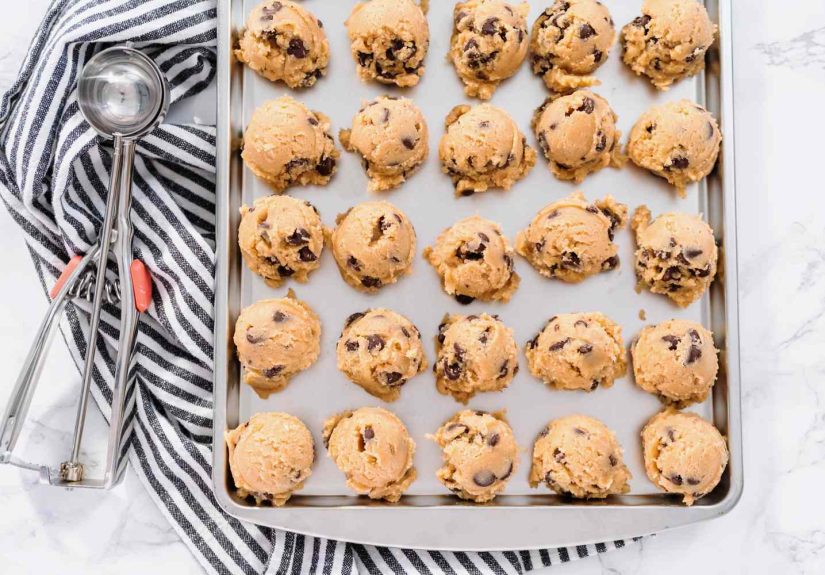
Freeze on a sheet: place dough balls on a parchment-lined baking sheet and freeze until solid
(a few hours or overnight). -
Pack airtight: transfer frozen dough balls to a zip-top freezer bag or airtight container.
Press out excess air. - Label like a pro: cookie type, date, oven temp, and bake time (plus “add 2–3 minutes from frozen”).
Why this works: pre-freezing prevents dough balls from fusing into one mega-cookie boulder (which is impressive,
but not the vibe).
Method 2: Freeze slice-and-bake logs (icebox cookies that save freezer space)
- Shape the dough into a log (or two smaller logs for easier handling).
- Wrap tightly in plastic wrap, then add a second layer (foil or a freezer bag).
- Freeze until firm.
-
Thaw before slicing in the refrigerator until the dough is sliceable (usually overnight),
then slice and bake.
Extra tip: if your log gets a flat side in the freezer, roll it a few times during the first hour of chilling
(or store it in a cardboard paper towel tube cut lengthwise as a little “log keeper”).
Method 3: Freeze cutout dough (for roll-outs, holidays, and people who own three sizes of star cutters)
- Divide into disks and wrap each one tightly, or roll between parchment into flat sheets.
- Double-wrap to prevent dry edges.
- Freeze flat so it stacks neatly.
- Thaw in the fridge until pliable, then roll/cut as usual.
Flat sheets thaw faster and roll out like a dreamplus they don’t take up your entire freezer like an unruly snow tire.
Method 4: Freeze bar-cookie dough (cookie dough’s “meal prep” era)
- Press dough into a slab on parchment (or into a freezer-safe pan lined with parchment for easy lifting).
- Wrap the slab/pan tightly to block air.
- Thaw overnight in the refrigerator, then bake according to your recipe.
How long can you freeze cookie dough?
For best quality, many food-safety and baking resources suggest using frozen cookie dough within
about 2–3 months. That window keeps flavors fresh and helps prevent freezer burn.
If your dough is wrapped extremely well and stored at a steady freezer temperature, it may still bake up well
beyond that, but texture can slowly decline over time (think: drier edges, less vibrant butter flavor).
Can you bake cookie dough straight from frozen?
Most of the time, yesespecially for portioned dough balls. Baking from frozen is the whole point of “emergency cookies.”
Here’s how to do it without turning your cookies into “crisp on the outside, raw geology in the center.”
Freeze-and-bake timing guide
- Start with the same oven temperature your recipe uses.
- Add 2–4 minutes to the bake time for frozen dough portions (varies by size and dough richness).
-
Watch the edges: cookies are usually done when edges look set and centers look slightly underdone
(they finish as they cool). - Use a light-colored sheet pan if you have onemore even browning and fewer surprise scorched bottoms.
When you should thaw first
- Slice-and-bake logs (thaw to slice cleanly).
- Roll-out dough (thaw until pliable so it doesn’t crack).
- Very thick portions (jumbo cookies): a short thaw helps the center bake evenly.
How to prevent freezer burn (and “my dough tastes like last night’s garlic bread”)
Freezer burn is basically dehydration plus air exposure. It won’t usually make dough unsafe, but it can make it taste stale
and bake up dry. Odor transfer is the other villainbecause butter loves collecting “notes” from whatever lives nearby.
Here’s how to protect your dough:
- Double-wrap (plastic wrap + freezer bag, or plastic wrap + foil).
- Press out air from bags; consider using a straw to gently pull extra air out before sealing.
- Freeze quickly in small portionsfast freezing means smaller ice crystals and better texture later.
- Store in the back of the freezer where temperature is most stable (not in the door).
- Label clearly so you don’t keep re-opening the bag to play “sniff detective.”
Common problems (and fixes that don’t involve kitchen drama)
“My cookies spread too much after freezing.”
This can happen if the dough warmed up during handling or your freezer cycles warmer near the door.
Fix: bake from fully frozen, use a chilled pan, and make sure the dough is well wrapped.
If the original recipe already spreads a lot, chilling (or a slightly longer bake from frozen) helps.
“My frozen dough is dry and crumbly.”
Usually freezer burn or air exposure. Fix: improve wrapping next time. For the current batch,
let the dough sit a few minutes at room temp just until workable, then press/reshape portions gently before baking.
“The cookies taste… flat.”
Butter can pick up freezer odors, and long storage can dull flavor. Fix: double-wrap, store airtight,
and aim for the best-quality window. Also, consider freezing dough without delicate toppings (like flaky salt)
and adding them right before baking.
Food safety: the part where I kindly ruin raw-dough snacking
Even homemade cookie dough can carry food-safety risks because flour is typically a raw ingredient,
and many recipes contain raw eggs. That means tasting raw dough can potentially make you sick.
Freezing doesn’t reliably “kill the bad stuff,” eitherit just puts things on pause.
- Don’t taste raw dough (sorry, I don’t make the rules; microbes do).
- Wash hands and surfaces after handling dough, flour, and eggs.
- Bake fully and follow recipe temperatures and times for best safety and texture.
If you want something safe to snack on, look for recipes designed as edible cookie dough that use
heat-treated flour and no raw eggs (or use pasteurized ingredients).
Smart labeling (because all frozen dough looks the same at 10 p.m.)
A good label turns your freezer into a bakery menu instead of a suspense novel.
Write this on the bag/container:
- Cookie name (e.g., “Choc Chipextra dark”).
- Date.
- Oven temp + bake time (and “+ 2–4 min from frozen” if applicable).
- Portion size (tablespoon, #40 scoop, etc.).
FAQ
Can you freeze cookie dough with baking powder or baking soda?
Yes. Most standard cookie doughs freeze well with chemical leaveners. For best results, freeze dough promptly
and bake within the best-quality window so the leavening performs reliably.
Can you freeze store-bought cookie dough?
Usually yes, and many brands are already designed for chilled or frozen storage. Keep it in airtight packaging
and follow label guidance. If you portion it into bake-ready pieces first, you’ll get the same “bake a few now” convenience.
Is it better to freeze dough or baked cookies?
Freezing dough gives you “fresh-baked” texture on demand. Freezing baked cookies is great for shipping,
gifting, or instant grab-and-go snacks. If you want warm, gooey centers: freeze dough. If you want convenience:
freeze baked cookies (or do both and become unstoppable).
Conclusion: yes, freeze the doughyour future self will high-five you
Freezing cookie dough is one of the easiest ways to bake smarter without sacrificing that fresh-from-the-oven magic.
Portion first, freeze until firm, store airtight, and label clearly. Most doughs bake straight from frozen with a small
time bump, while logs and roll-outs do best with a fridge thaw. Keep quality high by blocking air and odors,
and remember: raw dough isn’t a snackyour oven is the final boss.
Real-life experiences that make freezing cookie dough totally worth it (and occasionally hilarious)
If you’ve never frozen cookie dough before, the first “aha” moment usually happens on a night when you want
something sweet but you absolutely do not want to wash a mixing bowl the size of a kiddie pool. That’s when you
remember: there’s cookie dough in the freezer. You pop a couple frozen dough balls onto a sheet, and suddenly your
kitchen smells like a warm bakery instead of “whatever I microwaved earlier.” It feels like cheatingbut in the
wholesome, legal, dessert-based way.
People often start with holiday baking, because it’s the one time of year when cookie demand behaves like a
shopping mall parking lot: chaotic and somehow personal. Freezing dough turns the season into manageable steps.
You can make one dough on Saturday (say, chocolate chip), another on Sunday (ginger molasses), freeze both,
and bake in smaller bursts during the week. Instead of an eight-hour baking marathon, you get bite-sized sessions
and fresh cookies whenever guests “just happen” to drop by. The best part? You look wildly prepared, like you
run a cozy, competent household. (Your freezer knows the truth.)
There’s also the very real “labeling lesson.” The first time someone freezes dough without a label, they assume
they’ll recognize it later. Two weeks pass, and now you have a bag of mysterious beige lumps. Is it sugar cookie dough?
Snickerdoodle? Garlic biscuit dough? Nobody knows. At this point, your best move is to bake one “test cookie”
and call it research. After that, labeling becomes a non-negotiable habitbecause “Mystery Cookie Thursday”
is fun exactly once.
Another common experience: the freezer-odor surprise. Butter is a flavor sponge, and if your dough isn’t sealed well,
it can pick up the faint vibe of whatever else is hanging out nearby. (Frozen salmon has no business in your
chocolate chip cookies’ personal space.) The fix is simpledouble-wrap and store airtightbut the memory sticks.
After one batch of “chocolate chip with notes of freezer,” people become very dedicated to good containers.
Families also love the “portion control that isn’t depressing.” Freezing dough makes it easy to bake just a few cookies
at a time, which means you can have fresh cookies more often without committing to forty-eight cookies living on your
counter whispering your name. Want two cookies after dinner? Great. Want six for a movie night? Also great. It feels
flexible and intentional, instead of that familiar cycle of “We baked a batch!” followed by “We ate a batch.”
And then there’s the quiet joy of cookie customization. Once you get the hang of freezing dough balls, it’s easy to
split a base dough into mini “flavor teams.” Half the batch gets chocolate chunks, a quarter gets toasted pecans,
and the last quarter gets dried cherries and a little orange zest. Freeze them in separate labeled bags, and now your
freezer is basically an artisanal cookie shop. On any given day, you can choose your mood: classic, nutty, fancy, or
“I had a long day and deserve chocolate the size of a small satellite.”
The overall experience is this: freezing cookie dough turns baking from an event into an option. It removes the
all-or-nothing pressure, saves time during busy weeks, and gives you warm cookies on demandwithout starting from
scratch every time. Once you’ve had that first successful “two cookies from frozen” win, you’ll start freezing dough
on purpose, not just as leftovers. That’s when you know you’ve leveled up.