Table of Contents >> Show >> Hide
- Why Historical Portraits Look So Powerful (Even When the Sitter Was Just… a Guy)
- Why Cats Belong in the Frame
- The 25 Historical Portrait Concepts (Because Your Cat Deserves a Title)
- 1) The Renaissance Merchant Prince
- 2) The Baroque Countess of Drama
- 3) The Enlightenment Philosopher
- 4) The Naval Commander
- 5) The Regency Socialite
- 6) The Victorian Industrial Magnate
- 7) The Gothic Romantic
- 8) The Imperial Court Favorite
- 9) The Classical Scholar
- 10) The Frontier Captain
- 11) The Gilded Age Heiress
- 12) The Jazz Age Icon
- 13) The Revolutionary Leader
- 14) The Grand Duchess of Winter
- 15) The Desert Prince
- 16) The Mountain Warden
- 17) The Painter’s Muse
- 18) The Cathedral Patron
- 19) The Scientific Pioneer
- 20) The Judge of All Things
- 21) The Opera Star
- 22) The Garden Empress
- 23) The Minimalist Modern Monarch
- 24) The Seaside Aristocrat
- 25) The Coronation Portrait
- How to Make the “Majestic” Look Feel Real (Without Forcing the Cat)
- Bonus: of Real-World Experiences With Majestic Cat Portraits
- Conclusion: A Little History, A Lot of Whiskers, and 25 Ways to Make a Cat Look Legendary
There are two universal truths in this world: (1) humans have always loved looking important in portraits, and
(2) cats have always looked important without even trying. So when you mash those truths togetherespecially in
today’s era of playful digital editing and “what if my pet were royalty?” creativityyou get a delightful new
genre: cats reimagined as grand historical sitters.
This article is your guided tour through the idea: why classic portraits feel so “majestic,” why cats are
absurdly perfect for the role, and how 25 imagined historical-style portraits can capture everything from
Renaissance drama to Gilded Age swaggerwhile still honoring the most historically accurate detail of all:
the cat’s total lack of interest in your agenda.
Why Historical Portraits Look So Powerful (Even When the Sitter Was Just… a Guy)
Traditional portraiture is basically visual PR. Artists and patrons used portraits to project status, identity,
accomplishment, and sometimes a little “don’t mess with me” energy. Majestic portraits often share a toolkit of
tactics: commanding posture, formal clothing, symbolic objects (books, swords, globes, medals), and backgrounds
that quietly whisper, “I own at least three estates and a questionable number of velvet curtains.”
The magic is that these choices aren’t random. Clothing can suggest wealth or authority. Props can signal
education, leadership, creativity, or power. Even the angle of the headchin up, eyes steadycan turn an ordinary
sitter into a legend. In many ways, the “majesty” comes from design: a coordinated set of visual signals that
tells you how the subject wants to be perceived.
Now swap in a cat, and the system still works. Why? Because cats already communicate a lot through posture,
gaze, ears, and tail positionmeaning you can build a believable “royal” attitude using the same visual language
portrait artists have always leaned on.
Why Cats Belong in the Frame
Historically, cats have worn many symbolic hats (even when they refuse to wear literal hats). They’ve been
admired for pest control, associated with mystery and independence, and celebrated in art across cultures.
Ancient Egypt famously elevated cats into sacred space, linking them with divine protection and iconography.
Later, cats appear in manuscripts, prints, paintings, and modern museum collectionssometimes as companions,
sometimes as muses, and sometimes as tiny chaos agents who absolutely did not ask to be included.
On the personality side, cats are ready-made aristocrats. They sit like they own the room. They stare as if
they’re evaluating your life choices. They accept praise like it’s overdue. In short: if you want a “majestic
figure,” you will have a hard time finding a creature more naturally prepared than a cat.
Majestic Cat Portraits (SEO-friendly keywords you’ll actually use)
- Majestic cat portraits
- Historical portrait style cat art
- Cats as royalty portraits
- Renaissance cat painting aesthetic
- Victorian cat portrait parody
- Regal cat photography edits
The 25 Historical Portrait Concepts (Because Your Cat Deserves a Title)
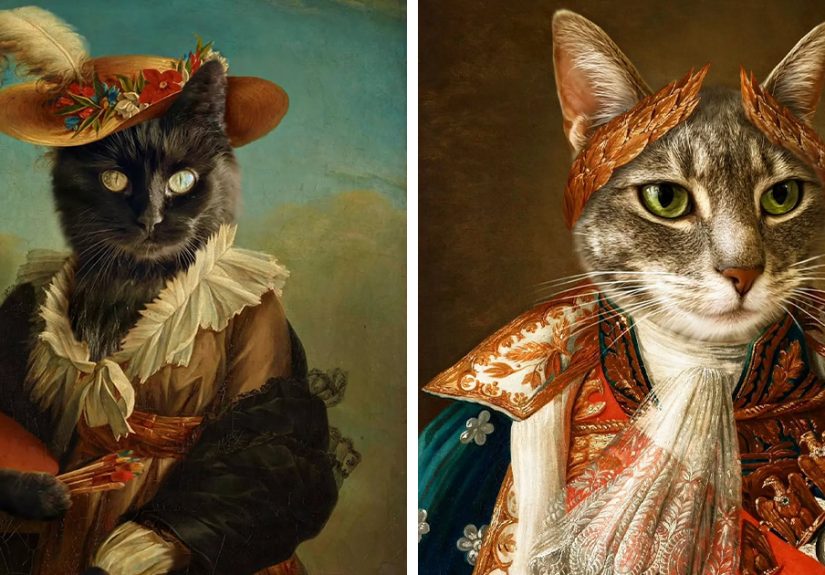
Below are 25 portrait “templates” inspired by real historical styles and the visual grammar of classic
portraiture. These aren’t copies of specific paintings. Think of them as creative prompts: distinct eras,
outfits, props, and moods you can imagine (or recreate) while keeping the cat’s personality front and center.
1) The Renaissance Merchant Prince
A cat in a dark brocade doublet, paws folded like it just approved a major trade deal. The background hints at
ledgers and a distant harbor. The expression says, “Yes, I control the spice route. No, you may not touch my
whiskers.”
2) The Baroque Countess of Drama
Pearls, satin, and lighting so theatrical it practically comes with a soundtrack. One paw rests on a velvet
armrest as if it’s the most natural thing in the world. The gaze is intense: this cat has secrets and
absolutely will not share them.
3) The Enlightenment Philosopher
A powdered-wig vibe, a small stack of books, and a quill nearbybecause nothing says “I think deeply” like a
creature that stares at a wall for 20 minutes and calls it research.
4) The Naval Commander
A crisp coat with brass buttons, a map table, and a tiny ship model. The pose is steady and symmetrical,
suggesting disciplineuntil you notice the tail, which implies a mutiny is still possible.
5) The Regency Socialite
Soft curls (fur), a delicate collar, and a ballroom background blurred into candlelit glow. This cat looks
like it has opinions about everyone in the roomand those opinions are not flattering.
6) The Victorian Industrial Magnate
A stern chair, a pocket watch, and a “built-my-empire” vibe. The cat’s posture is upright, the stare is
direct, and the overall energy is “I invented this factory. Also, I own your sofa.”
7) The Gothic Romantic
Dark clothing, moody architecture, maybe a stormy sky outside the window. The cat looks wistful, like it’s
composing poetry about a tragic love storythen immediately forgetting it because a moth flew by.
8) The Imperial Court Favorite
Heavy embroidered fabric, rich jewel tones, and a cushion that screams “palace budget.” The cat’s chin is
slightly lifted, the ultimate “I was born for this” angle.
9) The Classical Scholar
Marble columns, a laurel motif, and a scroll. The subject looks calm and timeless, as if it’s been studying
ancient texts for yearswhen in reality it’s been studying how to open a cabinet.
10) The Frontier Captain
Weathered textures, a rugged coat, and a landscape that suggests big skies and bigger attitudes. The cat’s
expression says it has survived winter and will survive your attempts to put on a tiny hat.
11) The Gilded Age Heiress
Feathers, jewelry, and enough shine to reflect your insecurities. The pose is elegant, the gaze is measured,
and the entire portrait screams “old money” even if the cat was adopted last month.
12) The Jazz Age Icon
Art Deco geometry, a sleek silhouette, and a background that whispers “speakeasy.” The cat looks like it knows
the password and will not tell you.
13) The Revolutionary Leader
A bold red sash, a confident stance, and a distant crowd. The portrait radiates convictionthough the cat’s
actual platform is mostly “more treats” and “abolish closed doors.”
14) The Grand Duchess of Winter
Fur-on-fur luxury (very on-brand), icy color tones, and a regal cape. The cat appears like a mythic ruler of
snowfieldsuntil it sees a heated blanket and immediately switches loyalties.
15) The Desert Prince
Warm light, textured fabrics, and an elegant profile. The cat looks serene, like it belongs in a storybook
caravanwhile also giving the unmistakable vibe that it expects service.
16) The Mountain Warden
A sturdy cloak, a dramatic peak in the distance, and a brooch that looks like it has a backstory. The cat’s
posture is grounded and watchful, as if guarding an ancient pass (or your kitchen).
17) The Painter’s Muse
A studio setting with brushes and a half-finished canvas. The cat is posed like it’s the inspiration for a
masterpiece, which is accurateif the masterpiece is “how I missed my deadline because the cat sat on my work.”
18) The Cathedral Patron
Stained-glass hues, gold trim, and a dignified three-quarter pose. The symbolism is clear: power, reverence,
and a faint suspicion this cat donated generously to the building fund (with your money).
19) The Scientific Pioneer
Instruments, diagrams, and a precise, studious vibe. The cat looks like it just discovered a new element:
“treatium.” The seriousness is impeccable; the irony is delicious.
20) The Judge of All Things
Dark robes, a high-backed chair, and lighting that says “final verdict.” The cat’s eyes are calm, unblinking,
and slightly terrifying. You are guilty of waking it from a nap.
21) The Opera Star
Dramatic posture, theatrical costume, and a background of red velvet and stage lights. This cat looks like it
can hit a perfect notethen chooses silence, because the audience hasn’t earned it.
22) The Garden Empress
Lush foliage, soft sunlight, and a floral collar that somehow doesn’t look ridiculous. The cat is centered,
poised, and deeply satisfied, as if it personally invented roses.
23) The Minimalist Modern Monarch
Clean lines, a simplified color palette, and a single bold symbollike a crown-shaped silhouette. The mood is
contemporary and confident. The cat’s expression remains timeless: mildly unimpressed.
24) The Seaside Aristocrat
A windswept cape, a distant lighthouse, and a pose that says “I gaze into the horizon because my legacy is
vast.” In practice, it’s gazing because a seagull moved.
25) The Coronation Portrait
The full fantasy: throne, ceremonial fabric, a symbolic orb (a yarn ball counts), and a gaze so steady it
could stabilize a shaky economy. The cat has achieved peak majesty. The cat has also achieved peak entitlement.
How to Make the “Majestic” Look Feel Real (Without Forcing the Cat)
The secret is to work with cat behavior, not against it. Cats naturally communicate confidence through upright
posture, a steady gaze, and relaxed positioningso your best “royal” moments often happen when the cat is simply
comfortable and curious. If the ears are forward and the body looks loose, you’ll get a calmer, more composed
portrait vibe. If the ears are pinned back, the tail is whipping, and the pupils are huge, your “coronation”
shoot is about to become an action film.
Practical (and humane) tips that still feel creative
- Use props around the cat, not on the cat. A cushion, a draped blanket, or a “throne” chair works better than costumes.
- Chase the light, not the pose. Soft window light instantly makes images feel painterly.
- Capture the three moods: calm (majestic), alert (commanding), and mildly annoyed (historically accurate aristocracy).
- Keep sessions short. Most cats do not want a 45-minute photoshoot. They want a 45-second photoshoot and a 45-minute nap.
- Let the cat choose the set. If it sits somewhere with conviction, that place is now the palace.
Finally, if you’re editing digitally, treat “historical portrait style” as a mood board: rich textures, subtle
grain, deeper shadows, and gentle highlights. You’re not trying to copy a specific paintingyou’re borrowing the
visual language that makes classic portraits feel timeless.
Bonus: of Real-World Experiences With Majestic Cat Portraits
If you’ve ever tried to photograph a cat, you already know the emotional roller coaster: you begin with a plan,
the cat immediately rejects your plan, and somehow the cat still ends up looking like the main character. That’s
the first “experience lesson” of majestic cat portraitsyour role is less “director” and more “court painter who
has accepted chaos as a medium.”
People often describe the funniest part as the sheer mismatch between the grandeur they’re aiming for and the
cat’s personal priorities. You set a chair like a throne, place a dramatic blanket like a royal cape, and your
cat walks over, sniffs the whole scene like a skeptical museum curator, and then sits one foot to the leftbecause
that’s where the vibes are. And honestly? That’s historically consistent. Many portrait sitters had opinions, too.
Cats just express theirs with more bluntness and less diplomacy.
Another common experience: the “majestic moment” arrives when you stop chasing it. You may spend ten minutes
trying to get a stately pose, but the winning shot happens when the cat pauses mid-stride, ears forward, eyes
focused, and posture tallusually because it heard something interesting. This is where understanding body
language helps. A relaxed stance and forward ears often signal comfort or curiosity, which reads as confidence on
camera. Meanwhile, a twitchy tail or ears angled back can mean overstimulation, and that’s your cue to give the
cat space (and preserve your dignity).
Pet owners also report a surprisingly wholesome side effect: these portraits make you notice your cat’s “faces”
and gestures in a new way. The slight squint that reads as calm. The slow blink that feels like trust. The way a
cat can look noble simply by sitting still and letting the world revolve around it. When you start matching those
natural expressions to portrait “roles” (the judge, the scholar, the empress), it becomes a kind of character
studylike you’re translating personality into art.
And yes, there’s the classic experience of props failing spectacularly. The crown? Rejected. The little cape?
Offended. The ornate collar? Immediately transformed into a chew toy. This is why many creators shift to
“environmental majesty”: instead of dressing the cat, you dress the world around the cat. Draped fabric behind
the chair, a soft spotlight from a lamp, a vintage-looking book nearby, or a yarn ball standing in for a royal
orb. It’s the same visual trick historical portraiture usessymbols and setting do a lot of storytellingexcept
now the storyteller is also a fuzzy creature who may disappear under the bed at any moment.
The final experience many people share is the reward: you end up with an image that feels both ridiculous and
genuinely beautiful. The humor is obvious (“Sir Whiskers, Duke of Snacks”), but the artistry can be reallight,
texture, posture, and expression combining into something that looks like it belongs in a gallery. And then,
inevitably, the cat sees the attention you’re giving the portrait and decides it deserves a second portrait. The
monarchy, apparently, is hereditary.