Table of Contents >> Show >> Hide
- Who Is Hormazd Narielwalla?
- What “Modernist Love Affair” Actually Refers To
- Why His Materials Feel So Modernist
- How Narielwalla Builds the “Love Affair”
- Reading “Modernist Love Affair” Like a Story
- Why Interior Designers Keep Noticing His Work
- Collecting “Modernist Love Affair” Without Guesswork
- Experiences Around Hormazd Narielwalla’s Modernist Love Affair
- Conclusion: A Modernist Crush That Actually Lasts
If modernism had a dating profile, it would be all sharp cheekbones, clean lines, and an obsession with
“honest materials.” Hormazd Narielwalla’s Modernist Love Affair takes that exact energycool,
geometric, slightly mysteriousand turns it into something unexpectedly tender: a romance between the human body
and the architecture of ideas.
Narielwalla is known for building artworks from tailoring and sewing patternsthose diagram-like paper
templates that map a body without showing a face. In his hands, patterns become abstract portraits, color
studies, and modernist compositions that feel part Bauhaus, part love letter, and part “I found this in a drawer
and now it’s art.” That’s not a drag. That’s the point.
Who Is Hormazd Narielwalla?
A collage artist who starts where fashion ends
London-based artist and author Hormazd Narielwalla has built a distinctive practice by using discarded
tailoring patterns (including Savile Row suit patterns) and their vintage counterparts as the base for
collage works. A major origin story is his artist’s book Dead Man’s Patterns (2008), inspired by the
bespoke patterns of a deceased tailoring clientpaper outlines made for a body that no longer exists.
Instead of treating them as trash, he treated them like drawings: elegant, human, and quietly haunting.
Patterns as portraits (without the awkward eye contact)
A pattern is a set of instructionslines, curves, numbers, notationsdesigned to become a second skin. That makes
it oddly intimate. It’s also naturally abstract: a shoulder becomes an arc; a waist becomes a curve; a sleeve is
basically modern sculpture waiting to happen. Narielwalla leans into that abstraction, turning these “body maps”
into compositions that feel like people, places, and moodsall without painting a single literal figure.
What “Modernist Love Affair” Actually Refers To
A series of geometric works with numbered variations
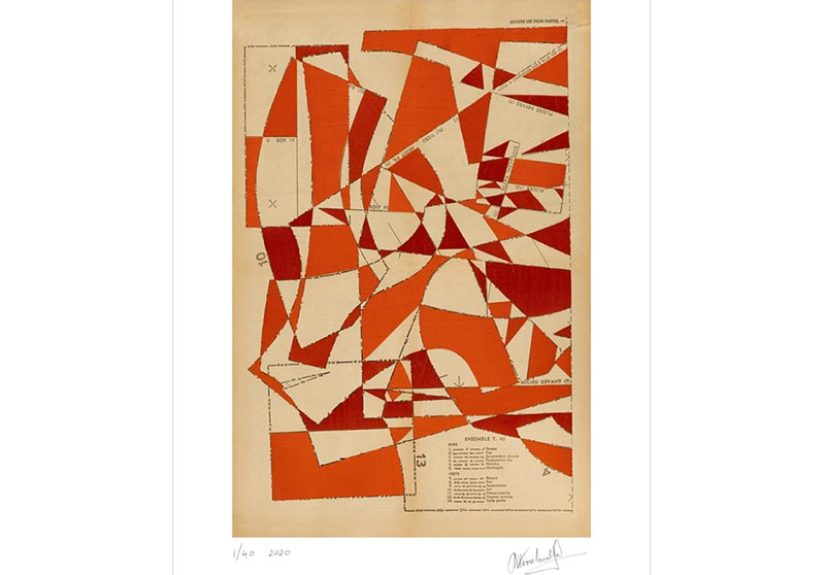
The Modernist Love Affair isn’t just a poetic phraseit’s a recognizable body of work connected to
Narielwalla’s ongoing interest in geometry, color, and the way modernism reshaped how we see structure. Works
appear with titles like The Modernist Love Affair No.3 and No.5, and they’re described as mixed-media
collages built on vintage French sewing patterns. The numbering matters: it suggests variations on a theme the
way architects revisit a floor plansame logic, different emotional weather.
The limited-edition print that made “Modernist Love Affair” more collectible
The phrase also appears as a limited-edition art print collaboration sold through design-forward retail channels.
Product details describe a giclée print on heavyweight Somerset paper, hand-signed and numbered, offered as a
small edition. In other words: modernist vibes, but make it accessiblesomething you can actually hang in your
home without needing museum-level insurance premiums.
Why His Materials Feel So Modernist
Because tailoring patterns are basically blueprints
Modernism loves systems: grids, proportions, structure, and clarity. A tailoring pattern is all of that, with the
bonus of being rooted in human measurement. In Narielwalla’s work, the body becomes a kind of architecturean
engineered form with seams, joins, and structural logic. That’s why the collages don’t feel like decoration; they
feel like design thinking made emotional.
Because modernism always had a “human problem”
Here’s the funny thing about modernism: it wanted to be universal, but people are inconveniently specific.
We slouch. We age. We have feelings. Narielwalla’s pattern-based collages play in that tension. The base layer is
measured and rational, but the final image is expressivebuilt from cut paper, color, texture, and compositional
choices that behave more like memory than math.
How Narielwalla Builds the “Love Affair”
Letting the pattern lead (a surprisingly good relationship strategy)
Narielwalla has described a process that begins with choosing a pattern base, selecting color, and then allowing
the work to evolve without preliminary sketchingtrusting judgment and the visual push-and-pull of the materials.
That approach matters for reading Modernist Love Affair: these pieces aren’t cold diagrams. They’re more
like conversations with structure, where the pattern suggests what it wants to become.
Color as mood, not just style
In works connected to The Modernist Love Affair, he’s been known to use decorative papers (including
Japanese papers) and strong geometric arrangements to create a sense of shifting light and atmosphereproof that
a grid can be romantic if you stop treating it like a spreadsheet.
Reading “Modernist Love Affair” Like a Story
The body is presenteven when it’s missing
There’s a built-in ghost of the body in every pattern: not spooky, but quietly real. A pattern is evidence that
someone existed with specific proportions. When Narielwalla layers modernist shapes over that evidence, the result
feels like a dialogue between the physical and the ideal. The modernist part wants order. The pattern part
insists: “Yes, but whose body are we talking about?”
Modernist romance: the thrill of structure
The “love affair” in the title reads like a playful confession. Modernism has always seduced artists and designers
with its promise of clarityclean forms, bold color blocks, purposeful composition. Narielwalla doesn’t reject that
seduction; he embraces it. But he also complicates it by building on pattern papermaterial that carries history,
labor, and the intimate weirdness of clothing construction.
Why Interior Designers Keep Noticing His Work
It behaves like architecture on a wall
A good modernist collage does something many artworks don’t: it organizes space. The geometry gives your eye a
path, which makes it a strong candidate for interiorsespecially if your room has clean lines, midcentury cues,
or simply a big blank wall begging for something smarter than “Live Laugh Love.”
It’s a bridge between art people and design people
Narielwalla’s work sits in the sweet spot where collectors, fashion fans, and design enthusiasts can all nod
enthusiastically without pretending they totally understand each other. If your friend says, “It’s so Bauhaus,”
and your other friend says, “It’s so couture,” both can be rightbecause the material logic comes from clothing,
but the visual language is modernist abstraction.
Collecting “Modernist Love Affair” Without Guesswork
Originals vs. editions: what you’re actually buying
If you see a work like The Modernist Love Affair No.5 listed as mixed media on vintage sewing patterns,
you’re likely looking at an original collage. Those works emphasize material presence: the paper edges, the
layering, the way the underlying pattern lines peek through like a secret. A limited-edition print version, on
the other hand, translates the composition into a more standardized formatstill beautiful, more attainable, and
easier to place in a modern home.
Why the pattern base matters for value and meaning
With Narielwalla, the “support” (what the artwork is made on) is not a neutral backdrop. The pattern is content.
It’s concept. It’s history. Even when you’re buying a print, knowing the original logictailoring patterns as
human blueprintadds depth. You’re not just buying a pretty geometric collage; you’re buying a story about bodies,
craft, and modernism’s ongoing obsession with form.
Experiences Around Hormazd Narielwalla’s Modernist Love Affair
Seeing Modernist Love Affair (or living with it) tends to spark a specific kind of experienceone that’s
part visual, part emotional, and part “wait, is that a sleeve?” For a gallery visitor, the first moment is often
the clean hit of geometry: bold shapes, crisp edges, a composition that feels balanced enough to have a personal
trainer. Your eyes read it as modernist abstractionconfident, ordered, design-savvy. Then, as you step closer,
the work starts whispering its second language: faint pattern markings, numbers, curve guides, and dotted
notations that reveal the base material is a garment map. The piece becomes less like a poster and more like a
constructed objectan argument made from paper.
If you’ve ever held tissue-thin pattern paper, you know it has a particular texture and fragility. That
association can make the experience surprisingly personal. A viewer might suddenly think of a relative sewing at a
kitchen table, or of being fitted for something formal, or of thrift-store dresses with mysterious origins. Even
if you’ve never sewn a button in your life, you can feel the labor embedded in the material: the idea that
something once existed to be worn, moved in, lived in. That adds a kind of warmth to modernism, which is often
accused (sometimes unfairly) of being emotionally distant.
In a home setting, the experience evolves with time. In the morning, the piece can read as calm and architectural,
like a window into a perfectly organized universe. In the evening, when shadows soften the wall, the underlying
pattern lines may become more noticeable, and the work starts to feel like a palimpsestlayers of intention and
revision. That slow reveal is part of the charm. It rewards repeat looking. You don’t “finish” the artwork in one
glance; you keep discovering it in small doses, like a long-running crush on a very stylish person who also
happens to be emotionally complex.
People also tend to have a funny, social response to the work. Guests might first compliment the colorsbecause
that’s the polite thing to do when you’re standing in someone’s hallwayand then they notice the pattern base and
suddenly the conversation turns. Someone asks, “Is this fashion?” Another person says, “No, it’s like
architecture.” Then a third person (inevitably) says, “It’s giving Bauhaus.” That’s the cross-disciplinary magic:
the work is a safe meeting point for different kinds of curiosity. It doesn’t require specialized vocabulary to be
enjoyed, but it gives you plenty of vocabulary if you want to go deeper.
And perhaps the most consistent experience is a quiet shift in how you see everyday materials. After spending time
with Modernist Love Affair, it’s hard not to look differently at a paper pattern, a sewing template, or
even an instruction sheet. You start noticing the beauty of functional line workthe elegance of curves designed
for movement, the precision of marks meant to become something else. That’s a modernist lesson in the best sense:
form and function aren’t enemies. In Narielwalla’s hands, they’re in a relationshipoccasionally dramatic,
consistently compelling, and honestly kind of adorable.
Conclusion: A Modernist Crush That Actually Lasts
Hormazd Narielwalla’s Modernist Love Affair works because it doesn’t treat modernism like a dusty
art-history chapter. It treats it like a living attractionsomething you can fall for, question, and return to.
By building modernist abstraction on top of tailoring patterns, he connects the clean ideals of design to the
real, measured complexity of bodies. The result is both visually satisfying and conceptually rich: a romance
between structure and humanity, told in paper, color, and precision.