Table of Contents >> Show >> Hide
- Why Texture Changes So Fast
- What You Need
- The Best Basic Method for Boiled Eggs
- Boiled Egg Timing Chart
- How to Choose Your Ideal Texture
- How Egg Size and Starting Temperature Affect Timing
- How to Peel Boiled Eggs Without Destroying Them
- Common Boiled Egg Mistakes
- Best Uses for Each Egg Texture
- Food Safety and Storage
- A Foolproof One-Week Egg Plan
- Real-Life Experience: What Boiling Eggs Actually Teaches You
- Conclusion
- SEO Tags
Boiling an egg sounds like one of those kitchen tasks nobody should need instructions for. Drop egg in water. Heat happens. Breakfast appears. And yet, somehow, boiled eggs still manage to cause tiny domestic crises. The yolk is too runny. The yolk is too chalky. The shell peels off in microscopic confetti. The white turns rubbery like it took a CrossFit class you did not authorize.
The good news is that learning how to boil an egg to your ideal texture is not hard. It just requires one humble superpower: timing. Once you understand how a one-minute change can take you from silky jammy center to fully set yolk, you stop gambling and start cooking on purpose. That means soft-boiled eggs for toast, medium eggs for grain bowls, jammy eggs for ramen, and hard-boiled eggs for meal prep, salads, and deviled eggs that do not taste like regret.
This guide breaks down exactly how to boil eggs based on texture, how to make them easier to peel, how to avoid the dreaded green ring, and how to adjust your method like a calm, capable person who definitely did not once forget eggs on the stove while scrolling. Let’s get into it.
Why Texture Changes So Fast
Eggs are dramatic little things. The whites and yolks cook at different rates, so even a short difference in cooking time changes the final result. A six-minute egg can be luscious and jammy, while a ten- or twelve-minute egg becomes firm enough for slicing, stuffing, and lunchbox duty. That is why a timer matters more than “I’ll just eyeball it.” Eyeballing eggs is how you end up with a center that looks emotionally unavailable.
For the most consistent results, use large eggs and start with a pot of gently boiling water. This hot-start approach gives you more predictable timing and tends to make peeling easier than some cold-start methods. Then, once the eggs hit your preferred doneness, cool them quickly to stop the cooking. That final step is not optional if you want precision. Residual heat is sneaky.
What You Need
- Large eggs, preferably a few days to a week old
- A saucepan or pot
- Water
- A slotted spoon or spider
- A timer
- A bowl of ice water
That is it. No gadget parade necessary. You do not need a laboratory setup or an egg oracle. A timer, a spoon, and a little attention will do the job beautifully.
The Best Basic Method for Boiled Eggs
Step 1: Bring water to a gentle boil
Fill a pot with enough water to cover the eggs by about an inch. Bring it to a boil, then lower the heat just enough that the water stays lively but not violently chaotic. You want motion, not a hot tub for stressed-out eggs banging into the pot.
Step 2: Lower in the eggs carefully
Use a slotted spoon to gently lower cold eggs into the water. Lowering them carefully helps prevent cracks and keeps you from performing emergency shell rescue five seconds into breakfast.
Step 3: Start the timer immediately
This is where the magic lives. Once the eggs hit the water, timing determines the texture.
Step 4: Move the eggs to an ice bath
As soon as the timer goes off, transfer the eggs into a bowl of ice water for at least 5 minutes, and ideally closer to 10 minutes for easier peeling. This stops carryover cooking and helps preserve the exact texture you were aiming for.
Step 5: Peel or store
If you are eating them right away, peel once cool enough to handle. If you are meal prepping, leave the shells on until you need them. Shells are nature’s cling wrap, and they do a nice job of protecting texture and freshness.
Boiled Egg Timing Chart
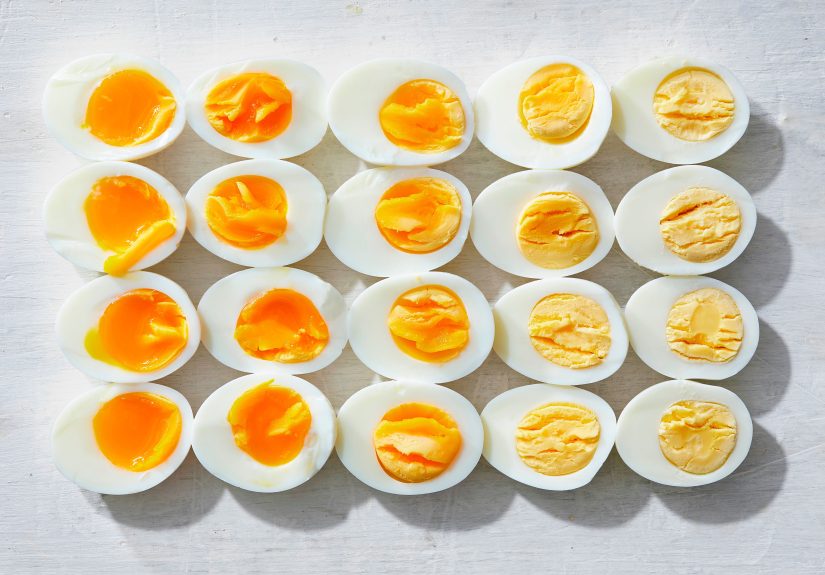
Use this timing guide for large eggs lowered into gently boiling water. Think of these times as your starting point. Your stove, pot, altitude, and egg size can nudge the results slightly, so after one batch, you can adjust like a seasoned egg whisperer.
| Time | Texture | Best For |
|---|---|---|
| 5 to 6 minutes | Soft whites, very runny yolk | Egg cups, toast soldiers, spooning straight from the shell |
| 6 1/2 to 7 minutes | Set whites, jammy center | Ramen, avocado toast, salads, rice bowls |
| 8 to 9 minutes | Creamy, custardy yolk | Snack eggs, grain bowls, upgraded lunch boxes |
| 10 to 11 minutes | Mostly firm yolk, still tender | Cobb salad, niçoise-style plates, meal prep |
| 12 minutes | Fully set yolk and white | Deviled eggs, egg salad, slicing, picnic duty |
If you like your eggs right on the edge between two categories, welcome to the part where you become delightfully picky in the best possible way. Add or subtract 30 seconds on your next batch. That tiny change can make a surprisingly big difference.
How to Choose Your Ideal Texture
For soft-boiled eggs
Choose soft-boiled eggs when you want drama in the center. The whites should be set enough to hold their shape, while the yolk stays fluid or nearly fluid. This style is perfect for dipping toast, finishing ramen, or making a breakfast feel suspiciously elegant on a Wednesday.
For jammy eggs
Jammy eggs are the sweet spot for many people because they split the difference between spoonable and sliceable. The center is thick, glossy, and rich without running everywhere like it is trying to escape the plate. If you only memorize one timing zone, make it the 6 1/2- to 8-minute range.
For hard-boiled eggs
Hard-boiled eggs should be fully cooked but not overcooked. The goal is a yolk that is set and creamy, not dry and crumbly. If your yolks develop a greenish-gray ring, you did not ruin the egg, but you did overcook it. That ring is the egg equivalent of a sigh.
How Egg Size and Starting Temperature Affect Timing
Not all eggs behave exactly the same. Large eggs are the standard for most timing charts, so if you are using medium eggs, shave off a little time. If you are using extra-large or jumbo eggs, add a little time. The difference is usually modest, but it matters when you are chasing a very specific texture.
Egg temperature also affects the outcome. Fridge-cold eggs are convenient and predictable, especially when you lower them into already boiling water. Room-temperature eggs may cook a bit faster. Consistency is your friend here. If you always cook fridge-cold large eggs the same way, you will get results that are easier to repeat.
How to Peel Boiled Eggs Without Destroying Them
Peeling can feel like a rude joke if you do everything right and the shell still comes off in shards the size of glitter. A few simple tricks help.
- Use eggs that are not ultra-fresh. Eggs that are several days old often peel more easily.
- Cool them quickly in ice water after cooking.
- Crack the shell all over, then peel under running water if needed.
- Start peeling from the wider end, where there is usually a small air pocket.
If you are making deviled eggs for guests, do yourself a favor and practice good peeling strategy. Nobody needs a platter of eggs that look like they survived a tiny avalanche.
Common Boiled Egg Mistakes
Boiling too aggressively
A roaring boil can cause eggs to knock around, crack, and cook unevenly. Gentle boiling is plenty. You are cooking breakfast, not punishing it.
Skipping the ice bath
If you skip the cold shock, the eggs keep cooking from residual heat. That means your beautiful jammy egg may become a firm egg by the time you peel it.
Not using a timer
There is no award for guessing. Timers exist because humans are distractible, and because one notification can turn “perfectly cooked” into “why is the yolk the texture of sidewalk chalk?”
Cooking too long
Overcooked eggs often have tough whites and that green ring around the yolk. They are still edible, but the texture is less appealing and the flavor can be a bit sulfurous. That is not the mood we are aiming for.
Best Uses for Each Egg Texture
- Runny soft-boiled: toast, breakfast boards, spoon-from-the-shell moments
- Jammy: ramen, noodle bowls, salads, grain bowls, avocado toast
- Creamy medium: snack plates, sandwiches, lunch prep
- Hard-boiled: egg salad, deviled eggs, potato salad, Cobb salad, picnic spreads
Matching the egg texture to the dish is one of those tiny kitchen upgrades that makes you seem much fancier than you actually are. A jammy egg on a grain bowl says, “I have my life together,” even if your laundry situation suggests otherwise.
Food Safety and Storage
If you want fully cooked eggs, keep going until both the whites and yolks are firm. That is the safest route, especially when serving people who are more vulnerable to foodborne illness. Soft-boiled and runny-centered eggs are delicious, but they are less fully cooked, so make that choice knowingly.
Hard-cooked eggs should be refrigerated within 2 hours of cooking. Stored in the refrigerator, they are best used within 1 week. If you are meal prepping, keeping them in their shells until you need them is a smart move for both quality and convenience.
A Foolproof One-Week Egg Plan
If you love boiled eggs but hate morning decision-making, boil a batch at the start of the week. Make half at 7 minutes for jammy lunches and half at 11 or 12 minutes for salads and snacks. Label the containers if needed. Yes, this sounds extremely organized. No, it does not mean you need to become the sort of person who alphabetizes spices for fun.
A batch like this gives you ready-to-go protein for breakfast, lunch, and those weird afternoon moments when a bag of chips is calling your name but a peeled egg would be the smarter choice. Boiled eggs are humble, versatile, affordable, and refreshingly low-maintenance once you stop overthinking them.
Real-Life Experience: What Boiling Eggs Actually Teaches You
The funny thing about learning how to boil an egg is that it starts as a cooking skill and ends up feeling like a small lesson in self-awareness. Most people do not begin with a grand egg philosophy. They begin because they wanted breakfast, meal prep, or a ramen topping that looked like the photos. Then the trial-and-error begins. Maybe the first batch was undercooked, and the whites slid around like they had somewhere else to be. Maybe the second batch went too far and produced yolks so dry they practically requested a glass of water.
That is usually when the obsession starts. You realize that texture is personal. One person’s “perfect soft-boiled egg” is another person’s “absolutely not.” Some people want a yolk that spills like sauce. Some want it thick and jammy. Some want a fully set center because they are making egg salad and would prefer not to fight a forkful of lava at noon. Once you accept that there is no single perfect boiled egg, only your perfect boiled egg, the whole process becomes much more fun.
There is also something deeply satisfying about how small the adjustments are. Thirty seconds here. One minute there. A longer ice bath. Slightly older eggs. A gentler boil. These are tiny tweaks, but they create real improvement. It is one of the most rewarding kitchen experiments because the feedback is instant. You crack the egg open, and there is your answer. No mystery. No complicated tasting notes. Just, “Ah, yes, this is exactly what I wanted,” or “Well, that one is joining the salad.”
Many home cooks also discover that boiled eggs become a kind of kitchen confidence builder. Once you can reliably make soft, jammy, medium, and hard-boiled eggs, you start trusting your timing in other recipes too. You become less likely to wing important things and more likely to appreciate how a little precision makes cooking easier, not fussier. It is not about perfectionism. It is about reducing kitchen disappointment, which is a noble goal if there ever was one.
Then there is the peeling issue, which deserves its own emotional support group. Almost everyone has made a batch of beautiful eggs only to peel them into lumpy little moonscapes. But even that gets better with experience. You learn the ice bath matters. You learn older eggs can help. You learn that peeling under water is not weird if it works. Eventually, you stop taking a bad peel personally. The egg is not judging you. It is just being difficult.
In the end, boiled eggs are a reminder that good cooking is often about paying attention to small details that create big comfort. A perfectly timed egg on toast can make an ordinary morning feel more intentional. A bowl of noodles with a jammy egg can feel restaurant-worthy without leaving home. A container of hard-boiled eggs in the fridge can rescue a busy day with almost no effort. That is why this simple skill matters. It is not only about boiling an egg. It is about knowing how to make a modest ingredient exactly the way you love it, over and over again.
Conclusion
If you have ever wondered how to boil an egg to your ideal texture, the answer is wonderfully simple: start with a reliable method, use a timer, cool the eggs quickly, and make tiny adjustments until the center looks exactly the way you want. That is the whole game. Once you know your preferred minute mark, boiled eggs stop being unpredictable and start becoming one of the easiest wins in your kitchen.
Whether you love a runny center, a jammy middle, or a fully set hard-boiled egg, your perfect version is only a few minutes away. Which is excellent news, because some days the most satisfying kind of kitchen success comes in a shell.