Table of Contents >> Show >> Hide
- Meet Your Kale: Why the Type Changes the Cut
- Before You Cut: Pick, Wash, and Dry Like You Mean It
- De-Stemming: Removing the Rib Without Losing Your Mind
- Knife Skills That Make Kale Behave
- How to Cut Kale for Whatever You’re Cooking
- Storage: Keep Cut Kale Fresh (Not Funky)
- Troubleshooting: When Kale Fights Back
- Quick Cheat Sheet: The Fast Way to Cut Kale
- Bonus: of Kale-Cutting “Experiences” You’ll Totally Recognize
Kale has two moods: “I’m a delicate leafy green” and “I’m a tiny edible Christmas tree with opinions.”
The difference is almost always how you prep and cut it. Do it right, and kale becomes tender ribbons for salads, tidy bites for sautés,
and chip-ready pieces that actually crisp instead of steaming into sadness.
This guide walks you through exactly how to cut kalefast, safely, and in a way that matches what you’re cooking. No culinary acrobatics.
Just smart steps, sharp knife energy, and fewer runaway leaves on your countertop.
Meet Your Kale: Why the Type Changes the Cut
Not all kale behaves the same on a cutting board. If you’ve ever wondered why one bunch slices like a dream and another fights you like a
tiny green tumbleweed… you’re not imagining it.
Curly kale
This is the ruffly, frilly classic. It’s sturdy, a little more bitter than other varieties, and its texture makes it great for soups,
sautés, and chips. It also loves hiding grit in its curlsso washing matters.
Lacinato kale (a.k.a. Tuscan or “dinosaur” kale)
Long, dark, bumpy leaves that slice into gorgeous ribbons. It’s typically a bit more tender than curly kale and shines in salads when
cut thin and massaged.
Red Russian kale
Flatter leaves with purple stems. It’s often more tender and sweet-ish, which makes it a great “starter kale” for people who claim they
don’t like kale (they might still be lying, but you’ll have a better chance).
Baby kale
Smaller leaves with thinner ribs. You can usually skip aggressive de-stemming and just give it a quick chopor even use it as-is for
salads and quick wilts.
Before You Cut: Pick, Wash, and Dry Like You Mean It
Cutting kale is easy. Cutting dirty kale is a crunchy surprise you didn’t order. Start here.
Step 1: Choose a good bunch
- Look for: deep color, perky leaves, firm stems.
- Avoid: lots of yellowing, slimy patches, or a “wet dog” smell (kale should smell fresh, not existential).
Step 2: Wash it the safe, sane way
For fresh bunch kale: rinse under cool running water and gently rub the leaves to remove dirt. Skip soap, detergents, and produce washes.
(Kale is not a cast-iron pan.) If the leaves are especially sandy, swish them in a big bowl of cold water, lift them out (don’t dump the
bowlgrit sinks), and rinse again.
For bagged greens labeled “washed,” “triple-washed,” or “ready-to-eat,” you generally don’t need to wash them again.
Rewashing can sometimes increase contamination risk if your sink, spinner, or hands aren’t perfectly clean. If you still choose to rinse,
keep it quick and keep everything spotless.
Step 3: Dry thoroughly (especially for salads and chips)
Wet kale doesn’t slice cleanly and won’t crisp well. Use a salad spinner, then pat dry with a clean kitchen towel or paper towels.
If you want restaurant-level crunch, let it air-dry for a few minutes after spinning.
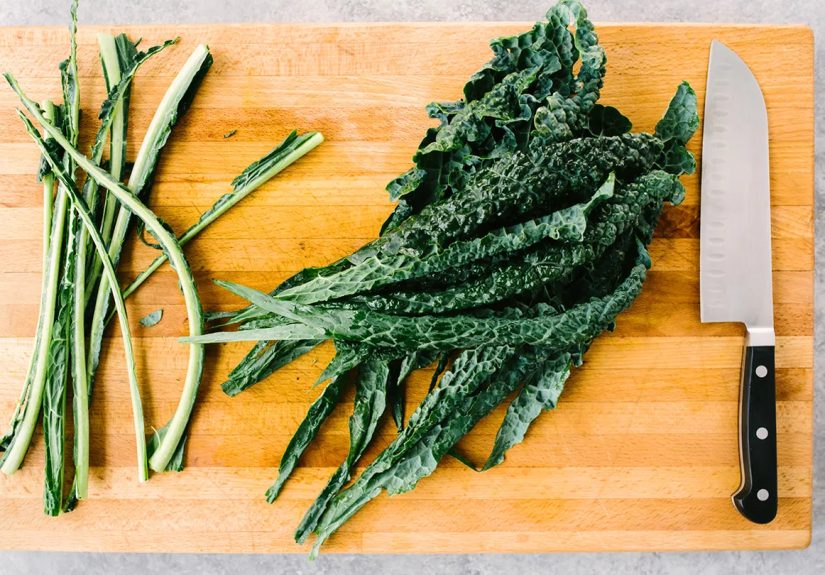
De-Stemming: Removing the Rib Without Losing Your Mind
That thick center rib is edible, but it’s also the reason some people describe kale as “chewy.” For most recipes, removing the rib makes
the leaves cook faster and feel more tenderespecially in salads.
Method A: Strip-and-zip (fastest)
- Hold the stem at the bottom with one hand.
- With your other hand, pinch the leaf where it meets the stem.
- Pull your pinched hand up the stem to strip the leaf off in one motion.
This is quick and satisfyinglike peeling off a sticker in one perfect go.
Method B: Fold-and-slice (neatest)
- Lay a leaf flat on a cutting board.
- Fold it in half lengthwise so the stem sits along the edge.
- Slice the leafy part away from the stem with a sharp knife.
This gives you cleaner pieces and is great for lacinato kale, which tends to lie flatter on the board.
Don’t throw out the stems (unless you want to)
Kale stems can be sliced thin and cooked until tender in stir-fries and sautés, blended into soups, or even turned into crispy toppings.
If you’re not using them today, freeze them for stock or smoothies. Waste less, flex more.
Knife Skills That Make Kale Behave
You don’t need fancy knives. You do need a stable cutting board and a plan.
Setup for success
- Use a big board: kale sprawls.
- Stabilize it: damp paper towel under the board if it slides.
- Use a sharp chef’s knife: dull knives crush leaves instead of cutting them.
Cut #1: Rough chop (for soups, sautés, omelets)
- De-stem the leaves.
- Stack a few leaves, roll loosely, then slice into 1-inch ribbons.
- Turn the pile and cut again to create bite-size pieces.
Think “spoon-friendly.” If it won’t fit on a fork without a wrestling match, chop again.
Cut #2: Chiffonade ribbons (for salads and quick wilts)
Chiffonade is just a fancy word for “roll and slice into thin ribbons.” It’s the cut that makes kale feel more tender
and easier to chew.
- De-stem and stack 3–6 leaves (depending on size).
- Roll into a loose “cigar.”
- Slice crosswise into thin ribbons (about 1/8–1/4 inch).
- Fluff the ribbons so they don’t clump.
Cut #3: Fine mince (for pesto, stuffing, or mixing into meatballs)
- Start with chiffonade ribbons.
- Gather into a pile.
- Rock your knife through the pile until finely chopped.
This is great when you want kale to “disappear” into a dish while still adding color and nutrients.
How to Cut Kale for Whatever You’re Cooking
The best way to cut kale depends on the job. Here’s the practical cheat code: cut smaller for quick cooking and raw salads, larger for
long simmering.
Kale salad
- Best cut: thin chiffonade ribbons.
- Pro move: massage with a little olive oil, lemon juice (or vinegar), and a pinch of salt for 1–2 minutes until darker,
softer, and slightly reduced in volume. - Why it works: it softens the leaves and tames the “I’m chewing a houseplant” vibe.
Sautéed kale or stir-fry
- Best cut: 1-inch pieces.
- Tip: if using stems, slice them thin and start cooking them first. Add leaves after stems begin to soften.
Soups, stews, and braises
- Best cut: 1–2 inch pieces.
- Tip: curly kale holds up better for long cooking; lacinato turns silky.
Kale chips
- Best cut: don’t cuttear.
- Why: torn edges create more texture and crisp better. Keep pieces roughly chip-sized and dry them well.
Smoothies
- Best cut: rough chop or hand-tear.
- Tip: freeze in portion packs. Frozen kale blends easily and reduces the “green confetti stuck to everything” problem.
Storage: Keep Cut Kale Fresh (Not Funky)
Kale is sturdier than most greens, but it still hates two things: too much moisture and too much air.
Your goal is “dry-but-not-desert-dry.”
Storing a whole bunch
- Store unwashed leaves in the fridge, loosely wrapped with paper towels to absorb moisture.
- Place in a breathable produce bag or a partially closed zip-top bag in the crisper drawer.
Storing washed and chopped kale
- Dry it thoroughly.
- Wrap in paper towels, then store in a container or bag.
- Use within a few days for best texture.
Freezing kale
For long-term storage, blanch briefly, cool in ice water, dry well, then freeze. It won’t be salad-worthy after freezing, but it’s perfect
for soups, sautés, and smoothies.
Troubleshooting: When Kale Fights Back
“My kale is still tough.”
- Cut thinner (chiffonade helps a lot).
- Massage it for salads.
- Cook longer with a splash of broth or water and a lid for a few minutes to steam-tenderize.
“My cutting board is a leafy chaos zone.”
- Work in batcheskale is bulky.
- Stack and roll leaves before slicing.
- Use a larger board (or accept that kale has moved in and pays no rent).
“It tastes bitter.”
- Remove thicker ribs and stems.
- Pair with acid (lemon/vinegar) and a touch of salt.
- Cook it with garlic, onion, or a pinch of red pepper flakes to round out the flavor.
Quick Cheat Sheet: The Fast Way to Cut Kale
- Rinse kale under cool running water; rub leaves gently.
- Dry well (spinner + towel).
- De-stem (strip-and-zip or fold-and-slice).
- Roll leaves and slice:
- Salad: thin ribbons
- Sauté: 1-inch pieces
- Soup: 1–2 inch pieces
- Store dry kale with paper towel in the fridge.
Bonus: of Kale-Cutting “Experiences” You’ll Totally Recognize
Let’s talk about the very real emotional journey of cutting kalebecause if you’ve ever bought a heroic-looking bunch and then stared at it
like it’s a pop quiz, congratulations: you’re normal.
First experience: you wash it. Or you think you wash it. Then you take a bite later and discover the unmistakable crunch of…
earth. Not the fun “garden fresh” kindmore like “tiny sandbox.” This is why kale needs a confident rinse, especially curly kale, which
can trap grit in all those ruffles like it’s hiding valuables. After you learn that lesson once, you become the person who swishes greens
in a bowl like you’re panning for gold. (Because you are. The gold is not eating sand.)
Second experience: the stem. You try to cut around it with the precision of a surgeon, and suddenly the leaf is sliding away from you like
it has places to be. That’s when you discover the magic of strip-and-zipgrabbing the base and pulling the leaf off in one smooth motion.
It’s oddly satisfying, like peeling a label off a jar in one piece. And then you realize you’ve created a small mountain of stems and
you’re faced with the age-old question: “Do I compost these… or do I pretend I’m the kind of person who fries kale stems as a crispy topping?”
Third experience: you chop everything into random sizes because you’re hungry and time is fake. Then you cook it, and half the pieces are
tender while the other half still feels like it could be used to patch a roof. That’s when the “cut for the recipe” lightbulb goes on.
Thin ribbons for salads (chew-friendly). Bite-size pieces for sautés (fork-friendly). Larger pieces for soup (they’ll shrink and soften).
Suddenly kale stops being unpredictable and starts being… honestly kind of cooperative.
Fourth experience: the kale salad glow-up. You make a salad, taste it, and it’s aggressively kale. Then you massage it with olive oil, a
squeeze of lemon, and a pinch of salt for a minutejust long enough to question your life choicesand the leaves turn darker, softer, and
noticeably less loud. The salad goes from “punishment food” to “wait, this is actually good.” You feel powerful. You consider texting
someone about it. You don’t. But you could.
Final experience: you try kale chips. The first batch is soggy because the leaves were damp. The second batch is burnt because you wandered
off for “one second.” The third batch? Crisp, light, salty perfection. You realize kale isn’t difficult; it’s just dramatic. Treat it with
the right prep, and it rewards you. Ignore the basics, and it performs a crunchy (or soggy) protest.
So yescutting kale is a skill. But it’s also a collection of small wins that add up fast. And once you’ve got the rhythm, you’ll cut kale
like you mean it… even if you’re still side-eyeing it a little.