Table of Contents >> Show >> Hide
If you have ever watched a breaker glide across the floor, freeze on a beat, and somehow make gravity look optional, you have probably had the same thought as the rest of us: “That looks amazing. Also, my hips are already nervous.” The good news is that beginner break dance moves are absolutely learnable when you start with the right foundation. The bad news is that if you begin by launching yourself into a windmill in your living room, your floor may file a complaint.
This guide is all about smart beginnings. Instead of chasing flashy power moves on day one, you will learn how to build rhythm, control, balance, and confidence with beginner-friendly breaking basics. We will cover the moves that actually give new dancers a usable foundation: toprock, a simple go-down, the six-step, CCs, and a baby freeze progression. Along the way, you will also learn how to practice safely, what mistakes beginners make, and how to make your practice sessions look less like chaos and more like actual dancing.
If your goal is to learn some break dance moves, feel comfortable in a cypher, or simply stop tripping over your own shoelaces while attempting footwork, you are in the right place.
What Breaking Really Is
Before getting into the moves, it helps to understand what breaking actually is. Breaking, often called breakdancing in mainstream media, grew out of hip-hop culture in New York and became known for improvisation, musicality, footwork, freezes, and explosive athletic movement. In other words, it is not just “spin dramatically and hope for the best.” It is a structured dance form with clear building blocks.
At the beginner level, the most important idea is this: breaking is built in layers. You usually start standing up with toprock, transition to the floor with a go-down, move through footwork, and finish or punctuate your combo with a freeze. Later, advanced dancers add power moves, tricks, and more complex transitions, but the basics are where style is born. A clean beginner with rhythm will almost always look better than an ambitious beginner flopping into the floor like a dropped backpack.
Before You Practice a Single Move
Warm Up Like You Mean It
If you skip your warm-up, your muscles will let you know in the most annoying way possible. Breaking asks a lot from your wrists, shoulders, hips, knees, ankles, and core. Spend at least 8 to 10 minutes raising your body temperature and waking up your joints. A smart dance warm-up can include light jogging in place, bouncing on the balls of your feet, shoulder rolls, hip circles, ankle mobility, wrist circles, squats, and gentle dynamic stretches.
Do not jump straight into hard static stretches while your body is still cold. Think “prepare the machine,” not “fold yourself into a pretzel immediately.”
Use the Right Practice Space
A smooth, clean surface matters. Too slippery and you will slide like a shopping cart with commitment issues. Too sticky and your knees and wrists will not forgive you. Practice on a flat surface with enough room to extend your legs and place your hands comfortably. Remove clutter. Nobody wants their first freeze interrupted by a coffee table.
Dress for Movement, Not for Drama
Wear sneakers with grip and clothes that let you move freely. Beginners sometimes practice in socks because it feels easier to turn, but socks on certain surfaces can also make you unexpectedly audition for a slapstick comedy. Shoes are the safer bet while you learn control.
Respect Recovery
Breaking can be hard on the body, especially when you are new and excited. Practice with intensity, but also with common sense. Hydrate, rest, and stop when something feels sharp, unstable, or wrong. “Tired” is normal. “My wrist is sending legal notices” is not.
5 Beginner Break Dance Moves to Learn First
1. Basic Toprock
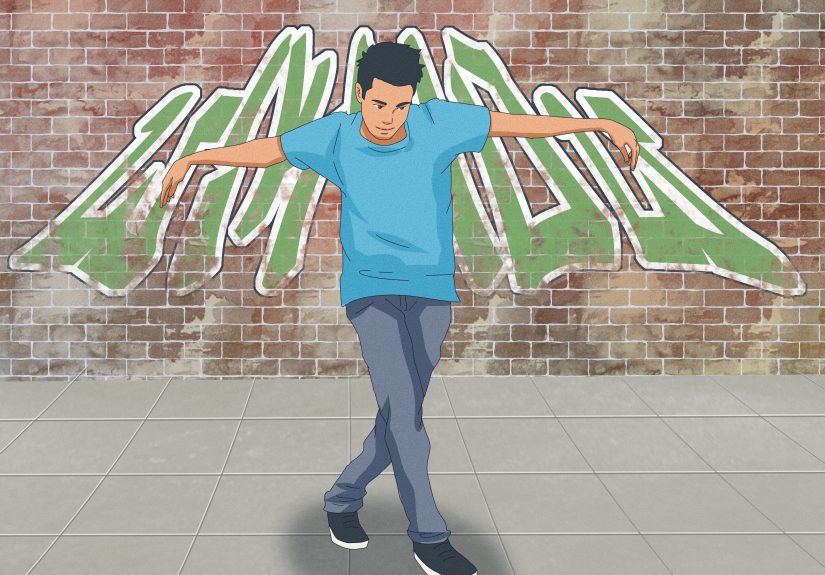
Toprock is your standing introduction. It is where you show rhythm, confidence, posture, and musicality before going to the floor. Many beginners rush through it because they want the “cool floor stuff,” but strong toprock makes everything else look more intentional.
How to do it:
Start standing tall with your knees soft and your chest relaxed. Bounce lightly to the beat. Step one foot out to the side or diagonally forward, let the opposite arm swing naturally, then return to center. Repeat on the other side. Keep alternating while staying loose through the shoulders and torso. The goal is not to stomp. The goal is to groove.
Beginner tips:
Keep your weight centered. Stay on beat. Let your arms complement the step instead of flailing around like they are trying to escape your body. Once you are comfortable, add a slight pivot, a shoulder accent, or a sharper directional change. Even simple toprock looks good when it is clean.
2. A Simple Go-Down
A go-down is the transition from standing to floorwork. It connects your toprock to your footwork, which makes your set look like a dance instead of a series of unrelated life choices.
How to do it:
From your toprock, lower your center of gravity by bending your knees. Place one hand on the floor for support, then step or slide one leg back so you land in a crouched, stable position close to the floor. Keep it smooth and controlled. Your goal is to arrive in position, not crash-land into it.
Beginner tips:
Practice slowly at first. If you slam your knee down, you are moving too fast or dropping without control. Think of the go-down as a sentence transition. It should connect ideas, not cause emotional whiplash.
3. The Six-Step
The six-step is one of the most famous beginner breakdance moves for a reason. It teaches coordination, circular floor movement, weight transfer, and body control. It also teaches humility, because at first your legs will absolutely try to tie themselves into modern art.
How to do it:
Begin in a low crouch. Place one hand on the floor near your hip for support. Move one leg across the front to create the first “hook” position. Extend the opposite leg behind you. Then place the second hand down and continue moving your legs around your body in a circular pattern until you return to your starting crouch. That full loop creates the six-step.
The important part is not speed. It is sequence. Each step sets up the next one. Your shoulders should stay stacked over your supporting hands, and your core should stay engaged so your hips do not float way up in the air or collapse to the ground.
Beginner tips:
Say the steps out loud if you need to. Seriously. “One, two, three…” is not embarrassing; it is useful. Keep the movement small and clean first. Once the pattern is clear, add tempo. If you get lost, stop, reset, and walk through the shape again. The six-step becomes satisfying only after it stops feeling like a puzzle designed by your ankles.
4. CCs
CCs are a beginner favorite because they add style fast. They are part footwork, part kick-out, and part attitude. When done well, they make you look sharper and more dynamic without requiring circus-level balance.
How to do it:
Start from a low crouch with both hands near the floor. Shift your weight into your hands and one planted foot. Kick the opposite leg out to the side while rotating your torso open slightly. Then return to center and switch sides. The movement should feel like a quick kick-and-twist with control through the core.
Beginner tips:
Do not throw your leg out wildly. Extend it with intention. Keep the supporting foot planted and your chest lifted enough that the shape reads clearly. Start slow enough to feel the weight shift from side to side. When you get more comfortable, you can make your CCs snappier and hit them on stronger beats in the music.
5. Baby Freeze
The baby freeze is one of the classic beginner freezes because it introduces balance, body placement, and the idea of “hitting” a pose. It looks impressive, but it should be learned with patience. This is not the move to rush because your body will instantly reveal whether your setup is solid or suspicious.
How to do it:
Begin on your hands and knees. Bend one arm so that the elbow presses into the side of your midsection or hip area. Place your other hand on the floor slightly in front for support. Lean your weight forward carefully. Start by lifting one foot lightly, then the other, keeping your head off the floor unless you are specifically learning with supervised support and proper placement. Hold for a brief moment, then come down with control.
Beginner tips:
Use a soft practice surface if needed, but not something so squishy that your hands sink. First, practice the arm position and weight shift before trying to lift both feet. If you feel wrist pain, stop and reset. A baby freeze should feel challenging, not sketchy. There is a difference.
How to Combine These Moves Into a Beginner Set
Once you can do each move separately, begin linking them together. A simple beginner combo might look like this:
Toprock for 8 counts → simple go-down → one clean six-step → two CCs → baby freeze → stand up and reset.
This kind of short set is perfect because it teaches flow. Breaking is not just about collecting moves like Pokémon cards. It is about connecting them in a way that feels musical and intentional. Practice your combo with one song for a week, then switch songs and see whether your timing still works. If a move falls apart every time the beat changes, that means you memorized the motion but not the rhythm.
Common Beginner Mistakes
Going Too Fast Too Soon
Speed hides mistakes for about two seconds. Then it makes them worse. Learn the pathway first, then build tempo.
Ignoring the Music
If your body is doing one thing and the beat is doing another, the dance looks disconnected. Count the beat. Nod your head. Feel where you want to hit your freeze.
Poor Hand Placement
In footwork and freezes, your hands are part of your base. If they land too far away, your balance gets weird fast. Keep them placed with purpose.
Hips Too High in Footwork
Many beginners turn the six-step into a panicked tabletop. Stay low, stay compact, and keep your movement circular.
Practicing Only the “Fun” Move
Yes, the freeze is cool. Yes, the six-step feels official. But if you never practice toprock, transitions, or timing, your dancing will look unfinished.
A Smart Weekly Practice Plan
If you want real progress, keep your sessions short, focused, and repeatable.
Day 1: Rhythm and Toprock
Practice bounce, timing, posture, and two or three standing steps.
Day 2: Go-Down and Floor Entry
Work on lowering smoothly without crashing or losing the beat.
Day 3: Six-Step Mechanics
Drill the pathway slowly. Focus on hand placement, hooks, and staying low.
Day 4: CCs and Shape
Practice side-to-side control and clear leg extension.
Day 5: Freeze Basics
Work on baby freeze setup, balance, and short holds.
Day 6: Combine Everything
Run your beginner combo with music and record yourself.
Day 7: Recovery or Light Review
Stretch, walk through your basics, and give your wrists and legs a break.
on Real Beginner Experiences With Break Dance Moves
Learning how to do some break dance moves is one of those experiences that is equally exciting, humbling, funny, and weirdly addictive. Most beginners start out thinking the hardest part will be strength. Then they discover the truth: the hardest part is often coordination. Your brain understands the six-step. Your body, meanwhile, is acting like it just met the concept of left and right five minutes ago.
A very common beginner experience is that toprock feels easy until music starts playing. Without music, you step side to side and think, “Wow, I am basically ready for the world stage.” Then the beat drops, your arms forget their job, and suddenly you are doing something that resembles enthusiastic grocery shopping. That is normal. Musicality takes time. The breakthrough usually comes when a dancer stops trying to “do moves” and starts trying to ride the rhythm.
Another big beginner experience is frustration with footwork. The six-step is famous, but for new dancers it can feel less like a dance move and more like assembling furniture without instructions. People often report that one direction feels possible and the other direction feels cursed. They also notice that as soon as they try to go faster, their hips rise, their shoulders shift, and the whole move loses shape. This is why experienced breakers emphasize drilling the pattern slowly. The first victory is not speed. The first victory is getting through the pathway without stopping and staring at your own legs like they have betrayed you personally.
There is also the freeze experience, which deserves its own category of emotional drama. The first time a beginner briefly balances in a baby freeze, even for one second, it feels huge. It is the kind of tiny win that makes someone immediately want to text a friend, post a clip, or replay the moment twelve times. But getting there usually involves several attempts where the body does not quite stack correctly, the elbow placement feels off, or the wrists get tired faster than expected. Most dancers learn quickly that freezes are less about brute force and more about alignment, patience, and confidence over the hands.
Beginners also go through a very real “I look ridiculous” stage. This is universal. Every dancer, no matter how stylish they become later, has gone through a phase where their transitions looked clunky and their timing wandered off like it had another appointment. The people who improve are not the ones who avoid looking awkward. They are the ones who keep showing up anyway.
One of the best experiences in learning beginner breakdance moves is discovering that repetition is not boring when progress is visible. A move that felt impossible on Monday can feel understandable by Friday. A combo that looked stiff in week one can suddenly start to flow in week three. That is when breaking gets fun in a whole new way. You stop chasing random tricks and start noticing details: cleaner angles, better timing, smoother entries, stronger freezes, more confidence.
And maybe the most satisfying experience of all is this: one day, without warning, the moves stop feeling separate. Your toprock leads naturally into the go-down. Your footwork circles cleanly. Your freeze lands right on the beat. For a few seconds, it feels like actual dancing instead of trial and error. That moment is small, but it is gold. It is also exactly why people fall in love with breaking.
Final Thoughts
If you want to learn how to do some break dance moves, start with control, not chaos. Master your toprock, learn a clean go-down, drill your six-step, sharpen your CCs, and build your freeze with patience. That combination gives you something more valuable than a flashy trick: a real foundation.
Breaking rewards consistency. Ten focused practice sessions will do more for your progress than one wildly overconfident afternoon where you try to become a legend before lunch. Stay musical, stay low, stay patient, and let your style develop one clean rep at a time. The coolest dancers are not always the ones doing the most. They are the ones doing the basics so well that even a simple move looks undeniable.