Table of Contents >> Show >> Hide
- Before You Craft: Nursery Mobile Safety Rules That Matter More Than Aesthetics
- Plan Your DIY Nursery Mobile Like a Designer (Without Needing Design School)
- Tools and Materials
- How To Make A Nursery Mobile: The Step-by-Step Method That Works for Any Design
- Three Proven DIY Nursery Mobile Projects (With Real-World Details)
- Project 1: Felt Ball Hoop Mobile (Beginner-Friendly, Soft, Modern)
- Project 2: Graphic Paper Circle Mobile (Modern, Affordable, Surprisingly Stylish)
- Project 3: Puffy Cloud and Wooden Star Mobile (Dreamy Texture, Big “Aww” Energy)
- Optional advanced style: Sewn felt theme mobile (space, ocean, woodland)
- Design Tweaks That Make Your Nursery Mobile Look “Boutique,” Not “Beginner”
- Should You Add Lights or Music?
- Where To Hang a Nursery Mobile
- When To Remove a Crib Mobile
- FAQ: DIY Baby Mobile Questions People Actually Ask
- Conclusion
- Experiences DIYers Often Have When Making a Nursery Mobile (Real-Life Lessons + Little Wins)
A nursery mobile is the tiny chandelier of babyhood: it’s decorative, it moves, and it has exactly one job
quietly impress visitors while your newborn stares at it like it’s premium streaming content.
The good news? You don’t need an art degree (or a trust fund for artisanal felt) to make a beautiful DIY baby mobile.
You just need a plan, a few basic supplies, and a healthy respect for safety.
In this guide, you’ll learn how to make a nursery mobile step-by-step, plus three proven project styles
(felt ball hoop, graphic paper circles, and puffy clouds with wooden stars). We’ll also cover where to hang it,
when to remove it, and how to make it look intentionally designednot like “I panicked in the craft aisle.”
Before You Craft: Nursery Mobile Safety Rules That Matter More Than Aesthetics
Yes, we’re starting with safety. Because a nursery mobile should be charming, not “featured in a cautionary tale.”
The simplest way to keep a mobile safe is to treat it as decor and visual stimulationnot as a toy your baby can reach.
Quick safety checklist
- Keep it out of reach. Hang it high enough that baby can’t grab it, pull it down, or tangle in it.
- Attach it securely. Use proper hardware (ceiling hook in a stud or a rated anchor) and test it with a gentle tug.
- Avoid long cords near sleep spaces. If your mobile includes any powered element (lights/music), keep cords well away.
- Use parts that won’t shed or break. No glitter that rains down like craft confetti. No brittle pieces that could snap.
- Skip anything tiny or detachable. Beads, buttons, bells, and mini charms are cuteuntil they’re choking hazards.
- Know when to take it down. Mobiles should be removed once baby becomes more mobile (more on timing below).
Also: safe sleep means a clear crib. Even if your mobile theme is “Woodland Creature Rave,” the crib itself should stay simple
(firm mattress, fitted sheet, and nothing else during sleep). If you want plush animals, hang them elsewhere in the room.
Plan Your DIY Nursery Mobile Like a Designer (Without Needing Design School)
Pick a theme that won’t annoy Future You
Choose something you genuinely enjoy looking at daily. Themes that age well:
celestial (stars/moon), clouds, simple shapes, ocean, woodland, botanical, minimalist geometric, or soft “neutral nursery decor.”
If your nursery already has a color palette, pull 2–4 colors from it and stick with that.
Decide on a mobile style
- Embroidery hoop mobile: classic, easy, lightweight, great for felt balls and paper shapes.
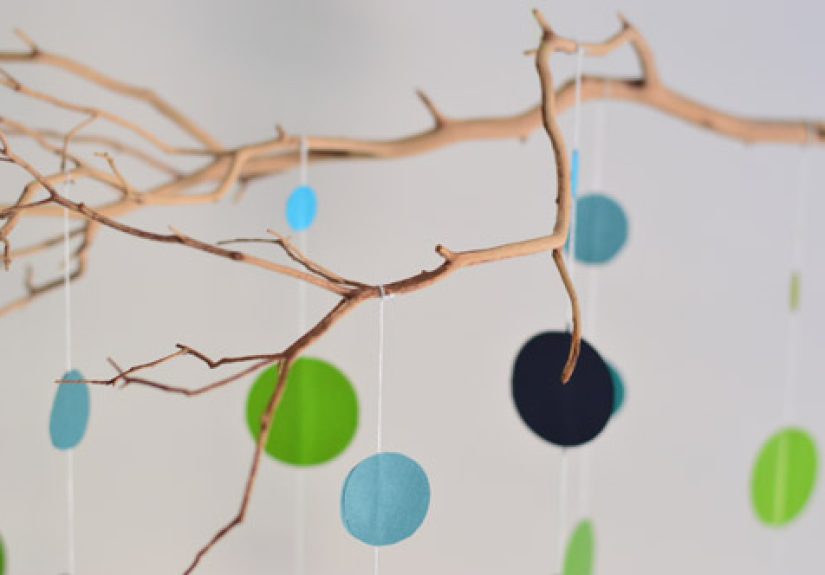
- Branch mobile: organic and modern; works well for stars, moons, leaves, or hanging ornaments.
- Crossbar or dowel mobile: simple and clean; ideal for minimal hanging shapes.
- Geometric frame mobile: striking but a little more engineering (balancing matters more).
Choose where it will hang
For most DIYers, a ceiling-mounted mobile is the sweet spot: it looks polished and keeps everything safely out of reach.
A wall-mounted arm can work too. A crib-mounted arm is convenient, but you need to be extra careful about reach and stability.
Tools and Materials
Your exact supply list depends on the style you pick, but here are the “greatest hits” you’ll see across most tutorials.
Core supplies (for most nursery mobiles)
- Embroidery hoop (wood) or dowel/branch
- Strong string (cotton twine, waxed twine, or sturdy thread)
- Scissors
- Measuring tape or ruler
- Ceiling hook + appropriate anchor (or wall hook/arm hardware)
Helpful add-ons
- Large needle (especially for felt balls)
- Hot glue gun (for locking knots or securing strands)
- Tape (temporary positioning while you adjust)
- Hole punch + eyelets (for paper mobiles)
- Felt sheets, pre-made felt balls, cardstock, or lightweight ornaments
Pro tip: your “hardware confidence” matters. If you’re not sure whether a hook is secure, it isn’t.
Use a stud when possible, or a properly rated anchor for your wall/ceiling type.
How To Make A Nursery Mobile: The Step-by-Step Method That Works for Any Design
Regardless of whether you’re making a felt ball nursery mobile, a paper mobile, or a cloud-and-star masterpiece,
the build process follows the same logic: frame → strands → elements → balance → hang → safety check.
Step 1: Prep your frame
If you’re using an embroidery hoop, tighten it so it stays perfectly round. If it’s unfinished wood and you want it lighter or warmer,
you can leave it raw (minimalist) or seal it with a baby-safe finish. For a dowel or branch, sand any rough spots.
Step 2: Decide on strand count and layout
Most hoop mobiles look best with 6–12 strands. Odd numbers can look artsy; even numbers can feel symmetrical.
Mark your tie points lightly with pencil so spacing stays consistent.
Step 3: Build your hanging elements
Choose lightweight pieces that won’t cause the mobile to tilt wildly. Great options include felt shapes, paper circles,
stuffed clouds, foam-free ornaments, or flat cutouts. If you’re sewing felt, make pieces double-sided so it looks finished from every angle.
Step 4: Assemble strands on a table first
This is the part that saves your sanity. Lay your hoop on a flat surface, attach strands temporarily with tape,
and add your elements. Keep lengths varied so the mobile has depth and movement.
Step 5: Balance like you’re leveling a picture frame
Hang the mobile from a temporary spot (even a closet rod works) and check:
- Does the hoop hang level?
- Are any strands visibly heavier?
- Does it move gently, not spin like a carnival ride?
Adjust strand lengths, shift tie points slightly, or lighten heavy strands until it hangs evenly.
Step 6: Secure knots and connection points
Once balanced, tighten knots and (if appropriate) add a tiny dab of hot glue to lock themaway from anywhere a baby could touch.
Trim excess string so nothing dangles unnecessarily.
Step 7: Hang it safely and test it
Install your hook. Hang the mobile. Give it a gentle tug test. Then step back and make sure it’s well out of baby’s reach.
If your brain whispers, “Could the baby grab that in two months?” listen to the whisper.
Three Proven DIY Nursery Mobile Projects (With Real-World Details)
Project 1: Felt Ball Hoop Mobile (Beginner-Friendly, Soft, Modern)
The felt ball mobile is popular for a reason: it’s cozy, quiet, lightweight, and it looks like boutique nursery decor.
Many tutorials use a wooden embroidery hoop, white string, and pre-made felt balls (because felting your own is a hobby unto itself).
What you’ll need
- Wood embroidery hoop (around 12–14 inches is a common sweet spot)
- Strong string (cut multiple long pieces so you can vary lengths)
- Large needle
- Felt balls in 2–4 coordinating colors
- Tape + hot glue (optional but helpful)
Build steps
- Cut your strands. A practical approach is to start long and trim later so you can adjust the “drop.”
- Thread each strand through the hoop. Leave a consistent length above the hoop (this becomes your top gather point).
- Temporarily tape strands in place. This keeps spacing consistent while you work.
- String felt balls below the hoop. Space them unevenly for a relaxed, modern look.
- Gather and knot the top strands. Tie a tight, secure knot above the hoop so the mobile hangs from one point.
- Secure the hoop connection points. A small dot of hot glue can help prevent slipping over time.
- Vary your final strand lengths. Trim and knot the ends so strands don’t look “copied and pasted.”
Designer tip: if you’re going for a calm nursery vibe, keep contrast gentle (cream, gray, dusty blue, sage).
If you want baby’s eyes to really track movement, add one darker accent color for definition.
Project 2: Graphic Paper Circle Mobile (Modern, Affordable, Surprisingly Stylish)
If you like crisp design, a paper mobile is basically a tiny art installation. One popular approach uses
embroidery hoops, colored waxed twine, cardstock, and eyelets to create hanging strands with circles at different heights.
Bonus: it can double as party decor and then move to the nursery.
What you’ll need
- Embroidery hoop
- Cardstock in multiple colors (art-quality cardstock holds up better)
- Waxed twine or strong thread
- Scissors
- Hole punch (small) + eyelets (optional but makes it look finished)
- Cup hook for ceiling mounting
Build steps
- Choose your circle sizes. A mix of small and medium circles looks more dynamic than one size.
- Cut circles cleanly. Use a circle cutter or template if you want a polished look.
- Make strands at varied lengths. Visual interest comes from different drop lengths.
- Attach strands to the hoop. Slip knots and evenly spaced tie points help the hoop stay balanced.
- Hang the hoop from three points. Three-point suspension helps keep a hoop level, especially with many strands.
Paper mobile pro move: keep shapes lightweight and avoid anything that bends easily.
If humidity is a thing where you live, cardstock beats thin construction paper every time.
Project 3: Puffy Cloud and Wooden Star Mobile (Dreamy Texture, Big “Aww” Energy)
This style brings soft texture into the nursery without filling the crib with soft objects.
One classic method uses felt clouds stuffed with cotton, plus wooden stars painted in a warm metallic tone.
The clouds don’t need to be perfectbecause, conveniently, real clouds are also a little chaotic.
What you’ll need
- White felt sheets
- Fabric glue
- Cotton balls or stuffing
- Small wooden stars
- Paint (non-toxic craft paint) + brush
- Tiny drill bit (for holes in stars) or pre-drilled shapes
- Clear jewelry string or sturdy thread
Build steps
- Paint stars. Two thin coats look smoother than one thick coat.
- Drill a small hole at the top of each star. Go slowly to avoid splitting.
- Cut cloud shapes from felt. Fold felt to cut two layers at once.
- Glue cloud edges, leaving a small opening. Let dry fully (patience is part of the craft tax).
- Stuff clouds lightly. Pull cotton balls apart first so clouds look fluffy, not lumpy.
- Seal the opening and let dry.
- Attach clouds and stars to your frame. Use a hoop, dowel, or even hang individually from a ceiling fixture (safely anchored).
Want it extra polished? Keep the cloud sizes consistent and vary only the hanging lengths.
That “controlled variation” is what makes it look store-bought.
Optional advanced style: Sewn felt theme mobile (space, ocean, woodland)
If you’re comfortable with a needle and thread, sewn felt mobiles can look like heirloom decor.
Many designs thread felt planets, stars, or animals onto twine and tie them to a wooden hoop.
The trick is making pieces double-sided so the mobile looks finished from every viewpoint.
Design Tweaks That Make Your Nursery Mobile Look “Boutique,” Not “Beginner”
Use a limited palette
Choose 2–4 colors and repeat them with intention. Too many colors can look chaotic (unless chaos is the theme, in which case… respect).
Vary lengths, not everything at once
If you vary color, size, texture, and length all at once, the eye doesn’t know where to rest.
Pick one or two variables to “move” and keep the rest consistent.
Balance weight visually and physically
If one side has five felt balls and the other side has two plus a wooden star the size of a waffle, the hoop will tilt.
Keep heavier elements closer to the center or spread weight evenly.
Think about baby’s viewpoint
Newborn vision develops over time. High-contrast shapes can be more engaging early on,
while softer palettes may feel more calming for older babies. You can design for both by adding one darker accent element.
Should You Add Lights or Music?
You can, but for many DIY mobiles, it’s smarter to keep the mobile simple and use a separate sound machine or night light.
Powered mobiles introduce cords, batteries, and components that require strict placement and manufacturer guidance.
- If you add electronics: keep cords far away from the sleep space and out of reach.
- Prefer battery packs that are wall-mounted (not dangling) and secured.
- Never improvise electrical wiring for nursery decor.
Where To Hang a Nursery Mobile
The most popular placement is centered over the crib, but you have options:
- Ceiling over crib: classic look, easiest to keep out of reach when hung high and centered.
- Over changing table: great for distraction during diaper changes (a true gift to humanity).
- Wall-mounted beside crib: reduces overhead hardware and can be safer if baby is particularly grabby.
Wherever you hang it, avoid placing cribs near windows or cords from blinds/curtains. Nursery decor should never compete with safety basics.
When To Remove a Crib Mobile
This part matters. As babies grow, their ability to reach and pull changes fastlike “new skill unlocked” fast.
A general rule used by pediatric safety guidance is to remove crib mobiles when a baby can push up on hands and knees,
and some guidance also mentions removing around 5 months (whichever comes first). Other pediatric guidance emphasizes that
once a baby can sit up, it’s definitely time for the mobile to come down.
Translation: if you’re wondering whether it’s time, it’s probably time.
You can always rehang it over a dresser as decor if you still love it (and you shouldyou made it).
FAQ: DIY Baby Mobile Questions People Actually Ask
How high should I hang a nursery mobile?
High enough that baby can’t reach it now or soon. Babies level up quickly. If you can reach it easily while standing,
that doesn’t automatically mean baby can’tespecially once they start pulling up.
What’s the easiest nursery mobile for beginners?
A felt ball hoop mobile or a ribbon hoop mobile is usually the fastest path to a cute result.
Pre-made felt balls are forgiving, lightweight, and don’t require sewing.
Are paper mobiles safe?
They can be, if they’re secured well and kept out of reach. Use sturdy cardstock and strong knots so pieces don’t detach.
If the paper is within reach, it’s not a decoration anymoreit’s a shredding opportunity.
Can I hang a mobile directly from a chandelier or ceiling light fixture?
It’s better to use a dedicated, properly installed hook. Light fixtures aren’t always designed to support additional weight or movement.
If you do use an existing ceiling point, make sure it’s stable and doesn’t interfere with electrical components or heat.
Conclusion
Learning how to make a nursery mobile is one of those rare DIY projects that hits the trifecta:
it’s doable for beginners, it looks genuinely special, and it makes the nursery feel finished.
Start with a simple frame (like a wooden embroidery hoop), choose lightweight elements (felt balls, paper shapes, clouds),
assemble strands on a table, balance carefully, and hang it securely out of reach.
The best nursery mobile is the one that makes you smile every time you walk into the room
and keeps baby safely entertained for those precious minutes when you’re drinking lukewarm coffee like it’s a spa experience.
Experiences DIYers Often Have When Making a Nursery Mobile (Real-Life Lessons + Little Wins)
If you’ve never made a nursery mobile before, here’s what tends to happen in the real world (aka the place where string tangles exist).
First, you’ll feel wildly confident while choosing a theme. “Celestial clouds in soft neutrals,” you’ll think, like a person who has
never tried to thread twine through a felt ball with a needle the size of a toothpick.
Then comes the string phase, which is where many DIYers discover that string has a personality. It likes knots you didn’t approve,
it coils when you want it straight, and it will absolutely tie itself to your elbow if given the chance. A common trick is to cut strands longer
than you think you need, tape them temporarily in place, and only trim once you’ve done a test hang. People who skip the test hang tend to end up
with a mobile that looks amazing… at a 17-degree angle.
Next is the balancing phase, which feels a little like leveling a picture frame in a house built in 1920.
You adjust one strand, then another strand looks wrong, and suddenly you’re moving half the elements by a quarter inch like a tiny interior designer.
The upside is that once you see the hoop hang level, it’s genuinely satisfyinglike you just solved a small, adorable engineering problem.
If you’re making a felt ball mobile, many makers report that pushing a needle through dense felt can make fingers sore.
Using a thimble (or even a grippy tool to help pull the needle through) can make the process much more pleasant.
The funny part is that the finished result looks so calm and soft, you’d never guess it involved a brief contest of strength.
Paper mobiles come with a different “experience moment”: humidity. DIYers in more humid climates often notice thin paper can curl,
which is why thicker cardstock and clean cuts matter. The win here is speedonce your shapes are cut and your strands are measured,
the build can feel fast and artistic, like you’re assembling a modern sculpture that just happens to be baby-sized.
Cloud mobiles tend to produce the most compliments, probably because anything fluffy automatically reads “nursery.”
People often learn that clouds look better when the stuffing is pulled apart (not packed in), and that letting glue dry fully
is the difference between “soft dreamy cloud” and “why is my cloud peeling open.”
Finally, the most common long-term lesson is a sweet one: a mobile doesn’t have to be used forever to be worth making.
Many parents remove crib mobiles once babies become more mobile, then rehang them over a dresser or reading corner.
The mobile becomes part of the room’s storysomething handmade that marked the beginning of a new season of life.
And honestly, that’s the best kind of decor: the kind that means something, not just the kind that matches the curtains.