Table of Contents >> Show >> Hide
- What Makes a Crunchwrap a Crunchwrap?
- How I Picked “The Best” Copycat Crunchwrap Recipe
- The Best Copycat Crunchwrap Recipe (My Tested Version)
- The Taste Test: Copycat vs. Taco Bell Crunchwrap
- So… Which One Won?
- Easy Upgrades That Still Taste Like the Real Deal
- Troubleshooting: Common Crunchwrap Problems (and Fixes)
- Is the Copycat Crunchwrap Cheaper?
- Conclusion: The Best Copycat Crunchwrap Is the One You Eat Immediately
- Extra: of Crunchwrap Experiments (a.k.a. My Week in Hexagons)
There are two kinds of people in this world: the ones who occasionally crave a Crunchwrap, and the ones who
have a standing emotional-support relationship with a Crunchwrap. If you’re reading this, I’m going to assume
you’ve been in at least one parking lot at night, holding a warm hexagon of hope like it’s a tiny edible hug.
The Crunchwrap Supreme is fast-food engineering at its peak: hot and cold layers, crunchy and melty textures,
and a tortilla shell that somehow stays handheld… most of the time. But I had a mission: find the best copycat
Crunchwrap recipe, make it at home, and test it side-by-side against the real Taco Bell version like a very
serious food scientist who also owns a non-serious number of hot sauces.
What Makes a Crunchwrap a Crunchwrap?
Before I started “research” (read: aggressively bookmarking recipes), I needed to define the Crunchwrap
essentials. Taco Bell’s official lineup points to the core cast: seasoned beef, nacho cheese sauce, reduced-fat
sour cream, lettuce, and tomatoes. The copycat recipes worth their salt add the crucial structural hero:
a crunchy tostada layer that keeps the tortilla from becoming a sadness sponge.
The non-negotiables
- Hot base: seasoned beef (or your favorite protein) + warm nacho cheese sauce
- The crunch layer: a tostada shell (or a clever crunchy substitute)
- Cold topper: sour cream + shredded lettuce + diced tomatoes
- The seal: a small tortilla “cap” to help you fold into a tight hexagon
- The finish: pan-crisped until golden and confident
A great Crunchwrap is basically a layered casserole with the social skills to leave the house.
How I Picked “The Best” Copycat Crunchwrap Recipe
I combed through a pile of popular American recipe sites and looked for patterns. The best methods agreed on a
few key moves: build hot ingredients first, place the tostada in the middle like a crunchy roof, add the cold
ingredients last, then seal with a small tortilla round and toast seam-side down so it stays shut.
My judging criteria (yes, I made a rubric)
- Structural integrity: does it hold together, or does it become a lap event?
- Crunch longevity: does it stay crunchy past the first three bites?
- Hot/cold contrast: is the lettuce still crisp, or is it “steamed salad”?
- Flavor accuracy: does it taste like the drive-thru classic?
- Ease: can a normal human make it on a Tuesday?
The winning “best copycat” wasn’t one single recipe as much as the smartest overlap between them:
classic layers, tortilla-cap trick, and a simple skillet crisp that mimics the griddled finish.
Think of it as a greatest-hits albumexcept the hits are cheese and crunch.
The Best Copycat Crunchwrap Recipe (My Tested Version)
This is the version I tested against the real deal. It stays true to the classic flavor profile, uses widely
available ingredients, and actually folds without requiring a background in origami.
Ingredients (makes 4 Crunchwraps)
- 1 lb lean ground beef
- 1 packet taco seasoning (or your favorite blend)
- 2/3 cup water (or per seasoning packet directions)
- 4 large burrito-size flour tortillas (10–12 inch)
- 4 tostada shells
- 1 to 1 1/2 cups nacho cheese sauce (store-bought or homemade)
- 1 1/2 cups shredded lettuce (iceberg for the classic crunch)
- 1 cup diced tomatoes
- 1 cup shredded cheese blend (cheddar/Monterey Jack or “Mexican blend”)
- 3/4 cup sour cream
- Neutral oil or cooking spray (for crisping)
- Optional: hot sauce, jalapeños, seasoned rice, or a swipe of guac
Step-by-step
-
Cook the beef.
Brown ground beef in a skillet, drain excess fat, then stir in taco seasoning and water.
Simmer until thick and saucy. (Food safety note: cook ground beef to 160°F.) -
Warm your tortillas.
Microwave each large tortilla for 10–15 seconds or warm briefly on a dry skillet.
Warm tortillas fold better and crack lesslike people. -
Build the hot center.
Place one tortilla down. Add a scoop of seasoned beef in the center. Drizzle nacho cheese sauce over the beef.
Sprinkle a little shredded cheese for extra melt insurance. -
Add the crunch.
Place a tostada shell on top. Press gently so it nests into the warm layers. -
Add the cold layers.
Spread sour cream on the tostada. Top with lettuce and tomatoes.
(Keep the lettuce and tomatoes dry-ishwater is the enemy of crunch.) -
Seal it with a tortilla “cap.”
Cut a smaller tortilla round (or a second tortilla) into a circle about 5–6 inches wide.
Place it over the cold toppings. This is the secret handshake. -
Fold into a hexagon.
Working around the circle, fold the outer tortilla edge up and over in pleats.
You want 6-ish folds, snug and overlapping, until it looks like a tortilla manhole cover. -
Toast seam-side down.
Heat a skillet over medium heat with a thin slick of oil or cooking spray.
Place Crunchwrap seam-side down first, press lightly, and cook 2–3 minutes until golden.
Flip and crisp the second side for 2–3 minutes. -
Rest, then cut.
Let it sit for 1 minute before slicing. This helps layers settle and keeps cheese from erupting like a tasty volcano.
Pro tips that made the difference
- Use a bigger tortilla if possible. A 12-inch tortilla makes folding dramatically easier.
- Keep the tostada centered. Off-center tostada = uneven bites and one side that collapses emotionally.
- Dry your veggies. Pat lettuce and tomatoes with paper towel to keep the tostada crunchy longer.
- Don’t overstuff. This is not the time to be brave. It’s the time to be foldable.
The Taste Test: Copycat vs. Taco Bell Crunchwrap
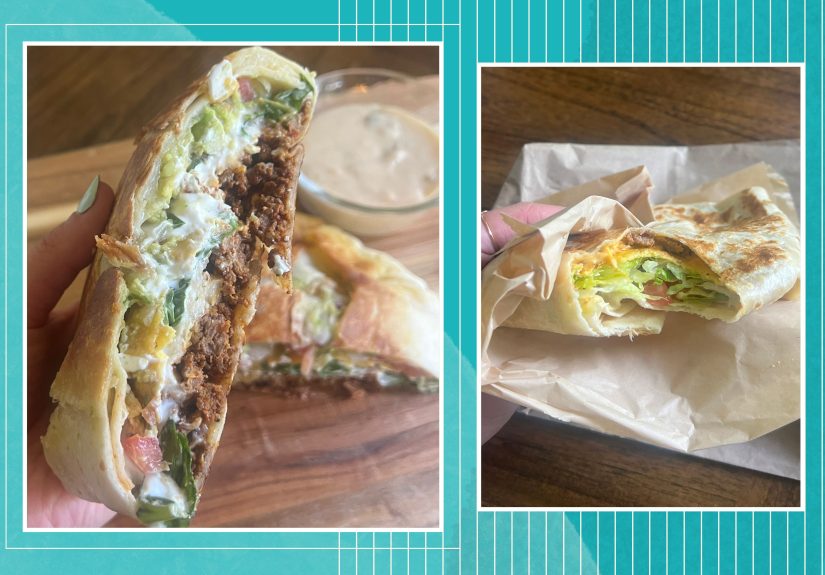
For fairness, I bought a Crunchwrap Supreme from Taco Bell and brought it home immediately. I also made my copycat
Crunchwraps at the same time, cut both in half, and judged them like a snack-obsessed sommelierexcept instead of
swirling wine, I was staring intensely at lettuce.
Round 1: First bite (the “hello” bite)
Taco Bell: The first bite delivered familiar seasoned beef flavor and that signature nacho-cheese tang.
Crunch was present, but the shell felt a little softer than I rememberedlike it had survived a long commute.
Copycat: Louder crunch, hotter interior, and noticeably fresher lettuce. The flavor was extremely close,
especially with a store-bought nacho cheese sauce that leans “fast-food queso.”
Round 2: Texture (the reason we’re all here)
Taco Bell: Soft exterior with a crisp moment in the middle. The contrast is good, but the tostada
crunch can fade depending on how long the Crunchwrap sits after it’s made.
Copycat: The skillet-crisped tortilla gave a more consistent crunch on the outside, and the tostada
stayed snappy longer because the cold toppings were drier and placed above the crunchy layer.
Round 3: Balance (hot vs. cold, creamy vs. fresh)
Taco Bell: Classic ratiocreamy, salty, and familiar. Tomatoes and lettuce are there, but not always abundant.
Copycat: More customizable. I used slightly more lettuce and tomato, which made the whole thing feel fresher
and less heavy. Also: I could actually taste the tomato, which is not always a given in fast food.
Round 4: Structure (the “did it explode?” test)
Taco Bell: Built like it’s been through training. It holds together well, though the seam can loosen
if it’s overfilled or handled like a steering wheel.
Copycat: When folded tightly and toasted seam-side down first, it stayed sealed surprisingly well.
The tortilla-cap trick was the difference between “clean hexagon” and “abstract tortilla sculpture.”
So… Which One Won?
If we’re judging by pure nostalgia and convenience, Taco Bell still has the edge. It’s the original vibe.
But if we’re judging by freshness, crunch, and hot-off-the-skillet satisfaction,
the copycat version winsespecially when eaten immediately.
My unofficial scorecard
- Crunch: Copycat
- Flavor accuracy: Tie (copycat gets very close with the right nacho cheese sauce)
- Freshness: Copycat
- Convenience: Taco Bell
- Customization: Copycat (and it’s not close)
The real headline: the best copycat Crunchwrap isn’t just “as good as Taco Bell.” In a few waysespecially crunch
and temperatureit can be better. The trade-off is that you’re now the Crunchwrap employee. Congratulations on
your new job. The benefits are edible.
Easy Upgrades That Still Taste Like the Real Deal
1) Make it “extra Taco Bell”
- Use a nacho cheese sauce with a strong queso vibe
- Add a small handful of shredded cheese under and over the tostada
- Keep seasoning bold and a little salty (within reason)
2) Make it fresher
- Add chopped onion or pico
- Mix a squeeze of lime into sour cream for a tangy crema
- Add a few pickled jalapeños for brightness
3) Swap the protein
- Chicken: shredded rotisserie chicken + taco seasoning + a splash of broth
- Vegetarian: black beans + seasoned rice + extra cheese
- Breakfast: eggs + hash browns + cheese sauce (dangerously good)
Troubleshooting: Common Crunchwrap Problems (and Fixes)
Problem: It won’t fold shut
- Use a larger tortilla (12-inch helps a lot)
- Stop overstuffing (I say this with love)
- Use the tortilla-cap trick so your folds have something to land on
Problem: It’s soggy
- Drain beef well and simmer seasoning until thick
- Pat lettuce and tomatoes dry
- Keep cold toppings above the tostada, not under it
Problem: It falls apart in the pan
- Toast seam-side down first and press gently for 15–20 seconds
- Let it crisp before flipping (don’t rush the golden crust)
- Use medium heat, not highburning is not bonding
Is the Copycat Crunchwrap Cheaper?
Usually, yesespecially if you’re making multiple Crunchwraps. Buying tortillas, beef, lettuce, tomatoes, and
cheese sauce up front costs more than one drive-thru order, but the per-wrap cost drops quickly when you make a batch.
Plus, you can control portions (and actually add enough lettuce to count as “a vegetable,” technically).
Conclusion: The Best Copycat Crunchwrap Is the One You Eat Immediately
Here’s the honest truth: the copycat Crunchwrap shines when it’s fresh, hot, and crisped right out of the skillet.
That’s the moment it beats the real dealbecause time is the mortal enemy of crunch. Taco Bell’s Crunchwrap is still
iconic, still satisfying, and still the champion of convenience. But at home, you can chase the same flavor, improve
the texture, and tailor every bite.
If you try this, do yourself a favor: set up an assembly line, keep your veggies dry, and toast seam-side down first.
Then cut it open, admire the layers like you’re on a cooking show, and take the kind of bite that makes you briefly
believe adulthood is going okay.
Extra: of Crunchwrap Experiments (a.k.a. My Week in Hexagons)
After the official taste test, I did what any reasonable person would do: I kept making Crunchwraps “for research”
until my kitchen smelled like a taco night that never ends. The first unexpected lesson was that Crunchwraps are
basically mood rings. Make one when you’re calm and patient, and it folds neatly into a gorgeous hexagon. Make one
when you’re hungry and chaotic, and it turns into a tortilla burrito-pancake hybrid that leaks cheese the second you
look away. The food mirrors the soul.
On day two, I tried the “more is more” approachextra beef, extra cheese, extra nacho sauce. The result tasted amazing
for exactly 90 seconds, right up until the tostada started to surrender under the pressure of my overconfidence.
The wrap didn’t fully collapse, but it did develop what I’d call “structural feelings.” The fix was simple: keep the
hot layers thick but not watery, and respect the tostada like it’s a load-bearing wall.
Day three was all about crunch longevity. I tested three tiny tweaks: patting lettuce dry, draining tomatoes, and
adding a second light sprinkle of shredded cheese above the tostada before the cold toppings. Drying the veggies
made the biggest difference. It felt sillylike I was giving salad a spa daybut it kept the tostada snappy longer.
The extra cheese helped too, acting like a melty “seal” between crunch and chill.
Day four, I went rogue and tried a Doritos-style substitute for the tostada. It was fun and loud and tasted like a
party, but it lost its crunch faster than the tostada and threw the flavor off the classic profile. Great for a
remix, not for a true copycat.
By day five, I had my routine down: warm tortilla, hot layers first, tostada centered, sour cream spread like mortar,
dry lettuce and tomatoes on top, tortilla cap, six confident folds, seam-side down in the skillet. I could assemble
one in under two minutes, which is either impressive or a sign I should be monitored by a professional.
The last lesson was the most important: a Crunchwrap is best eaten immediately, preferably while standing in the
kitchen, because sitting down implies you have timeand time is how crunch dies. If you want a make-ahead strategy,
prep your components separately and assemble right before crisping. When you do that, the copycat doesn’t just
compete with the real deal. It feels like the Crunchwrap you wish you always got: hotter, crunchier, fresher, and
exactly the way you like it.