Table of Contents >> Show >> Hide
- What “Ionian” Usually Refers To (And Why Names Get Weird)
- Deck-Mounted + Gooseneck: The Two Decisions That Change Everything
- Signature Features of an Ionian Deck-Mounted Gooseneck Faucet
- 1) Bridge-body design: traditional looks, serious stability
- 2) Separate hot and cold handles: precision you can actually use
- 3) Side spray / side rinse: the underrated MVP
- 4) Ceramic disc cartridges: built for drip-free adulthood
- 5) Brass construction: weighty, durable, and not just “pretty metal”
- 6) Flow rate and water efficiency: don’t confuse “strong” with “wasteful”
- Finishes: Choosing a Look You’ll Still Like After 10,000 Dish Cycles
- Planning & Installation: What to Know Before the Drill Comes Out
- Care & Maintenance: Keep It Gorgeous Without Making It Your Second Job
- Ionian vs. Other Popular Kitchen Faucet Styles
- FAQ
- Conclusion
The phrase “Ionian deck-mounted gooseneck faucet” sounds like it belongs on a yacht, next to a crystal decanter and someone named “Chip.”
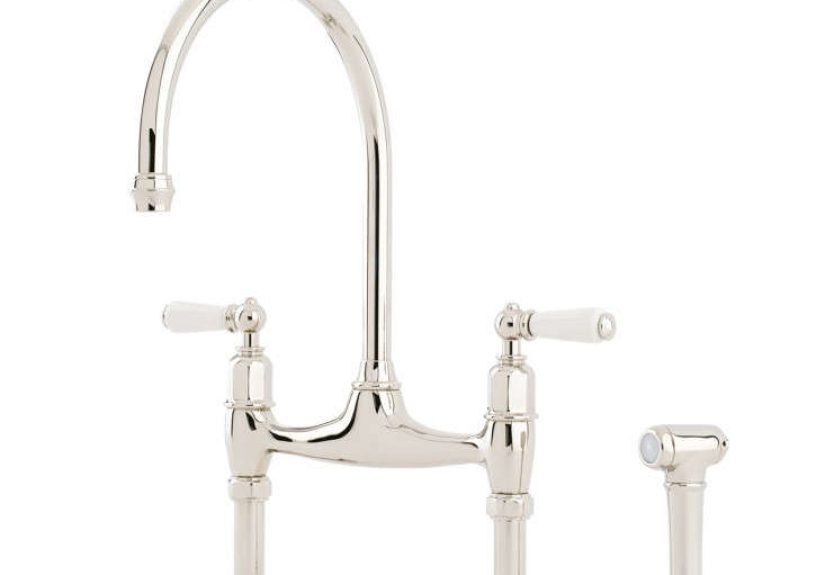
In reality, it’s a very specific (and very satisfying) kind of kitchen faucet: a deck-mounted, bridge-style beauty with a high-arc “gooseneck”
spoutbuilt for real-life cooking, cleaning, and that one enormous stockpot you only remember you own on soup day.
This guide breaks down what an Ionian deck-mounted gooseneck faucet is, why people love it, how to choose the right configuration,
and what to know before you cut holes in anything you can’t un-cut. Along the way: practical tips, no keyword stuffing, and exactly
zero honking geese.
What “Ionian” Usually Refers To (And Why Names Get Weird)
“Ionian” is commonly used to describe a traditional, bridge-style faucet silhouetteclassic proportions, separate hot/cold handles,
and an elegant high-arc spout. Depending on where you shop, you may see the same general design language marketed under different
collection names or model numbers (especially with premium, globally distributed brands).
The big takeaway: don’t get hung up on the label. Focus on the anatomydeck-mounted installation, bridge body, gooseneck spout, and
(often) a side spray. Those features are what you actually live with every day.
Deck-Mounted + Gooseneck: The Two Decisions That Change Everything
Deck-mounted: installed on the sink or countertop “deck”
A deck-mounted faucet installs through holes in your sink deck or countertop (as opposed to wall-mounted). It’s the most common setup
in American kitchens because it’s compatible with a wide range of sinks and simplifies plumbing access for repairs.
With bridge faucets in particular, deck-mounting also gives you that iconic “bridge” tube visible above the decklike functional jewelry
for your sink area.
Gooseneck (high-arc) spout: clearance you can feel
A gooseneck spout is the high-arc curve that creates more vertical space between the spout and the sink. In plain English: you stop
playing Tetris with your cookware. Tall pitchers fit. Oversized pans fit. You can rinse a sheet pan without performing interpretive dance.
Signature Features of an Ionian Deck-Mounted Gooseneck Faucet
While specs vary by model, an Ionian-style deck-mounted gooseneck faucet tends to prioritize three things:
classic form, precise control, and daily usability.
Here’s what to look for.
1) Bridge-body design: traditional looks, serious stability
Bridge faucets connect hot and cold supplies above the deck, visually “bridging” the handles to the spout. This style is popular in
traditional, farmhouse, and transitional kitchensespecially if you want a faucet that feels intentional (instead of “the builder special
that came with the sink”).
- Best for: apron-front sinks, classic cabinetry, unlacquered brass moments, and kitchens with personality.
- Not ideal for: ultra-minimal spaces where you want the faucet to disappear.
2) Separate hot and cold handles: precision you can actually use
If you like setting water temperature “just so,” dual-handle control is deeply satisfying. You get fine-tuned blending instead of
“too coldtoo hotnow I’m boiling my hands.” Yes, that’s a technical term.
It’s also a look: two handles framing a high arc spout reads “classic kitchen” in the same way a subway tile backsplash reads “I have
opinions and I stand by them.”
3) Side spray / side rinse: the underrated MVP
Many Ionian-style bridge faucets pair the main spout with a side spray (sometimes called a side rinse). It’s fantastic for:
- Rinsing corners of deep sinks
- Blasting food off plates (politely)
- Filling large pots sitting on the deck or in an adjacent bowl
- Quick veggie rinses without rearranging the universe
If you cook a lot, a side spray is one of those features you don’t brag aboutuntil you’re in someone else’s kitchen and suddenly
you’re like, “Wait… where’s the spray?”
4) Ceramic disc cartridges: built for drip-free adulthood
Modern premium faucets typically use ceramic disc technology for durability and leak resistance. In practical terms, that means smoother
operation and fewer “mystery drips” that keep you up at night like a tiny, water-based horror movie.
5) Brass construction: weighty, durable, and not just “pretty metal”
A well-made Ionian deck-mounted gooseneck faucet is often built with brass components. Brass is valued for durability and longevity
in plumbing fixtures, especially when paired with quality internal valves and solid finishing processes.
6) Flow rate and water efficiency: don’t confuse “strong” with “wasteful”
In the U.S., kitchen faucets must meet federal flow requirements, and many premium faucets come in around the mid-range for strong
everyday performance without going full firehose.
Here’s the sweet spot: enough pressure to rinse a cutting board clean, but not so much that your sponge launches across the sink like
it’s training for the Olympics.
Finishes: Choosing a Look You’ll Still Like After 10,000 Dish Cycles
Your faucet finish is basically the kitchen equivalent of shoes: it has to look good, handle daily abuse, and not punish you for having
fingerprints (how dare you).
Polished finishes
Polished chrome and polished nickel are classic choices for a reason. They’re bright, timeless, and tend to coordinate easily with
stainless appliances and many cabinet pulls.
Warm metals: brass, gold, bronze
Warm finishes add character fastespecially in traditional and transitional kitchens. They also show water spots differently than chrome,
depending on sheen and texture.
“Living finishes” (unlacquered brass): the patina lifestyle
Unlacquered brass is designed to age. It will patina, and it may do so unevenly. That’s not a defectit’s the entire point. If you want
a faucet that develops character like a leather jacket, this is your lane. If you want it to look exactly the same forever, choose a
protected finish instead.
Planning & Installation: What to Know Before the Drill Comes Out
Bridge faucets are not difficult, but they are picky. The most common problems come from skipping the “measure twice” part.
Do the planning and your future self will thank you loudly.
Step 1: Confirm hole count and spacing
Many bridge-style setups use two holes for the faucet body/handles, and a third hole if you’re adding a side spray, soap dispenser,
or filtration tap. If your sink already has pre-drilled holes, let that guide your configuration.
Step 2: Check deck thickness and clearance
Deck-mounted faucets must clamp securely through the sink deck or countertop. If you have a thick stone countertop with an undermount
sink, make sure the mounting hardware is compatible and there’s enough access from below.
Step 3: Plan for backsplash and handle swing
Traditional lever or cross handles need room to operate. If your faucet sits close to a raised backsplash, handle clearance can become a
daily annoyance. Leave breathing space whenever possible.
Step 4: Don’t ignore connection type
Supply connections (and whether unions or adapters are included) matter. If you’re renovating, it’s the perfect time to replace old
shutoff valves and supply lines so your new faucet isn’t connected to plumbing that last saw daylight during the flip-phone era.
A quick “I’m doing this myself” checklist
- Read the spec sheet before ordering (yes, before).
- Confirm hole sizes and any accessories (side spray, soap dispenser).
- Check shutoff valves and replace if questionable.
- Flush supply lines after connecting (it helps protect the cartridge/aerator).
- After installation, check for leaks with paper towels (they don’t lie).
Care & Maintenance: Keep It Gorgeous Without Making It Your Second Job
The good news: most premium faucets don’t need complicated care. The bad news: abrasive cleaners will absolutely ruin your week.
Stick to gentle, non-abrasive cleaning and wipe dry when you can.
Daily/weekly care
- Use mild dish soap and water on a soft cloth.
- Avoid scouring pads, harsh powders, and aggressive acids.
- Dry after heavy use to reduce spottingespecially on darker finishes.
If you have hard water
Mineral buildup can clog aerators and sprays over time. If your spray pattern gets weird (like it’s sneezing), clean the aerator and
any rubber nozzles per manufacturer guidance.
Ionian vs. Other Popular Kitchen Faucet Styles
Bridge faucet vs. single-handle pull-down
A single-handle pull-down is the “Swiss Army knife” of kitchen faucetsfast temperature control, integrated sprayer, and often an easier
retrofit. A bridge-style Ionian gooseneck faucet is the “tailored blazer” choice: it’s deliberate, classic, and instantly upgrades the
look of a sink wall.
Side spray vs. pull-down sprayhead
Side sprays keep the main spout clean and elegant. Pull-down heads consolidate everything into one unit. Neither is “better” universally
it depends on how you cook and how much you value the classic bridge silhouette.
FAQ
Is a deck-mounted gooseneck faucet practical for everyday use?
Yes. The high-arc clearance makes daily tasks easier, and deck-mounted installation keeps plumbing accessible for service.
Do bridge faucets work with modern kitchens?
Absolutely. Bridge faucets look especially sharp in “warm modern” kitchensthink clean cabinetry, natural stone, and one or two heritage
details that make the room feel lived-in (in a good way).
Should I choose a living finish like unlacquered brass?
Choose it if you want patina and character. Skip it if you want uniform color for years. Living finishes are a vibe, and they commit to
the bit.
Conclusion
The Ionian deck-mounted gooseneck faucet is the rare kitchen upgrade that’s both visually iconic and genuinely useful. The bridge-body
design brings timeless style, the high-arc spout adds real clearance, and side spray options turn cleanup into a quicker, less dramatic
activity (a win for everyone, including the person who “soaked” the pan and forgot it for two days).
Choose it when you want your faucet to look like a design decisionnot a default. Plan your hole configuration, confirm clearances,
pick a finish that matches your lifestyle, and you’ll end up with a fixture that feels right every single day.
Bonus: Real-World Experiences With the Ionian Deck-Mounted Gooseneck Faucet (About )
In real kitchens, the Ionian-style deck-mounted gooseneck faucet tends to win people over in a surprisingly unglamorous moment: the first
time they wash something enormous. A stockpot, a roasting pan, a vase you swear you only bought because “it looked artsy.” That extra
height under a high-arc spout is the difference between easy rinsing and awkwardly tilting cookware like you’re trying to pour out a
canoe.
Another common “oh, this is nice” moment shows up with temperature control. If you’re coming from a single-handle faucet that goes from
arctic to volcano in a quarter-inch of movement, dual handles can feel like upgrading from a dimmer switch to actual lighting design.
People who cook a lot often prefer being able to set a reliable warm rinse without hunting for the precise angle that doesn’t offend
either their hands or their patience.
Side sprays get a glow-up in daily use, too. Homeowners often expect them to be optionaluntil they start using one for sink cleanup.
Spraying down corners, rinsing off soap, blasting crumbs into the drain: it’s the kind of practicality you don’t post on social media,
but it quietly improves your routines. And unlike some pull-down heads, a side spray leaves the main spout looking clean and uninterrupted,
which is half the reason people buy a bridge faucet in the first place.
Finish choice creates the biggest “experience gap.” Protected finishes (chrome, polished nickel, some PVD-type finishes) are typically
chosen by households that want easy maintenance. They wipe clean, stay consistent, and don’t punish you for touching them with your
human hands. Living finishes like unlacquered brass are the opposite: you’re choosing change. People who love them describe the finish as
“warming up” over timedeveloping darker areas where the faucet is touched most and lighter areas where it isn’t. People who don’t love
them describe the exact same thing as “why does my faucet look different every week?” Neither group is wrong; they just bought different
lifestyles.
Installation stories are usually smooth when the planning is solidand chaotic when it isn’t. The most common learnings: confirm hole
spacing before ordering, read the spec sheet early, and don’t assume your existing holes match your dream faucet layout. When installers
talk about “easy installs,” they usually mean “everything matched the plan.” When they talk about “long installs,” they mean “surprise,
your sink has three holes and your faucet wants two plus a spray.”
Bottom line: this faucet style tends to deliver a premium, “designed” feel, but it rewards people who measure carefully and choose a
finish aligned with how they actually live. If you do that, it’s the kind of upgrade that makes even washing lettuce feel slightly more
dignifiedwhich is not nothing.