Table of Contents >> Show >> Hide
- The Celebration Everyone Wanted an Invite To
- The Wedding Rule Kylie Allegedly Broke (and Why It Still Matters)
- What Kylie Actually Wore (and Why Cameras Made It Complicated)
- The Internet Reaction: From “It Looked Dirty” to “It’s Not That Deep”
- Lauren Sánchez’s Bridal Moment Raises the Stakes
- The Real Takeaway: Wedding Guest Style Rules That Actually Help
- of Real-World Experiences Inspired by the “Almost-White” Panic
- Conclusion
- SEO Tags
If you want to start a wedding-weekend debate that will travel faster than a Venetian water taxi, here’s the recipe:
(1) invite a global celebrity, (2) add a dress that reads almost white in paparazzi photos, and (3) let the internet do what it does best—argue
like it’s a competitive sport.
That’s basically what happened when Kylie Jenner showed up for Jeff Bezos and Lauren Sánchez’s ultra-watched Venice wedding festivities and
people online decided her look flirted with the most famous unwritten rule in wedding culture: don’t wear white unless you’re the bride.
One viral jab summed up the mood with all the grace of a comment section cannonball: “It looked dirty.”
Was it actually white? Was it silver? Blue? A trick of the flash? More importantly: why do we still care so much about a color rule when modern weddings can include
everything from pajama-themed afterparties to destination weekends with multiple dress codes? Let’s unpack the moment, the etiquette, and the very real
takeaway for anyone who has ever panic-texted a friend from a hotel mirror: “Does this look too light??”
The Celebration Everyone Wanted an Invite To
Bezos and Sánchez’s wedding weekend in Venice was designed for maximum spectacle and maximum privacy—a balancing act that basically guarantees
maximum attention. Reports described a multi-day lineup of events, tightly controlled arrivals by boat, heavy security, and a guest list stacked with celebrities,
business power players, and fashion-world royalty.
The festivities reportedly kicked off with a glamorous welcome party in a cloister near the Madonna dell’Orto church, with guests arriving by convoy of boats.
The logistics were so choreographed that even the entrances were engineered to reduce paparazzi access (and, inevitably, to create a more dramatic photo funnel when
people did get captured).
Meanwhile, Venice locals and activist groups weren’t exactly rolling out the red carpet. Protests around overtourism and inequality became part of the broader
story, with some reports noting changes to venues and heightened security concerns. In other words: the backdrop was already charged. Add fashion drama, and you’ve
got a headline machine.
The Wedding Rule Kylie Allegedly Broke (and Why It Still Matters)
Rule #1: Don’t Wear White—Or Anything That Can Be Mistaken For It
The classic etiquette rule isn’t only “don’t wear white.” In practice, it’s more like:
don’t wear anything that could be read as bridal—white, ivory, cream, champagne, very pale pastels, or anything with a lace-and-corset
vibe that photographs like a wedding gown in the wrong lighting.
Most guests aren’t trying to steal attention; they’re trying to avoid becoming a cautionary tale. Because once a dress becomes a debate, it stops being a
dress and becomes a topic. And weddings already have plenty of topics: timelines, seating charts, speeches, cake, weather, and somebody’s uncle
discovering the open bar like it’s an untapped natural resource.
Why This Rule Exists: Attention Is the Bride’s Currency
At its best, the “no white” norm is about respect. A wedding is one of the rare social events where the focus is deliberately centralized—on the
couple, and especially on the bride in many traditions. Wearing the signature color of the bridal outfit can read like competition, even if you didn’t mean it
that way.
At its worst, the rule can become a weapon—a way for strangers to perform moral superiority over someone else’s hemline. (And yes, the internet can do
that with an Olympic-level straight face.)
Modern Reality Check: Dress Codes Are Custom Now
Plenty of couples now request white outfits for guests, set a color palette, or throw themed events where traditional rules loosen. But unless you know the couple
wants guests in white or “winter whites,” the safest move is to assume the classic rule still applies—especially at a wedding where every
photo is effectively a press release.
What Kylie Actually Wore (and Why Cameras Made It Complicated)
Silvery-Blue in Person, Near-White in Photos
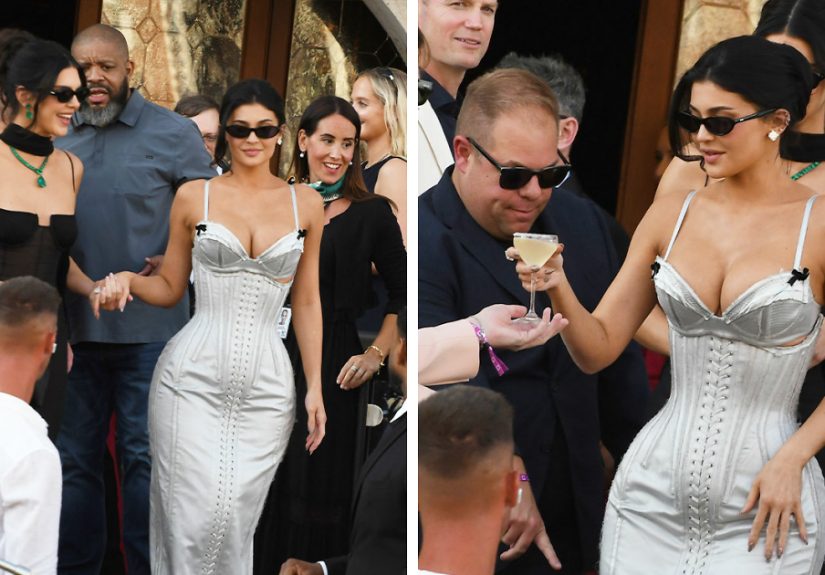
Here’s the key detail: accounts of Kylie Jenner’s dress often describe it as a silvery, icy-blue corset-style gown with dark strap
details. But in certain paparazzi shots—especially the kind taken at speed from across water, in bright daylight, or under hard flash—it can read
very close to white.
That “white-adjacent” effect is a real phenomenon. Satin and sheen-heavy fabrics reflect light aggressively. Add a pale color and a high-contrast setting
(sunlight on water is basically nature’s ring light), and your dress can jump two shades lighter on camera. The result: a look that might feel safely silver in
a mirror becomes a scandal in a screenshot.
The Style Choice: Corsetry, Clean Lines, and a Big Trend Moment
The silhouette itself also mattered to the conversation. Corset-inspired gowns have been everywhere—red carpets, after-parties, fashion weeks, and yes, wedding
guest wardrobes. They’re dramatic, structured, and flattering in a way that reads “event dressing.” That can be totally appropriate for black-tie,
but it also edges closer to bridal territory when paired with pale tones.
In a normal setting, you might see this and think: “That’s a formal dress.” In a celebrity wedding setting, people think:
“That’s a formal dress that will be photographed from 47 angles and judged by 4 million people who don’t know the dress code.”
Accessories That Scream “I’m Here for the Party”
Reports also noted statement jewelry—big diamonds that clearly signal black-tie glamour. On one hand, that levels up the outfit for an event of this scale.
On the other hand, when the internet is already side-eyeing your color choice, sparkling accessories don’t exactly whisper
“I’m trying to keep it low-key.”
To be fair: almost nobody at a billionaire wedding weekend is aiming for “low-key.” That ship sailed, probably past a gondola, and definitely past a
photographer with a long lens.
The Internet Reaction: From “It Looked Dirty” to “It’s Not That Deep”
Why People Felt So Confident… From Their Couch
Online reactions tended to split into two camps:
- Team Etiquette: “Too close to white. She knows better.”
- Team Reality: “It’s silver/blue. Lighting exists. Touch grass.”
Both camps are responding to something real. Wedding etiquette is a legitimate cultural norm. So is the reality that cameras lie—or, at least, they tell a
story shaped by exposure, lenses, and the mood of a photo editor who wants a punchy headline.
The Screenshot Test (a.k.a. The New Etiquette Rule Nobody Asked For)
In 2026, the real wedding guest anxiety isn’t only “Will I offend the bride?” It’s also:
“Will my outfit become a debate slide on TikTok?”
The “screenshot test” is brutal: if your dress looks white in a random phone photo, it will look even whiter in flash. If it looks bridal in one angle,
that angle will become the viral one. And once your look has a nickname, you’re not attending a wedding anymore—you’re attending an internet
trial with no judge and unlimited recess.
The Kardashian-Jenner Factor
Kylie Jenner doesn’t have to “try” to make headlines at an event like this. Her attendance is news. Her outfit is news. Her sunglasses are
probably news. So when she wears a shade that could be interpreted as bridal-adjacent, the story writes itself: “Major wedding rule broken.”
That doesn’t prove intent. It proves that celebrity culture turns tiny choices into narrative fireworks. The wedding guest rule isn’t just etiquette
anymore—it’s content.
Lauren Sánchez’s Bridal Moment Raises the Stakes
A Dress Built for a Spotlight
Part of why the “don’t wear white” conversation gets louder at high-profile weddings is that the bride’s look is often treated like a
fashion event in its own right. Lauren Sánchez’s wedding style was widely covered, including details about couture craftsmanship and inspiration tied to
old-Hollywood glamour. When a bride is wearing a gown that took hundreds of hours to create, people instinctively feel the contrast: this is the moment.
That context makes any guest outfit that even hints at bridal territory feel riskier, because the story becomes “bride versus guest” whether anyone asked
for that storyline or not.
Does the Bride Actually Care?
Here’s the secret the internet hates: we don’t know. We don’t know what the dress code memo said. We don’t know if guests were given a color
palette. We don’t know if Lauren Sánchez saw the dress and thought “cute” or “absolutely not” or, most likely,
“I am getting married, please hand me my veil.”
What we do know is that public weddings create public interpretations. And in public interpretations, a near-white dress becomes a symbol: of etiquette, of ego, of
the spotlight, of celebrity culture, of whatever the commenter had going on that day.
The Real Takeaway: Wedding Guest Style Rules That Actually Help
Forget the pile-on. If you want practical guidance that survives both real life and the camera roll, here it is.
1) Run the Outfit Through Three Lights
- Mirror light: your hotel or bathroom lighting (often warm and forgiving).
- Daylight: near a window or outside (the truth serum of color).
- Phone flash: yes, do it. It’s annoying. It’s also how you avoid looking like a surprise bride.
2) If It Photographs White, Treat It Like White
You might know it’s “ice blue.” The camera might disagree. Your safest move is to trust the photo, not the label.
3) Choose a Color With an Obvious Identity
If the event is formal and you love pale tones, consider colors that read unmistakably as themselves: a soft rose, a clear powder blue, a buttery gold, a lilac that
doesn’t drift into bridal champagne. The goal is not to dim your style—it’s to avoid ambiguity.
4) When in Doubt, Add Contrast
If you already own the dress and it’s borderline, contrast can help: a darker wrap, a bold stole, a colored shawl, or accessories that visually move the look
away from bridal. (No, this doesn’t mean you need to wear neon. Just don’t let “bridal illusion” be the headline.)
5) If You Mess Up, Fix It Like a Grown-Up
The internet loves “gotcha.” Real life loves solutions. If you arrive and realize your outfit is too light:
- Put on a jacket or wrap.
- Swap into a darker dress if you have a backup.
- Keep it low-drama. A sincere “I didn’t realize it photographed this light” goes further than defensiveness.
of Real-World Experiences Inspired by the “Almost-White” Panic
Even if you’ll never attend a billionaire wedding in Venice (most of us won’t, unless we accidentally wander into the wrong water taxi), the core
experience behind this headline is surprisingly relatable: the moment you realize your outfit looks different outside your closet than it did inside it.
Plenty of wedding guests have lived a version of this. Someone buys a pale blue dress that looks obviously blue under warm store lighting, then steps into daylight
and suddenly it reads like “cloud.” Another guest wears a champagne slip dress—because the tag said “champagne”—and learns that
cameras interpret champagne as “white, but make it scandal.” The dress itself hasn’t changed; the context has. Sunlight, flash, and reflective
fabric are a trio that will humble anyone.
Then there’s the group chat factor. Before weddings, friend groups now do informal wardrobe audits like they’re running a mission briefing:
“Send pics. Front, side, flash. Okay now stand by a window. Is it reading white?” It sounds dramatic until you remember what’s at stake:
nobody wants to be remembered as the guest who turned into a subplot. Weddings are emotional, expensive, and heavily photographed. The last thing most people
want is to add stress to the couple or become the story at someone else’s milestone.
One of the most common “save” moves is the emergency layer. A darker shawl, a tailored blazer, even a scarf can shift an outfit away from bridal vibes in
seconds. Guests also borrow from each other more than they admit. It’s not unusual for a friend to quietly offer a wrap with the same energy as handing someone
a mint before a big presentation: no shame, just teamwork.
Another relatable piece: people underestimate how much venue matters. Beach weddings and waterfront venues reflect light like mirrors, washing out
pale colors. Outdoor ceremonies at midday are basically a free photo studio, and that means anything pastel can creep toward white in pictures. Meanwhile, indoor
candlelit receptions can make pale silver look warmer and darker. The same dress can look “safe” at dinner and “uh-oh” during the ceremony
photos. That’s why the best planning isn’t just choosing a dress; it’s choosing a dress for the lighting conditions you’ll actually be in.
And finally, there’s the lesson that matters more than any rule: kindness. Most of the time, if a guest makes a questionable color choice, it’s not a
villain origin story—it’s a styling miscalculation, a shipping mishap, or a camera trick. The internet can turn that into a morality play, but real
weddings run better on grace. If your friend shows up in a dress that photographs too light, help them fix it quietly. If you’re the guest who made the
mistake, adjust and move on. The goal isn’t to win etiquette court. The goal is to celebrate the couple and keep the day joyful—without accidentally
cosplaying as “surprise bride” in the album.
Conclusion
Kylie Jenner’s near-white (or silver-blue, depending on your screen brightness and your willingness to argue online) became a flashpoint because it hit the
intersection of modern celebrity culture and old-school wedding etiquette. The rule is simple, but the optics are complicated—especially at a wedding where
every arrival is photographed, every fabric reflects like a disco ball, and every comment section is ready to appoint itself the etiquette police.
If you take one thing from the headline, make it useful: dress for the camera and the couple. Test your outfit in real lighting. Avoid ambiguous
shades. Bring a backup layer. And remember: the best wedding guest look isn’t the one that wins the internet. It’s the one that lets the couple stay
the main characters while you have a great time in the background—exactly where the cake is.