Table of Contents >> Show >> Hide
- What Exactly Is a “Jellyfish” Glass Table?
- Why This Look Feels So Current Right Now
- How Artisans Create the Dripping “Tentacle” Effect
- Why Jellyfish Were the Perfect Natural Blueprint
- How to Style a Jellyfish Glass Table Without Overdoing It
- Practical Engineering: Beauty Still Has to Behave
- Care and Maintenance for Crystal-Clear Drama
- Buying or Commissioning: A Smart Checklist
- Art vs. Furniture? The Best Pieces Are Both
- Extended Experience Section (500+ Words): What It Actually Feels Like to Live With a “Jellyfish” Glass Table
- Conclusion
Some furniture whispers. A “Jellyfish” glass table absolutely does not. It glows, drips, and seems to hover between
sculpture and utilitylike it swam into your living room during high tide and decided to stay for coffee.
These striking pieces, often associated with artist-led glass work and organic design language, are part of a bigger
shift in interiors: people want objects with character, motion, and emotional pull. Straight lines still have their place,
but today’s design lovers also crave curves, asymmetry, and forms that feel alive.
That’s exactly why jellyfish-inspired tables are having a moment. They combine hand-worked glass artistry, ocean-inspired
aesthetics, and collectible-design energy in one unforgettable silhouette. The effect is dramaticbut not loud.
The “tentacles” (those flowing, melted-looking drips) soften a room, catch light all day, and turn even a minimal space
into a conversation starter. If your style leans coastal, contemporary, maximalist, or “I only buy pieces that make
guests ask questions,” this trend sits right at the intersection of art and function.
What Exactly Is a “Jellyfish” Glass Table?
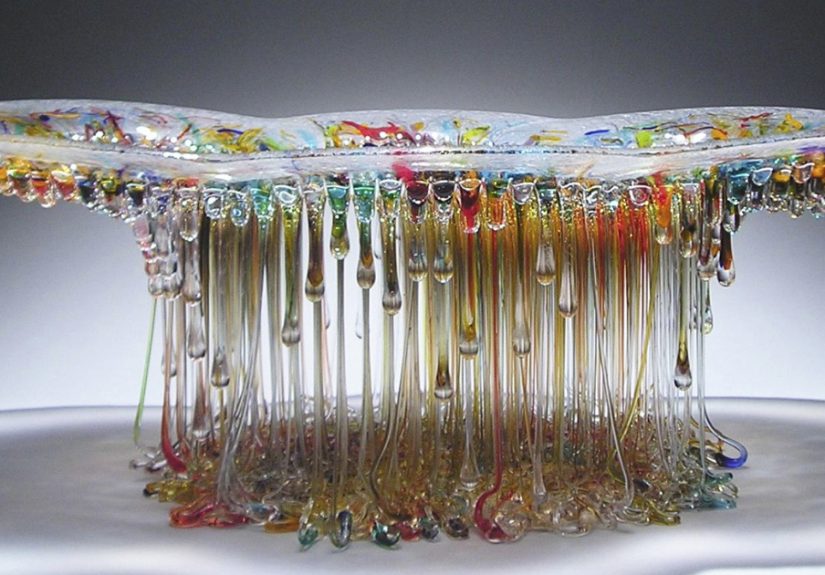
A jellyfish glass table is a sculptural table form where the top resembles a floating bell and the base descends in
elongated, fluid strands that look like tentacles. The most iconic versions are crafted from fused and shaped glass,
producing a translucent, almost aquatic look that changes with light. Some are true table-center sculptures; others
function as side tables, cocktail tables, or display pedestals.
In design terms, these pieces sit inside biomorphic furniture: objects inspired by natural anatomy and movement.
Think coral-like edges, wave forms, shell curves, and organism-like geometry. Instead of rigid symmetry, biomorphic pieces
favor flowexactly what makes jellyfish tables feel so hypnotic.
Why This Look Feels So Current Right Now
1) Organic and biomorphic forms are back in a big way
Interior trends have shifted from purely strict minimalism toward expressive silhouettes and tactile personality.
Designers are embracing curved furniture, sculptural profiles, and forms that feel “grown” rather than manufactured.
A jellyfish table fits this perfectly: it’s soft in line, strong in identity, and impossible to confuse with mass-market décor.
2) The “dripping” aesthetic has moved from novelty to design language
A few years ago, melted or dripping forms felt playful and niche. Today, they read as intentionally artistic
especially when executed in high-end materials like glass, bronze, or ceramic. The dripping tentacle base adds motion
to otherwise static rooms and works as a visual bridge between surreal art and functional furniture.
3) Coastal motifs are evolving into sophisticated, grown-up interiors
Coastal design is no longer just anchors, stripes, and seashells on every surface. The modern version is subtler:
watery tones, natural textures, and references to marine forms without turning your house into a themed gift shop.
A jellyfish glass table nails that balance. It evokes the ocean without shouting “beach rental.”
How Artisans Create the Dripping “Tentacle” Effect
The magic is technique. While each studio has its own process, these tables generally rely on core glass arts methods:
Kiln forming and glass fusion
Kiln forming involves heating glass so it fuses, slumps, or reshapes over/within molds. This is often how artists create
the bell-like top and the flowing base transitions. The heat schedule (ramp, soak, anneal) controls whether edges stay
crisp, soften, or stretch into those sea-creature drips.
Flameworking for fine detail
Flameworking (lampworking) uses rods or tubes heated in flame, then pulled and shaped by hand. This can add tendril-like
details, small organic protrusions, and nuanced motion cues that make each piece feel one-of-one rather than factory-repeat.
Cold working and finishing
After hot processes, artists grind, polish, and refine edges for stability and touch comfort. This final stage is where
a dramatic art object becomes a usable tablesafe edges, better balance, cleaner optics, and a premium finish.
Why Jellyfish Were the Perfect Natural Blueprint
Real jellyfish have a medusa forman umbrella-like bell with trailing structureswhich naturally translates into table architecture:
top as bell, base as tentacles. That biological logic is part of why these pieces feel “right” even when they look surreal.
Your eye recognizes the rhythm from nature: suspended top, downward flow, transparent body, shifting light.
Jellyfish also symbolize contrast: delicate but resilient, soft-looking but technically complex, simple shape with deep visual impact.
Great design works the same way. At first glance, this is “just a cool glass table.” On closer look, it’s engineering, artistry,
and storytelling packed into one object.
How to Style a Jellyfish Glass Table Without Overdoing It
Scenario A: Modern minimal apartment
Use the table as the hero piece and let everything else stay quiet. Think linen sofa, low-contrast rug, one sculptural floor lamp,
and maybe a single ceramic bowl on top. If your room is already full of bold forms, give the table breathing room. It doesn’t need a hype team.
Scenario B: Coastal contemporary living room
Pair with sea-glass blues, chalky whites, pale oak, and woven texture. Add matte finishes around it so the table’s shine stands out.
Keep accessories curated: one coral-inspired object, one stack of art books, one vessel with branches. Ocean mood, no tourist souvenir energy.
Scenario C: Collector-maximalist home
You can go boldjust layer intentionally. Mix with lacquer, bronze, statement textiles, and art lighting.
The trick is material contrast: if the table is transparent and fluid, surround it with a few grounded elements (stone, wood, upholstery)
so the room feels composed, not chaotic.
Practical Engineering: Beauty Still Has to Behave
If you’re buying for daily use, ask practical questions first, swoon second:
- Is the glass tempered where needed? Horizontal glass table surfaces should prioritize safety glazing.
- What’s the load limit? Not every art table is built for heavy décor stacks.
- How stable is the base? Jellyfish forms can look delicate but should feel planted.
- Is the top replaceable/repairable? Especially relevant for high-traffic homes.
- What are the care instructions? Microfiber-friendly finishes matter for daily maintenance.
In short: sculptural tables can be practical, but the best ones are honest about intended usegallery-level centerpiece,
occasional table, or truly everyday coffee table.
Care and Maintenance for Crystal-Clear Drama
Glass’s superpower is light. Its weakness is fingerprints at eye level. To keep your jellyfish table looking museum-ready:
- Use a soft microfiber cloth (not scratchy paper products) for routine wipe-downs.
- Use light cleaner mistmore spray often means more streaks.
- Wipe in consistent strokes instead of random circles for better clarity.
- Add felt pads to decorative objects to reduce micro-scratches.
- Avoid placing heavy, hard-bottom items directly on bare glass.
- Clean on cooler/overcast timing when possible so solution doesn’t flash-dry too fast.
Bonus tip: keep one cloth slightly damp and one dry for final buffing. Yes, it’s a tiny extra step. Yes, it makes a very
visible difference.
Buying or Commissioning: A Smart Checklist
Whether you’re purchasing from a gallery, artisan studio, or design marketplace, evaluate beyond the glam shot:
- Provenance: artist/studio background, process transparency, edition size.
- Dimensions: especially width at the widest tentacle spread and clearance around seating.
- Color behavior: ask for daylight and evening photos; transparent glass shifts with lighting temperature.
- Shipping protocol: crating, insurance, white-glove setup, and acclimation guidance.
- Aftercare: cleaning kit recommendations, long-term maintenance, and breakage policy.
Commissioning can be especially rewarding if you want custom tint, exact height, or a “tentacle density” matched to your room scale.
A good artist will ask about your space, not just your budget.
Art vs. Furniture? The Best Pieces Are Both
The smartest way to understand jellyfish glass tables is this: they are functional sculpture.
They hold your coffee, yesbut they also shape the emotional tone of a room. They bring movement to still spaces,
softness to angular architecture, and wonder to everyday routines.
In a world of algorithm-friendly furniture that all starts to look the same, jellyfish tables offer something increasingly rare:
personality with craftsmanship. They’re not for everyoneand that’s the point.
Extended Experience Section (500+ Words): What It Actually Feels Like to Live With a “Jellyfish” Glass Table
The first week with a jellyfish glass table is usually the same story: everyone forgets what they were saying mid-sentence.
Someone walks in, sees it, and pauses like they just noticed an aquarium where the aquarium definitely should not be.
That reaction never fully disappears. Even months later, guests drift toward the piece as if it’s giving off a tiny gravitational field.
You start to realize this table isn’t only décorit’s social choreography.
Morning light is where the table earns its reputation. Around 8 a.m., the top catches a pale wash of daylight and the tentacle base
throws soft, uneven shadows on the floor. It looks different every hour. At noon, it appears cleaner and almost architectural.
By evening, especially with warm lamps, it glows from within and the drips feel deeper, like layered water. If you’re the kind of person
who rearranges lighting just to make a room feel “right,” this piece is dangerously rewarding.
Practical life with it is easier than people thinkbut not zero effort. You quickly build rituals:
coaster before cup, felt pad before sculpture, microfiber pass before guests. The table teaches restraint in the best way.
Instead of dumping random clutter on the surface, you edit. A book, a bowl, maybe one object with texture.
Suddenly your coffee table styling improves because the furniture itself refuses visual chaos. It’s like having a stylish friend
who politely removes the tenth throw pillow when you’re not looking.
Families with kids or energetic pets often ask whether a sculptural glass piece is realistic. The honest answer:
yes, with boundaries. Placement matters. If it sits in a narrow sprint path between couch and hallway, you’re setting yourself up for stress.
But in a thoughtfully planned layoutwith enough circulation room and clear visual linesit becomes surprisingly livable.
Many owners say the “specialness” of the piece naturally changes behavior: people become more intentional around it,
in the same way they are around a piano or a large artwork.
Emotionally, the biggest surprise is how calming it can be. Curved, translucent forms soften mental noise in a room full of screens and hard edges.
On busy days, there’s something grounding about a shape that looks fluid and slow. You notice reflections, tiny distortions, little pools of color,
and your attention shifts from “What’s next?” to “What’s here?” That might sound dramatic for a table, but good design often works quietly like that.
There’s also a storytelling effect. Over time, the piece gathers moments: holiday centerpieces, late-night tea conversations,
Sunday stacks of magazines, birthday candles reflected in the glass. Because the table is visually memorable, those ordinary moments feel cinematic.
People remember the room by remembering the object. “Oh, your place with that sea-creature table.” Exactly.
If you work from home, the table can even influence creative mood. Writers use it as a visual reset point between tasks.
Designers pull material swatches against it to test transparency and shine. Photographers love how it reacts to bounce light.
It’s one of those rare pieces that keeps offering angles, not just function.
The only real downside? It may ruin boring tables forever. Once you’ve lived with an object that behaves like both furniture and art,
ordinary rectangles can feel emotionally undercaffeinated. But that’s also the joy: you don’t buy a jellyfish glass table because you need
somewhere to set a remote. You buy it because home should include a little wonderand because sometimes the best design choice is the one
that feels like it washed in from another world and somehow fits perfectly in yours.
Conclusion
“Jellyfish” glass tables are more than a passing décor obsession. They represent where interior design is headed:
toward handcrafted statement pieces, biomorphic silhouettes, and objects that combine function with emotional impact.
If you choose the right size, verify safety details, and style with intention, this one piece can transform an entire room
not by filling space, but by creating atmosphere. In practical terms, it’s a table. In lived experience, it’s a tiny sea fantasy
rendered in glass, light, and movement.