Table of Contents >> Show >> Hide
- What Jon Stewart Meant by “Reverse Oprah”
- The “Qatari Mega-Jet,” Explained Without the Turbulence
- The “Free Jet” Problem: Ethics, Optics, and the Price of a Bargain
- How the U.S. Government Responded
- Why Stewart’s Joke Hit Harder Than a Legal Memo
- The Bigger Context: Transactional Politics Meets Luxury Branding
- So What Happens Next?
- Experiences That Make This Story Feel Familiar (Even If You’ve Never Been Near a 747)
There are political scandals, political “scandals,” and then there are stories so cartoonishly on-the-nose that they arrive
pre-packaged with their own punchlines. Enter: a luxury jumbo jet reportedly valued around $400 million, offered by Qatar’s ruling family,
embraced by the Trump administration, and instantly transformed into late-night comedy catnip.
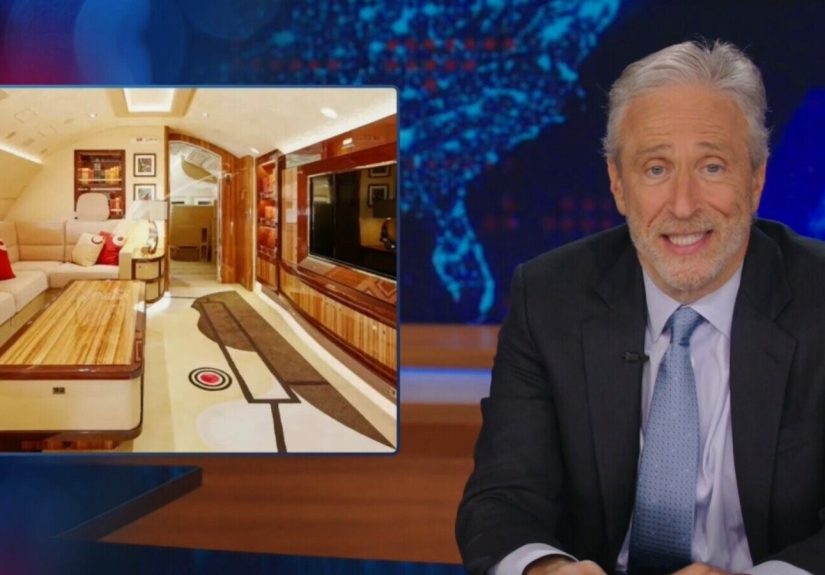
On The Daily Show, Jon Stewart looked at the whole situation and delivered the kind of line that sticks because it’s both funny
and painfully efficient: Trump, Stewart joked, is “the reverse Oprah.” Not “You get a car!” but “I get a jet… and that’s it.”
A gift for the audience? No. A gift for the vibes? Also no. A gift that becomes an aviation-sized metaphor for modern power? Bingo.
What Jon Stewart Meant by “Reverse Oprah”
The Oprah reference is cultural shorthand: a famously generous, audience-centered spectacle where the host gives away gifts with contagious joy.
Stewart’s twist flips that generosity inside out. In his telling, the “giveaway moment” still existsbut the recipient list is exactly one person.
Stewart’s joke lands because it turns a complicated ethical debate into a single image: confetti falling, the crowd cheering, and the host pointing at himself.
In the segment, Stewart zeroed in on the part that feels tailor-made for satire: the jet isn’t just a temporary presidential aircraft.
Under the reported arrangement, it could later end up with Trump’s presidential library foundation after he leaves office.
That’s the detail that makes the whole thing sound less like state logistics and more like a luxury loyalty program.
The “Qatari Mega-Jet,” Explained Without the Turbulence
Strip away the jokes for a second, and the basic contours look like this: Qatar’s ruling family offered a Boeing 747-8an enormous, long-range aircraft
often associated with heads of state and ultra-high-end VIP travel. The plane’s estimated value has been widely reported at about $400 million.
The Trump administration signaled it would accept the aircraft for potential use as a presidential plane while the delayed Air Force One replacement program
continues to slog along.
Why a 747-8 Is Such a Big Deal
A Boeing 747-8 isn’t just “a plane.” It’s a flying building with a tail. It’s designed to cross continents comfortably, host meetings in the air,
and carry a lot of people and equipment. It’s also a maintenance-and-security headache if you want it to function as Air Force One in anything more than
name. A true presidential aircraft requires secure communications, defensive systems, and modifications that take time, money, and painstaking testing.
Why This Happened in the First Place: The Air Force One Delay Problem
The U.S. has been trying to replace the aging Air Force One fleet for years. But the replacement aircraft program has faced repeated delays.
That creates a vacuumand vacuums in Washington get filled with “creative solutions,” especially when they come packaged as “free.”
The timing has also been sharpened by real-world reminders that older aircraft can have issues. In January 2026, Air Force One reportedly had to turn back
after a minor electrical problem, forcing a switch to a backup aircraft. Incidents like that don’t automatically prove a crisis, but they do help explain
why the idea of a newer (or at least different) aircraft becomes politically convenient.
The “Free Jet” Problem: Ethics, Optics, and the Price of a Bargain
If someone says, “Don’t worry, it’s free,” most adults hear: “Ah. So the bill is coming later, just in a different form.”
That’s essentially the core critique. A foreign government (or ruling family) offering an ultra-valuable gift to the United Statesespecially one that could
later be transferred to a president’s library foundationraises questions that go beyond standard diplomacy.
The Legal Questions People Keep Asking
Public reporting has described legal opinions and internal reviews suggesting the arrangement could be structured in a way that the administration argues is lawful
(for example, routing the aircraft through the U.S. government rather than making it a direct personal gift). At the same time, critics have argued the proposal
clashes with the spiritif not the letterof constitutional and ethics safeguards meant to prevent foreign influence.
The Constitution’s Foreign Emoluments Clause is frequently cited in debates like this, because it generally restricts federal officeholders from accepting gifts
from foreign states without congressional consent. Even if lawyers can thread a needle, the optics remain: a luxury aircraft from a foreign power looks less like
routine diplomacy and more like a “thank you note” written in jet fuel.
The National Security Angle Isn’t a Punchline
Beyond ethics, there’s the security question: if the aircraft is meant to serve presidential travel needs, it must be vetted and modified to an extraordinary standard.
That process can take years, not weeks. And even if the plane is “free,” the retrofit almost certainly isn’t. The phrase “free jet” starts to sound like
“free puppy”which is how you end up buying 900 chew toys and replacing a couch.
How the U.S. Government Responded
Reporting in 2025 described the administration’s intent to accept the aircraft, followed by later reporting that the Defense Department formally accepted a Boeing 747 gift from Qatar.
That acceptance didn’t end the controversyit supercharged it. Congressional critics raised alarms about ethics, influence, and security. Some proposed legislation aimed to block
or limit the use of foreign-provided aircraft as Air Force One. Others pushed oversight, including calls for inspectors general to review the arrangement.
In other words, the story quickly became Washington’s favorite genre: “Technically complicated, morally loud.”
Why Stewart’s Joke Hit Harder Than a Legal Memo
Stewart didn’t have to explain procurement rules or constitutional clauses. He just had to point at the absurdity-shaped hole in the narrative:
Why does a presidential library need a mega-jet?
That single question captures the emotional logic of the criticism. Presidential libraries are typically archives and museumsplaces for records, exhibits, and history.
When the story includes an aircraft potentially ending up with a library foundation, it reads like a perk disguised as patriotism. Comedy thrives in that gap between
what’s being said (“It’s for the country”) and what people suspect (“It’s also… for him”).
The “Reverse Oprah” Frame Is Sticky on Purpose
Great satire gives audiences a simple label they can reuse. “Reverse Oprah” is meme-able because it explains the power dynamic instantly:
- Oprah model: public spectacle, gifts distributed outward, audience included.
- Reverse Oprah model: public spectacle, gifts concentrated inward, audience watching the host unwrap it.
It’s not just a joke. It’s a critique of governance as brandingwhere public office becomes a stage, and “deals” become part of the storyline.
The Bigger Context: Transactional Politics Meets Luxury Branding
The jet story didn’t appear in a vacuum. It landed in a political moment where deals, optics, and personal branding often collide.
Reporting around the time of the offer described diplomatic travel in the Gulf region, business headlines, and a general sense that big-ticket gestures were part
of the language of influence.
Qatar is also a complicated actor in U.S. foreign policy conversationsoften described as a U.S. partner in some arenas and criticized in others.
That complexity makes the “gift” feel even more loaded. When the donor is geopolitically significant, a present is rarely just a present.
The Practical Reality: A “Flying Palace” Still Has to Fly Like Air Force One
Turning any jumbo jet into a functional presidential aircraft means solving for:
- secure communications and encryption,
- defensive systems and survivability features,
- hardening against electronic threats,
- ongoing maintenance, staffing, and training pipelines,
- and the unglamorous truth: timelines rarely match political calendars.
In January 2026 reporting, the jet’s delivery timeline was described in “summer 2026” termsanother reminder that even when something is promised as simple,
aviation and security rarely cooperate with slogans.
So What Happens Next?
If the aircraft is delivered and modified for presidential use, it may serve as a stopgapor it may become a symbol that outlives its practical value.
The political fight isn’t only about whether the plane can be used. It’s about what it signals: how power is exchanged, how influence is perceived,
and how easily public trust gets sandblasted when luxury perks enter the chat.
Stewart’s “reverse Oprah” line will likely outlast many of the finer points of the policy debate, because it turns a dense controversy into a human story
about incentives. The punchline works because the premise makes people blink: a mega-jet as a “gift,” wrapped in national colors, floating above questions
that refuse to stay on the ground.
Experiences That Make This Story Feel Familiar (Even If You’ve Never Been Near a 747)
One reason the “reverse Oprah” joke spread is that the underlying experiencebeing told a massive perk is “for everyone,” while it clearly benefits someone specific
is weirdly relatable. Most people haven’t been offered a jumbo jet. But many have watched “free” things turn out not to be free at all.
Think about the everyday version: a workplace announces a “new benefit” that sounds amazing until employees realize it mainly helps executives, or it comes with strings
like longer hours and fewer protections. Or a company offers a “complimentary upgrade” that quietly locks customers into a more expensive plan.
The pitch is generosity; the feeling is suspicion. The jet story operates on the same emotional frequencyjust scaled up to an aircraft with multiple bathrooms.
There’s also a public-service experience hiding in this debate: anyone who has seen how government procurement works knows the phrase “the item was donated”
doesn’t end the spreadsheet. A donated asset still needs security reviews, maintenance schedules, specialized staff, spare parts, training, and compliance work.
The “gift” becomes the first domino in a long chain of costsfinancial and operationalmost of which don’t fit into a neat headline.
Then there’s the museum-and-memory angle. Many Americans have visited presidential libraries or similar institutions and recognize the pattern:
history is packaged for public consumption, often with a spotlight on symbolism. A plane displayed at a library can become an exhibit, a photo-op, a monument,
or a branding tool. Visitors might not parse the legal pathway that got it there; they’ll remember the spectacle. That’s part of why critics focus so intensely
on the “library” detail. It doesn’t just raise ethics questionsit shapes the story people will tell later.
For people who follow politics like a sport (or like a stress hobby), there’s another familiar experience: watching serious governance debates get flattened into
slogans and theatrics. In that environment, comedy becomes a translation service. A segment on The Daily Show can take a dense controversy and convert it into
something that feels instantly understandablesometimes more understandable than official statements. That’s not just entertainment; it’s a coping mechanism for a news cycle
that often feels too surreal to process at normal speed.
Finally, there’s the interpersonal experience of gifts and influence. Most people learn early that gifts can create obligationssometimes subtle, sometimes direct.
A friend picks up dinner and later expects favors. A relative gives an expensive present and then uses it as leverage in family arguments.
Scale that up to geopolitics, and you can see why the phrase “free jet” makes so many people squint. Even if nothing improper happens, the perception of obligation
can still corrode trust. And trust, unlike a 747, is not built to handle repeated rough landings.
That’s why Stewart’s “reverse Oprah” line resonates as more than a laugh: it names a feeling. The feeling that the audience is watching a giveaway show where
the host keeps the prizes, and everyone else is told to clap because it’s “for the country.”