Table of Contents >> Show >> Hide
- Why This Oakland Kitchen Feels So Current
- The Layout Is Doing the Heavy Lifting
- Materials That Make the Kitchen Feel Human
- The Storage Strategy Is the Quiet Star
- Why This Kitchen Works for a Creative Couple
- Design Lessons Worth Stealing for Your Own Remodel
- Real-Life Experiences: Living With a Modern Live/Work Kitchen in the Oakland Spirit
- Conclusion
Some kitchens are built for cooking. Some are built for entertaining. And some, the overachievers, quietly decide they would also like to be a studio, a meeting spot, a coffee bar, a landing pad, and the social center of the home. That is exactly the magic of this Oakland kitchen. It is not just handsome; it is useful in the deeply satisfying, real-life way that makes you forgive a room for occasionally collecting mail, a laptop charger, and one mysterious ceramic bowl you swear was just here five minutes ago.
Set inside a circa-1920 converted schoolhouse loft in West Oakland, this kitchen was designed by Christina Zamora for herself and her wife and creative partner, Cathy Lo. The result is a modern live/work kitchen that does not lean on gimmicks or trend-chasing. Instead, it takes the bones of the loft18-foot ceilings, exposed concrete walls, steel windows, and an open floor planand turns them into assets. The kitchen feels calm, architectural, and personal all at once. That balance is hard to pull off. Many modern kitchens either look like an art gallery with a dishwasher or a family command center with all the romance of airport security. This one avoids both traps.
What makes the room so compelling is that every design move seems to have a job. The white oak millwork warms up the industrial shell. The island acts like furniture instead of a wall. Hidden storage keeps the counters from turning into a junk parade. Open shelving is used with discipline rather than abandon. Even the materialsconcrete, stainless steel, Corian, smoked glass, oaksound like a band that would absolutely open for a very cool architecture conference.
Why This Oakland Kitchen Feels So Current
The best modern kitchens today are not trying to look futuristic. They are trying to look inevitable, as if every cabinet, shelf, and work surface ended up exactly where it belongs. That is the energy here. The kitchen anchors one end of the loft, but it does not bully the rest of the space. In a live/work home, that matters. You want connection, not collision.
Instead of forcing a bulky enclosed kitchen into an airy loft, Zamora embraced the logic of a one-wall-plus-island arrangement. It is a smart move for open-concept and loft-style homes because it preserves flow, keeps sightlines open, and allows the kitchen to stay connected to adjacent living and work areas. The layout feels especially right for creative professionals who need a home to do more than one thing before lunch.
There is also a confidence in the restraint. The design does not scream for attention with oversized pendants, acrobatic marble veining, or a backsplash trying to audition for its own Instagram account. Instead, the kitchen gets its character from proportion, texture, and craftsmanship. In other words, it has grown-up charisma.
The Layout Is Doing the Heavy Lifting
A one-wall kitchen that respects the loft
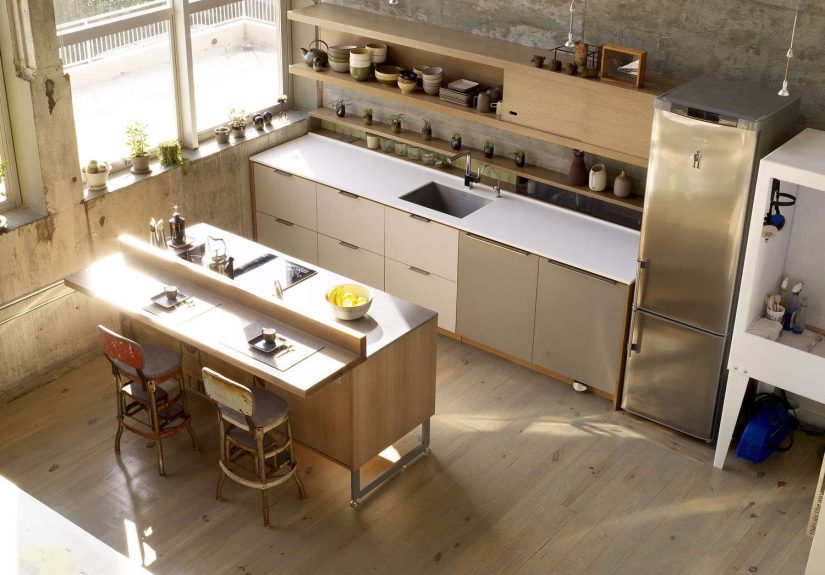
In compact or open homes, the one-wall kitchen is often the unsung hero. It keeps cabinetry consolidated, reduces visual clutter, and leaves room for the rest of life to unfold. In this Oakland loft, that strategy makes the kitchen feel integrated rather than isolated. The bank of cabinetry sits comfortably against the back wall, where exposed board-formed concrete steps in as a ready-made backdrop. That concrete is not hidden or “improved” out of existence. It is allowed to be what it is, which gives the room texture, honesty, and just enough grit.
That decision says a lot about the project. A less confident remodel might have covered the wall with glossy tile and called it a day. But leaving the concrete visible lets the architecture do part of the design work. That is efficient, visually rich, and frankly a little smug in the best possible way.
An island that behaves like furniture, not a barricade
The island is where this kitchen really earns its live/work stripes. Zamora wanted it to feel “floating and open,” and that instinct was exactly right. Too many islands act like the kitchen equivalent of a roadblock, cutting a room in half and making everyone walk around them as if they are dodging a mildly annoying monument. This island does the opposite. It defines space without closing it off.
Its furniture-like quality matters because the loft is one continuous environment. The island becomes a bridge between cooking, conversation, working, and casual eating. It is topped in stainless steel, incorporates a bent steel backsplash, and includes a solid white oak breakfast bar cantilevered on hidden brackets. That mix gives the piece warmth and precision at the same time. It can handle meal prep, coffee breaks, laptop sessions, and late-night snacks without ever seeming confused about its identity.
In practical terms, the island also proves why this feature remains central to modern kitchen design. A good island adds prep space, seating, storage, and circulation benefits all at once. A great island, like this one, also works as a spatial divider that does not ruin the party.
Materials That Make the Kitchen Feel Human
White oak keeps the industrial shell from getting chilly
Lofts can be beautiful, but they can also slip into that “former warehouse, current echo chamber” mood if the finishes are too cold. White oak is the antidote here. The newly milled oak cabinetry brings softness, grain, and a sense of lived-in calm to the concrete walls and steel windows. It also connects the kitchen to the vintage furniture and ceramics collection, making the space feel curated rather than staged.
Natural wood is especially effective in modern kitchens because it adds warmth without adding fuss. It lets the room breathe. And in a creative household, that matters. You want the kitchen to feel inspiring, not intimidating. White oak says, “Yes, this room is beautifully designed.” It also says, “Please set down your mug; I am not emotionally fragile.”
Concrete, stainless steel, and Corian sharpen the composition
Warmth alone would not have been enough. The industrial side of the loft still needed to show up. That is where the harder materials come in. Stainless steel on the island brings a professional, workshop-like edge that feels right at home in a live/work environment. The single sheet of white Corian on the back counter, complete with an integrated backsplash lip, introduces a clean line and low-maintenance practicality. The exposed concrete wall adds character without decorative clutter.
Together, these materials create tension in the best way. The room is neither rustic nor slick. It is balanced. That balance is what makes the kitchen feel modern in a lasting way instead of merely trendy.
The Storage Strategy Is the Quiet Star
Hidden storage keeps the room from becoming visual chaos
If you have ever worked from home at a kitchen counter, you know how quickly the room can descend into nonsense. One coffee mug becomes three. A stack of mail appears. A charging cable breeds in the wild. A modern live/work kitchen only succeeds if it has somewhere for all that life to go.
This Oakland kitchen handles that beautifully. An integrated plywood storage box behind the sink keeps the countertop clear and closes partially with sliding smoked glass doors. Upper shelving includes recessed lighting and sliding panels for barware and glass storage. Below, the drawers are thoughtfully detailed, with white oak construction, laminate fronts, and custom unfinished stainless pulls. The whole setup is full of intention without looking precious.
What is especially smart is the mix of concealed and visible storage. Open shelving is used selectively, which is exactly how it works best in real life. A little openness can add air and personality; too much can turn daily dishes into an accidental museum exhibit. Here, the visible elements are curated, and the messier realities stay tucked away. That is not cheating. That is wisdom.
Compact appliances support the architecture
The 24-inch refrigerator and 24-inch oven are another example of thoughtful restraint. In a loft kitchen, oversized appliances can dominate the room and make the space feel more suburban showroom than urban studio. By choosing compact appliances, the design preserves openness while still delivering the functionality the couple needs. The Miele induction cooktop strengthens that modern, efficient profile even further.
This is one of the most overlooked lessons in kitchen design: bigger is not always better. Better is better. In a room that needs to cook, host, and occasionally coexist with creative work, proportion matters more than bragging rights.
Why This Kitchen Works for a Creative Couple
The phrase “live/work” can sound suspiciously like a euphemism for “you will answer emails next to your toaster.” But in the best homes, it means something richer. It means designing a space that can support different kinds of attention, energy, and interaction throughout the day. This kitchen gets that exactly right.
For a creative couple, the kitchen is not just a food zone. It is a place to brainstorm, regroup, entertain clients or friends, unpack ideas, and move fluidly between tasks. The breakfast bar offers a casual perch. The open plan keeps conversations easy. The material palette is tactile and calming rather than distracting. Nothing about the room feels rigid.
There is also a lovely sense of authorship here. The couple’s collection of Heath Ceramics, the vintage seating, the artwork on the island’s backside made from recycled kiln shelving, and the houseplants all make the kitchen feel deeply theirs. That is a big part of why the room lands emotionally. It is not a catalog kitchen. It is a working room with a point of view.
Design Lessons Worth Stealing for Your Own Remodel
1. Let the architecture participate
If your home has concrete, brick, beams, unusual windows, or other character-rich elements, resist the urge to smooth everything into generic perfection. Good remodels often come from working with the existing architecture instead of trying to erase it.
2. Use an island to connect spaces, not divide them
An island should improve circulation and conversation. If it feels like a boulder in the middle of the room, scale it back or rethink the shape and openness of the base.
3. Mix warm and cool materials
Wood alone can feel soft. Steel and concrete alone can feel severe. Put them together and suddenly the room has depth, texture, and a little swagger.
4. Hide what deserves to be hidden
Integrated storage, sliding doors, appliance garages, and smart drawer planning are not boring details. They are the difference between a kitchen that photographs well and a kitchen that actually lives well.
5. Keep open shelving on a short leash
Open storage is most successful when it is edited. Think beautiful daily-use pieces, not every mug you have owned since college.
Real-Life Experiences: Living With a Modern Live/Work Kitchen in the Oakland Spirit
What makes this kind of kitchen memorable is not just the design language; it is the lived experience. You can imagine the rhythm of a day unfolding here without much effort. Morning light cuts through the steel windows. Coffee lands on the white oak breakfast bar. One person answers a couple of emails while the other slices citrus or sets a pan on the induction cooktop. Nothing feels crowded, even though a lot is happening. That is the hidden luxury of a truly well-planned kitchen: not more square footage, but less friction.
People who live in creative households tend to understand this instinctively. A room does not need to be formal to be beautiful, and it does not need to be messy to feel alive. The best spaces support spontaneity. In a live/work kitchen, that might mean a countertop that is clear enough for lunch prep at noon and concept sketches at 2 p.m. It might mean an island where a friend can sit with a glass of wine while dinner comes together, or where somebody spreads out fabric swatches, ceramic samples, or a laptop for a quick working session. A good kitchen should not panic when life gets interesting.
This Oakland example also speaks to something many homeowners want now: a room that feels grounded. Modern life is noisy. Screens multiply. Notifications breed like rabbits. A kitchen with tactile materials and thoughtful storage can act like a reset button. White oak feels calm under your hands. Smoked glass adds softness. Concrete gives the eye something real to rest on. Even the restraint of the palette helps. There is no design shouting match here, no feature so loud it steals the room’s attention every five seconds.
Another lived-in pleasure is flexibility. In many homes, the kitchen has become the unofficial headquarters whether anyone planned for it or not. Kids do homework there. Adults work there. Guests drift there. Groceries explode there. Packages are opened there. The point is not to stop this from happening. The point is to design for it gracefully. That is why this kitchen feels so relevant. It accepts that life is layered. It plans for overlap. It understands that usefulness can be elegant.
There is also something distinctly Oakland, or at least Bay Area, about the whole approach. The kitchen embraces craft, individuality, and adaptive reuse without becoming self-congratulatory about it. Recycled kiln shelving on the back of the island, custom millwork made with care, ceramics that reflect the owners’ history, and a balance of industrial bones with handmade warmth all contribute to a space that feels local, personal, and inventive. It is modern, yes, but not anonymous. That is a meaningful distinction.
Most of all, this kitchen proves that a hardworking room does not need to look hardworking. It can be serene and still be useful. It can be edited and still feel warm. It can be architectural and still invite people to lean, linger, snack, work, talk, and stay a little longer than they planned. Honestly, that may be the dream: a kitchen that does not just function beautifully, but quietly improves the mood of everyone standing in it.
Conclusion
Kitchen of the Week: A Modern Live/Work Kitchen for an Oakland Creative Couple succeeds because it understands a modern kitchen’s real assignment. The job is not merely to look polished in photos. The job is to support daily life with style, flexibility, and a little grace under pressure. Christina Zamora’s Oakland loft kitchen does exactly that with a one-wall layout, a floating furniture-like island, warm white oak millwork, compact appliances, and storage solutions that keep clutter from staging a hostile takeover.
For homeowners planning a remodel, the lesson is wonderfully clear: design for the way you actually live. Keep the flow open. Let materials do some storytelling. Make room for work, conversation, cooking, and collections that mean something. And when in doubt, choose the detail that makes the room easier to use tomorrow, not just prettier today. Pretty matters. But pretty that survives real life? That is the good stuff.