Table of Contents >> Show >> Hide
- What Is the Nitric Oxide (FeNO) Test for Asthma?
- How the FeNO Test Works
- Uses of the FeNO Test in Asthma Care
- Understanding FeNO Results (ppb): What’s Low, Intermediate, or High?
- What Can Affect FeNO Results (So You Don’t Overinterpret Them)
- Benefits, Limits, and Safety
- FeNO vs. Other Asthma Tests: How It Fits Together
- Questions to Ask Your Clinician Before (or After) a FeNO Test
- The Takeaway
- Experiences: What FeNO Testing Looks Like in Real Life (and Why People End Up Loving It)
If asthma had a group chat, your lungs would be the friend who types “I’m fine” while clearly not being fine.
The nitric oxide test for asthmabetter known as the FeNO test
(fractional exhaled nitric oxide)is one way to catch that contradiction.
It’s fast, needle-free, and oddly satisfying: you breathe into a handheld device, and it tells your clinician
whether your airways are showing signs of a specific kind of inflammation that often responds well to inhaled steroids.
In this guide, we’ll break down what FeNO is, when it’s useful, how to read results (including common cutoffs),
what can throw numbers off, and how it fits alongside spirometry and other asthma tests. We’ll keep it practical,
specific, and just funny enough that your lungs won’t roll their eyes.
What Is the Nitric Oxide (FeNO) Test for Asthma?
Nitric oxide is a gas your body makes naturally. In asthmaespecially
allergic or eosinophilic asthmaairway inflammation can ramp up nitric oxide
production in the lining of the airways. The FeNO test measures how much nitric oxide is in the air you exhale,
reported as parts per billion (ppb).
Think of FeNO as an “inflammation clue,” not a full diagnosis by itself. It doesn’t directly measure how narrow
your airways are (that’s spirometry’s job). Instead, it helps answer questions like:
Is there evidence of the type of airway inflammation that typically improves with inhaled corticosteroids?
Why this matters: asthma isn’t one-size-fits-all
“Asthma” is an umbrella term. Some people have asthma driven by Type 2 (T2) inflammation
(often associated with allergies and eosinophils). Others may have asthma symptoms with low T2 inflammation,
where inhaled steroids may help lessor where the bigger issue is triggers, technique, adherence, reflux, vocal cord
dysfunction, or something else entirely.
FeNO doesn’t replace your clinician’s judgment, but it can add a helpful data pointespecially when symptoms
and standard lung tests don’t tell the whole story.
How the FeNO Test Works
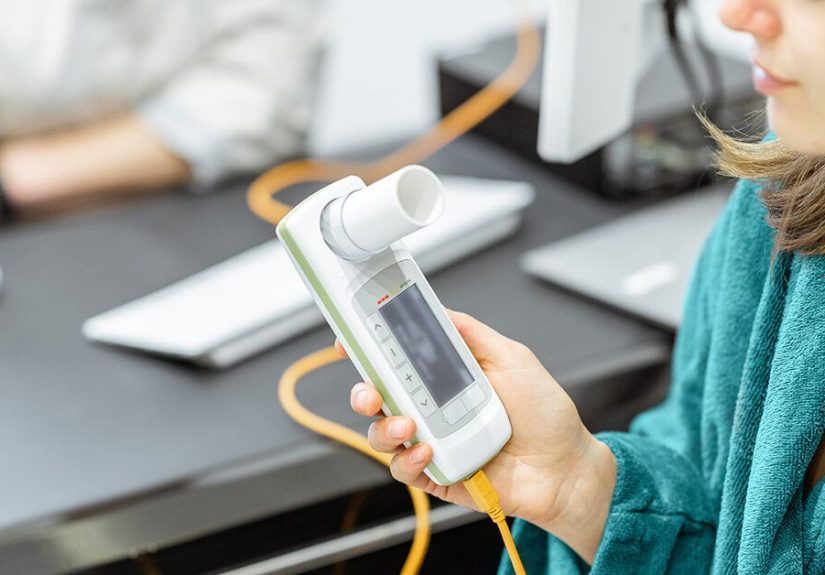
The FeNO test is usually done in a clinic (often alongside pulmonary function testing). It’s quicktypically
just a few minutesand feels more like a “breathing video game” than a medical procedure.
What the test feels like
- You’ll sit comfortably and place your lips around a mouthpiece.
- You’ll inhale deeply (usually through the device) and then exhale slowly and steadily.
- The device measures nitric oxide in your exhaled breath and gives a number in ppb.
The key is the slow, steady exhale. This is not the time for dramatic, heroic blowing like you’re
trying to cool a thousand birthday candles. Your clinician wants controlled airflow, because that’s how FeNO is standardized.
How to prepare so your number isn’t “accidentally weird”
Preparation instructions can vary by clinic, but many follow a simple theme: avoid things that temporarily change
airway chemistry or breathing patterns.
- Avoid eating, drinking, or strenuous exercise for about 1 hour before the test (common instruction).
- Don’t do spirometry or peak flow right before FeNO (often separated by about an hour in some protocols).
- Take medications as directed unless your clinician specifically tells you to hold something for testing.
If you show up a little off-script, don’t panicjust tell the technician. The goal is accuracy, not perfection.
Uses of the FeNO Test in Asthma Care
Clinicians typically use FeNO in three big ways: supporting diagnosis, guiding treatment,
and monitoring inflammation over time.
1) Supporting an asthma diagnosis when it’s unclear
Asthma diagnosis often involves symptoms (wheeze, cough, shortness of breath, chest tightness), plus objective testing
like spirometry. But real life is messy: symptoms can come and go, spirometry can be normal between flare-ups,
and some people can’t perform certain tests well.
FeNO can help when the diagnosis is uncertain, especially in adults and children (often age 5+ in educational materials),
because a higher FeNO level can suggest airway inflammation consistent with allergic/eosinophilic asthma.
It’s not a stand-alone yes/no stampbut it can strengthen the case when combined with history, exam, and other tests.
2) Predicting who is more likely to respond to inhaled corticosteroids
One of FeNO’s most practical roles is estimating whether inhaled corticosteroids (ICS) are likely to help.
In general, higher FeNO often points toward inflammation that tends to be steroid-responsive.
Example: You have a chronic cough and nighttime symptoms. Spirometry is borderline.
A higher FeNO result adds evidence that airway inflammation is activemaking an ICS trial more reasonable,
and giving you a measurable target to follow up on later.
3) Monitoring asthma inflammation and adjusting treatment
Asthma control isn’t just “How do you feel today?” It’s also “Are you headed toward a flare?”
FeNO can be used as a monitoring toolespecially if your asthma is known to track with T2 inflammation.
FeNO monitoring can support decisions like:
- Whether an inhaled steroid dose is likely doing its job
- Whether inflammation is rising before symptoms explode
- Whether a medication plan is being followed consistently (because FeNO often drops when ICS is taken regularly)
- Whether it’s reasonable to step down therapy in stable patients (always clinician-guided)
Real-world scenario: A patient reports “I’m using my controller inhaler every day,”
but FeNO stays persistently high. That can trigger a helpful, non-judgmental conversation:
“Can we walk through your routine, inhaler technique, and whether refills match daily use?”
Sometimes the issue is missed doses. Sometimes it’s technique. Sometimes it’s ongoing allergen exposure.
FeNO doesn’t assign blameit just waves a tiny scientific flag.
4) Adding context for severe asthma and advanced therapies
In specialty care, FeNO may also be used as one piece of phenotypingalongside blood eosinophils, IgE testing,
allergy evaluation, and clinical historywhen considering whether a patient has T2-high asthma that might benefit
from certain add-on therapies. It’s not the only marker, and it’s not perfect, but it can contribute to the bigger picture.
Understanding FeNO Results (ppb): What’s Low, Intermediate, or High?
FeNO results are reported in ppb. There’s no single “perfect” number for everyone,
but clinical guidelines commonly use cut points to interpret results in context.
Commonly used cut points
- Adults: Low is often considered < 25 ppb, high is often > 50 ppb.
- Children: Low is often considered < 20 ppb, high is often > 35 ppb.
- Intermediate: Between those ranges, interpretation leans heavily on the clinical story.
Translation into plain English:
- Low FeNO: Less evidence of eosinophilic (T2) airway inflammation. Steroids may be less likely to helpthough not impossible.
- High FeNO: More evidence of eosinophilic (T2) inflammation. In symptomatic patients, inhaled steroids are more likely to be beneficial.
- Intermediate FeNO: The “it depends” zone. Allergies, recent infections, medication use, and baseline trends all matter.
Trends matter: your personal baseline can be more useful than a single number
FeNO can be especially useful when you look at it over time. Some guideline language uses changes like:
- For higher baseline values: a change of about 20% or more can be considered meaningful.
- For lower baseline values: an absolute change around 10 ppb may be meaningful.
Example: If your FeNO drops noticeably after starting or consistently using an inhaled steroid,
that supports the idea that inflammation is responding. If it climbs steadily across visits, that can be an early warning sign
even before your rescue inhaler starts getting a workout.
What Can Affect FeNO Results (So You Don’t Overinterpret Them)
FeNO is usefulbut it’s also sensitive. Many factors can nudge the number up or down. That’s why clinicians interpret
FeNO alongside symptoms, spirometry, trigger exposure, and medication history.
Reasons FeNO may be higher
- Allergic/eosinophilic (T2-high) airway inflammation
- Ongoing allergen exposure (for example, uncontrolled indoor allergies)
- Uncontrolled asthma in patients whose asthma is T2-driven
Reasons FeNO may be lower
- Regular use of inhaled corticosteroids (often lowers FeNO over time)
- Some exposures (like tobacco smoke) may reduce FeNO readings in some people
- Different asthma biology (non–T2-high asthma can have low FeNO even when symptoms are real)
Bottom line: FeNO is a strong supporting actor, not the entire cast.
If you treat it like a single, definitive “asthma truth machine,” it will disappoint you.
If you treat it like a trendable inflammation signalespecially for steroid-responsive asthmait can be genuinely helpful.
Benefits, Limits, and Safety
Benefits
- Noninvasive (no needles, no blood draw)
- Fast (often just minutes)
- Actionable for certain decisions (especially around inhaled steroids and inflammation monitoring)
- Kid-friendly for many children who can cooperate with the breathing technique
Limitations
- Not a stand-alone diagnostic test: asthma diagnosis still relies on history and objective lung testing when possible.
- Doesn’t measure airflow obstruction: you can have a normal FeNO and still have asthma symptoms for other reasons.
- Availability varies: not every clinic has FeNO testing.
- Insurance coverage and cost can vary: many clinics can provide a cost estimate if you ask before testing.
Is it safe?
The FeNO test is generally considered safe and painless. The “risk” is mostly that you’ll feel mildly competitive about
exhaling at the perfect steady pace. (Don’t worrymost devices coach you through it.)
FeNO vs. Other Asthma Tests: How It Fits Together
A strong asthma workup usually combines multiple angles:
Spirometry
Measures how much air you can blow out and how quickly. It’s central for diagnosing airflow limitation and checking response
to bronchodilators.
Bronchoprovocation testing (like methacholine challenge)
Assesses airway hyperresponsiveness when spirometry is normal but asthma is still suspected.
Peak flow monitoring
Helpful for tracking variability over time at homeespecially when symptoms fluctuate or in certain action plans.
Allergy testing and blood markers
Can identify allergic triggers and support an understanding of T2 inflammation (often alongside eosinophil counts, IgE, and clinical history).
Where FeNO shines: It adds a focused read on airway inflammation that’s often linked to steroid responsiveness.
In other words, it can help answer “Should we treat inflammation more aggressively?” while spirometry answers “How are airflow and lung function doing?”
Questions to Ask Your Clinician Before (or After) a FeNO Test
- What’s my FeNO number, and what range are you using for interpretation?
- Are we comparing this to my previous FeNO results (my baseline), or is this my first measurement?
- How does this result fit with my spirometry, symptoms, and trigger history?
- If FeNO is high, is the plan to adjust inhaled steroids, address allergens, check technique, or something else?
- If FeNO is low but I still feel awful, what other diagnoses or triggers are we considering?
The Takeaway
The nitric oxide test for asthma (FeNO) is a quick breath test that helps estimate airway inflammation,
especially the allergic/eosinophilic type that often responds to inhaled corticosteroids. It can support diagnosis when asthma is unclear,
help guide therapy decisions, and provide trend data over timeparticularly for patients whose asthma is driven by T2 inflammation.
Use it wisely: FeNO is best interpreted alongside symptoms, spirometry, exposures, and medication history.
When it’s treated as a single magic number, it can mislead. When it’s treated as one piece of a smart clinical puzzle,
it can be a genuinely useful tooland a surprisingly polite one, since it doesn’t even require a bandage afterward.
Experiences: What FeNO Testing Looks Like in Real Life (and Why People End Up Loving It)
Let’s talk about the human side of FeNObecause “exhale into a device” sounds simple until you’re the one in the chair,
trying to breathe like a calm yoga instructor while a screen politely tells you to “keep going… keep going…”
(You will discover muscles you didn’t know you had. Mostly in your face. Somehow.)
Experience #1: The “I’m Fine” Runner Who Wasn’t Fine
One common story is the active adult who can still do workouts… but keeps getting a stubborn cough at night,
or a wheeze that only appears when the weather changes, pollen spikes, or life gets stressful (so, basically always).
Spirometry in clinic can come back normal. The patient feels vindicated for about seven secondsuntil symptoms return that night.
A FeNO test can add missing context: a high number suggests inflammation is simmering even when airflow tests look okay.
For some people, that’s the “aha” moment that leads to a controller inhaler trialand a follow-up FeNO that actually shows the inflammation cooling down.
It’s not that FeNO “proves” asthma all by itself. It’s that it sometimes catches the quiet kind of asthma that hides during office hours.
Experience #2: The Parent With a “Mystery Cough” Kid
Parents often describe the emotional roller coaster of a child who coughs for weeks, especially at night,
but doesn’t always wheeze in a way that’s obvious to everyone else. If the child can cooperate with the test,
FeNO may be used as one more clue. Parents tend to like FeNO because it’s fast and noninvasiveno blood draw,
no sedation, no scary machines. The tricky part is coaching: kids can accidentally blow too hard or stop too early.
The best technicians turn it into a game“steady like you’re blowing a bubble”and suddenly the child is an elite athlete
in the sport of Controlled Exhaling.
Experience #3: The “I Swear I Take It” Controller Inhaler Moment
Here’s a surprisingly common experience: a patient genuinely believes they’re using their inhaled steroid regularly,
but the timeline is fuzzy, technique is imperfect, or the inhaler lives in a bag that lives in a car that lives in a different zip code.
When FeNO stays persistently high, it can spark a practical conversation that’s less about judgment and more about reality:
“Are doses getting missed? Is the inhaler empty? Are we rinsing after use? Are we using a spacer if needed?
Is the spray actually reaching the lungs or mostly the back of the throat?”
Patients often say this kind of conversation feels more productive than vague advice like “be more consistent,”
because now there’s an objective metric to track. When FeNO drops after technique improves or routines get simpler,
it’s a tangible winlike your lungs finally received the memo.
Experience #4: The Allergy Season Plot Twist
Some people discover FeNO is a little like a smoke detector: it’s helpful, but it doesn’t tell you exactly which toast you burned.
During allergy season, FeNO can rise along with symptoms. That can be validating (“It’s not in my head!”),
and it can also guide a more targeted plan: better allergen control, updated allergy meds, or adjusting asthma therapy during peak seasons.
Patients often appreciate having a way to separate “I feel tight because it’s a bad air day” from “I feel tight because my controller plan isn’t strong enough.”
Sometimes it’s both. Lungs are multitaskers.
The biggest takeaway from real-world FeNO experiences is this: people like tests that connect directly to decisions.
A FeNO number can help you and your clinician talk about inflammation in a concrete waywhat it might mean,
what might be driving it, and what you’ll do next. It doesn’t replace symptoms or lung function testing.
But for the right patient, at the right time, it can turn asthma care from guesswork into a clearer plan with measurable checkpoints.