Table of Contents >> Show >> Hide
- What Exactly Is New?
- Why This Matters (More Than It Looks Like on a Release Note)
- Conversion Goals + Surveys: The Two Signals You Actually Want to Hear About
- How to Set Up Crazy Egg Notifications (Without Turning Your Slack Into a Slot Machine)
- Choosing the Right Delivery Channel
- Real-World Use Cases (The Stuff That Makes Your Boss Say “Nice”)
- Best Practices to Avoid Notification Chaos
- Mini Playbook: A Practical Setup in 20 Minutes
- Experiences from the Field: What Teams Notice After Turning On Crazy Egg Notifications
- Conclusion
If you’ve ever found yourself refreshing an analytics dashboard like it’s a stock ticker (no judgment), this Crazy Egg update is for you.
Crazy Egg now lets you set up notifications when a Conversion Goal is hit or when a survey response comes in.
Translation: instead of you hunting for signals, the signal taps you on the shoulder and says, “Hey. Something important just happened.”
The best part? These notifications can go to the places your team already liveslike email and Slackor they can
kick off automated workflows via Zapier or an API endpoint (aka: send the event where you want, when you want).
It’s a small feature with “big ripple” potential: faster follow-ups, tighter feedback loops, and fewer missed opportunities.
What Exactly Is New?
Crazy Egg’s update adds a notification layer on top of two things teams care about most:
conversion moments (someone did the thing you wanted) and voice-of-customer feedback (someone told you why they didor didn’t).
- Conversion event notifications: Get notified when a defined Conversion Goal is counted.
- Survey response notifications: Get notified when a visitor submits a response to one of your on-site surveys.
- Delivery options: Email, Slack, Zapier triggers, and API endpoint delivery for automation.
In plain American English: when your website produces a meaningful business event, you can now route that moment to the right humans (or systems)
instantlywithout waiting for a daily report, a weekly meeting, or the magical powers of “someone will notice.”
Why This Matters (More Than It Looks Like on a Release Note)
Conversion rate optimization (CRO) is basically the sport of making small changes and watching what happens. The problem is, “watching what happens”
often turns into delayed reactions. A lead fills out a form at 9:02. Sales finds out at 3:30. By then, the lead’s excitement has cooled off and
they’ve moved on to another tab… and possibly another vendor.
Notifications change the timing. They don’t replace analysis; they speed up response. That speed shows up in a bunch of practical ways:
- Faster lead follow-up: Sales gets pinged when a demo request hits.
- Real-time support triage: Support gets alerted when a survey response includes “I’m stuck” or “help.”
- Experiment monitoring: Growth teams can watch conversions roll in after a launch without babysitting dashboards.
- Ops and reporting hygiene: Automations can log events to spreadsheets, CRMs, or databases automatically.
In other words, this update helps teams move from “we’ll look at it later” to “we can act on it now,” which is where the real ROI usually lives.
Conversion Goals + Surveys: The Two Signals You Actually Want to Hear About
Conversion Goals: Your “Yes, That’s What We Wanted” Moments
In Crazy Egg’s Conversion Analytics, you define conversions based on triggersoften tied to pages, buttons, forms, or other on-site actions.
Once your goals are set up, notifications give you a way to react the moment a goal is counted.
Here’s a simple example:
A lead-gen site defines a Conversion Goal as “Contact form submitted.” Now, instead of reviewing form completions at the end of the day,
your workflow can notify Sales immediately in Slack, log the event to a Google Sheet, and even create a follow-up task in your CRM.
Surveys: Your “Here’s What’s Really Going On” Moments
Surveys often deliver the most brutally useful insight on your sitebecause visitors will tell you the truth while they’re still experiencing the problem.
A well-timed micro-survey can uncover why people bounce, what they expected to find, or what’s blocking checkout.
Notifications make survey feedback more actionable by turning it into a team event, not a “someone should read this later” backlog.
If a user says “Your pricing page is confusing,” that’s a giftespecially if the right person sees it before the next sprint planning meeting.
How to Set Up Crazy Egg Notifications (Without Turning Your Slack Into a Slot Machine)
Set up notifications for a Conversion Goal
- Open the Goal details page for the conversion you care about.
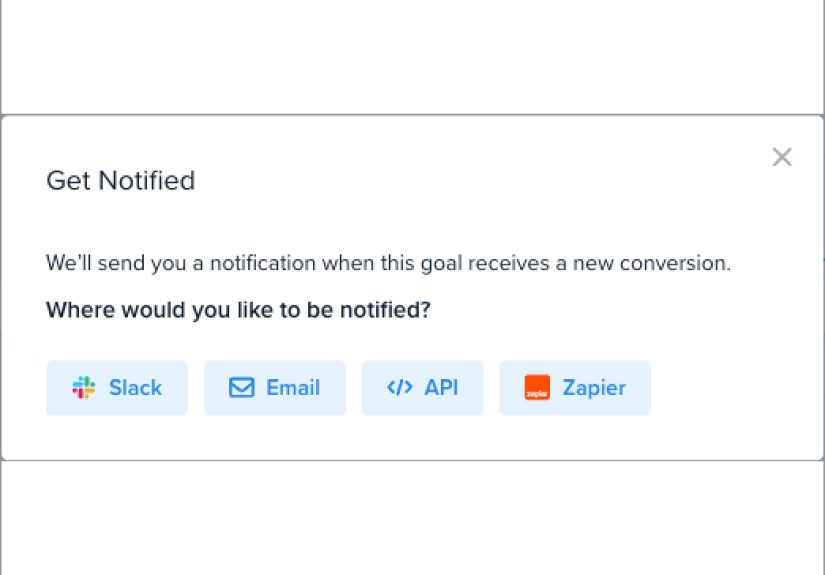
- Click “Get Notified”.
- Select the notification destination: email, Slack, Zapier trigger, or API endpoint.
- Follow the on-screen steps to connect the destination and save.
Set up notifications for Survey responses
- Open the Survey results page for the survey you want to monitor.
- Click “Get Notified”.
- Choose where notifications should go (email, Slack, Zapier, or API endpoint).
- Complete setup and save.
Manage existing notifications
Once you’ve created a few notifications, you can view and manage them from the account’s Options area (look for the list of notifications you’ve created).
This matters because the fastest way to ruin a good notification system is to never prune it.
Choosing the Right Delivery Channel
Email: Best for Accountability and Simple Routing
Email notifications are great when you need a clear audit trail or you want messages routed through existing inbox rules.
For example:
- Support inbox: Survey responses containing “help” or “can’t log in” go to the support queue.
- Marketing alias: NPS feedback goes to a shared mailbox where it’s tagged, categorized, and reviewed weekly.
Email is also the “lowest-friction” option for teams that don’t want to connect additional tools right away.
Slack: Best for Speed (and a Little Healthy Peer Pressure)
Slack is where notifications really shine because it’s real-time and visible. If a conversion comes in, the team sees it. If a user complains
about a checkout issue, the team sees it. If your landing page suddenly starts converting like it drank three espressos, the team sees it.
Pro tip: create purpose-built channels like #site-leads, #site-voice-of-customer, or #checkout-alerts.
Your general channel is not a notification landfill. Protect it.
Zapier: Best for “If This, Then Everything” Automation
Zapier is the friendly bridge between “a website event happened” and “five systems should know about it.”
With Crazy Egg triggers, you can build workflows like:
- Create a row in Google Sheets for each goal conversion.
- Send an SMS for high-intent survey responses (for example, enterprise demo requests).
- Create tasks, tickets, or CRM records based on survey responses or conversion events.
If your team already runs on automations, Zapier turns Crazy Egg from a measurement tool into a workflow trigger.
API Endpoint: Best for Custom Workflows and Data Pipelines
An API endpoint notification is your “bring your own plumbing” option. Instead of routing through an off-the-shelf integration, you send event data
to a URL you controlthen your systems can do anything: enrich the payload, match it to existing users, route it to internal tools,
or push it into your data warehouse.
A few practical uses:
- Data enrichment: Attach account owner, plan type, or lifecycle stage before notifying teams.
- Security and compliance: Keep sensitive details out of third-party routing and handle them internally.
- Advanced routing: Different survey responses go to different systems based on keywords, sentiment, or page context.
Real-World Use Cases (The Stuff That Makes Your Boss Say “Nice”)
1) Lead Gen: Slack Pings for High-Intent Conversions
Your “Request a Demo” goal converts. Crazy Egg fires a notification to Slack. Sales replies in-thread, claims the lead, and follows up while the
prospect is still in “shopping mode.” Even if your CRM also gets the lead, Slack is the speed layer.
2) E-Commerce: Catch Checkout Issues Faster
Surveys on checkout pages are great for surfacing friction (“promo code didn’t work,” “shipping too expensive,” “payment failed”).
Notifications ensure those comments don’t sit unnoticed while revenue quietly leaks out.
3) Product Marketing: Watch Launches Without Hovering
You ship a new pricing page, run an A/B test, or update a homepage hero. Conversion notifications let you monitor meaningful events without
constantly toggling tabs. You still analyze results laterbut you get early signal if something is clearly broken or surprisingly strong.
4) Support: Turn Survey Responses Into Tickets
When someone answers a survey with “I need help,” that’s not “insight”that’s an open support request wearing a trench coat.
With notifications routed correctly, your team can respond fast, and your user feels heard instead of abandoned on Page 3 of the FAQ.
5) Ops: Build a Clean, Automatic Event Log
Teams often need a lightweight record of key events for weekly reporting. Notifications can feed a simple spreadsheet or database table so that:
- Marketing can reconcile conversion spikes with campaign launches.
- Product can correlate feedback with releases.
- Leadership can see momentum without waiting for a full analytics readout.
Best Practices to Avoid Notification Chaos
Start with “Critical Few” Notifications
Begin with 2–4 notifications that are truly meaningful: top conversions and the highest-value survey.
If you notify on everything, you’ll train everyone to ignore everything. Humans are funny that way.
Name Your Goals Like a Grown-Up Future You Will Thank
“Goal #3” is not a goal name. It’s a cry for help. Use clear naming like:
Lead – Demo Request, Signup – Trial Started, Ecom – Purchase Completed.
When notifications appear in Slack or email, clarity prevents confusion and speeds action.
Route by Team, Not by Hope
Send conversion alerts to the people who can act on them. Survey alerts to the people who can fix them.
If everyone gets everything, nobody owns anything.
Be Thoughtful About Data in Notifications
Notifications are meant to trigger action, not broadcast sensitive personal information. If you’re routing events into shared channels,
consider limiting what’s displayed and pushing detailed data into secure systems.
Use Zapier or an API Endpoint for Smarter Filtering
Want to notify only when an NPS score is low? Or only when someone mentions “refund” or “bug”? A no-code workflow (Zapier) or a lightweight endpoint
can filter and route messages so your channels stay high-signal.
Mini Playbook: A Practical Setup in 20 Minutes
- Pick one conversion goal (e.g., demo request or checkout complete).
- Pick one survey (e.g., “What stopped you today?” on checkout or pricing).
- Send conversions to #site-leads in Slack and survey responses to #voice-of-customer.
- Add a Zapier workflow that logs both events into a sheet or database.
- Review weekly: remove noisy notifications, refine routing, and add one new alert only if it’s clearly valuable.
That setup covers speed (Slack), accountability (email if needed), and long-term learning (logged data). You can always get fancier later.
Experiences from the Field: What Teams Notice After Turning On Crazy Egg Notifications
Most teams have the same first reaction when they turn on conversion and survey notifications: “Wait… we can do that?” And then the second reaction:
“Oh no… we can do too much of that.” The difference between a notification system that changes how you work and one that becomes background noise
usually comes down to how intentional you are in the first week.
A common experience is that the first notification you set up becomes the team’s new heartbeat. Sales teams love instant conversion pings
because it’s basically a real-time “somebody just raised their hand” signal. Even if your CRM is the official source of truth, Slack pings create a fast
feedback loop: people respond sooner, follow-ups get logged earlier, and prospects feel like they’re talking to a real human instead of a form that
disappears into the void.
Product and UX teams often get the most value from survey response notificationsnot because they want more messages, but because they want
fewer surprises. When survey feedback hits while a visitor is actively experiencing the site, it tends to be specific: “The coupon field isn’t working,”
“Shipping costs show up too late,” “I can’t find pricing for teams,” “Your signup button did nothing.” Seeing those comments in real time changes team
behavior. Instead of saving feedback for a quarterly “voice of customer review,” teams start treating it like live telemetry. Not every response is urgent,
but the pattern recognition is faster.
Another repeat pattern: teams quickly realize that routing is the whole game. If conversion alerts go to a general channel, they get ignored.
If survey alerts go to everyone, nobody owns them. But if notifications go to the right placewith a clear owneraction becomes automatic. Support teams
often set up a dedicated channel and treat survey “help me” responses like lightweight tickets. Marketing teams use a separate channel for NPS and feedback,
where themes can be tagged for future copy and page updates. The biggest change isn’t the featureit’s the habit: people start responding to site signals
as part of daily work instead of “whenever we remember.”
Finally, teams that get the most out of this update usually do one more thing: they connect notifications to a simple system of record.
A spreadsheet log, a CRM note, a database tableanything that prevents “we saw it in Slack once” from becoming “we lost it forever.” Slack is great for
speed, but systems are great for memory. When teams pair instant alerts with lightweight logging (often through automation), they get both: fast response
and clean reporting. That’s when a small product update starts behaving like a serious operational upgrade.
Conclusion
Crazy Egg’s conversion and survey notifications are one of those deceptively simple updates that can quietly transform a team’s workflow.
Conversions become moments you act on, not numbers you review later. Surveys become a live stream of customer reality, not a dusty folder of feedback.
Whether you route alerts to email, Slack, Zapier, or an API endpoint, the real win is speed: faster follow-up, faster fixes, and faster learning.