Table of Contents >> Show >> Hide
- Think Like a Shop Designer (Not Like a Pile Collector)
- Go Vertical: Your Walls Are a Second Floor
- Go Mobile: Put Big Tools on Wheels (Your Back Will Thank You)
- Use the “Dead Space”: Under, Over, and In-Between
- Small Parts Storage That Doesn’t Become “Screw Soup”
- Lumber, Sheet Goods, and Long Things That Love to Fall Over
- Make Your Shop Safer (Which Also Saves Space)
- A Sample Layout for a One-Car Garage Workshop
- Budget-Friendly Space-Saving Upgrades Under $100
- Make It Stick: The 5-Minute Reset Rule
- Conclusion: A Small Shop Can Feel Big (If Your Storage Is Smart)
- Real-World Experiences: What Actually Happens in Tiny Shops
A small workshop is basically a magic trick: you’re expected to fit a bench, tools, lumber, hardware, and your dignity
into a space the size of a generous walk-in closet. The good news? With the right storage strategy, even a tiny shop can feel
“bigger” without knocking down walls or negotiating with your neighbor’s property line.
This guide breaks down practical small workshop storage and space-saving solutions that work in real garages,
basements, sheds, and spare roomscomplete with layout logic, tool-by-tool storage ideas, and examples you can steal (politely).
You’ll end up with a shop that’s safer, faster to work in, and way less likely to eat your 10mm socket.
Think Like a Shop Designer (Not Like a Pile Collector)
The secret isn’t buying more storage. It’s deciding what deserves prime real estate. In a small shop, every square foot
should earn its keep. Before you install a single hook, do this quick “shop map” exercise:
- List your frequent tasks (cutting, sanding, assembly, finishing, maintenance).
- Group tools by workflow (measuring + marking together, drilling + driving together, etc.).
- Rank by frequency: daily, weekly, occasional, “why do I own this?”
Put daily tools at arm’s reach, weekly tools within a step or two, and occasional items higher, lower, or farther away.
This single decision reduces clutter because you stop storing everything like it’s equally important. (It’s not. Your random
specialty jig from 2017 knows what it did.)
Go Vertical: Your Walls Are a Second Floor
If your workshop feels cramped, it’s usually because storage is happening on the floor. Floors should be for: you, rolling carts,
and the occasional dramatic walk away from a mistake you absolutely meant to make. Everything else? Put it on the wall.
French Cleat Walls: The “Move-It-Anytime” Storage System
A French cleat wall is a modular wall storage system made from angled strips (commonly a 45-degree bevel) that let you hang
cabinets, shelves, tool holders, and binsthen rearrange them whenever your tool collection evolves (which it will).
It’s one of the best workshop wall storage options because it’s strong, customizable, and doesn’t lock you into one layout.
- Best for: hand tools, cordless tools, small shelves, wall cabinets, specialty holders.
- Space-saving win: storage stays nearly flush to the wall, keeping walkways clear.
- Pro tip: build a “test panel” first so you can dial in fit and hanger thickness before committing wall-to-wall.
Make a few starter holdersdrill rack, battery shelf, sanding stationand let the system grow with your shop. The biggest advantage
is psychological: once you know storage can be changed easily, you actually change it instead of living with “temporary” chaos for five years.
Pegboard (and Modern Panel Systems): The Quick-Access Classic
Pegboard is popular for a reason: it’s cheap, flexible, and lets you see your tools. Modern versions and upgraded hooks
reduce the classic pegboard problem where the hook comes off with the tool and you invent new words.
- Best for: frequently used hand tools, layout tools, light accessories.
- Space-saving win: high density storage on a narrow footprint.
- Pro tip: group tools by task (measuring here, cutting there) so your brain stops playing hide-and-seek.
Slatwall and Rail Systems: Clean, Adjustable, “Grown-Up Garage” Vibes
Slatwall/rail storage systems are sleek and adjustablegreat if your shop shares space with a car, laundry, or your family’s
belief that “garages are for storage.” Rails with hooks, baskets, and shelves can hold everything from power tools to extension cords.
If your priority is a tidy look and quick reconfiguration, a rail system can be a strong alternative (or complement) to cleats and pegboard.
Go Mobile: Put Big Tools on Wheels (Your Back Will Thank You)
In a small shop, stationary everything is a trap. A mobile approach lets you:
roll tools into the open when needed, then tuck them back into a corner afterward. It’s like having a bigger shopwithout the mortgage.
Rolling Tool Carts and “Dedicated Stations”
A rolling cart isn’t just storage; it’s a workflow upgrade. Set up a cart for a single tool category (like routing, sanding, or drilling)
with drawers for bits, accessories, and safety gear. When it’s time to work, everything is already together.
- Example: a “router cart” with bit storage, wrenches, edge guides, and a small vacuum hose hook.
- Example: a “finishing cart” with wipes, tape, stir sticks, and disposable gloves (aka “finger-savers”).
Flip-Top Carts for Benchtop Tools
Benchtop tools are notorious space hogs: planer, spindle sander, mortiser, mini lathe, benchtop drill press. A flip-top cart
lets you mount two tools on one stand, rotating the top to use whichever tool you need.
That’s a major space-saving solution because you’re trading unused horizontal surface area for a compact, multi-tool footprint.
Just remember to account for infeed/outfeed clearance when you roll it into position.
Clamp Storage That Moves With You
Clamps are the shop equivalent of socks in a dryer: you start with a few, then somehow you own forty-seven.
A mobile clamp rack or clamp cart keeps them accessible during glue-ups and can be parked against a wall when not needed.
If clamps are currently piled in a corner, you’re losing time and risking a clamp avalanche. A dedicated rack (wall-mounted or mobile)
turns chaos into a grab-and-go system.
Use the “Dead Space”: Under, Over, and In-Between
Small shops aren’t short on spacethey’re short on used space. The best storage often hides in places you’re ignoring.
Under-Bench Storage: The Most Valuable Real Estate You’re Not Renting
Your workbench should do more than hold projects and absorb coffee rings. Add drawers, shelves, or sliding trays underneath
for tools you use constantly (but don’t want on the benchtop).
- Great under-bench candidates: sandpaper, measuring tools, clamps, chisels, frequently used fasteners.
- Easy win: shallow drawers for small hand tools; deep drawers for power tools.
- Bonus trick: use the toe-kick area for a slim drawerperfect for rulers, straightedges, and your “mystery shims.”
Ceiling and Overhead Storage: The “Free Square Footage” Zone
The ceiling area above a workbench or parking space can store seasonal, bulky, or rarely used itemsthink holiday bins,
camping gear, spare jigs, or offcuts you’re definitely going to use “someday” (sure).
For safety: mount overhead racks into structural framing, keep heavy items in sturdy bins, and don’t store anything overhead
that you’d hate to meet face-first. Gravity has a flawless attendance record.
Between-Stud Niches and Skinny Shelves
If your shop has framed walls, the cavities between studs can become recessed storage.
Add simple shelves for glue bottles, spray cans, or small organizers. Even a 3–4 inch deep shelf can hold a surprising amount
without protruding into your walkway.
Small Parts Storage That Doesn’t Become “Screw Soup”
Hardware is where organization goes to die. One spilled bin and suddenly every screw is “kind of the same” and your project timeline
becomes “maybe next weekend.”
Modular Bins, Drawer Cabinets, and Stackable Organizers
Choose stackable organizers with adjustable dividers for screws, nails, washers, and bits. Store by type and size, label clearly,
and keep refills behind or below the “working” stock. This makes it easy to grab what you need without unpacking your entire inventory.
- Labeling tip: use big labels you can read from standing height. Tiny labels are a prank you play on Future You.
- Restock tip: keep a “refill bin” so you don’t buy duplicates just because you can’t find the originals.
Foam Inserts and Shadow Boards (When You Want Instant Visibility)
Foam drawer inserts are fantastic for mechanics-style tool storage: every tool has a cutout, and missing tools are obvious.
Shadow boards do the same on the wall. They’re especially useful for small shops because they prevent “pile migration”
(tools slowly drifting into random piles like they’re escaping).
Lumber, Sheet Goods, and Long Things That Love to Fall Over
Storing wood is often the biggest challenge in a small woodworking shop. The solution is usually a mix of:
vertical storage, rolling carts, and “only keep what you’ll use.”
Vertical Lumber Storage
A vertical lumber rack uses a narrow footprint and can fit behind a door or along a wall. Keep boards sorted by species or thickness.
Add a lower “catch” so the ends don’t kick out and turn your rack into a medieval trap.
Sheet Goods: Cart or Compact Rack
Full sheets are awkward, heavy, and love blocking everything. A compact sheet-goods cart lets you roll plywood or MDF into a corner.
If you rarely use full sheets, consider storing partial panels and buying full sheets only when needed.
Clamp and Pipe Storage (Because You Own More Than You Admit)
Clamps store best on a wall rack or a dedicated cart. Pipe clamps, in particular, are space hogs; give them a rack that keeps them
aligned, accessible, and not tangled like headphones in a pocket.
Make Your Shop Safer (Which Also Saves Space)
A cluttered shop isn’t just annoyingit’s hazardous. When storage is planned well, you reduce tripping, improve dust control,
and protect tools from damage.
Keep the Floor Clear and the Cords Managed
Use hooks or reels for extension cords and air hoses. Store them near the outlet or compressor so you don’t drag cords across the shop.
A clean floor path is a real productivity boosterbecause you can move materials without performing interpretive dance around obstacles.
Dust and Cleanup Stations
Build a small “cleanup zone”: broom holder, dustpan hook, shop vac parking spot, and a bin for rags. When cleanup is effortless,
it actually happens. If cleanup is hard, it becomes a folk tale your shop tells to frighten new apprentices.
A Sample Layout for a One-Car Garage Workshop
Here’s a proven approach for tight spaces, especially a one-car garage workshop organization setup:
- Center line: keep the main cutting area flexible (often the table saw or a mobile work surface).
- Perimeter tools: place machines along walls (or on mobile bases) so the center stays open.
- Assembly/outfeed: use a combined outfeed + assembly table to double-duty the footprint.
- Wall storage behind the bench: French cleats, pegboard, or rail systems for daily tools.
- Corner stations: sharpening, small drill press, or benchtop sander in corners on mobile carts.
- Overhead: seasonal bins and rarely used jigs above, not underfoot.
The key is keeping the middle adaptable. If every tool is locked in place, you’re forced to work around the shop.
When the shop adapts to the project, the project goes fasterand your blood pressure stays in a human range.
Budget-Friendly Space-Saving Upgrades Under $100
You can make big gains without a big shopping spree:
- Magnetic strips: for small metal tools (snips, screwdrivers, hex keys) and quick access.
- Clear bins + labels: visibility prevents duplicate buying and reduces “dig time.”
- Simple wall hooks: hang hearing protection, respirators, cords, and jigs.
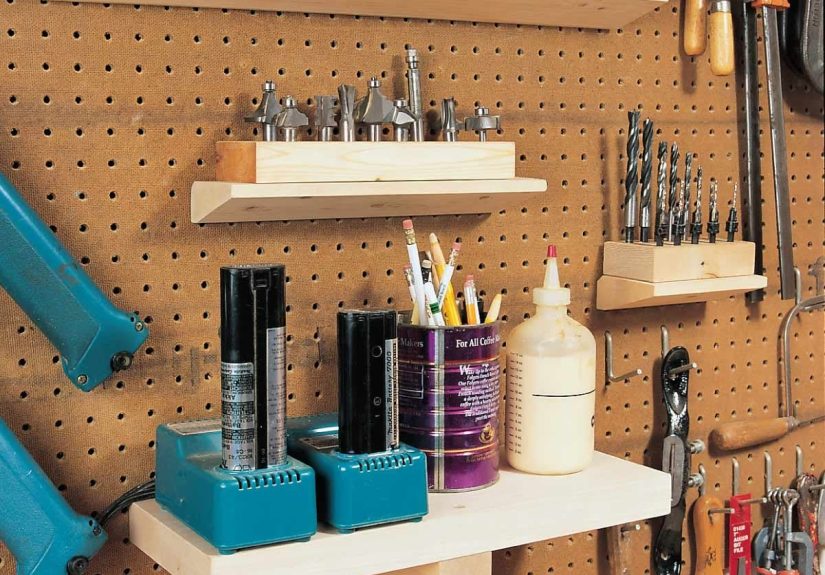
- DIY battery charging shelf: one spot for chargers, batteries, and power tool accessories.
- Scrap sorting box: a dedicated bin for usable offcuts, so scraps stop colonizing your bench.
Make It Stick: The 5-Minute Reset Rule
Even the best storage system fails if it takes too long to use. A small shop needs a daily rhythm:
- End each session with a 5-minute reset: tools back, bench cleared, floor swept.
- One “mystery bin” maximum: a temporary catch-all you sort weekly.
- Storage should be one motion: if it requires moving three things to put one thing away, it won’t happen.
Design storage so returning a tool is easier than setting it down “for a second.” That’s the moment your shop stays organized.
Conclusion: A Small Shop Can Feel Big (If Your Storage Is Smart)
Great small workshop storage isn’t about cramming more stuff into the roomit’s about building a system that respects
workflow, uses vertical space, embraces mobility, and keeps daily tools instantly accessible. Start with walls, add mobile stations,
exploit dead space, and give small parts a real home. You’ll work faster, waste fewer materials, and spend less time muttering
“Where did I put that?” into the void.
Real-World Experiences: What Actually Happens in Tiny Shops
Let’s talk about the part nobody puts in the glossy “after” photos: real small workshops are living ecosystems. They grow, they shed,
they go through phases, and sometimes they mysteriously produce five tape measures even though you only remember buying one.
The following are common, real-world patterns seen in compact garages and basement shopsand how people successfully handle them.
1) The “Flat Surfaces Attract Stuff” Law
In tiny shops, every flat surface becomes a storage shelf the moment you turn your back. The workbench collects tools, the outfeed
table collects clamps, and your “temporary staging area” becomes a permanent museum exhibit titled Projects I Will Finish Eventually.
The fix that actually works isn’t willpowerit’s giving every category a quick-return home:
a wall hook for the drill, a bin for fasteners, a drawer for layout tools, and a specific spot for ongoing project parts.
A common turning point is building one dedicated “parking zone” for in-progress work: a shallow shelf or labeled tote that holds the
project’s parts, hardware, and notes. When the project has a home, your bench can go back to being a bench.
2) The “I’ll Remember Where I Put It” Myth
People genuinely believe they will remember where they placed the router bit set. They will not. Not because they’re forgetful,
but because workshops generate visual noise: offcuts, dust, clamps, cords, and that one pencil that disappears like it’s being
subpoenaed. Successful small-shop owners lean hard into labels and visibilityclear bins, drawer dividers, and wall storage where
tools are seen at a glance.
The practical lesson: store the most-used items in the most obvious places. If you use it every session, it should be visible
without opening three drawers. If you must open drawers, make them predictable: same categories, same locations, every time.
3) The “Clamps Multiply Overnight” Phenomenon
Almost everyone underestimates how many clamps they’ll accumulate. In a small shop, clamps become the tipping point between
“cozy and functional” and “hazardous obstacle course.” Real solutions usually follow one of two paths:
a wall-mounted clamp rack near the assembly area, or a mobile clamp cart that rolls to the action.
Once clamps are stored intentionally, glue-ups get calmer, faster, and less likely to end with a clamp falling on your toe.
4) The Mobile Shop Revelation
Many small-shop owners resist putting tools on wheels because it feels temporaryuntil they try it. Then it feels like unlocking
a cheat code. A planer on a mobile base can live in a corner 95% of the time and roll out only when needed. A sanding station cart
can carry abrasives, hearing protection, and a hose connection, so setup time drops dramatically.
The experience-driven insight is that mobility changes behavior: you stop leaving tools out “because it’s annoying to put them away,”
since “put away” now means “roll it back.” That’s why rolling stations are one of the best space-saving solutions for small shops.
5) The “One Upgrade That Changes Everything” Moment
In real workshops, organization usually improves in leaps, not slow progress. Someone installs a French cleat wall and suddenly
the shop has a flexible backbone. Or they add under-bench drawers and the benchtop stays clear for the first time ever.
Or they mount overhead storage and reclaim enough floor space to move safely around a project.
The most repeatable advice from real small-shop setups: pick one high-impact zonelike the wall behind your benchand complete it.
A half-finished storage system is just another project living in your shop. A finished zone becomes a habit.
6) The “Maintenance Is the Difference” Truth
A small workshop can look organized on day one and chaotic by day seven. The difference is a simple routine:
a five-minute reset after each session, a weekly quick sort of the “mystery bin,” and a monthly purge of scraps and duplicates.
People who do this don’t have more discipline; they have a system that’s easy to maintain.
And yessometimes the most valuable storage solution is deciding not to store something at all. If a tool hasn’t been used in a year,
it might be a candidate for a higher shelf, a smaller footprint, or a new home elsewhere. In a tiny shop, space is a premium material,
like walnut: you don’t waste it on filler.