Table of Contents >> Show >> Hide
- Quick Comparison: 2023’s Standout Racks
- How to Choose the Right Bike Rack (Without Regretting It)
- The 10 Best Bike Racks for 2023
- 1) Thule T2 Pro XTR (Hitch Platform) Best Overall Hitch Rack
- 2) Küat NV 2.0 (Hitch Platform) Best for Trailheads and E-Bike Households
- 3) 1Up USA Quik Rack (Hitch Platform) Best for Long-Term Durability and Modular Upgrades
- 4) Saris SuperClamp EX (Hitch Platform) Best Lightweight Option with Serious Capacity
- 5) RockyMounts MonoRail (Hitch Platform) Best Value Platform Rack
- 6) Yakima RidgeBack 4 (Hitch Hanging) Best for Families Hauling Lots of Bikes
- 7) Thule Apex XT (Hitch Hanging) Best Hanging Rack with Premium Stability
- 8) Thule Gateway Pro (Trunk Strap Rack) Best Premium Trunk Rack
- 9) Saris Bones EX (Trunk Strap Rack) Best Budget-Friendly Trunk Rack for Wide Vehicle Fit
- 10) Yakima HighRoad (Roof Wheel-On) Best Roof Rack for No-Frame-Contact Carry
- Hitch Rack Buying Tips (The Stuff People Learn After Buying)
- Roof Rack Reality Check (Before You Bonk Your Bike on a Garage Door)
- Trunk Rack Success Checklist
- FAQ
- Conclusion
- Real-World Experiences (What Riders Commonly Run Into)
If you’ve ever tried to wedge a bike into the backseat like it’s a yoga pose, you already know the truth:
a good bike rack is cheaper than therapy (and way better for your car’s upholstery). In 2023, the “best” rack
wasn’t just about holding a bikeit was about holding it without frame scuffs, wobble, roadside panic,
or the awkward moment you realize your hatch won’t open with the rack on.
This guide breaks down 10 standout bike racks that were widely recommended and widely used in 2023 across three
main styles: hitch (most stable, easiest loading), roof (keeps your rear access
clear, but adds height drama), and trunk (budget-friendly and surprisingly capablewhen used
correctly).
Quick Comparison: 2023’s Standout Racks
| Rack | Mount Type | Best For | Typical Capacity | Notable Trait |
|---|---|---|---|---|
| Thule T2 Pro XTR | Hitch (platform) | All-around premium choice | 2 bikes | No frame contact + integrated locks |
| Küat NV 2.0 | Hitch (platform) | Trail riders + e-bikes | 2 bikes (expandable) | Built-in repair stand |
| 1Up USA Quik Rack | Hitch (platform) | Durability + modular upgrades | 1 bike (expandable) | Metal-heavy, replaceable parts |
| Saris SuperClamp EX | Hitch (platform) | Lightweight, e-bike-capable | 2 bikes | Strong capacity without a tank-like rack |
| RockyMounts MonoRail | Hitch (platform) | Value + broad compatibility | 2 bikes (expandable) | Good features for the price |
| Yakima RidgeBack 4 | Hitch (hanging) | Families hauling 3–4 bikes | 4 bikes | Tilt access, fully assembled |
| Thule Apex XT (or Apex XT Swing) | Hitch (hanging) | Multiple bikes + convenience | 4 bikes | Anti-sway cradles, optional swing-away |
| Yakima HighRoad | Roof (wheel-on) | No frame contact roof hauling | 1 bike | No wheel removal, carbon-friendly |
| Thule UpRide | Roof (wheel-on) | Easy roof loading without frame clamps | 1 bike | No frame contact, wide bike fit |
| Saris Bones EX | Trunk (strap) | Budget hauling on many vehicles | 2 bikes | Fits many spoiler/hatch styles |
How to Choose the Right Bike Rack (Without Regretting It)
1) Hitch vs. Roof vs. Trunk: the real trade-offs
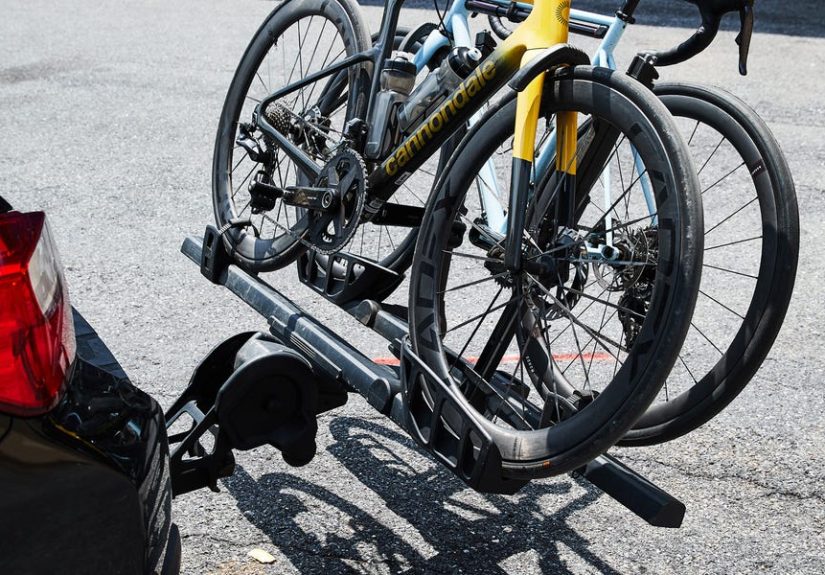
- Hitch racks are the easiest to load and usually the most stable. Platform trays (wheel-hold) are the gentlest on bikes.
- Roof racks keep your rear hatch accessible and free up the hitchbut lifting a bike overhead can be a daily strength test.
- Trunk racks cost less and store easily, but they require careful installation and often involve some frame contact.
2) Weight limits matter (especially with e-bikes)
Many “standard” bike racks are designed around traditional bikes. E-bikes and some downhill rigs are heavier,
and racks have per-bike limits for a reason. If you’re anywhere near the limit, choose a rack with breathing room.
Your future self will thank you at the first pothole.
3) No frame contact is the safest default
Platform hitch racks and wheel-on roof racks that avoid clamping the frame are great for carbon frames and fancy paint.
Hanging racks and many trunk racks can work well, but they may need adapters for step-through frames or smaller bikes.
The 10 Best Bike Racks for 2023
1) Thule T2 Pro XTR (Hitch Platform) Best Overall Hitch Rack
In 2023, the Thule T2 Pro XTR stayed near the top for one simple reason: it’s built like it expects you to actually use it.
It’s a tray-style rack that holds bikes by the wheels, which helps reduce frame scuffs and makes it friendly for carbon frames.
It’s also known for a user-friendly install and smart features like tilt access and integrated security.
- Why it’s great: No frame contact, stable ride, integrated locks, easy install/removal.
- Watch-outs: Premium price; rack weight can be hefty compared to ultralight options.
- Best for: Riders who want one dependable rack for road, gravel, and mountain bikes.
2) Küat NV 2.0 (Hitch Platform) Best for Trailheads and E-Bike Households
The Küat NV 2.0 earned its reputation by mixing rugged build quality with real-world convenience.
A standout feature is the integrated repair standhandy for quick tweaks, dropped chains, or that “why is it squeaking now”
moment in the parking lot. It’s also designed to handle heavier bikes, making it a strong candidate for e-bikes (within rating).
- Why it’s great: Repair stand, solid trays, good for heavier bikes, expandable capacity.
- Watch-outs: Costs more than basic racks; add-ons can reduce weight limits (check specs).
- Best for: Mountain bikers, families with mixed bikes, riders who like “features that actually matter.”
3) 1Up USA Quik Rack (Hitch Platform) Best for Long-Term Durability and Modular Upgrades
If you like gear that looks like it could survive a meteor shower, the 1Up USA style is for you.
The Quik Rack is simple, metal-forward, and modularmeaning you can add trays as your bike-hauling needs grow.
Many riders choose 1Up because parts are replaceable and the design avoids a lot of fragile plastic bits.
- Why it’s great: Expandable, tough materials, clean design, strong long-term ownership appeal.
- Watch-outs: Some bikes need careful positioning; accessories may be needed for certain fits.
- Best for: Frequent riders who keep gear for years (and don’t want a “disposable” rack).
4) Saris SuperClamp EX (Hitch Platform) Best Lightweight Option with Serious Capacity
The SuperClamp EX is a go-to when you want a rack that doesn’t feel like you’re deadlifting a refrigerator.
It’s often praised for balancing a lighter rack weight with a strong per-bike capacity. It uses wheel-holding arms
and aims to keep frame contact minimal, which is a nice bonus for modern bikes.
- Why it’s great: High capacity for its class, compact footprint, easier to handle than many “heavy duty” racks.
- Watch-outs: Like many tray racks, fat tire setups may need accessory parts.
- Best for: People who remove/install racks often, but still want e-bike-ready strength.
5) RockyMounts MonoRail (Hitch Platform) Best Value Platform Rack
In 2023, the RockyMounts MonoRail hit a sweet spot: broad compatibility, sensible features, and a price that feels less like a dare.
It secures bikes by the front wheel, keeps frame contact off the table, and usually offers practical touches like tilt for hatch access.
- Why it’s great: Strong feature set for the money, good tire compatibility, expandable options.
- Watch-outs: May require some initial assembly; always double-check wheelbase fit for extra-long bikes.
- Best for: Riders who want platform stability without “premium tax.”
6) Yakima RidgeBack 4 (Hitch Hanging) Best for Families Hauling Lots of Bikes
When you need to carry three or four bikes, hanging racks become appealing: more capacity, less cost than a four-tray platform rack.
The RidgeBack is popular for being straightforwardoften arriving ready to useand offering tilt-down access so you can get into the rear
without removing everything.
- Why it’s great: 4-bike capacity, easy tilt access, good for family fleets.
- Watch-outs: Hanging racks can require adapters for step-through frames; there may be more bike-to-bike “tetris.”
- Best for: Groups, families, and riders who regularly carry multiple bikes at once.
7) Thule Apex XT (Hitch Hanging) Best Hanging Rack with Premium Stability
The Apex XT is often chosen by people who want a hanging rack but still care about stability and bike spacing.
Anti-sway cradles help reduce bike-to-bike contact, and the overall build quality feels solid. If you love the idea of a hanging rack
but want fewer “clank symphonies,” this is a strong contender. There’s also an Apex XT Swing variant for easier rear access.
- Why it’s great: Anti-sway cradles, generous spacing, integrated locking features on many versions.
- Watch-outs: Like most hanging racks, unconventional frames may need a top-tube adapter.
- Best for: 3–4-bike hauling with a more premium feel than budget hanging racks.
8) Thule Gateway Pro (Trunk Strap Rack) Best Premium Trunk Rack
Trunk racks get a bad reputation because cheap ones can be wobbly or fiddly. The Gateway Pro aimed to solve that with a sturdier build,
anti-sway cradles, and a fold-flat design for storage. It’s a smart option if you don’t have a hitch and you want something that feels
more “engineered” than “rope-and-hope.”
- Why it’s great: Anti-sway design, folds flat, good spacing for a trunk rack.
- Watch-outs: Fit is vehicle-specificalways verify compatibility; trunk racks can block cameras/sensors.
- Best for: Riders without a hitch who still want a stable, name-brand trunk setup.
9) Saris Bones EX (Trunk Strap Rack) Best Budget-Friendly Trunk Rack for Wide Vehicle Fit
The Bones EX became a favorite because it fits a broad range of vehicles, including many hatchbacks and spoiler setups
that frustrate other trunk racks. It’s light, relatively quick to mount once you learn the strap routine, and it’s widely used by
riders who want a dependable trunk rack without spending hitch-rack money.
- Why it’s great: Broad vehicle fit, lightweight, easy storage, widely available.
- Watch-outs: Like most trunk racks, it can involve frame contact and may require extra care with fancy frames.
- Best for: Budget buyers, apartment dwellers, occasional riders, and “I just need it to work” shoppers.
10) Yakima HighRoad (Roof Wheel-On) Best Roof Rack for No-Frame-Contact Carry
Roof racks make sense when you want to keep the hitch free or your rear access clear.
The HighRoad stands out because it holds the bike by the wheelsno front wheel removal and no frame clampmaking it a strong pick for
carbon frames or full-suspension bikes. It’s also a practical choice if you swap the rack between vehicles with compatible crossbars.
- Why it’s great: No wheel removal, no frame contact, accommodates a wide range of wheel sizes.
- Watch-outs: You must lift the bike overhead; watch overall vehicle height in garages and drive-thrus.
- Best for: Riders who prefer roof transport and want a wheel-on, carbon-friendly system.
Hitch Rack Buying Tips (The Stuff People Learn After Buying)
Match the rack to your hitch size
Many premium racks come in 2-inch versions (common on SUVs and trucks), while some offer 1.25-inch compatibility for smaller vehicles.
Using the correct receiver size and installing the rack tightly reduces wobble. If you’re using adapters, understand that adapters can
reduce capacity ratings and increase movement.
Platform racks are usually kinder to bikes
Tray/platform racks that grab the tires (not the frame) are a safer default for carbon and odd-shaped frames.
Hanging racks can be great for big groups, but they often need a top-tube adapter for step-through frames and kids’ bikes.
Think about “daily friction”
If you’ll remove the rack often, weight matters a lot. If the rack will live on your vehicle, durability and security features matter more.
If you’re hauling e-bikes, prioritize per-tray weight rating and ease of loading (optional ramps can be game-changing).
Roof Rack Reality Check (Before You Bonk Your Bike on a Garage Door)
- Height: Add bike + rack + crossbars to your vehicle height. Then write it on a sticky note. Then put it on your dashboard.
- Loading: Taller vehicles make roof loading harder. If lifting overhead is a struggle now, it won’t get easier when you’re tired.
- Wind and MPG: Roof racks can add noise and drag. Not a dealbreakerjust a heads-up.
Trunk Rack Success Checklist
- Confirm fit for your exact make/model/year. Trunk racks are not one-size-fits-all in practice.
- Protect paint by cleaning contact points and straps before mounting.
- Check straps often on long drives. They can loosen slightly as things settle.
- Mind hot exhaust and sharp edges that can wear straps over time.
FAQ
What’s the safest rack style for expensive bikes?
A quality platform hitch rack with no frame contact is a strong “safe default,” especially for carbon frames.
Wheel-on roof racks also avoid frame clamps, but they introduce height-related risks.
Do I need locks?
If the rack has integrated locks, greatuse them. If not, add a quality cable or chain lock for stops.
No lock makes theft impossible, but basic security reduces the “easy target” factor.
Can I carry a step-through or kids’ bike?
Platform racks usually can. Hanging and trunk racks often need a frame adapter (top-tube style) for step-through frames.
Conclusion
In 2023, the best bike racks weren’t defined by hypethey were defined by the small details that made loading easier,
driving steadier, and your bike less likely to look like it wrestled a cheese grater. If you want the most stress-free
option, a platform hitch rack like the Thule T2 Pro XTR or Küat NV 2.0 is hard to beat. If you need multi-bike capacity
on a budget, hanging hitch racks like the Yakima RidgeBack or Thule Apex XT make family trips doable. And if you’re hitch-less,
trunk racks like the Saris Bones EX can still be a smart, practical solutionas long as you install carefully and confirm fit.
Real-World Experiences (What Riders Commonly Run Into)
People often think buying a bike rack is the finish line, but it’s really the starting line for a series of small “aha” moments.
One of the most common experiences is discovering the difference between a rack you can lift and a rack you’ll want to lift.
In everyday life, heavier platform hitch racks feel incredibly stable on the roadbut if you remove the rack after each trip,
that stability can come with a penalty: awkward carrying angles, bumping your shin on the receiver, and a new appreciation for
lightweight options like the RockyMounts MonoRail or Saris SuperClamp EX. Riders who take racks on and off frequently tend to value
“manageable weight” more than they expected.
Another common story: the first time someone transports two bikes on a hanging rack, they learn the art of bike “tetris.”
Handlebars don’t politely stay in their own lane. Pedals try to high-five spokes. Frames swing just enough to tap each other at stoplights.
Owners of hanging racks like the Yakima RidgeBack or Thule Apex XT often develop a routine: alternate directions, stagger saddle heights,
and use extra straps to reduce sway. It becomes second naturelike tying shoesonce you’ve done it a few times, but the first trip can feel
like you’re trying to pack a closet using only elbows.
With trunk racks, the most frequent “experience lesson” is how important clean contact points are. Riders commonly report that trunk racks
work best when you treat mounting like a mini preflight check: wipe the trunk, wipe the feet, confirm strap routing, then tighten and recheck
after a few miles. Many people also learn that trunk racks are excellent for shorter trips and occasional use, but they demand more attention
on long highway drives (especially in rain, dust, or heat). The Saris Bones EX gets praise for vehicle fit and quick storage, but the best results
tend to come from owners who take two extra minutes to keep straps tidy and tension consistent.
Roof racks deliver a different kind of reality check. Riders love keeping the hitch free and preserving rear access, but almost everyone has a
“height moment.” It might be the near-miss with a garage door, a parking structure sign, or the realization that drive-thrus are not always your friend.
Owners of wheel-on roof racks like the Yakima HighRoad or Thule UpRide often adopt simple habits: a dashboard reminder, a phone note, or even a tag on the
steering wheel. The upside is a clean rear end and easy hatch access; the trade-off is being the person who says, “Waithow tall am I today?”
Finally, there’s the quiet victory of finding a rack that matches your actual riding life. Some riders start with a trunk rack to save money, then move to
a hitch platform rack once they ride more often. Others do the opposite: they own a premium hitch rack but realize they only need it a few weekends a year,
so they switch to something simpler. The most positive experiences tend to come from matching the rack to your reality: your vehicle, your bike weight,
how often you ride, and whether you want to store a rack in a closet or leave it on the car. When those pieces line up, a bike rack stops being “gear”
and starts being what it should be: the easiest part of getting out to ride.