Table of Contents >> Show >> Hide
- The headline needs one important footnote
- What made this a “telegraph” in the first place?
- How the Greek hydraulic telegraph worked
- From beacon fires to actual information
- Polybius made the idea even smarter
- Why the system mattered in war and politics
- So, was it really the world’s first telegraph system?
- The Byzantine system that probably caused the date confusion
- Why this old technology still feels strangely futuristic
- Experiencing the story today: why the ancient signal still feels alive
- Conclusion
- SEO Tags
History loves a dramatic headline, and this one definitely arrives wearing a cape. The idea that ancient Greeks built the world’s first telegraph system sounds like the kind of claim that should come with thunder, marble columns, and at least one professor dramatically removing their glasses. But here is the fun twist: the story is real enough to be fascinating, even if the timeline in the headline needs a tune-up.
The best-documented Greek system usually linked to this claim was not a Victorian telegraph with wires, keys, and a stressed-out operator tapping away in Morse code. It was something older, stranger, and honestly pretty clever: a coded long-distance signaling system that used torches, synchronized timing, and water-filled containers to send preset messages across distance. In other words, the ancient Greeks were experimenting with structured telecommunications long before Samuel Morse made “What hath God wrought” famous.
So, did the Greeks invent the first telegraph? That depends on how strict your definition is. But did they create one of the earliest known systems for transmitting coded information over distance rather than merely shouting, sending a runner, or waving at the horizon like a desperate uncle at a barbecue? Yes, they absolutely did. And once you understand how it worked, it becomes obvious why this ancient Greek telegraph still grabs modern attention.
The headline needs one important footnote
Let’s clear up the historical fog before it rolls downhill and confuses everyone in the valley. The system most often described as the ancient Greek telegraph is associated with Aeneas Tacticus, a fourth-century BCE military writer. Later, the historian Polybius described the problem this system was trying to solve and explained how it worked. That places the technology around the 300s BCE, not 1,600 years ago.
So where does the “1,600 years ago” angle come from? Most likely from a later Byzantine beacon network, often associated with Leo the Mathematician in the ninth century CE. That was also Greek in language and culture, but it was Byzantine, not classical ancient Greek. In other words, people sometimes blend two remarkable stories into one oversized historical smoothie.
And honestly, you do not need the fuzzy date to make the story impressive. A communications system from more than 2,000 years ago is already the kind of thing that makes modern group chats look a little less immortal.
What made this a “telegraph” in the first place?
If you think a telegraph must involve electricity, the ancient Greek version will seem like an impostor wearing a fake mustache. But if you use the broader definition of telegraphy as sending coded information across distance, then the Greek system qualifies as a true ancestor of later telegraphic thinking.
That distinction matters. Plenty of ancient cultures used smoke, drums, horns, mirrors, and beacon fires to send signals. The problem is that many of those methods transmitted only simple alerts: danger, victory, arrival, attack, or some version of “things are bad, please hurry.” Useful? Absolutely. Flexible? Not really.
The Greek innovation was not just sending a signal. It was sending a specific coded message within an agreed system. That is what pushes the conversation out of the general world of signaling and into something much closer to telegraphy.
How the Greek hydraulic telegraph worked
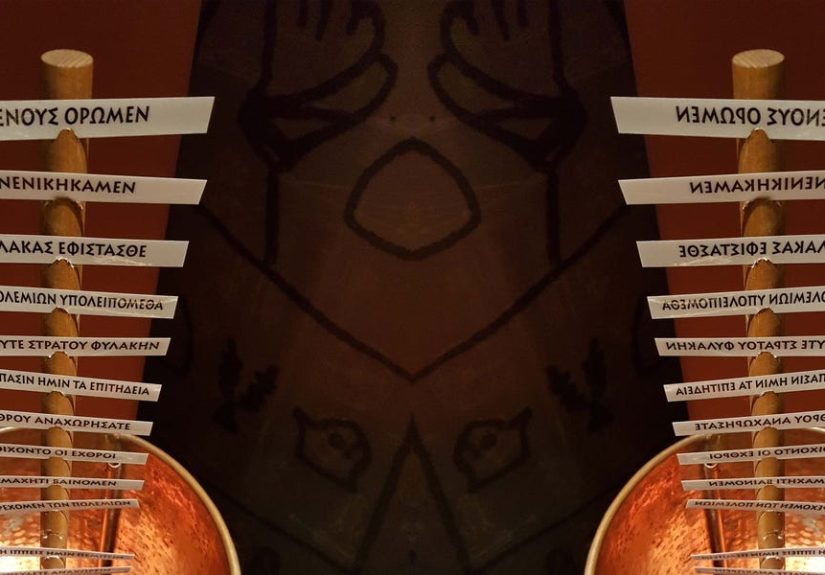
This is the part where the story goes from “interesting” to “wait, they did what with water?” The hydraulic telegraph used paired stations equipped with identical containers filled with water. In each container floated a rod marked with different preset messages at measured intervals. Think of it as a low-tech message menu attached to a floating pointer.
The setup
Each station had the same water vessel, the same rod, and the same list of possible messages. The messages might include warnings such as “enemy cavalry approaching,” “ships have arrived,” or “send reinforcements.” Because the system depended on matching equipment and synchronized procedure, both sides had to prepare carefully in advance. This was not freestyle communication. This was protocol, ancient edition.
The transmission
When the sending station wanted to transmit a message, the operator first raised a torch to alert the receiving station. Once both sides were ready, both operators opened a valve at the bottom of their water containers at the same time. As water drained, the rod slowly dropped. When the desired message reached the lip of the vessel, the sender raised a torch again. Both sides then closed their valves. If everything had been timed correctly, the receiving station’s rod stopped at the exact same message.
That is the genius of the system. No alphabet was required at this stage. No spoken language crossed the distance. No runner risked being intercepted. Instead, both stations used synchronized mechanical timing to land on the same prearranged message. It was part semaphore, part engineering, part teamwork, and part “please do not sneeze during the timing sequence.”
The limitation
The hydraulic telegraph was brilliant, but it had a very obvious weakness: it could send only messages that had already been written on the rods. If your enemy did something unexpected, you were in trouble. That limitation bothered Polybius, who pointed out that real warfare is full of surprises. A message system that works only when the future behaves politely is useful, but not enough.
From beacon fires to actual information
Long before the hydraulic telegraph, Greeks were already using fire as a communication tool. Greek literature preserves memorable examples, including the famous beacon chain in Aeschylus’ Agamemnon, in which the fall of Troy is relayed through a line of fires to Mycenae. Whether that represents practical history, dramatic symbolism, or some blend of both, it shows that the idea of long-distance signaling by flame was deeply embedded in Greek imagination.
But simple beacon systems have the same problem as a car alarm: they definitely communicate something, yet the details can be fuzzy. A fire may tell you that victory has come, or that danger is near, or that your neighbor has very serious feelings about dry brush management. It does not easily tell you whether the enemy force is large, where exactly it is moving, or which commander needs help.
That is why the hydraulic telegraph mattered. It turned signaling from a blunt warning tool into a more structured messaging system. It introduced a communications principle that modern readers will instantly recognize: successful networks require shared codes, synchronized rules, and reliable procedures. The Greeks were not just sending flames into the night. They were building a protocol.
Polybius made the idea even smarter
Polybius did not stop at admiring the earlier system. He also described an improved method using torches to represent letters in a grid, a scheme related to what later became known as the Polybius square. Instead of sending only preset warnings, this approach made it possible to spell out a wider range of messages by signaling row-and-column combinations.
That is a huge leap in communications history. Once you can encode letters instead of only whole preset statements, you move closer to a general-purpose telegraph. The system becomes slower and more demanding, but also far more flexible. In modern terms, it is the difference between choosing from canned text replies and actually typing your own message.
This is why the ancient Greek story still feels modern. It is not simply a tale of fire on hilltops. It is a story about information architecture. One method optimized speed but limited expression. Another expanded expression but required more complexity. Welcome to communications engineering, where people have apparently been making trade-offs for millennia.
Why the system mattered in war and politics
Military history is full of moments when whoever knows first wins first. Ancient battlefields moved fast enough to punish delay but slowly enough that long-distance information remained painfully hard to move. A horseman could carry a message, but roads were rough, weather was rude, and enemy forces were not known for respecting the privacy of sealed correspondence.
The Greek telegraph-like systems offered a workaround. High points could be linked by line of sight. Urgent warnings could travel faster than a human messenger. Commands could be standardized. Defenders could respond before an attack reached the city gate. For a world built on walled towns, mountain ridges, and maritime conflict, that kind of speed mattered.
There was also a political dimension. Communication is power. The ability to pass instructions quickly helps rulers coordinate territory, generals direct campaigns, and cities react to crisis. The ancient Greeks may not have had fiber optics, but they already understood something every modern state understands: whoever controls the network controls the tempo.
So, was it really the world’s first telegraph system?
This is where honest history has to resist the temptation to dunk everything in certainty sauce. Calling the Greek system “the world’s first telegraph” is exciting, but it is probably safer to call it one of the earliest documented telegraph-like systems or one of the earliest known coded long-distance communication systems.
Why the caution? Because ancient societies across the world developed sophisticated signaling traditions, and surviving evidence is uneven. Historians are always limited by what was recorded, preserved, copied, and rediscovered. The Greeks get credit partly because writers like Polybius described the mechanics in enough detail for later readers to understand the method.
Still, even the cautious version is impressive. The Greek hydraulic telegraph was not just a signal fire. It was a structured device-based system for sending agreed information over distance. That earns it a serious place in the prehistory of telecommunications.
The Byzantine system that probably caused the date confusion
The story gets even more interesting when we jump forward many centuries. In the Byzantine Empire, a famous beacon warning system is associated with Leo the Mathematician and the reign of Emperor Theophilos in the ninth century CE. This line of beacons reportedly stretched across Asia Minor to send warning of Arab raids toward Constantinople.
This later network was dazzling in its own right. It used a chain of stations across long distances and seems to have involved a more refined signaling logic than a simple bonfire-on-hilltop alert. It was fast, strategic, and built for imperial defense. If someone heard “Greek telegraph” and “more than a thousand years old” in the same sentence, it is easy to see how the ancient Greek hydraulic system and the Byzantine beacon chain might get mashed together.
But they are not the same thing. One belongs to the classical Greek world of the fourth century BCE. The other belongs to the medieval Byzantine world of the ninth century CE. Both are remarkable. Both deserve attention. But historians prefer them unmixed, like good olive oil and bad internet arguments.
Why this old technology still feels strangely futuristic
What makes this story stick is not merely that the Greeks sent messages with fire and water. It is that they were already thinking in the language of systems. They understood synchronization. They relied on standardization. They recognized that communication depended not just on speed but on shared coding rules. Those are not primitive ideas. Those are foundational ideas.
Modern communication networks still wrestle with the same essential problems. How do you encode information? How do you prevent misunderstanding? How do you balance speed against flexibility? How do you make sure sender and receiver stay in sync? Replace torches with electrical pulses, water rods with circuits, and hilltops with towers, and the ancient logic still looks surprisingly familiar.
That is why the ancient Greek telegraph is more than a curiosity. It is a reminder that the history of technology is not a straight line beginning in the nineteenth century. It is a long trail of experiments, hacks, workarounds, and brilliant half-steps toward the communication world we now take for granted.
Experiencing the story today: why the ancient signal still feels alive
One of the most interesting things about this topic is that it does not stay trapped in a textbook very well. The moment you picture the system in action, it becomes vivid. You can almost feel the dry night air on a ridge, see the orange flare of a torch, and imagine two operators trying very hard not to ruin the timing. Ancient communication suddenly stops looking abstract and starts looking intensely human.
That is part of the experience people have when they encounter this story through ruins, museum exhibits, classical drama, or historical writing. A hill is no longer just a hill once you realize it may have been chosen for line-of-sight communication. A beacon tower is no longer just a pile of old stones once you understand it may have been part of a network. A passage in Polybius stops being dusty prose and starts sounding like an engineer trying to explain why the previous version of the product had serious limitations.
There is also something oddly emotional about realizing how much ancient people cared about speed. We sometimes imagine the ancient world as slow, patient, and unbothered, as if everybody had endless time to stare nobly into the middle distance. They did not. Armies moved. Ships arrived. Cities panicked. Rulers wanted answers quickly. The need for rapid information was not invented by smartphones. It was baked into politics, war, trade, and survival from the beginning.
Even classroom demonstrations of the hydraulic telegraph can be revealing. The system sounds simple until you try to imagine how precise both sides had to be. Matching containers, identical rods, clear visibility, disciplined timing, and agreed meanings all had to line up. Suddenly the ancient operators do not seem quaint. They seem skilled. They were not just lighting fires. They were maintaining a network with almost no margin for sloppiness.
And then there is the theatrical experience. If you read Agamemnon and come across the beacon chain announcing Troy’s fall, the scene lands differently once you know real Greek thinkers later designed communication systems around exactly this logic of sightlines and signals. Literature and technology begin to overlap. The flame onstage is not just a poetic image. It belongs to a broader world in which fire could genuinely carry news faster than a rider.
Maybe that is the deepest reason this topic endures. It compresses thousands of years of human ambition into one unforgettable image: a message leaping across darkness. We still do that today, just with different tools. Our texts, alerts, and live updates feel modern, but the underlying dream is ancient. Someone far away knows something urgent. Someone here needs to know it now. Build a system. Agree on the code. Watch the signal. Hope the message arrives.
In that sense, the ancient Greek telegraph is not merely old technology. It is a preview of us.
Conclusion
The ancient Greeks did not invent the electric telegraph, and the headline’s date probably confuses a classical Greek system with a later Byzantine one. But the core claim remains powerful: Greek thinkers created one of the earliest known systems for sending coded information across distance, and they did it with remarkable ingenuity.
The hydraulic telegraph of Aeneas Tacticus and the refinements described by Polybius reveal a world already wrestling with problems of coding, synchronization, flexibility, and speed. That makes these systems more than historical oddities. They are early chapters in the long human story of telecommunications.
So yes, before wires hummed, before Morse clicked, and long before your phone buzzed with twelve notifications you did not ask for, people on Greek hilltops were already trying to solve the timeless problem of communication: how to make information travel faster than feet.