Table of Contents >> Show >> Hide
- Selective Breeding 101: How We Got Here
- Dog Breeds Today vs 100 Years Ago: What Changed Most?
- 1) Flat-Faced (Brachycephalic) Breeds: Cutest Faces, Hardest Breaths
- 2) The English Bulldog: From Athlete-ish to… Sofa Sculpture
- 3) The Pug: The Nose Shrink Nobody Asked the Dog About
- 4) German Shepherd Dogs: The Sloping Back Debate
- 5) The Bull Terrier: The “Egg Head” Evolution
- 6) Long-Backed Breeds (Dachshunds): Cute, Courageous, and Spinally Complicated
- Health Consequences: What the Research Actually Suggests
- Why the Shift Happened: Show Rings, Trends, and Human Psychology
- Breeding in a Healthier Direction: What’s Changing Right Now
- How to Be a Smart Dog Buyer (or Adopter) in 2025
- Real-Life Experiences: What People Notice With “Modern” vs “Classic” Breed Types (Bonus +)
- Conclusion: The Future Can Look More Like Health
If you’ve ever stared at an old photo of a “classic” German Shepherd and thought, Wait… why does this one look like it could
actually jog without filing a complaint?you’re not imagining things. Over the last century, selective breeding has reshaped
many dog breeds in visible, dramatic ways: shorter muzzles, heavier wrinkles, deeper chests, longer backs, more exaggerated angles,
and “signature” features that weren’t always so extreme.
Some of these changes are harmless (even helpful). Others come with real consequences: breathing trouble in flat-faced dogs,
orthopedic strain from extreme proportions, and a genetic bottleneck that makes certain inherited disorders harder to avoid.
The story isn’t “purebreds bad, mixed-breeds good.” It’s more nuancedand a lot more interestingthan that.
In this deep dive, we’ll compare dog breeds today vs 100 years ago, explain how breed standards and show culture
influenced “the look,” and break down what science and veterinary medicine say about health tradeoffs. We’ll also talk about the
growing movement to breed dogs in a healthier directionbecause evolution didn’t do this to them. People did. (And people can fix it.)
Selective Breeding 101: How We Got Here
Selective breeding means choosing which dogs reproduce based on desired traitssize, coat, color, temperament,
herding ability, hunting drive, guarding instinct, or appearance. This isn’t new. Humans have shaped dogs for thousands of years.
What is relatively modern is how quickly and intensely many breeds were “standardized” and then locked into that standard.
Breed Standards: The Blueprint That Changed the Dog
Most recognized breeds have an official “ideal” description used for judging in conformation (dog shows). Standards can encourage
functional traitslike strong feet for a working herderor inadvertently reward extremeslike a flatter face, heavier skin folds, or
a more sloped topline. The American Kennel Club (AKC) describes breed standards as an ideal against which dogs are judged, which
helps explain why show trends can ripple into breeding decisions over time.
Closed Studbooks, the “Popular Sire” Effect, and Genetic Narrowing
Many registries rely on closed populations (or mostly closed), meaning new genetic material rarely enters. When a winning dog becomes
the must-use stud (hello, “popular sire” effect), his genes can spread fast. The downside is reduced genetic diversity, which can raise
the risk that hidden disease mutations become common in the breed.
Modern genetic analyses back this up: many breeds show substantial inbreeding and reduced diversity compared to more naturally mixed
dog populations. That doesn’t doom every purebred dogit just means breeding decisions matter a lot more than most people realize.
Dog Breeds Today vs 100 Years Ago: What Changed Most?
A century is long enough for selective breeding to create noticeable shiftsespecially when a trait is fashionable and consistently
rewarded. Below are some of the clearest “then vs now” patterns, with a focus on real-world consequences.
1) Flat-Faced (Brachycephalic) Breeds: Cutest Faces, Hardest Breaths
The most talked-about change is the rise of extreme brachycephalyshortened muzzles and compact skulls in breeds like
Pugs, English Bulldogs, French Bulldogs, Boston Terriers, and others. Compared with many early 1900s examples, today’s “ideal” faces
in some lines are flatter, with tighter nostrils and more crowded teeth.
Veterinary medicine has a name for the health problems that can follow: Brachycephalic Obstructive Airway Syndrome (BOAS).
It’s linked to anatomy like narrowed nostrils, elongated soft palate, and other airway changes. The practical result can be noisy breathing,
heat intolerance, exercise limitations, and in severe cases, the need for surgery.
Scientific studies have found that as brachycephalic features become more exaggerated, BOAS risk increases. In plain English:
the flatter the face, the higher the odds the dog struggles to breathe like a normal dog should. That’s not “anti-breed” talkjust
anatomy meeting physics.
2) The English Bulldog: From Athlete-ish to… Sofa Sculpture
Historic Bulldogs were sturdier and more athletic-looking than many modern show types. Over time, selection for a heavier front,
shorter legs, wider chest, and flatter face created a dog that can look iconicbut may face challenges with breathing, skin infections
in folds, heat regulation, and reproduction (including high rates of C-sections in some populations).
The takeaway isn’t “Bulldogs shouldn’t exist.” It’s that breeding choices can aim for a Bulldog that still looks like a Bulldog
without pushing anatomy into the danger zone.
3) The Pug: The Nose Shrink Nobody Asked the Dog About
Many older photos and illustrations show Pugs with slightly longer muzzles and less extreme facial compression. Today’s Pug “look”
often includes a flatter face and more prominent eyes. Those big eyes can be adorable, but they can also be more vulnerable to injury
and irritation, especially when the face is very short.
Combine that with BOAS risk and you get the modern Pug paradox: enormous popularity, enormous charm, and sometimes an enormous snore
that sounds like a tiny motorcycle.
4) German Shepherd Dogs: The Sloping Back Debate
German Shepherds are a great example of how a breed can split into different “types.” Many earlier working-line dogs looked more level
in the topline and were bred heavily for performance: herding, service work, protection, and later police/military tasks. Some modern
show lines in various regions have been criticized for exaggerated rear angulation and a more pronounced slope, which can affect movement
efficiency and may contribute to orthopedic stress in some dogs.
It’s important to be fair: the breed also has many responsible breeders focused on stable temperament, sound structure, and health testing.
If you want a German Shepherd that can actually do German Shepherd things (like work all day and still have the energy to judge your life choices),
looking at functional structure and health screening is key.
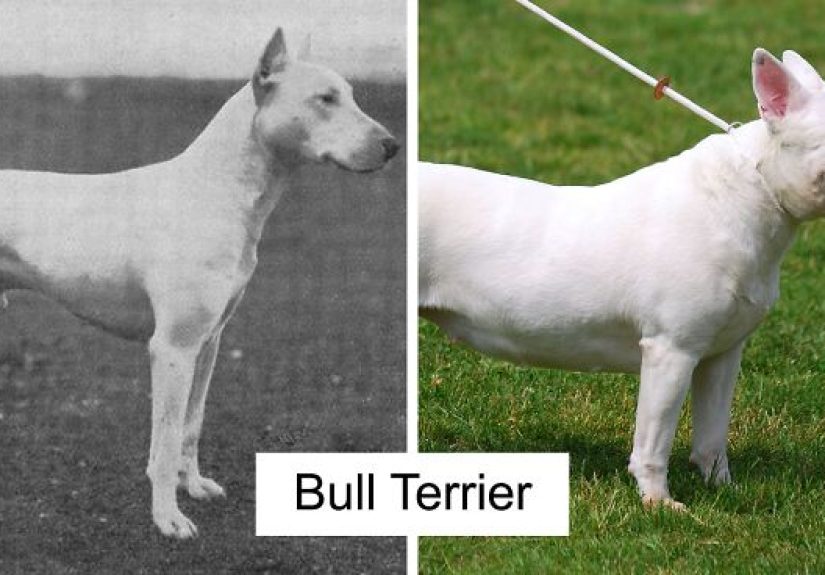
5) The Bull Terrier: The “Egg Head” Evolution
The Bull Terrier’s head shape has famously changed. Earlier versions typically had a less extreme profile, while modern show types often feature
a more pronounced “roman nose” and curved head shape. This is a classic case of a breed drifting toward a signature silhouette that stands out
in a lineupand can be rewarded in the ringwhether or not it contributes to function.
6) Long-Backed Breeds (Dachshunds): Cute, Courageous, and Spinally Complicated
Dachshunds were built for a purpose: going to ground after badgers. A long back and short legs help in tunnels. But as proportions become more
extremelonger backs, shorter legsthe mechanical stress on the spine can rise.
Intervertebral disc disease (IVDD) is a known concern in the breed. Again, this doesn’t mean “don’t get a Dachshund.” It means structure,
fitness, weight management, and breeding for moderation matterbecause gravity never takes a day off.
Health Consequences: What the Research Actually Suggests
The health conversation around selective breeding can get emotional fast. So let’s ground it in what veterinary and scientific sources
commonly agree on: some traits are strongly associated with certain risks, and genetic diversity affects a population’s ability to avoid
inherited disease over time.
Conformation-Linked Problems: When “A Look” Becomes a Liability
-
Airway issues in brachycephalic dogs: BOAS risk is closely tied to facial and airway anatomy. More extreme facial compression generally
increases risk. - Skin fold problems: Heavy wrinkles can trap moisture and bacteria, increasing irritation and infections.
- Orthopedic strain: Extreme angulation, very short limbs, and long backs can stress joints and spine depending on the breed and the individual dog.
- Eye injuries: Prominent eyes can be more exposed, especially in very short-faced breeds.
Genetics: Diversity Is Not a BuzzwordIt’s a Buffer
Breed formation and tight selection can concentrate both desirable traits and harmful mutations. Large-scale genetic studies have discussed how selective
breeding can increase frequency of disease-causing mutations in some breeds. Meanwhile, veterinary hospital datasets comparing purebred and mixed-breed dogs
show a mixed picture: purebreds can be more likely for some inherited conditions, while for many disorders there may be no difference.
Translation: “purebred” alone doesn’t tell you whether a dog will be healthy. The breed matters, the line matters, and the
breeding practices matterespecially screening, diversity management, and avoiding extremes.
Why the Shift Happened: Show Rings, Trends, and Human Psychology
Humans love categories. We love “the perfect example.” We love a signature look that screams, “That’s a Pug!” from across a parking lot.
Breed standards and conformation shows didn’t invent that instinctthey formalized it. Once a look becomes “the ideal,” breeders who want to win
may drift toward whatever judges reward.
Add social media, celebrity dogs, and the modern obsession with “cute baby faces,” and you get a powerful feedback loop: demand rises, breeding intensifies,
and extremes can become normalized.
Popularity Changes the Gene Pool Fast
When a breed explodes in popularity (think French Bulldogs in recent years), the market can attract both responsible breeders and high-volume producers.
More dogs are born, and corners can get cut: poor health screening, limited genetic diversity, and selection for looks over function. The breed’s public image
becomes “normal,” even if the dog’s anatomy is anything but normal.
Breeding in a Healthier Direction: What’s Changing Right Now
Here’s the good news: the conversation is shifting. Many veterinary organizations, researchers, and breed clubs now emphasize health testing and moderation.
Some regions and groups have implemented or studied screening systems for brachycephalic dogs, aiming to identify healthier individuals for breeding.
Genetic testing has also become more common, though it must be used carefully to avoid shrinking the gene pool further by excluding too many dogs at once.
What Responsible Breeding Can Look Like
- Health testing: Orthopedic screening (hips/elbows where relevant), cardiac exams, eye exams, breed-specific genetic tests.
- Selection for function: Movement, breathing, endurance, and structural soundnessnot just a dramatic silhouette.
- Moderation over extremes: A bit more muzzle, a bit less wrinkle, a more balanced rearsmall changes can matter a lot.
- Diversity management: Avoiding overuse of popular sires and making mating choices that protect genetic variety.
The goal isn’t to erase breeds. It’s to preserve what people love about thempersonality, purpose, identitywhile reducing preventable suffering.
Because no dog should have to “be brave” just to breathe.
How to Be a Smart Dog Buyer (or Adopter) in 2025
Whether you’re getting a purebred puppy, adopting, or rescuing a specific breed type, you can reduce risk by asking better questions.
Think of it like hiring a contractor: you don’t need to be an expert, but you should absolutely request receipts.
Questions Worth Asking
- What health tests were done on both parents, and can I see results?
- How does the breeder select for temperament and functionnot just appearance?
- For flat-faced breeds: can the parents exercise normally without distress or overheating?
- What are common health issues in this line, and what’s been done to reduce them?
- Do you take puppies back if things don’t work out?
If you’re adopting, you can still apply the same logic: choose a dog whose structure and breathing seem comfortable; keep them lean;
ask your vet about breed-linked risks; and build fitness gradually. Health isn’t just geneticsenvironment and care matter too.
Real-Life Experiences: What People Notice With “Modern” vs “Classic” Breed Types (Bonus +)
Talk to longtime dog ownersespecially those who grew up around a breedand you’ll often hear the same theme: “They don’t look quite the same anymore.”
That observation isn’t automatically a judgment; it’s usually just lived reality. People who remember an older-style Collie, Bulldog, or German Shepherd
often describe dogs that looked a little less extreme and moved a little more effortlessly. Whether that’s because of true population-wide change,
selective memory, or the fact that most of us didn’t grow up watching slow-motion gait videos on the internet… it’s probably a mix.
Owners of flat-faced dogs frequently describe a very specific set of everyday adjustments. Summer walks become “early morning or not at all.”
Play sessions turn into short bursts with water breaks. Many learn to read subtle signs of breathing stress: the dog who flops down mid-walk,
the one who sounds like a tiny accordion after climbing stairs, the one who gets red-faced (well… as red as fur allows) after excitement.
Some families swear by harnesses over collars because anything that adds pressure near the throat can make breathing feel harderespecially in dogs already
working with less airflow than they deserve.
Then there’s the “people don’t realize until they live it” category. Skin folds can require regular cleaning so irritation doesn’t build up.
Prominent eyes can pick up dust and scratches like magnets. Dental crowding can mean more frequent cleanings. None of this makes the dog less lovable.
It just means the cute factor sometimes comes with a maintenance planlike owning a vintage car that’s adorable but also has opinions about reliability.
On the working-structure side, people who choose performance lines (herding, hunting, sport, service work) often report a different experience:
the dog may look less exaggerated, but come with more drive and “job energy.” A German Shepherd from strong working lines might have a more functional frame
and excellent stamina, but also may insist on structured training and enrichment. Owners describe these dogs as brilliant…and occasionally too brilliant.
A bored working dog will invent hobbies, and your baseboards are not going to like those hobbies.
Dachshund households have their own set of modern realities. Many owners become amateur engineers: ramps to couches, no jumping off high beds,
weight management like it’s a sacred ritual, and a vigilant eye for back discomfort. They’ll tell you the breed is bold, funny, and stubborn in the best way
and they’ll also tell you they’ve never said “please don’t launch yourself like a torpedo” so many times in one lifetime.
What ties these experiences together is not regretit’s awareness. Most people aren’t trying to start a debate at the dog park.
They’re trying to keep their dog comfortable, active, and thriving. The more the public understands how selective breeding shaped modern dogs,
the easier it becomes to support healthier breeding goalswithout losing the quirky, lovable traits that made these breeds famous in the first place.
Conclusion: The Future Can Look More Like Health
Selective breeding gave us remarkable dogspartners for work, sport, companionship, and just plain joy. But in the last 100 years, it also pushed
some breeds toward exaggerated traits that can make daily life harder than it needs to be. The good news is that the same force that changed dogs
can improve them: intentional, responsible selection.
If we reward moderation, prioritize health testing, protect genetic diversity, and celebrate dogs who can run, breathe, and live comfortably,
“dog breeds today vs 100 years ago” won’t have to be a cautionary tale. It can be proof that humans learnedand chose better.