Table of Contents >> Show >> Hide
- What Makes a Garden “French-style”?
- 1. Strong Symmetry and a Clear Central Axis
- 2. Parterres: The Signature Patterned Beds
- 3. Clipped Hedges and Topiary
- 4. Allées and Tree-lined Walks
- 5. Gravel Paths and Crisp Hardscaping
- 6. Water Features That Reflect and Command Attention
- 7. Garden Rooms, Bosquets, and Enclosure
- 8. Espalier, Trellises, and Vertical Discipline
- 9. Sculpture, Urns, and Focal Ornaments
- 10. A Controlled Plant Palette
- How to Adapt the Look for a Modern Home
- The Experience of a Classic French-style Garden
- Conclusion
A classic French-style garden does not tiptoe into a landscape. It arrives with purpose, posture, and very strong opinions about symmetry. Where an English cottage garden might fling flowers around like confetti, a French formal garden prefers a ruler, a plan, and a polished pair of shoes. And honestly, that is part of its charm.
Known for its balance, geometry, clipped greenery, and long, dramatic sightlines, the French-style garden turns outdoor space into living architecture. It is not just a place to grow plants. It is a place to stage beauty. From the grand precedent of Versailles to smaller modern interpretations in private backyards, the style is built around order, proportion, and the delicious idea that even nature can be persuaded to behave for a photograph.
If you love structure, elegance, and a landscape that looks smart in every season, understanding the elements of a classic French-style garden is the first step. The good news is that you do not need a palace, a powdered wig, or a staff of 40 gardeners. You just need the right design principles.
What Makes a Garden “French-style”?
At its core, a French-style garden is a formal garden shaped by geometry and visual control. It is closely associated with the grand landscapes of seventeenth-century France, especially the work linked to André Le Nôtre, whose designs helped define the style at places such as Vaux-le-Vicomte and Versailles. The goal was not merely pretty planting. It was total composition: house, paths, terraces, trees, water, sculpture, and flower beds all working together like a perfectly rehearsed orchestra.
That is why classic French garden design feels so composed. Nothing appears random. Paths align with doors and windows. Trees frame views. Beds mirror one another. Fountains and sculptures act like visual punctuation marks. The overall effect is crisp, grand, and deeply satisfying to the human brain, which apparently loves a straight line almost as much as it loves snacks.
1. Strong Symmetry and a Clear Central Axis
The most important element in a classic French-style garden is symmetry. This is the spine of the entire design. Usually, the layout begins with a central axis, a strong line that runs outward from the house or main viewpoint and organizes everything around it.
That axis may be expressed as a straight gravel path, a lawn panel, a canal, a reflecting pool, or a sequence of terraces and fountains. On either side, the garden is balanced with matched planting beds, paths, hedges, or ornaments. This does not mean every inch must be identical, but the composition should feel deliberate and visually even.
In practical terms, if you are designing a French-inspired garden at home, begin by identifying your main view. Maybe it is the back door, a patio, or a pair of French doors. From there, create one dominant line through the space. That axis becomes the organizing principle that keeps the design disciplined rather than chaotic.
2. Parterres: The Signature Patterned Beds
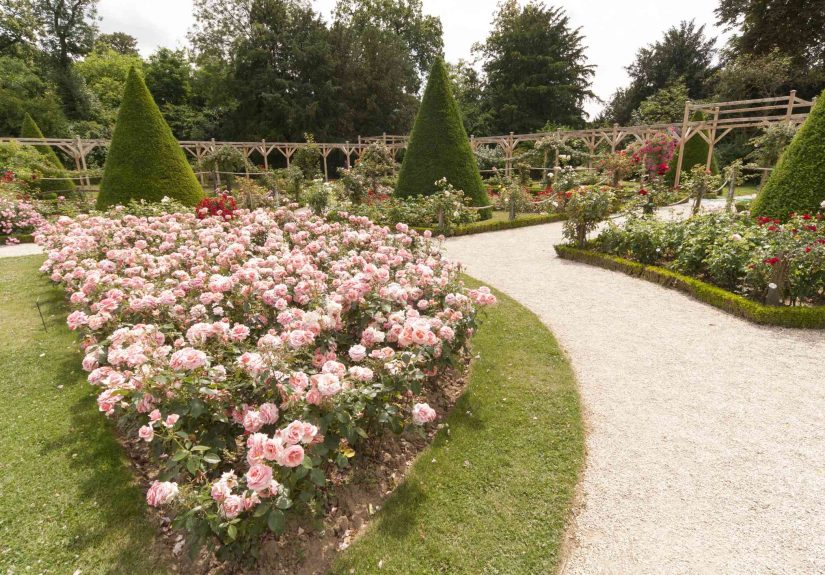
If the axis is the backbone, the parterre is the show-off. Parterres are formal planting beds laid out in symmetrical patterns, often edged with clipped hedges or hard materials and separated by gravel or paving. In grand historic gardens, parterres could be highly intricate, almost embroidered in appearance. In smaller residential gardens, they are usually simplified into rectangles, diamonds, scrolls, or four-square arrangements.
A classic French parterre does several things at once. It creates ornament at ground level, establishes rhythm, and makes the garden look elegant even when flowers are not in peak bloom. That is why boxwood or other dense evergreen edging is so important. The structure remains visible through the seasons.
For a modern backyard, you can capture the same feeling with low clipped hedges, gravel paths, and repeated geometric beds. The plant palette inside those beds can be more relaxed than the outline suggests. Think of the parterre as the tailored jacket. Inside it, you can still wear a silk scarf.
3. Clipped Hedges and Topiary
A French-style garden loves a well-behaved plant. Clipped hedges define spaces, frame views, edge paths, and reinforce the garden’s geometry. Topiary adds punctuation, giving the eye something bold and sculptural to land on. Balls, cones, pyramids, cubes, and columns are especially common because they echo the garden’s architectural character.
Traditionally, boxwood has been the poster child for this look, but yew, privet, holly, and other shearing-friendly plants can work beautifully depending on your climate. The key is density and clean lines. A hedge in a French garden is not merely a divider. It is a design statement.
Topiary is where the garden gets a tiny bit theatrical. A pair of clipped cones at an entry, spheres lining a path, or a row of standards in containers immediately signals formal style. It is refined, yes, but also a little dramatic in the best possible way. French gardens understand that subtlety is lovely, but a perfectly clipped yew is unforgettable.
4. Allées and Tree-lined Walks
One of the most recognizable elements of a classic French garden is the allée, a formal path lined with trees or tall shrubs planted at regular intervals. An allée creates movement, perspective, and grandeur. It draws the eye forward and makes even a modest garden feel more expansive.
These tree-lined walks are especially effective when they terminate in a focal point such as a statue, fountain, bench, urn, or gate. That destination matters. French design loves a reward at the end of a view. In other words, your eye is invited to travel, but it is not allowed to wander off and freeload.
In a home landscape, an allée can be scaled down using ornamental trees, pleached trees, or even upright shrubs planted in disciplined rows. The effect is still powerful because repetition is one of the style’s secret weapons.
5. Gravel Paths and Crisp Hardscaping
French-style gardens rely heavily on hardscape to keep everything legible. Gravel is a classic choice because it highlights geometry, contrasts beautifully with clipped greenery, and adds that unmistakable crunch underfoot that somehow makes everyone feel more sophisticated.
Paths are typically straight or symmetrically arranged rather than meandering. Edging may be brick, stone, or low planting. Steps, terraces, balustrades, and low walls often help transition between the house and garden, reinforcing the sense that the landscape is an extension of architecture.
This is one reason French gardens look good year-round. Even when flowers fade, the bones remain strong. If you want a garden that does not collapse into visual mush in November, structure is your best friend.
6. Water Features That Reflect and Command Attention
In a classic French-style garden, water is rarely accidental. It appears as a fountain, basin, canal, rill, or reflecting pool placed exactly where it will strengthen the layout. Water cools the scene, catches the sky, and doubles visual drama by reflecting surrounding forms.
A central fountain in a parterre, a rectangular reflecting pool on the main axis, or a circular basin at the intersection of paths all feel true to the style. The sound matters, too. The gentle splash of a fountain softens the strictness of the design, which is useful because too much formality without movement can start to feel like a lecture.
Even small spaces can use this idea. A modest stone basin, wall fountain, or narrow reflecting trough can introduce that French garden mood without requiring royal plumbing.
7. Garden Rooms, Bosquets, and Enclosure
Although French gardens are famous for long views, they also use enclosure brilliantly. Hedges, tree lines, walls, and trellised boundaries create a sequence of outdoor rooms, sometimes called bosquets when formed by trees or clipped plantings. These enclosed spaces provide contrast to the open central axis and make the experience of moving through the garden more interesting.
One area may feel like a formal lawn salon, another like a secret seating space, and another like a flower-filled parterre. That layering is important. A great French-style garden is not just one large flat statement. It is a procession.
For home gardeners, this can be achieved with hedged enclosures, repeated archways, or trellis panels that divide the yard into purposeful zones. Privacy and elegance can absolutely be roommates.
8. Espalier, Trellises, and Vertical Discipline
French gardens do not only train people to admire order. They train plants as well. Espalier, the practice of training shrubs or fruit trees flat against a wall or framework, is a classic formal technique that adds architecture, productivity, and old-world polish.
Espaliered pears and apples are especially traditional, but ornamental shrubs can also be trained for effect. In a French-inspired garden, this technique makes excellent use of walls, creates visual rhythm, and reinforces the idea that every surface can contribute to the composition.
Trellises, obelisks, and arbors also play a role, especially when supporting climbing roses or vines. The point is not wild abundance spilling everywhere. The point is vertical elegance with a little bit of restraint.
9. Sculpture, Urns, and Focal Ornaments
Every classic French-style garden benefits from ornament. Sculpture, stone urns, pedestal planters, sundials, benches, and decorative fountains all help create hierarchy and visual stopping points. These pieces are not clutter. They are punctuation marks in the sentence of the landscape.
Urns often flank stairs, gates, or the ends of paths. Statues may sit at axial intersections or conclude a long view. Even a single focal ornament can elevate a small formal garden by giving the layout a sense of destination and permanence.
The safest approach is to choose fewer, better pieces. French design is elegant because it is edited. One beautiful urn says “timeless.” Seven unrelated yard statues say “someone gave me a garden center gift card and I panicked.”
10. A Controlled Plant Palette
Planting in a French-style garden supports the structure rather than overwhelming it. Evergreens are vital because they hold the design together all year. Roses, lavender, iris, peonies, tulips, alliums, and seasonal bedding plants often provide bursts of color, but the planting is usually organized and repeated rather than mixed at random.
Color palettes tend to feel harmonious rather than chaotic. Whites, blues, pinks, purples, and silvery foliage are common in modern interpretations. Fragrance also matters. Lavender edging, roses over an arbor, and herbs tucked near paths make the garden feel luxurious in a way that is both visual and sensory.
In short, the best French garden plants are not merely pretty. They are disciplined team players.
How to Adapt the Look for a Modern Home
You do not need a Versailles-sized property to bring home classic French garden elements. What you need is structure, repetition, and restraint. Start small: a symmetrical pair of containers, a straight gravel path, clipped hedge borders, and one focal fountain or urn. Add a parterre near the house if space allows. Use evergreen shapes to anchor the layout. Let the architecture of the home guide the geometry of the garden.
If maintenance is a concern, simplify the patterning rather than abandoning the style. A clean rectangular layout with fewer plant varieties can still feel unmistakably French. Also, choose substitutes suited to your region if traditional boxwood struggles in your climate. The spirit of the design matters more than strict plant snobbery.
The Experience of a Classic French-style Garden
What makes a classic French-style garden so memorable is not just how it looks from above on a design plan. It is how it feels when you move through it. The experience is almost cinematic. You step outside and immediately sense intention. The path aligns with the doorway. The hedges frame your sightline. A fountain glints in the distance like it already knows it is the star of the scene.
There is a special pleasure in the predictability of the layout. In daily life, so much feels noisy, rushed, and slightly crooked. A French-style garden offers the opposite. It calms you by making visual sense. The symmetry is not stiff so much as reassuring. Your eye knows where to go. Your body slows down. Even the gravel seems to whisper, “Walk a little slower, you’re in a composed environment now.”
Then there is the sensory contrast. The structure is crisp, but the details are soft. You run your hand past clipped boxwood, then catch the scent of lavender warming in the sun. Roses climb a trellis with a little more romance than the geometry technically asked for. Water sounds bounce off stone. A row of pleached or espaliered trees creates shade that feels formal but still alive. It is order, yes, but not lifeless order. It is elegance with pulse.
One of the most satisfying experiences in a French-style garden is discovering how the views unfold. From the terrace, the garden reads like a pattern. From inside the path network, it becomes a sequence. A fountain that looked decorative from the house suddenly becomes immersive up close. A clipped hedge that seemed low and polite now creates a room of its own. A bench placed at the end of an allée turns into the perfect pause point, almost demanding that you sit, breathe, and admire the ridiculous amount of effort someone invested in making shrubs behave.
This style also changes beautifully with the seasons. In spring, bulbs and fresh foliage sharpen the patterns. In summer, roses, lavender, and perennial borders soften the lines without erasing them. In fall, the geometry becomes even more obvious as flower color fades and the clipped framework takes over. In winter, the garden can be downright magical, because the bones are exposed and the design is still readable. That is the hidden luxury of a formal garden: it does not disappear when bloom season ends.
For homeowners, living with a French-inspired garden can subtly change the way outdoor space is used. Instead of treating the yard as leftover land around the house, you begin to see it as a series of rooms and experiences. Morning coffee tastes better beside a gravel path and an urn. Evening light looks more dramatic when it catches the rim of a basin or the edge of a clipped hedge. Entertaining outdoors feels easier because the space already has natural order. The garden knows how to host.
Ultimately, the emotional power of a classic French-style garden lies in its balance. It offers discipline without dullness, beauty without chaos, and grandeur without needing to shout. It feels cultured, restful, and just a little bit glamorous. Not bad for a landscape built on straight lines and very committed shrubs.
Conclusion
The enduring appeal of a classic French-style garden comes down to one big idea: structure creates beauty. Symmetry, parterres, clipped hedges, allées, water features, sculpture, gravel paths, and disciplined planting all work together to produce a garden that feels polished, immersive, and timeless. Whether you borrow one or two elements or build a full formal layout, the style offers a practical lesson for any landscape: when the bones are strong, everything else looks better.
In other words, the French were right. A garden can absolutely be a work of art. It can also be a place to sit with a cup of coffee and pretend you own an estate. Both are excellent uses of the outdoors.