Table of Contents >> Show >> Hide
- So…what is this “largest cat painting” everyone’s talking about?
- Getting even bigger: the add-on panels and the “this might become a series” clue
- How big is “big,” exactly? A quick size reality check
- Why it looks the way it looks: ink, acrylic, and a calligraphy mindset
- The not-so-glamorous engineering behind a 20-foot painting
- Why giant cat art works (and why it spreads online so fast)
- (14 Pics) A guided tour of the giant feline universe
- If you ever see it in person, here’s how to enjoy it like a pro
- The takeaway: the bigger the canvas, the bigger the grin
- Real-World Experiences: Standing in Front of a Wall of Cats (The Part That Makes You Want to Tell Someone)
A wall-spanning feline parade, a brushwork style that borrows from multiple traditions, and the kind of scale that makes you ask,
“Do I need binoculars… or just a really tall ladder?”
There are cat people, and then there are cat peoplethe ones who don’t just want a framed paw print on the hallway wall.
They want the whole hallway to become the paw print. They want art so big you can’t “hang it” so much as “negotiate a lease with it.”
That’s the energy behind the headline-making giant cat painting that’s been described as the largest cat painting in the worldand, according to the
artist’s ongoing work, it’s not content to stay the same size. It’s expanding. Evolving. Becoming the final boss of feline decor.
In this article, we’ll unpack what the work is, why it’s getting bigger, what “largest” actually means in art-world terms, and why a 20-foot painting
of cats can be both a technical flex and a surprisingly smart way to get people to stop scrolling for five whole seconds.
So…what is this “largest cat painting” everyone’s talking about?
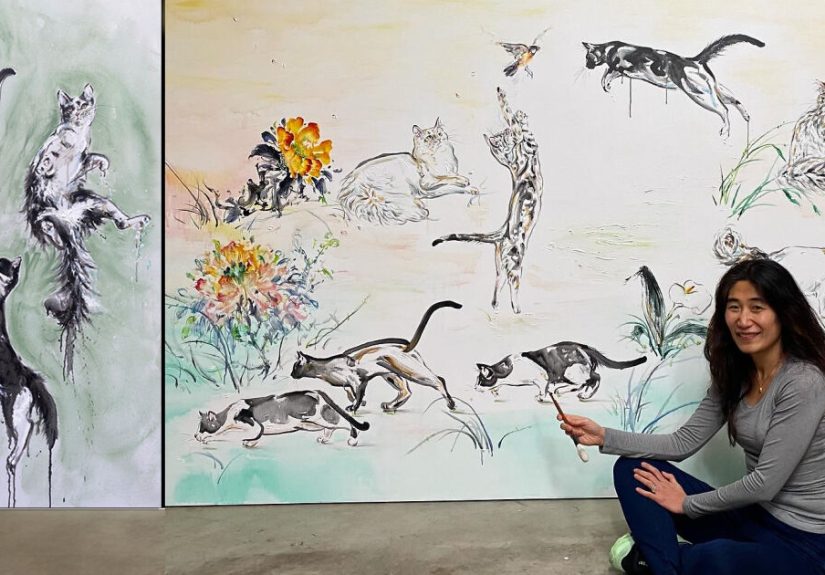
The piece most often tied to this claim is a massive, multi-panel cat painting titled “Spring Dance” by artist
Anita Yan Wong. It’s commonly described as measuring a little over 6 feet tall by 20 feet wide,
created with ink and acrylic on canvas, using calligraphy brushes to pull off a look that feels minimal,
fluid, and full of motion.
The “20 feet wide” part matters: instead of a single canvas the size of a garage door, “Spring Dance” is presented as two large panels
that line up to create one panoramic scene. Think of it like a cinematic widescreen… but the cast is cats, and they’re not waiting for their close-up.
They are the close-up.
It has also been associated with a public exhibition contextmost notably a cat-focused art show in the Seattle-area (Bellevue, Washington),
which helps explain why this piece isn’t just “big” in theory. It’s big in a way that people have to physically plan around.
One important note (because the internet loves a bold claim): the phrase “largest cat painting in the world” is often used in media and social posts
as a description or headline rather than a universally governed title. In other words, it’s widely billed that way,
and the measurements are undeniably enormousbut “world’s largest” in art can depend on definitions (more on that in a minute).
Getting even bigger: the add-on panels and the “this might become a series” clue
Here’s where the story gets more fun than a cardboard box delivery: the giant painting isn’t just a one-and-done accomplishment.
It’s growing.
Coverage of the work shows a third canvas in progress or added to the overall body of worka panel described as featuring
cats and flowers in a summer theme, around the same towering scale as the originals (roughly 76 inches by 120 inches).
That suggests the artist isn’t merely protecting a record-like brag. She’s building a bigger visual universe, panel by panel.
And if you’ve ever met an artist with a long-term vision, you know what this can mean: a two-panel panorama can turn into a three-panel statement,
then into a full seasonal cycle, then into a “please clear your entire wall for installation” situation. Today it’s 20 feet wide.
Tomorrow, your living room is basically a cat museum with furniture.
From a creative standpoint, expanding a work this way makes sense. Cats are dynamic. They leap, twist, stretch, and do weird little side-eye moves
that look like sarcasm in fur form. A longer canvas gives more runway for that energyand more space to build rhythms, repetition, and contrast
(calm cats next to chaos cats, a relatable ecosystem).
How big is “big,” exactly? A quick size reality check
Compared with the previous headline-grabber: “My Wife’s Lovers”
For years, the painting most commonly described in mainstream coverage as the “world’s largest cat painting” was
“My Wife’s Lovers” by Austrian artist Carl Kahlera famous late-19th-century work featuring dozens of cats.
It’s the one that pops up in auction stories and “cat facts” lists because it’s massive, dramatic, and historically fascinating.
Sotheby’s cataloged it at roughly 70 by 101 3/4 inches (about 5.8 feet by 8.5 feet). That’s huge for a traditional oil painting,
and it’s also famously heavyso heavy that reports about its display often mention special handling and support requirements.
Area math (because art can be nerdy, too)
Let’s do the simplest comparison that doesn’t require a PhD in “measuring stuff”: surface area.
- A painting around 6 feet by 20 feet is about 120 square feet of canvas.
- A painting around 70 inches by 101.75 inches is about 49 square feet of canvas.
That means the newer, panoramic-style work (at 6 x 20) is well over twice the surface area of the older “giant cat painting”
that made auction headlines. Even if you debate what should count as a single piece (one panel vs. multiple panels), the scale is unmistakable:
this is big-cat energy without any actual tigers in your house.
Why it looks the way it looks: ink, acrylic, and a calligraphy mindset
A giant canvas could easily become visually overwhelminglike someone hit “copy/paste cat” 500 times and called it a day.
What makes this work more interesting is the technique: it’s described as using ink and acrylic with
calligraphy brushes. That matters because calligraphic brushwork prioritizes gesturethe movement of the hand,
the speed of the stroke, and the way a line thickens or fades.
In practice, that kind of brushwork can make cats feel alive even when the style is minimal. A single confident line can suggest a spine arching,
a tail flicking, or a mid-leap twist that every cat owner recognizes as “gravity is optional and I have chosen chaos.”
“Contemporary Lingnan” in plain English
The artist describes her approach as connected to Lingnan painting traditionsoften discussed as a modern Chinese painting movement
known for blending influences across regions and styles. In plain English: it’s a “both/and” mindset.
Not “traditional or modern,” but “traditional and modern,” with a willingness to borrow techniques and visual strategies
from multiple art lineages.
That blend shows up in how the cats are rendered: not hyper-realistic fur-by-fur detail, but forms that feel expressive and directional.
It’s the difference between “here is a photograph of a cat” and “here is the spirit of a cat doing something mildly suspicious.”
The not-so-glamorous engineering behind a 20-foot painting
Let’s be honest: the art world loves romance (“the muse,” “the inspiration,” “the emotional truth of whiskers”).
But a painting this size also demands practical problem-solving.
Two panels can be smarter than one
Splitting a mega-painting into panels isn’t a shortcutit’s a strategy. Oversized canvases can be difficult to stretch, transport, store,
and safely display. Panels help reduce risk, improve manageability, and make it possible to exhibit the work in real-world spaces
without needing to remove a wall or summon a construction crew that specializes in “art-related panic.”
Transport and storage: where big art meets big logistics
Museums and conservators have long dealt with the challenge of moving large paintings. Oversized works may require custom crates,
careful handling, and sometimes even rolling the canvas (in controlled conditions) to reduce stress on the paint layer.
The bigger the artwork, the more the “how” matters: pressure points, vibration, humidity changes, and surface contact can all become problems.
For everyday readers, the takeaway is simple: a 20-foot painting isn’t just a bigger version of a normal painting.
It’s a different category of objectone that behaves more like a small architectural element than a typical framed piece.
If you’ve ever struggled to carry a mirror up the stairs without bonking the corners, you understand the vibe.
Display: the “wall math” no one warns you about
Big paintings don’t politely occupy space; they define it. Even if you’re not hanging something quite this enormous, the principle holds:
large canvases need sturdy support, thoughtful lighting, and enough viewing distance. You don’t want to stand two inches from a 20-foot panorama
unless you’re specifically studying brushwork (or you lost your glasses again).
Why giant cat art works (and why it spreads online so fast)
A massive painting of cats is funny before it’s anything else. That’s not an insultit’s a superpower.
Humor lowers the barrier to entry. People who think they “don’t get art” still get cats.
- Instant emotional hook: Cats trigger recognition, affection, and comedy in a single glance.
- Scale creates spectacle: When something familiar becomes enormous, your brain goes, “Waitwhy is this so big?” and pays attention.
- Detail rewards curiosity: A large panorama invites people to zoom in (with their eyes or their camera) and hunt for favorite moments.
- Community fuel: Cat lovers love to share. It’s basically a law of nature, right next to “cats will sit on the thing you need.”
The result is a perfect storm: the work is genuinely ambitious, visually engaging, and also irresistibly meme-able.
It’s not “serious art” versus “internet art.” It’s bothbecause modern culture is both.
(14 Pics) A guided tour of the giant feline universe
Below are 14 “pic slots” with suggested captions and alt text for web publishing. Replace each image source with your own uploaded image URL
(or your CMS media path). The captions are written to help readers notice scale, brushwork, and the “getting bigger” storyline.
If you ever see it in person, here’s how to enjoy it like a pro
1) Do the “walk-in reveal”
Start far enough away to see the whole panorama. Your brain needs the wide shot first. Then move in for details.
Giant art is basically a two-step dance: overview then treasure hunt.
2) Pick a “favorite cat” and track its vibe
Large compositions invite story-making. Choose one cat (the dramatic one, obviously) and follow how the lines guide your eye across the canvas.
You’ll notice how movement is built through spacing and rhythm, not just literal action.
3) Look for the brush “signature”
Calligraphy-driven work often reveals the artist’s speed and pressure. Some strokes feel like a whisper, others like a confident underline.
It’s the visual equivalent of hearing someone’s accentyou can tell it’s them even without a name tag.
4) Take a photo for scale (then put your phone down)
Yes, you’ll want the proof. After that, give yourself a minute without the screen. Big art is a physical experience.
Your body registers scale in a way a feed can’t replicate.
The takeaway: the bigger the canvas, the bigger the grin
A giant cat painting isn’t just a novelty. It’s a collision of ambition and accessibilityhigh-skill brushwork, serious planning,
and a subject that makes people smile on contact.
And the “getting even bigger” angle adds a layer that’s oddly inspiring: it’s a reminder that creative work doesn’t have to stop at the finish line.
Sometimes the finish line is just where you tape the next panel.
So if you’re looking for proof that art can be technically impressive, culturally relevant, and unapologetically fun, this might be your exhibit.
Because in 2026, the only thing more powerful than a giant painting is a giant painting of cats that refuses to stop growing.
Real-World Experiences: Standing in Front of a Wall of Cats (The Part That Makes You Want to Tell Someone)
Seeing a huge painting in person is different from seeing it online, and the difference gets bigger the larger the artwork gets.
On a phone screen, a 20-foot-wide painting and a 20-inch-wide poster can feel weirdly similarjust two rectangles you scroll past.
In a room, though, scale becomes physical. Your eyes have to travel. Your neck has to tilt. Your feet start doing the slow museum shuffle
even if you swear you’re “not a museum person.”
One of the first things people tend to do in front of oversized art is laughnot because it’s silly (though cats absolutely help),
but because the brain needs a second to recalibrate. It’s the same reflex you get when you see an extremely large statue or a giant sandwich on a menu:
a moment of “Wait, is that… allowed?” followed by delighted confusion.
Then comes the second experience: detail hunting. Big paintings invite you to behave like a detective.
You start scanning for little micro-scenescats mid-leap, cats turning, cats interacting, cats doing that classic “I meant to do that” posture.
Even in minimalist styles, you’ll catch yourself assigning personalities. This one is clearly a troublemaker. That one is the anxious one.
This one in the corner is judging you for your choice of shoes. You didn’t plan to narrate the cats, but it happens. It always happens.
There’s also a social experience that kicks in with cat art specifically: people start talking to strangers.
Large-scale cat work has an oddly disarming effect. Someone nearby will point and say, “That looks like my cat,” and another person will immediately
answer, “No, that’s my cat.” Suddenly you’re in a tiny pop-up community where everyone is united by one belief:
cats are ridiculous, and we love them anyway.
If you’ve ever gone to a local art walk, a neighborhood gallery night, or even a coffee shop with rotating art on the walls,
you’ve probably felt the mini thrill of discovering something unexpected. A giant cat painting multiplies that feeling.
It’s not just “oh, nice painting.” It’s “wow, someone made a whole environment out of this idea.” You start thinking about the behind-the-scenes work:
the logistics, the materials, the planning, the time. You may even imagine the practical problemslike how you’d get it through a doorway,
or what kind of wall could hold it. It turns art appreciation into a mix of wonder and puzzle-solving.
And finally, there’s the after-effect. People leave big art with a story. Not a vague “we went to a gallery,” but a specific memory:
“We saw the massive cat painting.” That’s the secret power of scaleit becomes a landmark in your day.
Even if you’re not collecting art, you’re collecting experiences, and big, joyful art is the kind that sticks.
Long after the visit, you’ll still picture it when you see a cat stretch in a sunbeamlike the painting quietly trained your brain
to notice the choreography cats do every day.
So if you’re building a list of “things worth seeing in person,” put giant art on itespecially giant art that doesn’t take itself too seriously.
Because the best gallery moments aren’t always the ones that make you whisper. Sometimes they’re the ones that make you grin,
point, and say, “Look at that one. That cat is absolutely plotting something.”