Table of Contents >> Show >> Hide
- Where the Metal Shard Story Comes From
- Why UFO Hunters Thought It Might Be Alien Technology
- What the Scientific Analysis Actually Found
- So Is the Mystery Over?
- The Bigger UAP Lesson: Better Data Beats Better Drama
- What Would Real Alien Technology Look Like?
- The Human Experience Behind the Shard
- Final Verdict
Every few years, a story lands on the internet like a silver dime tossed into a dark pond: a strange fragment, a mysterious lab result, a whisper about Roswell, and suddenly everyone with Wi-Fi is one microscope image away from declaring first contact. This time, the star of the show is a metal shard that UFO enthusiasts have long promoted as a possible piece of alien technology. It is layered, unusual, and wrapped in enough lore to make conspiracy forums practically glow in the dark.
But here is where the plot gets better than the headline. The shard was not just passed around in podcasts and documentaries. It was actually analyzed through a serious scientific process tied to the U.S. government’s All-domain Anomaly Resolution Office, or AARO, with work performed by Oak Ridge National Laboratory. That matters. It moves the conversation from “my cousin’s barber saw something weird in the desert” to “let’s see what isotopes, electron microscopy, and materials science have to say.” And in the UFO world, that is basically the equivalent of taking the mystery to couples therapy.
The result is a story that is far more interesting than a simple yes-or-no answer. The shard is real. The fascination is real. The odd composition is real. But the current evidence does not show that it is extraterrestrial. Instead, it tells us something just as revealing: why people keep chasing objects like this, how modern science tests extraordinary claims, and why the gap between “unexplained” and “alien” is a lot wider than believers want it to be.
Where the Metal Shard Story Comes From
The shard entered UFO lore through claims that it was linked to a crash retrieval story, often floated in the same broad cultural orbit as Roswell. That alone gave it rocket fuel. Roswell is not just an event in American folklore; it is the granddaddy of alien mystery branding. For decades, believers have treated any unusual scrap of metal with a dramatic backstory as potential evidence of nonhuman engineering. Add Cold War secrecy, military testing, and a public that loves a mystery, and you have the perfect recipe for a legend that refuses to die.
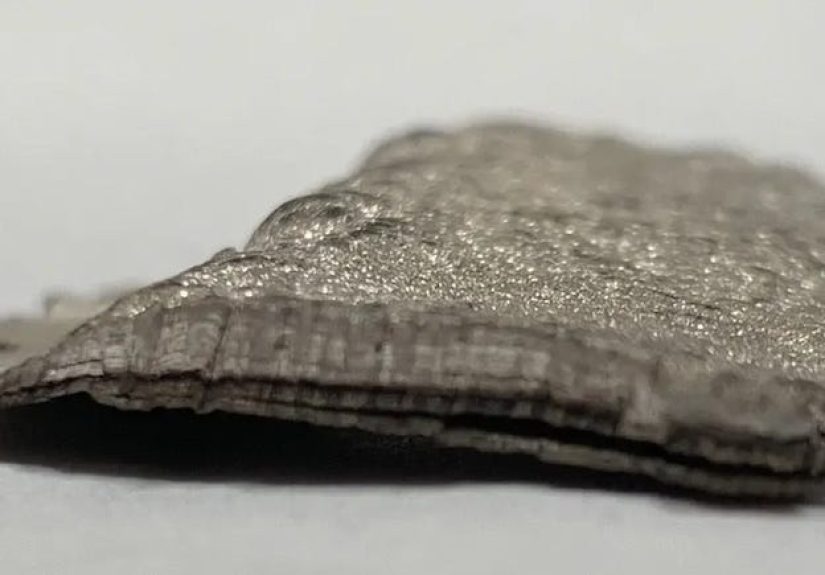
Groups and enthusiasts interested in UAPs, or unidentified anomalous phenomena, helped keep the shard in circulation. One reason it drew so much attention is that it was described as a magnesium-zinc-bismuth material with a layered structure that did not look like something most people would expect from ordinary household metal. That detail became catnip for the internet. Strange layering? Must be alien. Bismuth? Sounds exotic. Thin structural bands under magnification? Cue the dramatic music.
To be fair, unusual materials do deserve examination. History is full of discoveries that looked weird before they made sense. The mistake comes when weirdness gets promoted straight to “spaceship part” without stopping at intermediate stations like “industrial artifact,” “experimental alloy,” or “something made by humans during an era when engineers were trying all kinds of odd things.” Humanity has produced plenty of materials that would look bizarre to anyone finding them out of context. Ever seen aerogel, memory metal, or an old aerospace composite for the first time? Earth is perfectly capable of making objects that look like props from a sci-fi movie.
Why UFO Hunters Thought It Might Be Alien Technology
The appeal of the shard rests on a few specific ideas. First, its layered structure seemed unusual enough to suggest advanced engineering. Second, enthusiasts argued that bismuth in the material might point to a role as a terahertz waveguide, a concept that sounds extremely futuristic and therefore instantly marketable in UFO circles. Third, because the object’s provenance was murky, people filled in the blanks with their favorite explanation. And let’s be honest: “possibly alien” is much sexier than “probably a terrestrial alloy with an incomplete paper trail.”
There is also a psychological factor at work. UFO culture has trained people to treat official uncertainty as proof of a cover-up and unusual lab results as proof of cosmic visitors. If a sample is ordinary, the story dies. If it is unusual, the story mutates into “they don’t want you to know.” That means nearly every metal fragment with a mystery attached becomes a Rorschach test. Skeptics see incomplete evidence. Believers see hidden truth. Everyone else sees a headline and thinks, “Well, I’m definitely clicking that.”
Some enthusiasts also leaned on the language of “metamaterials,” a term that has a legitimate scientific meaning but gets stretched into a yoga class by online speculation. In science, a metamaterial is engineered to have properties not typically found in naturally occurring materials, often because of its structure rather than just its chemical makeup. In UFO discourse, the word sometimes becomes shorthand for “something weird enough that I would like it to be alien.” Those are not the same thing. Not even close.
What the Scientific Analysis Actually Found
Here is the part where the lab coats enter and ruin everyone’s favorite campfire tale. According to the published synopsis of the analysis, the shard was examined to test two big claims: whether it might be of non-terrestrial origin and whether it could have functioned as a bismuth-based terahertz waveguide. That is refreshingly specific. Instead of asking, “Could this be alien?” the analysis asked, “What measurable features would support or weaken that claim?” That is how real investigation works.
The answer was not especially friendly to the alien-tech theory. The material was found to be primarily a magnesium alloy containing magnesium and zinc, with bismuth, lead, and trace elements. Isotopic analysis of magnesium and lead was consistent with terrestrial origin. In plain English, the chemical fingerprint matched what scientists would expect from material made here, not from some cosmic hardware store in another star system.
The waveguide idea also hit turbulence. For the shard to support the more dramatic theories, the bismuth would need to have the right purity and arrangement. Instead, the analysis found multiple layers of bismuth rather than the neat, single, pure layer that believers had hoped for. Worse for the sci-fi crowd, the bismuth was mixed with lead, which would disrupt the necessary dielectric properties. Translation: if this was supposed to be an antigravity component, it seems to have missed several very important appointments.
The broader conclusion was blunt. The sample did not indicate a non-terrestrial origin, and the data did not support the idea that it functioned as the kind of waveguide proposed in speculative claims. The lab’s confidence was that the material was manufactured terrestrially, albeit with an uncommon combination of elements by today’s standards, and later damaged by mechanical and heat stress. That is not “the truth is out there.” That is more like “the metallurgy is in here, and it is disappointingly local.”
So Is the Mystery Over?
Not entirely, and that is part of why the story survives. The scientific analysis did not fully determine the shard’s original purpose or its complete chain of custody. That leaves a crack in the door, and UFO mythology loves a cracked door. If a sample is strange but not alien, believers often pivot to another argument: maybe the government is telling only part of the story, maybe the wrong piece was tested, maybe the truly extraordinary property was lost through damage, or maybe the analysis did not ask the right question.
That is one reason these cases never die cleanly. Science works by narrowing possibilities with evidence. Myth works by expanding possibilities with imagination. When a lab says, “This appears terrestrial,” science hears a strong conclusion based on available data. True believers hear, “Aha, but you didn’t say impossible.” And around and around we go, like a flying saucer in a content-marketing wind tunnel.
Still, uncertainty about one detail is not the same as evidence for aliens. Not knowing exactly where a terrestrial object came from does not magically convert it into off-world technology. It just means we are missing context. That happens all the time in archaeology, forensics, and materials science. The honest answer is that the shard remains interesting as an object with an unusual backstory and composition, but not as verified proof of extraterrestrial engineering.
The Bigger UAP Lesson: Better Data Beats Better Drama
This metal shard story also fits into a much larger shift in how the United States talks about UFOs. NASA’s UAP study emphasized an evidence-based approach and argued that the biggest problem in the field is not a lack of imagination. It is a lack of high-quality, calibrated, multi-sensor data. AARO has echoed a similar point, saying that many sightings remain unresolved largely because the information is weak, incomplete, or poorly captured.
That is an important distinction. “Unresolved” does not mean “alien.” It often means “the camera was bad, the metadata was lousy, the witness account was incomplete, and nobody had enough to reach a confident conclusion.” Official reviews have repeatedly said that most investigated cases turn out to involve ordinary objects, natural phenomena, or misidentification. That may sound less thrilling than interstellar visitors, but it is exactly how responsible analysis is supposed to sound.
Ironically, the shard is useful precisely because it was tested instead of endlessly mythologized. Even a mundane conclusion improves the quality of the conversation. It shows what serious evaluation looks like. It shows that claims about exotic materials can be checked against isotope ratios, microscopy, and structural analysis. And it shows that the road from “strange object” to “alien technology” is not a road at all. It is more like a cliff, and evidence has to build the bridge.
What Would Real Alien Technology Look Like?
If humanity ever did stumble across authentic extraterrestrial technology, the case would likely be stronger than a cool-looking shard with a dramatic origin story. Scientists would want an airtight chain of custody, reproducible measurements, isotopic or structural features inconsistent with known terrestrial processes, and properties that remain extraordinary under repeated independent testing. In other words, not just something weird, but something weird in a way that survives every attempt to explain it using known physics, engineering, and manufacturing history.
That last part matters. Extraordinary claims do not fail because people are narrow-minded. They fail because extraordinary evidence is rare. A meteorite is not alien technology. A classified aircraft is not alien technology. An experimental alloy from decades ago is not alien technology. A sample needs more than mystery. It needs a trail of proof that gets stronger the closer you look, not weaker.
Right now, this shard does not meet that standard. It meets a different one: a fascinating object that reveals how desperately people want a physical artifact to settle the UFO question once and for all. But reality is rude that way. It keeps asking for more data.
The Human Experience Behind the Shard
For many UFO hunters, the experience of following a story like this is emotional before it is analytical. It begins with the thrill of possibility. A fragment appears, the photos look strange, and suddenly the imagination starts sprinting ahead of the evidence. People picture crash sites, hidden hangars, secret programs, and the one stubborn artifact that will finally force the world to admit that we are not alone. That feeling is powerful. It is part wonder, part rebellion, and part hope that the universe is stranger than our daily routine of emails, traffic, and reheated leftovers.
Then there is the experience from the lab side, which is almost the exact opposite. Scientists do not usually approach a sample thinking, “Please let this be alien.” They approach it asking, “What is it, exactly, and what can we rule out?” That process is slower, less cinematic, and much more disciplined. Under a microscope, romance gets replaced by structure. Under isotopic testing, legend gets replaced by ratios. The suspense is still there, but it is the suspense of method, not myth. And yes, that does make for terrible movie dialogue but excellent science.
There is also a middle group: the curious public. These are the people who are not full believers and not full skeptics. They just love the mystery. For them, the shard is a perfect modern folklore object. It sits at the crossroads of science, secrecy, pop culture, and internet obsession. They know official reports lean terrestrial. They also know governments have kept genuine secrets before. So they hover in that uncomfortable but honest place between fascination and caution, which, frankly, is where more people should hang out.
And we cannot ignore the Roswell effect. In towns, museums, documentaries, and online communities shaped by decades of UFO lore, a fragment like this is never just a fragment. It becomes a symbol. It represents all the unanswered questions people feel they have been handed since the mid-20th century. It carries the emotional weight of every blurry military video, every hearing, every whistleblower claim, and every late-night conversation that begins with, “Okay, but what if just one of these stories is true?”
That is why even a sober laboratory conclusion does not kill the experience. The experience was never only about the metal. It was about the search. It was about wanting a tangible object that turns cosmic loneliness into cosmic company. It was about the hope that somewhere inside the microscope image, hidden between the magnesium and bismuth, was a message that says humanity is part of a much larger story. Instead, the shard seems to say something more modest but still meaningful: people will keep searching, science will keep testing, and mystery will keep selling tickets long after the latest “alien alloy” headline has drifted into the digital desert.
Final Verdict
So, could this metal shard be alien technology? Based on the public evidence, no compelling case has been made. The material is interesting, yes. The lore around it is irresistible, absolutely. But the best available analysis points to terrestrial manufacture, not extraterrestrial engineering. That may disappoint the true believers, but it should not disappoint anyone who cares about truth. Good science is not in the business of flattering our favorite theories. It is in the business of testing them until only the strongest ideas survive.
And maybe that is the most valuable takeaway. The shard did not give UFO hunters the proof they wanted. It gave everyone something better: a real-world example of how extraordinary claims should be handled. Not with blind faith, not with instant dismissal, but with careful analysis, better data, and a willingness to let the evidence be gloriously boring if that is where it leads. Sometimes the truth is out there. Sometimes the truth is a weird alloy from Earth wearing an alien Halloween costume.
Note: This article is formatted for web publication and intentionally removes citation placeholders, source-link clutter, and unnecessary markup artifacts.