Table of Contents >> Show >> Hide
- Before You Plant: A Quick Sunny-Vine Reality Check
- 1) Clematis (Clematis spp.)
- 2) Coral Honeysuckle (Lonicera sempervirens)
- 3) Crossvine (Bignonia capreolata)
- 4) Carolina Jessamine (Gelsemium sempervirens)
- 5) Purple Passionflower / Maypop (Passiflora incarnata)
- 6) American Wisteria (Wisteria frutescens)
- 7) Climbing Roses (Rosa, climbing types)
- 8) Trumpet Vine (Campsis radicans)
- 9) Hardy Kiwi / Kiwiberry (Actinidia arguta)
- 10) Grapes (Vitis spp.)
- 11) Hops (Humulus lupulus)
- 12) Bougainvillea (Bougainvillea spp.)
- Design Ideas for Sunny Vine Success
- of Real-World Experience Tips for Growing Perennial Vines in Full Sun
- Conclusion
- SEO Tags
Got a fence, pergola, arbor, or mailbox post that looks like it’s waiting for a personality?
Sun-loving perennial vines are the fastest way to turn “meh” vertical space into a living highlight reelflowers, fragrance, hummingbirds, and sometimes even fruit.
The trick is picking the right vine for full sun (usually 6+ hours of direct light), your USDA zone, and your tolerance for “vigorous” growth
(a polite gardening word that sometimes means “I will be here forever, and I brought friends”).
Below are 12 of the best perennial vines for sunny spotssome are floral show-offs, some are wildlife magnets, and a few are edible.
I’ll also point out which ones behave nicely and which ones need boundaries… like a toddler in a candy aisle.
Before You Plant: A Quick Sunny-Vine Reality Check
- Match the vine to the structure: Twining vines need a trellis or wires; clinging vines may attach to surfaces; heavy woody vines need serious support.
- Full sun doesn’t mean “no water”: Sun + wind + new plant = thirsty. Deep watering matters most in the first season.
- Plan for pruning: Many flowering vines bloom better when pruned at the right time (and worse when pruned at the wrong time).
- Know the “aggressive” candidates: Some spread by suckers or self-seeding and can overwhelm small gardens if you let them freestyle.
1) Clematis (Clematis spp.)
If vines had a red-carpet event, clematis would show up in couture. Big flowers, dreamy colors, and lots of cultivars for different climates.
Most clematis do well with plenty of sun for the top growthwhile keeping the root zone cooler.
Sun-loving why-you’ll-like-it
- Bloom power: Many varieties flower heavily with several hours of sun.
- Great on trellises: Clematis climbs by leaf petioles, so it likes thin supports (think wires, lattice, twine).
Growing tips
- “Head in the sun, feet in the shade”: Keep roots cool with mulch or low plants around the base, while the vine gets sun above.
- Pruning depends on type: Some bloom on old wood, some on new, some on bothcheck the tag so you don’t accidentally prune away your spring show.
2) Coral Honeysuckle (Lonicera sempervirens)
Want hummingbirds to treat your yard like a favorite drive-thru? Coral honeysuckle is a classic.
Unlike some invasive honeysuckles, this one is often recommended as a well-mannered, wildlife-friendly choice.
Why it shines in sun
- Best flowering in full sun: You’ll get the strongest bloom show with more light.
- Long season appeal: Tubular flowers are made for pollinators, especially hummingbirds.
Growing tips
- Don’t overfeed nitrogen: Too much N can mean lots of leaves, fewer flowers.
- Prune timing: Since it flowers on new growth, avoid heavy pruning right before bloomtidy after flowering instead.
3) Crossvine (Bignonia capreolata)
Crossvine is a tough, evergreen-to-semi-evergreen performer in many warm climates, with trumpet-shaped blooms that pop against glossy foliage.
It tolerates lots of conditions, but rewards you with more flowers when it gets more sun.
Why it’s a top sunny pick
- Sun = more blooms: It will grow in shade, but flower production improves with sunlight.
- Great for structures: Excellent for fences, arbors, and trellises where you want a full look.
Watch-outs
- Give it support early: Train it while stems are young so it goes where you wantbefore it decides for you.
4) Carolina Jessamine (Gelsemium sempervirens)
This vine brings early-season sunshineliterallythanks to fragrant yellow blooms that can brighten late winter into spring in mild climates.
It’s also famously deer-resistant. The tradeoff? It’s not a snack. For anyone.
Why it’s great in full sun
- Early color: When the garden is still waking up, Carolina jessamine is already dressed and ready.
- Fast coverage: Useful for screens and trellises where you want quick green.
Big caution
- Toxic plant: All parts are poisonous; sap may irritate skin. Plant thoughtfully if kids or pets are around.
5) Purple Passionflower / Maypop (Passiflora incarnata)
Passionflower looks like it was designed by someone who got bored and decided to invent a new geometry.
It’s also a powerhouse for pollinator gardens and can spread when it’s happyespecially in sun.
Why it earns a sunny spot
- Full sun to part shade: Strong growth and flowering with good light.
- Wildlife value: Often planted to support butterflies, plus the flowers are a conversation starter.
Growing tips
- Mulch helps: A loose mulch can keep roots cooler and support steadier growth.
- Expect enthusiasm: It can spread by suckers under ideal conditionsuse edging or containers if you need control.
6) American Wisteria (Wisteria frutescens)
Wisteria is famous for its waterfall bloomsand equally famous for turning “cute vine” into “structural engineering project.”
If you love the look but want a more region-appropriate option, American wisteria is commonly recommended over invasive Asian species.
Why it works in sun
- Sun helps bloom: Like most heavy bloomers, wisteria performs best with plenty of light.
- Long-lived woody vine: A true investment plantbuild a sturdy support and it can thrive for years.
Pruning basics
- Prune to manage vigor: Regular pruning and training help keep size in bounds and support flowering.
- Timing matters: Many guides recommend pruning around the seasons (often after flowering and again before spring growth) depending on your species and climate.
7) Climbing Roses (Rosa, climbing types)
Not a “true vine” (no tendrils or clingers), but climbing roses absolutely count when we’re talking vertical sun drama.
They give you that classic cottage-garden lookespecially on arbors, fences, and porch posts.
Why full sun is your best friend
- More sun = better blooms: Many rose guides recommend full sun (or at least 5–6 hours) for best flowering and plant health.
- Training boosts flowers: Bending and tying canes more horizontally encourages flowering laterals (aka: more blooms where you can see them).
Care tips
- Airflow matters: Don’t cram roses against a wall with no ventilationgood airflow helps reduce disease pressure.
- Prune after the big flush: Many climbers bloom best in spring, and pruning afterward helps renew canes and keep shape.
8) Trumpet Vine (Campsis radicans)
Trumpet vine is the ultimate hummingbird billboard: big, bold, and hard to miss.
It also grows like it drank three espressos and immediately signed up for a marathon.
Plant it for wildlife and summer colorjust don’t plant it if you want a calm, minimalist garden.
Why it’s a sunny standout
- Full sun fuels flowering: More light generally means more blooms.
- Pollinator magnet: Tubular flowers are a natural fit for hummingbirds.
Watch-outs
- Can be invasive/aggressive: It can sucker profusely and self-seed; placement and mowing/containment strategies help keep it controlled.
- Skip weak supports: Mature vines get thick and heavygive it a structure that won’t tap out.
9) Hardy Kiwi / Kiwiberry (Actinidia arguta)
If you want an edible vine that feels a little “secret garden,” hardy kiwi is a fun pick.
It’s vigorous, productive, and happiest in sun with good soil and real support.
Why it’s worth the trellis space
- Full sun for best production: Many extension guides note sun improves yield and fruit quality.
- Serious harvest potential: A mature vine can produce a lot of fruit in the right conditions.
What to plan for
- Usually needs both sexes: Many hardy kiwi types require a male and female plant for fruit (unless you choose a self-fertile cultivar).
- Pruning is not optional: Expect winter and summer pruning to keep it productive and manageable.
10) Grapes (Vitis spp.)
Grapes are one of the most practical “pretty vines” you can grow in the sunleafy shade, climbing charm, and fruit if you manage them well.
The key is training and pruning, because grapevines are built to roam.
Why grapes love sun
- Sun improves ripening: Good light supports better fruit development and reduces some disease pressure when paired with airflow.
- Easy to train on wires: Great for arbors, pergolas, and simple trellis systems.
Care tips
- Dormant pruning is standard: Many guides recommend pruning during dormancy (winter) to shape the vine and manage fruiting wood.
- Choose varieties for your region: Table grapes, juice grapes, and muscadines don’t all thrive in the same placesmatch cultivar to climate.
11) Hops (Humulus lupulus)
Hops are technically bines (they climb by wrapping stems, not tendrils), and they can shoot up in a hurry.
Even if you’re not brewing beer, hops make a gorgeous screen for summer shade on a sunny wall or pergola.
Why hops are great in sun
- Full sun to partial shade: Plenty of sunshine supports strong seasonal growth.
- Fast summer coverage: Perfect when you want quick seasonal screening and dramatic vertical greenery.
Growing tips
- Give it height: A tall trellis or strong twine system makes a huge difference.
- Expect dieback: In many climates, hops die back in winter and return from the crown in springlike a yearly encore.
12) Bougainvillea (Bougainvillea spp.)
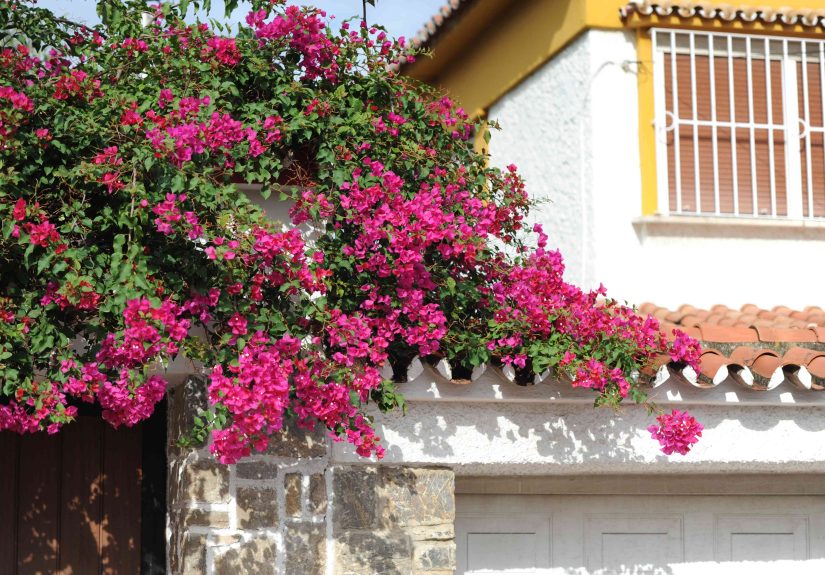
Bougainvillea is what happens when a plant decides subtlety is overrated.
In hot, sunny climates, it can bloom like crazy and turn a wall into a neon postcard.
In colder zones, it’s still a star in containers (and yes, it loves being outside in full sun when it’s warm enough).
Why bougainvillea is a full-sun MVP
- Thrives in sun and heat: Full sun is key for strong color and bloom.
- Perennial in warm zones: In USDA zones roughly 9–11, it can come back year after year outdoors.
Care tips
- Drainage is everything: Bougainvillea prefers soil that drains well; let it dry slightly between deep waterings once established.
- Mind the thorns: Plant it where you won’t have to squeeze past it in shorts. Ask me how gardeners learn this lesson.
Design Ideas for Sunny Vine Success
- Make a “bloom ladder”: Pair early bloomers (Carolina jessamine) with summer stars (trumpet vine, passionflower) and repeat bloomers (climbing roses).
- Go wildlife-first: Coral honeysuckle, crossvine, passionflower, and trumpet vine can turn your yard into a pollinator hub.
- Use edible climbers strategically: Hardy kiwi and grapes are happiest when you build a sturdy trellis and commit to annual pruning.
- Control the enthusiastic growers: Place aggressive vines where mowing, edging, or hard boundaries help keep them honest.
of Real-World Experience Tips for Growing Perennial Vines in Full Sun
If you’ve ever planted a vine and thought, “Cool, I’ll just water it sometimes and enjoy my new garden masterpiece,” you’re in excellent company.
Most gardeners learn the same three lessons: sun is powerful, vines are ambitious, and the difference between a dreamy trellis and a chaotic tangle is usually
training + timing.
First, sunny sites dry out faster than you expectespecially along reflective fences, south-facing walls, and driveways that radiate heat like a pizza stone.
New vines often struggle not because they “hate sun,” but because their roots never get a steady moisture rhythm in that first season.
A simple routine helps: deep water, then let the top inch dry; repeat. Mulch isn’t just for looksit’s a temperature buffer.
Clematis gardeners, in particular, swear by keeping the root zone cooler while the top growth enjoys the light, which is why you’ll see clematis planted with
low groundcovers or a thick mulch ring around the base.
Second, vines don’t magically climb the way you want. They climb the way they’re built.
Twining growers (like honeysuckle and wisteria) want something slender to wrap around.
Bines like hops spiral upward with gusto, but they need tall, strong lines.
And “climbers” like climbing roses? They don’t cling at allthey’re more like long-caney shrubs that need to be tied in.
The most common beginner mistake is giving a vine the wrong kind of support and then blaming the plant for being “difficult.”
It’s not difficult. It’s just following its job description.
Third, pruning is where sunny-vine gardens are won or lost. A lot of flowering vines bloom on specific kinds of woodold, new, or bothand the calendar matters.
Prune wisteria at random, and you may get a gorgeous green monster and zero blooms. Skip pruning on edible vines like grapes and hardy kiwi, and you can end up
with a leafy jungle that produces less fruit than it should. Even the famously vigorous trumpet vine is easier to live with when you prune and contain it on purpose.
Finally, a practical “future you” tip: choose the vine based on the maintenance you’ll actually do.
If you love a bold look and don’t mind regular control, trumpet vine and wisteria can be thrilling.
If you want “pretty + cooperative,” coral honeysuckle and crossvine are often easier fits.
And if you want tropical drama in a sunny spot, bougainvillea is incrediblejust remember it’s happiest where winters are mild or where you can overwinter a container.
The best vine isn’t the fanciest one. It’s the one that matches your sun, your structure, and your patience level.
Conclusion
Sunny gardens are basically a blank check for perennial vinesif you pick the right plant and give it the right support.
Start with a solid trellis or arbor, choose vines that match your climate, and don’t skip the “boring” stuff (watering, training, and timely pruning).
Do that, and your vertical space won’t just look betterit’ll work harder: more shade, more blooms, more wildlife, and maybe even a bowl of homegrown fruit.