Table of Contents >> Show >> Hide
- Charcoal vs. Coal: Same Job, Different Origin Story
- Way #1: The Furnace Bootstrap (Turn Trees Into “Instant Coal”)
- Way #2: The Campfire Cashback (Harvest Charcoal From Campfires)
- Way #3: The Renewable Charcoal Loop (From Hand-Fed to Semi-Automated)
- Common Mistakes That Make Charcoal Feel “Weird”
- Quick FAQ: Charcoal Instead of Coal
- of Gameplay Experiences With Charcoal
- Conclusion: Pick the Charcoal Method That Fits Your World
Coal is greatuntil it isn’t. Maybe your spawn is flatter than your phone battery at 2%,
maybe the nearest cave looks like a dentist appointment, or maybe you’re playing “I swear I’ll mine tomorrow”
and tomorrow has been six in-game days. Whatever the reason, you still need fuel, torches, and that cozy
“I’m not being hunted by monsters in the dark” glow.
Enter charcoal: coal’s woodsy cousin that shows up to the party wearing the same outfit,
doing the same job, but bragging about being renewable. Below are three practical ways
to get charcoal instead of coalfrom “Day 1 survival panic” to “my base runs on trees and vibes.”
Charcoal vs. Coal: Same Job, Different Origin Story
In most everyday gameplay, charcoal works like coal. You can use it as furnace fuel and
craft it into essentials like torches and campfires. The big difference is
how you obtain it: coal comes from mining, while charcoal comes from smelting wood.
- Fuel power: Charcoal and coal are equivalent for standard furnace fuel time (they smelt the same number of items).
- Renewable: Trees grow back. Coal ore does not.
- Storage quirk: Charcoal and coal don’t stack together (separate item types).
- Trade + blocks: Coal has extra perks (villager trades, coal blocks). Charcoal typically can’t match those conveniences.
Translation: if you need fuel and light now, charcoal is often the fastest “no mining required” answer.
Way #1: The Furnace Bootstrap (Turn Trees Into “Instant Coal”)
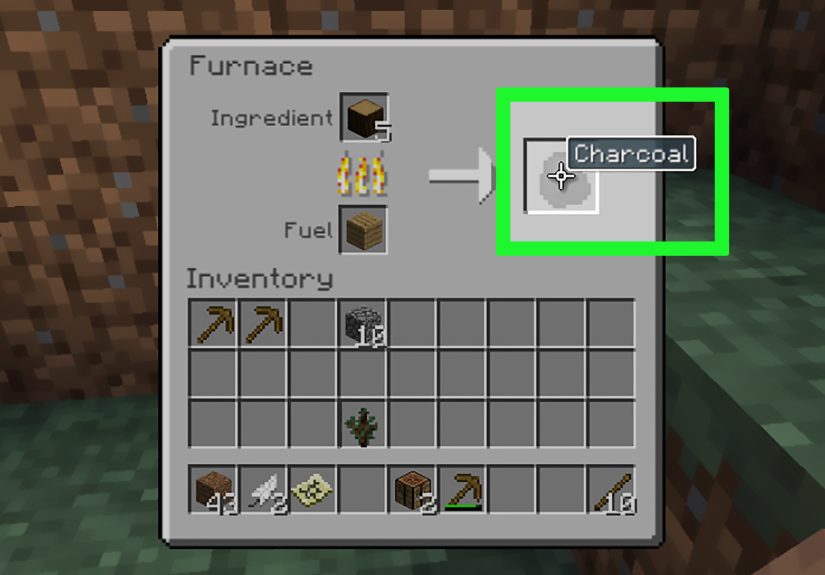
This is the classic method and the one every survival player should know: smelt logs in a furnace.
The trick is getting your first charcoal without already having coal. Fortunately, the game is full of
starter fuels that don’t require spelunking.
Step-by-step: Day 1 charcoal with zero coal
- Punch tree. Yes, with your bare hands. The circle of life begins with mild deforestation.
- Craft basics: Make a crafting table, then a wooden pickaxe.
- Mine 8 cobblestone and craft a furnace.
- Pick a starter fuel (see below) and smelt one log into one charcoal.
- Upgrade the loop: Use that charcoal to smelt more logs into more charcoal.
Starter fuels when you don’t have coal
You only need a tiny amount of fuel to smelt your first log. Options you can usually create immediately:
- Sticks: Cheap and fastgreat for the “I need one charcoal right now” moment.
- Planks: Easy to make, decent in a pinch, but you’re literally burning building material.
- Wooden tools: If you crafted a wooden pickaxe and replaced it with stone, the wooden one can become fuel.
- Saplings: Especially handy if you have extras and want to save planks.
The “first charcoal” math that makes this method shine
Here’s why charcoal snowballs. Once you have one charcoal, you can use it as fuel to smelt
multiple logs into more charcoal. That’s the core idea: a small starter fuel investment creates a
self-sustaining charcoal supply.
A popular early-game rhythm looks like this:
- Use a tiny starter fuel (like sticks) to smelt 1 log → 1 charcoal.
- Use that charcoal to smelt a batch of logs into charcoal.
- Repeat until you have enough charcoal for torches, cooking, and a small smelting queue.
Bonus tip: Make torches with charcoal and sticks early, then mine and explore with confidence instead of
living the “I can’t see, therefore I’m doomed” lifestyle.
Way #2: The Campfire Cashback (Harvest Charcoal From Campfires)
This method feels like a loophole the first time you discover it: regular campfires drop charcoal when broken
(unless you use Silk Touch). That means you can sometimes pick up charcoal without ever mining coalor even without building a furnace first.
Where to get campfires without crafting them
Campfires can generate naturally in certain village types (like taiga/snowy taiga villages). If you spot one early,
it’s basically a little “welcome gift” from the worldlike a complimentary mint, except it fuels your entire operation.
How to break a campfire for charcoal
- Do NOT use Silk Touch if your goal is charcoal.
- Break the campfire with your preferred tool (axes are fast), and collect the charcoal drops.
- Edition note: The number of charcoal drops can differ by edition (Java vs. Bedrock).
When this method is actually useful
Campfire harvesting is perfect when:
- You spawned near a village and want fuel/torches fast without digging.
- You’re doing a “no caves yet” run (hardcore, speedrun, roleplay, or just vibes).
- You want an early charcoal stash before setting up your furnace loop.
Is it the most reliable method? Not alwaysworld generation is world generation. But when it’s available,
it’s hilariously efficient for how little effort it takes.
Way #3: The Renewable Charcoal Loop (From Hand-Fed to Semi-Automated)
Once you understand the charcoal loop, you can scale it. This “third way” is really about systemizing
charcoal so you stop thinking about fuel altogether.
Option A: The simple “charcoal engine” at a starter base
Set up a tiny station near your crafting area:
- 1–2 furnaces
- A chest for logs
- A chest for finished charcoal
Workflow:
Put logs in the top slot. Put charcoal in the fuel slot. Smelt logs into charcoal.
Then pull some charcoal out for torches/cooking, and keep a portion in the fuel slot to keep the engine running.
This is the “responsible adult” version of fuel management: not flashy, but it works forever as long as trees exist.
Option B: Bulk charcoal using strong fuels (lava bucket, etc.)
If you’re producing charcoal at scale (smelting stacks of logs), using a higher-capacity fuel can reduce babysitting:
- Lava buckets burn a long time and are excellent for big smelting runs.
- Blocks of coal are convenient later (if you do mine coal eventually), but the whole point here is you don’t have to.
You’re not switching away from charcoalyou’re using “big fuels” to smelt logs into charcoal faster and with less clicking.
Think of it as hiring a forklift to move a stack of boxes instead of carrying each one like a heroic raccoon.
Option C: The classic tree farm + auto-smelter vibe
For long-term worlds, combine:
- A tree farm (even a simple manual row of saplings works)
- A furnace array (multiple furnaces)
- Hoppers + chests (to move logs in and charcoal out)
With even a modest setup, you’ll produce more charcoal than you can reasonably burnat which point you’ll
start using charcoal like it’s free. Because it is. That’s literally the point.
Common Mistakes That Make Charcoal Feel “Weird”
1) Smelting the wrong wood item
In vanilla gameplay, logs/wood blocks are the typical input for charcoal. If you toss in planks and nothing happens,
you didn’t break Minecraftyou just offered the furnace the wrong snack.
2) Mixing coal and charcoal stacks
Coal and charcoal look similar and behave similarly, but they’re not the same item. They won’t stack together, so your inventory may
feel “messier” until you dedicate one slot to each (or go full charcoal and stop pretending you’ll organize later).
3) Expecting charcoal to have every coal feature
Charcoal is amazing for fuel and torches, but coal has some convenience edges (like coal blocks and certain trade interactions).
Charcoal’s superpower is being renewable, not being fancy.
Quick FAQ: Charcoal Instead of Coal
Can you craft torches with charcoal?
Yes. Charcoal works as a substitute for coal in torch crafting, which is why it’s such a lifesaver on your first night.
Is charcoal better than coal?
If your goal is never running out of fuel, charcoal wins because trees are renewable. If your goal is compact storage
and certain extras (like coal blocks), coal has advantages. In practical survival play, many players use charcoal early and coal later
but you can absolutely run a world on charcoal indefinitely.
What’s the fastest “no-mining” path to charcoal?
Smelt one log using a tiny starter fuel (sticks/planks), then use your first charcoal to smelt more logs. If you find a village campfire,
break it for charcoal and skip straight to torches.
of Gameplay Experiences With Charcoal
If you’ve played Minecraft long enough, you’ve probably had that night: the sun drops fast, you’re holding a handful of raw pork,
and you’re staring at a dark forest like it owes you money. This is where charcoal quietly becomes the hero of your early game.
There’s something oddly satisfying about solving a “fuel crisis” without touching a single cave. You chop a tree, craft a furnace,
burn a couple sticks, andboomsuddenly you have the Minecraft equivalent of an emergency generator.
The first time you make charcoal instead of coal, it feels like cheating in the nicest possible way. Coal usually demands a commitment:
you need a cave, a mountainside, or at least enough courage to step into a hole you didn’t make. Charcoal, on the other hand, is just
you and a tree having a very honest conversation about priorities. You’re basically saying, “Listen, oak, I respect you… but I need torches.”
And the oak is like, “Fair.”
Charcoal also changes how you move through the world. When you’re not worried about coal veins, exploration becomes less desperate.
You can roam farther because your fuel source is portable: saplings in your pocket plus a few minutes of chopping equals more smelting power.
Many players end up developing a little routineplant saplings near camp, harvest wood every morning, toss a batch into the furnace, and keep
a “charcoal fund” in a chest like it’s the world’s least glamorous retirement plan.
The campfire trick is its own kind of funny experience. Finding a village early and realizing the campfire can pay you back in charcoal feels like
discovering a coupon you didn’t know you had. You’re not even being sneaky; you’re just… reallocating resources. The villagers don’t file a report.
They don’t even complain. They just keep walking around while you turn their decorative fire feature into your lighting budget.
And then there’s the late-game charcoal glow-up: once you have a steady wood supply, charcoal stops being “the backup plan” and becomes a lifestyle.
You’ll catch yourself smelting entire stacks without thinking, crafting torches by the dozens, and fueling big projectsglass for windows, stone for builds,
food for adventureswithout the usual “ugh, I need coal again” interruption. At that point, charcoal isn’t just a substitute for coal. It’s the reason you
can stay focused on building, exploring, and doing the fun parts of Minecraft instead of constantly auditioning for the role of Cave Dweller #3.
Conclusion: Pick the Charcoal Method That Fits Your World
If you want charcoal instead of coal, the best method depends on your situation:
- Need charcoal immediately? Do the furnace bootstrap: starter fuel → 1 charcoal → charcoal loop.
- Near a village? Grab charcoal from a campfire (just don’t Silk Touch it if you want drops).
- Planning long-term? Build a renewable charcoal system with a tree supply and a smelting setup.
Coal is nice. Charcoal is dependable. And in Minecraft, dependable usually means “I can keep doing my project instead of rage-mining for fuel.”
So go forth, chop responsibly (or not), and let the furnaces sing.