Table of Contents >> Show >> Hide
- Meet the artist behind the single-panel smiles: Marc Bilgrey
- Why one-panel cartoons hit so hard (and so fast)
- 42 quick-hit moments you’ll recognize in Bilgrey-style one-panel cartoons
- How to read a one-panel cartoon like a cartoon editor (without becoming one)
- Why tiny laughs matter: the science of “micro-joy”
- If you want to make your own one-panel cartoon (no art degree required)
- Extra: of real-life experiences that pair perfectly with one-panel cartoons
- Conclusion
Some days, your brain feels like it has 47 tabs open, three of them are playing sound, and one is definitely a spreadsheet you didn’t agree to. On those days, you don’t need a motivational quote. You need a clean, quick laughsomething that lands fast, doesn’t demand homework, and leaves you a little lighter than you were five seconds ago.
That’s where one-panel cartoons shine. They’re the espresso shot of comedy: one image, one idea, one well-timed twist. And when the cartoonist is someone like Marc Bilgreyknown for minimalist black-and-white drawings and punchlines that sneak up on youthose single panels can feel like tiny emotional resets.
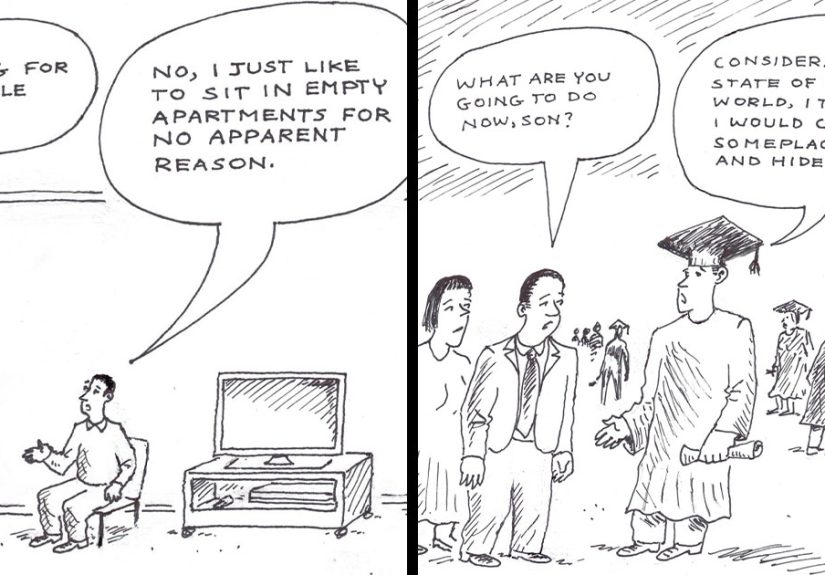
This article is a “gallery guide” to the kind of humor you’ll find in a set of 42 one-panel cartoons from Bilgrey. We’re not reproducing any cartoons here (your eyeballs can stay copyright-compliant), but we are breaking down what makes this style work, why it’s so re-readable, and which everyday moments these cartoons love to roastgently, of course, like a marshmallow held over the fire of modern life.
Meet the artist behind the single-panel smiles: Marc Bilgrey
Minimalist lines, maximum punch
Marc Bilgrey’s cartoons tend to look simple at first glanceclean linework, uncluttered scenes, and characters who often seem like they’ve wandered into adulthood by accident (relatable). That simplicity is strategic. A one-panel cartoon doesn’t have time for a long runway. It needs clarity fast, so the joke can do its job: surprise you.
Where the ideas come from (spoiler: not a comedy volcano)
Bilgrey has described his inspiration as coming from everyday life and the odd things people say and do. That’s why his cartoons feel familiar even when they’re absurd: the setups are normal enough to recognize, then the punchline nudges reality one inch to the leftjust far enough to make you laugh.
He’s also known beyond cartoons as a writer, and he’s published collections and work that reflect a steady interest in observation-driven humorcomedy that’s less “banana peel” and more “why does my printer only jam when someone important is watching?”
Why one-panel cartoons hit so hard (and so fast)
They’re built for the “click”
Great single-panel comics create a mental “click.” First, your brain reads the scene as ordinary. Then a detailoften a caption or a line of dialogueforces a quick reinterpretation. That tiny shift is where the laugh lives. Humor researchers and writers often describe this as a surprise plus a quick mental reframe: you spot the mismatch, then your brain resolves it.
The caption is a spotlight, not a speech
In a strong one-panel cartoon, the words don’t explain the imagethey aim the image. Think of classic magazine cartoons (the kind people love captioning): the picture sets the stage, and the caption snaps the joke into focus. The best captions feel inevitable after you read them, which is comedy’s version of a magic trick: you didn’t see the method, only the moment.
They’re short enough to rereadso they become funnier
Here’s a weird truth: some cartoons improve on replay. Once you know the punchline, you start noticing the background details, the expressions, the tiny visual choices that supported the joke all along. One panel is small, so your brain has time to explore itlike a mini scavenger hunt for meaning, but with fewer mosquitoes.
42 quick-hit moments you’ll recognize in Bilgrey-style one-panel cartoons
Instead of copying any specific cartoon, here are 42 classic “brighten-your-day” comedy beats you’ll often see in sharp, minimalist single-panel comicsespecially the kind that poke at everyday life with quiet mischief. If you’ve ever lived in a body, used the internet, or attempted a conversation before coffee, you’re already in the target audience.
- The office meeting that could’ve been an emailexcept now it’s an email that became a meeting that became a second meeting.
- Corporate jargon as a second language, where nobody’s sure what “synergy” means but everyone nods like it’s oxygen.
- Customer service scripts that sound friendly while quietly removing your will to live (politely, of course).
- A job interview where the question isn’t “Are you qualified?” but “Can you pretend this is normal?”
- Technology that’s “smart” in the same way a raccoon is “resourceful.”
- Autocorrect as a chaos gremlin, turning heartfelt messages into accidental threats.
- Password rules that require one uppercase letter, one symbol, and one emotional breakdown.
- “Just a quick call” that becomes a life event with chapters and side quests.
- Remote work reality: business up top, existential dread down below (and possibly pajama pants).
- The coffee dependency that’s less “habit” and more “medical necessity.”
- Weather small talk as the universal human bonding ritual, even when nobody enjoys the weather.
- Seasonal optimism (new year, new you) battling seasonal reality (same you, different calendar).
- The gym promise where your brain signs the contract and your legs refuse to ratify it.
- Diet trends that sound like dares: “Try eating only foods that were once pictured on a cave wall.”
- Parenting logic that makes perfect sense only if you’ve been awake since 2:00 a.m.
- Kids saying the quiet part out loud, with the confidence of tiny truth cannons.
- Pets as roommates who don’t pay rent but do judge your life choices.
- Cats with opinions, delivered through eye contact that feels like a performance review.
- Dogs with enthusiasm that could power a small city if we could bottle it.
- Dating misunderstandings, where both people are speaking English but somehow using different operating systems.
- Marriage banterthe loving kind where sarcasm is basically a shared hobby.
- Group chats that begin with plans and end with memes, as nature intended.
- Social media “life updates” that are really highlight reels edited by insecurity.
- Everyone’s “personal brand”, which is a phrase that still sounds like shampoo marketing.
- Bureaucracy as performance art: please fill out Form A-17 to request Form B-12.
- Waiting on hold long enough to develop a friendship with the hold music.
- Retail logic where the store has 900 items but not the one item you came for.
- Restaurants with “sharing plates”, aka “pay more to leave hungry with company.”
- Fine dining confusion when your meal arrives as a beautiful concept instead of food.
- Self-checkout drama starring you, an angry machine voice, and a surprise “unexpected item.”
- Therapy-speak in daily life, when someone says “set boundaries” and you just want them to stop chewing loudly.
- Mindfulness fails: you try to breathe deeply, then remember your inbox exists.
- The human desire to be efficient colliding with the human talent for procrastination.
- Appliance betrayalespecially printers, which are basically haunted staplers with Wi-Fi.
- Home improvement confidence that fades the moment you open the instruction booklet.
- Neighbors as mystery characters you only see when you’re dragging trash out in shame.
- Vacation expectations versus vacation reality, where the sun is hot and your luggage is somewhere else.
- Airports: the one place adults sprint and nobody asks questions.
- Time perception when you’re busy (hours vanish) versus bored (minutes become centuries).
- Existential thoughts appearing mid-errand, like “Why do we do all this?” while buying paper towels.
- Misheard phrases that change a normal conversation into accidental comedy.
- The polite social smile you wear while your brain is screaming, “I have no idea what’s happening.”
What makes these themes work is that they’re ordinaryand that’s the point. Bilgrey-style humor doesn’t need dragons or explosions. It just needs the daily friction points we all recognize, then one fresh angle that makes you think, “Oh no. That’s me.”
How to read a one-panel cartoon like a cartoon editor (without becoming one)
Step 1: Identify the “normal”
Before the joke, there’s the baseline reality: an office, a living room, a street corner, a store, a relationship moment. Your brain needs that normal frame so the twist has something to bounce off.
Step 2: Look for the one detail that “breaks” reality
It might be a single sentence. It might be an unexpected label, a sign in the background, or a character responding too honestly. The best one-panel cartoons don’t shout the jokethey let you discover it.
Step 3: Reread it once
This is the cheat code. The first read gives you the punchline. The second read lets you appreciate how efficiently the cartoon was built. That’s where you start noticing craft: the timing, the wording, the way the image and caption share the load instead of duplicating each other.
Why tiny laughs matter: the science of “micro-joy”
A one-panel cartoon won’t solve your problems. It’s not supposed to. But quick humor can act like a small pressure release valve. Research and health organizations often note that laughter and humor can support stress relief, mood, and social connectionespecially when it becomes a regular, low-effort habit.
That’s why a daily scroll through witty cartoons can be more than a distraction. It’s a brief reminder that your brain is allowed to play. And when you share a cartoon with someone else“this is so you,” “this is so us”you’re turning a private chuckle into a tiny moment of connection.
If you want to make your own one-panel cartoon (no art degree required)
Even if you never publish a thing, trying to think like a single-panel cartoonist is surprisingly fun. Here’s a simple approach:
- Start with a normal setting: office, kitchen, grocery store, doctor’s waiting room, group chat.
- Add a human problem: impatience, insecurity, confusion, ego, optimism, exhaustion.
- Introduce one twist: someone says the honest thing, the sign says the quiet part, or a “rule” becomes ridiculous when stated plainly.
- Make the words do the punchline: one clean sentence is usually stronger than three explanations.
- Trim: if you can remove a word and the joke still works, remove it. Cartoon captions love cardio.
And if you want a low-stakes practice game, try this: look at any ordinary scene (a coffee shop, a meeting, your pet staring at you) and write three captions. The first will be obvious. The second will be weird. The third is where the good stuff often hides.
Extra: of real-life experiences that pair perfectly with one-panel cartoons
One-panel cartoons fit into life the way good snacks do: they don’t ask you to rearrange your day, but they make the day better anyway. Picture the most common moments when you’re mentally “between tasks”not resting, not fully working, just floating in that awkward in-between where your brain tries to reboot.
Morning coffee time is prime territory. You’re not ready for a full article, a long video, or a deep conversation about “goals.” You just want your nervous system to stop acting like it’s late for something. A single-panel cartoon is perfect because it meets you where you are: half-awake, mildly skeptical, and hoping the universe doesn’t add another surprise meeting to your calendar. You read one panel, you get a quick laugh, and suddenly the day feels slightly less like a boss battle.
Commute moments (even if your “commute” is walking from your bed to your desk) have a similar vibe. You’re transitioning from one world to another. Your mind is doing that thing where it preloads worries like a streaming service buffering anxiety. A witty one-panel cartoon interrupts the spiral without demanding attention. You don’t have to remember characters or follow plotlines. You just get one clean punchline that reminds you: humans are weird, and that’s kind of funny.
The mid-afternoon slump is where one-panel humor becomes a rescue rope. That’s the time of day when your brain tries to replace productivity with snack-based theories. You refresh your email for no reason. You open a tab and immediately forget why. A quick cartoon is like a mental palate cleanser. It’s not procrastination in the “I lost an hour” senseit’s procrastination in the “I took a 20-second laugh break and came back less cranky” sense.
Social sharing is another experience that makes these cartoons feel bigger than a single panel. Sending a cartoon to a friend is basically a love language now. It says, “I see you,” or “This reminded me of our ongoing struggle with adulthood,” or “Here is proof that your workplace is not uniqueother people are also trapped in the same comedy ecosystem.” Even when you don’t talk much, exchanging a funny panel can keep a connection warm. No pressure. Just a small, shared grin.
And then there’s the quiet end of the day. You’ve survived. You’ve done the things. Your brain is tired of being serious. One-panel cartoons are gentle entertainmentshort enough to keep you from doom-scrolling, clever enough to feel satisfying, and light enough to end the day on a better note. If a cartoon can turn “ugh” into “okay, that’s funny,” it has done something valuable: it gave your day a softer landing.
That’s the hidden magic of this format. One-panel cartoons don’t need to be huge to matter. They’re small on purpose. They’re tiny sparks of wit that remind you to keep your sense of humor within arm’s reachright next to your keys, your coffee, and your ability to say, “No, I can’t hop on a quick call.”
Conclusion
There’s a reason single-panel cartoons have stuck around for generations: they’re efficient, sharp, and weirdly comforting. Marc Bilgrey’s styleminimalist visuals, everyday setups, and punchlines that tilt reality just enoughfits the format perfectly. And whether you’re reading a set of 42 cartoons in one happy sitting or grabbing a quick laugh between tasks, the takeaway is simple: humor is a tiny form of relief you can actually schedule.
If your day needs brightening, you don’t always need a grand solution. Sometimes you just need one good panel, one smart line, and one moment where you feel a little less alone in the absurdity of being human.